My mother lied to me for thirty years.
I learned that on a Tuesday morning in Gatlinburg, Tennessee, standing in the Goodwill parking lot with a hatbox in my hands and the strangest sensation I had ever known, as if the ground beneath my shoes had shifted half an inch and the world had not decided whether to warn me or swallow me.
It had been four months since my mother died.
March, still cold enough for frost in the mornings. She was seventy-nine, and the cancer moved quicker than anyone wanted to admit. She died in her own bed, under the quilt she’d pieced together from old church dresses and flour sacks, with the curtains cracked just enough to let in mountain light. She’d always said she didn’t want to die under fluorescent bulbs with strangers checking machines. She wanted home. We gave her home.
I told people afterward that we had time to say what needed saying. That’s what people want to hear. That the dying speak in full circles. That they gather up all the loose threads before they go and press them neatly into the hands of the living.
What I know now is this: six weeks is long enough to say many things, but not long enough to drag every lie into daylight.
I was her only child.
That sentence had shaped every room in my life. Every holiday place setting, every emergency contact form, every memory of being looked at with that softened pity people reserve for children who lose siblings too young. I had not been born an only child. I had become one at nine years old, in the summer the Hendersons’ house burned on Route 12.
My twin sister, Darlene, was inside. That was what I was told.
The story never changed. Not from my mother. Not from church ladies. Not from neighbors. The Hendersons had been watching her that afternoon. There had been a fire. It spread too quickly. There was nothing anyone could do. The damage was so severe there was almost nothing left to identify and nothing left to bury. My mother said that part in a flat voice and never liked questions after it.
I stopped asking.
Children know when adults are hiding behind pain because pain is the one excuse no one is allowed to challenge.
Still, grief has a shape when you’re a twin. It is not abstract. It is intimate, irritating, physical. It lives in small humiliations. Reaching for someone who is no longer there. Hearing a joke and turning to the wrong side. Seeing your own face in the mirror and flinching because it feels stolen. Darlene and I had shared a room, a birthday, a set of freckles across the bridge of the nose, and a private language made mostly of glances and half-laughed sounds. When she died, the world became overbright and then permanently dim.
I grew up inside that absence.
My mother never recovered either, at least not in a way people could see. She became softer in some places and stranger in others. There were rules after the fire that hadn’t existed before. Doors locked by dusk. Windows checked twice. No sleeping over anywhere, ever. She started burning old papers in the sink on random evenings. She jumped at the sound of tires in the gravel after dark. Back then I called it grief.
Now I call it fear.
The Tuesday everything changed had started as an ordinary errand. I was taking a second load of my mother’s things to Goodwill on Parkway. Grief becomes logistical after funerals. You sort cardigans. You decide which coffee mugs carry memory and which are simply chipped. You stack magazines and recipe boxes and costume jewelry and tell yourself usefulness is a form of honoring.
The second box held a mix of kitchen odds and ends, some old blouses, a ceramic rooster from the windowsill, and a folded afghan. At the very bottom, under everything else, sat a round powder-blue hatbox tied with yellowed kitchen twine.
I had never seen it before.
That alone was enough to make me pause. My mother was not a woman with mysteries in plain sight. She kept her house the way some women keep ledgers. Everything had a place, and anything hidden was hidden on purpose.
The box had been sealed shut with old masking tape gone brown at the edges. On the lid, written in her unmistakable hand, were three words:
DO NOT OPEN. BURNED.
I almost laughed at the absurdity of it, because who labels a thing burned and then keeps it for decades?
Then I looked closer and felt something in me tighten.
This wasn’t a joke. It wasn’t one of my mother’s odd practical notes. The letters were pressed hard enough into the cardboard to leave grooves.
I should have put it back.
Instead I untied the twine.
The first thing that came out was the smell—cedar, dust, and a faint floral sweetness, like sealed drawers and old Sunday clothes. There was tissue paper folded over a stack of letters held together by a rubber band that crumbled on contact. Resting on top of the letters was a blue plastic hair barrette with white daisies along the side.
I stared at it so long a man carrying a lamp to his truck glanced at me twice.
I have its twin.
Darlene and I got them together at Woolworth’s in Pigeon Forge the week before the fire. Matching barrettes, because at nine years old the whole point of being twins was to make the world acknowledge it. My own had stayed with me all these years in a small dish by my bathroom mirror. My mother had given it back to me after the fire. I had assumed she’d found it among our things and saved it because mothers save whatever survives.
But Darlene’s was not supposed to have survived.
If her barrette existed, then at least one piece of the story I had lived inside was false.
I sat in my car in that Goodwill parking lot and opened the letters.
Every envelope was addressed to the same person.
D. Maynard
Dunlap, Tennessee
There were around forty of them spanning three decades. None were mailed. Every envelope was sealed. My mother had written dates in the corners as though building a timeline only she intended to read.
D. Maynard.
The name was close enough to Darlene Mae to make my pulse stumble.
I drove home with the hatbox on the passenger seat and waited until I was at my kitchen table to read the oldest letter. I poured sweet tea and never took a sip. I set the two barrettes side by side and kept looking at them as if they might rearrange themselves into something easier.
Before opening the first envelope, I turned it over.
The return address on the flap was not in my mother’s handwriting.
It was in mine.
The same slant, the same loopy capital G, the same badly crossed t’s. Even the way the street number curled at the four was mine. It was unmistakable, intimate, absurd.
But the letter had been written when I was nine.
I had never addressed an envelope to Dunlap in my life.
My hands were shaking so hard the paper crackled when I unfolded it.
The first line hit me like a slap.
Darlene Mae,
I pray every day this reaches you somehow, even though I know I promised I would never send them.
Promised whom? Reaches where? My chest went tight.
I kept reading.
Your sister asks for you less now, but that’s worse somehow. Children should not get used to missing their own blood. I did what they told me was best. God forgive me if they were wrong. I still see your face at the window in my dreams.
At the window.
Not trapped inside a burning room. At the window.
I read the next letter, then the next. Each one widened the crack in the life I thought I knew. My mother’s words never explicitly said, Your sister lived, but they leaned against that truth so heavily there was no other way to read them. She wrote about imagining Darlene older. Wondering whether she had enough warm clothes. Wondering whether she still favored her left side when she ran. Wondering whether she hated her.
One letter, written a few years after the fire, said, I heard your sister laugh in the yard today and nearly called your name instead.
Another, written when I was in high school, said, She has your way of biting the inside of her cheek when she’s angry, and every time I see it I remember that I let one child keep the secret of losing the other.
That line frightened me more than the others because it suggested there was something I had once known and forgotten.
Deeper in the stack, my mother’s guilt turned more specific and more terrible.
You kept your promise, so I have kept mine.
I never told her whose body they counted.
I never told her why the Hendersons left town.
I never told her what your father did before the smoke ever started.
Your father.
Not your daddy. Not our father. Yours.
My mind snagged on that word. Darlene and I were twins. We had shared a womb, a face, a childhood. The idea that we could have different fathers sounded impossible, the kind of thing only happens in melodrama or biology textbooks no one thinks apply to them. Yet there it was, in my mother’s careful hand, buried among thirty years of remorse.
The letters became less like correspondence and more like confession. Certain names repeated. The Hendersons. A preacher named Eli Maynard. A promise made in a hospital room. A man leaving before dawn. A debt. A bargain. Fire as cover. Silence as survival.
By midnight I knew three things for certain.
My sister had not died in the fire.
My mother had hidden that truth my entire life.
And the lie had something to do with a man my mother feared enough to carry to her grave.
I did not sleep. I lay awake with the letters beside my bed, my mother’s handwriting burning against the dark. Every time I closed my eyes, I saw two blue barrettes on my table like proof and accusation.
The next morning I drove to Dunlap.
Three hours west across roads I had never had reason to take. The mountains softened into long stretches of green. I kept trying to talk myself out of what I was doing. Maybe D. Maynard was someone else. Maybe the letters were drafts for a novel my mother had never written. Maybe grief had made me stupid. Then I’d glance at the passenger seat where the hatbox sat, and the nonsense would collapse under the simple fact of the barrette.
Dunlap was smaller than I expected. A main street with brick storefronts, a diner, a pharmacy, and the kind of slow traffic that makes a stranger feel loud even in silence. I parked near the diner because my hands were too sweaty to keep driving.
Inside, I asked the woman behind the counter if she knew a Maynard family.
“Delia Maynard?” she asked, like there was only one.
That name struck me harder than if she had said Darlene.
“She lives out on Fredonia Road,” the woman continued. “Teaches piano. Keeps to herself.”
I wrote the address on a napkin.
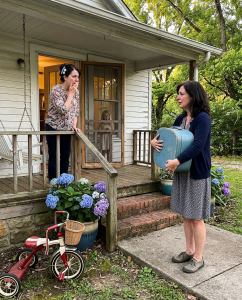
Her house sat back from the road beneath two sycamores, with a broad porch, tired hydrangeas, a wind chime, and a child’s tricycle on its side in the yard. Through the front window I could see a piano and framed photos.
I should have gone to the door.
Instead I sat at the curb gripping the steering wheel.
Then a little girl ran across the yard after a dog, laughing, and for one stunned second I forgot how to exist.
She had my face.
Not perfectly. Children never belong perfectly to one family line. But enough. The same narrow chin. The same eyes. The same cowlick near the right temple that neither Darlene nor I had ever managed to tame.
The front door opened.
A woman stepped onto the porch wiping her hands on a dish towel.
Everything in me stopped.
She was older, of course. Time had touched her around the eyes and softened her mouth. But I knew her with the violent certainty of instinct. It was like seeing myself translated into another life. My twin sister stood on that porch alive at forty.
She looked directly at me.
Her face changed, and what undid me was not surprise.
It was recognition.
As if she had always known this would happen. As if some part of her had been listening for the sound of my engine all day.
Then she reached up and touched her hair.
Clipped above her left ear was a blue plastic barrette with white daisies.
I got out of the car without feeling my legs.
The little girl stopped running. Even the dog quieted. I stood at the end of the walkway with the hatbox against my ribs like a shield.
My sister looked at me for a long time. There was fear in her expression, but underneath it was something older and sadder.
“She died before she could tell you, didn’t she?” she asked.
That was the first thing she ever said to me as an adult.
Not hello. Not my name.
I held up the barrette. “You were in the fire.”
Her eyes closed briefly. “No,” she whispered. “Someone else was.”
The words sliced clean through me.
Someone else. A body counted in place of hers. A child, perhaps. Or someone no one cared enough to question. My stomach turned.
The little girl on the porch said, “Mama?”
My sister glanced back sharply. “Inside, baby. Lock the screen.”
There was urgency in her voice that tightened every muscle in me.
When the child disappeared into the house, my sister came down one porch step, then stopped. “You look just like I remembered,” she said, and started crying.
I wanted to cross the yard and hold her. I wanted to slap her. I wanted to demand every lost birthday back with interest.
Instead I heard myself ask, “Why?”
She looked toward the road before answering. “Because your father thought I belonged to him.”
I frowned. “Our father.”
She flinched so visibly I knew the answer before she spoke.
“Not yours,” she said. “Only mine.”
She told me the story in pieces because that was all either of us could stand.
When my mother was pregnant, our father—at least the man I called Daddy—had already been suspicious. There had been another man before him, brief and dangerous, someone my mother had tried to leave behind. A preacher from outside town named Eli Maynard. Respectable in public. Rotten underneath. By the time she understood she was carrying twins, there were whispers, calculations, and fear. The doctor had said something rare was possible. Two eggs. Two fathers. My mother refused to believe it. Then we were born, and years later Eli saw enough of himself in Darlene to believe what he wanted.
According to my sister, he began visiting under church pretenses. Bringing candy. Touching shoulders too long. Asking questions about which child was which. My mother tried to keep him away, but men like that grow more dangerous when denied. The Hendersons, who were related to him through marriage, offered to help one afternoon when my mother had to be away. That was the day of the fire.
Only there had been no accident.
There had been smoke first, then shouting, then Darlene pushed out a back window and into the arms of Eli Maynard’s sister, who drove her away before anyone could see. My mother arrived to flames, panic, and a story already being built around her. A child was dead inside, they told her. The Hendersons would handle the authorities. If she wanted the living daughter kept safe, she would grieve publicly and stay silent.
“Why didn’t she fight?” I asked, horrified by my own question.
“She did,” Darlene said. “Just not in a way anyone could see. She tried to get me back. She tried for years. But he said if she ever came forward, he’d tell people what he was already saying in private—that I was his, that she had lied to everyone, that he would come for both of us. He said if she forced the truth out, you would be the one left unprotected.”
My anger shifted shape then. It did not disappear. It multiplied.
“She let me think you were dead.”
My sister nodded through tears. “And she let me think you were better off without me.”
The years that followed were a cruelty made of paperwork and silence. Eli Maynard renamed Darlene Delia and placed her with relatives farther west. When he died suddenly a few years later, she was old enough to know she had been taken but too young to undo it. By then records had been altered, stories hardened, and my mother had been warned often enough to understand that exposing the truth would drag out another kind of fire. The preacher’s family still held power in the county. The body in the Henderson house had been ruled the result of the blaze. No one wanted to revisit it.
My mother wrote letters instead.
She never mailed them because she had once gotten word that Delia—Darlene—was safe if left alone. Later, when she began spotting her from a distance in grocery stores and parking lots, she wrote more. She kept track of where my sister lived, who she married, when she had a child. She knew. She knew and said nothing.
That part was the hardest to forgive.
Not because I couldn’t understand fear. I could. By then I felt its outline around us both. But because silence becomes its own violence after enough years.
My sister led me onto the porch. Her daughter watched us from behind the screen with solemn eyes. We sat in old rocking chairs while afternoon deepened around the yard. I showed her the letters. She held them like relics. When she saw our mother’s handwriting, she pressed a fist to her mouth and bent forward.
“I always thought she chose you,” she admitted after a while. “Not because she loved you more. Because you were safer to keep.”
I answered before I meant to. “I always thought she lost you.”
We looked at each other then, really looked, and there was no easy place to put thirty years.
Her daughter’s name was June. She liked piano and strawberry milk and hated thunderstorms. Her husband had died three years earlier. She had built a quiet life and defended it fiercely because quiet was the first thing she’d ever had that felt like her own.
“What happens now?” I asked.
My sister glanced toward the road again.
“That’s the problem,” she said. “One of the Henderson boys is still alive. And last week he came by my house.”
The hair rose on my arms.
“He asked if I’d heard from anyone in Gatlinburg,” she said. “He said old things have a way of resurfacing after funerals.”
He knew about our mother.
He suspected the secret had moved.
That was why she had looked afraid before she looked relieved. That was why she had sent June inside.
For the first time, the story stopped being about the past alone. It had reached forward. It wanted something from us in the present.
I spent that night in her guest room, listening to the sounds of a house that should have been mine too. We stayed up late comparing scars and memories, testing the shapes of our voices against old childhood phrases. At one point she laughed exactly the way I did, and both of us burst into tears.
In the morning we drove back to Gatlinburg together.
I showed her our mother’s house. The window over the sink where she’d stood crying all those years. The hallway with our growth marks still penciled inside the closet. The dish on my vanity holding my barrette’s twin. My sister walked through each room as if she were stepping through the ribs of a life removed from her body.
In the cedar chest at the foot of my mother’s bed, we found what the letters had prepared us to expect but I had dreaded all the same: a bundle of legal papers, a hospital record with names partially scratched out, and an affidavit my mother had never signed. It detailed the events around the Henderson fire, named Eli Maynard, and stated that the body recovered from the house had never been properly identified. Tucked behind it was a note in shaky late-life handwriting.
If you are reading this together, then I failed in life but perhaps not in death. Forgive what fear made of me. Tell the truth if it can be told without burying another child.
We took the papers to an attorney in Knoxville first, then to the state police. By then I had learned enough not to trust local loyalties. The process was slow, humiliating, and far less cinematic than people imagine. There were interviews. Old reports. Contradictions. A reopening of records long sealed by neglect and convenience. The Henderson survivor denied everything. Then changed details. Then denied them differently. A former volunteer firefighter admitted quietly that there had always been uncertainty about the body. A retired nurse remembered my mother asking whether twins could have different fathers and being told yes, though rare. DNA testing on preserved medical samples and living relatives eventually confirmed the thing that had once sounded impossible: Darlene and I were fraternal twins with different fathers.
The state could not undo what had been done. Some crimes were too old. Some evidence too degraded. Some culprits too dead.
But the truth, once released, did what truth always does. It rearranged everything.
My mother was no longer remembered simply as a grieving woman. She became a woman cornered by men, institutions, and reputations bigger than her, and still not innocent of what her silence cost. The Henderson name never recovered its local shine. Eli Maynard’s descendants stopped pretending not to know. And my sister—my living sister—got her own name back.
Darlene.
She cried the first time the clerk said it out loud in the courthouse.
So did I.
There is no clean ending for a life split in half and then crudely stitched together decades later. We did not become identical strangers who magically completed each other. We were women with separate histories, separate damage, separate ways of folding towels and carrying anger. Some days we talked for hours. Some days one of us needed distance from the sheer ache of what had been taken. Her daughter took longer to trust me than I hoped. Fair enough. To her I was not a miracle. I was a disruption wearing her mother’s face.
But slowly, stubbornly, we built something.
A Tuesday supper each month. Shared recipes. Stories of childhood compared like evidence. Arguments over who remembered our mother most accurately. A photograph of the two of us at forty-one, standing shoulder to shoulder with matching blue barrettes in our hair, neither smiling quite right because we were both still learning what joy looks like after being delayed for thirty years.
People ask whether I forgave my mother.
The truest answer is that forgiveness never came to me as a single grand feeling. It came in splinters. When I read the letters and saw that she had loved my sister all along. When I understood the terror she had lived under. When I also admitted that love without courage can still ruin lives. I visit her grave sometimes and tell her things anyway. About June’s piano recitals. About Darlene’s garden. About the first Christmas we all spent together when no one knew whether to cry or pass the ham.
I still keep my original barrette in the porcelain dish by the bathroom mirror. Darlene keeps hers in a drawer lined with tissue paper. Sometimes when I stay at her house, June asks to see them side by side. She treats them like holy objects.
Maybe they are.
Two cheap blue barrettes from Woolworth’s. A matched set that outlived a lie, a fire, a preacher, and thirty years of silence.
The biggest red flag, I think now, was not my mother’s grief. Grief can make people strange. It was how many adults accepted a story with missing pieces because questioning it would have cost them comfort. That is how children disappear in plain sight. That is how women are taught to call terror a private matter. That is how a town helps a lie grow old enough to look like truth.
I loved my mother. I lost my sister. Then I found her again.
And some days, when Darlene laughs in the next room and June calls us both at once because she still gets us mixed up from behind, I wonder which hurts more—that we were stolen from each other for so long, or that somewhere deep down, both of us always felt the shape of that missing half and learned to live as though the ache was normal.