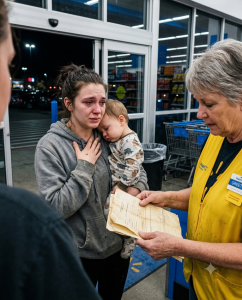
Every Tuesday night at 9:47 p.m., the young woman walked through the Walmart doors with the same sleeping toddler on her hip and the same guarded look in her eyes.
At first, Dottie Hargrove thought she was just another tired mother killing time before heading home. Beaumont had plenty of those. The late-night grocery crowd was full of exhausted people grabbing diapers, cough syrup, frozen dinners, and one more thing they had forgotten to buy two days earlier. But by the third week, Dottie realized this one never bought anything.
She only walked.
Up one aisle and down the next. Through cereal, candles, baby supplies, and pharmacy. Slow enough not to attract attention, steady enough not to look lost. She never took a basket. Never checked prices. Never stood still too long.
And always, always, one hand stayed pressed to her chest.
Dottie had been a greeter at that store on Eastex Freeway for eleven years. Long enough to know the rhythms of the place. Long enough to recognize loneliness in all its disguises. Teenagers came in laughing too loud because they didn’t want to go home yet. Elderly men wandered through hardware and pet food because their houses had gotten too quiet after dark. Nurses on night shift bought coffee with shoulders so tight they looked wired together.
People used big box stores for all kinds of reasons that had nothing to do with shopping.
Dottie understood that better than most now.
Her husband Earl had died seven months earlier after a fast, ugly stretch of illness that still didn’t feel real to her. Some days she could believe he was gone until she turned into the driveway and remembered there would be no truck in the yard, no game show humming in the den, no voice calling from the kitchen to ask whether she wanted tea. On those days, she tied on her yellow vest and came to work because fluorescent lights were easier than silence.
So she noticed details.
The young woman’s shoes had once been white canvas sneakers. By October they were gray with dirt and splitting at the seam near the left pinky toe. The child’s jacket was too thin for the sharp damp chill that settled over Southeast Texas after sunset. The woman’s hoodie had a broken zipper she kept tugging up and then giving up on. Her hair was clean but hurried, twisted into a knot that kept half-falling out by the end of the night.
And that paper.
Dottie noticed it by the sixth visit.
The woman kept it tucked under her palm against her chest as if it had a pulse of its own. She shifted the toddler from one hip to the other, pushed hair from her eyes, rubbed the child’s back when he stirred, but her fingers never strayed far from the folded square.
Something in that image lodged under Dottie’s ribs.
On the sixth Tuesday, she set a cup of coffee on the greeter stand before the young woman came in. Nothing fancy. Just hot, black, in a plain paper cup with a plastic lid.
When the woman passed, Dottie said, “Cold out there tonight.”
The woman slowed, then stopped. Her eyes were huge and dark, cautious but exhausted. She stared at the coffee as if it might be a trick.
“It’s not poisoned,” Dottie added lightly.
For the first time, the woman almost smiled.
She took the cup. “Thank you.”
Her voice was soft and carried the accent of East Texas without sounding local. Lufkin, maybe. Nacogdoches. Somewhere up the road.
As she lifted the cup, the folded paper slipped free for just a second. Dottie saw only worn edges and deep creases, nothing more.
The next Tuesday, Dottie added a small paper sack beside the coffee. Boys’ socks, peanut butter crackers, a travel toothbrush, and a pair of toddler mittens from the clearance bin.
“I can’t take that,” the woman said immediately.
“You’re not taking it,” Dottie replied. “I’m giving it. Earl always said there’s a difference.”
At the mention of Earl, the woman’s expression changed. Not because she knew the name, but because she knew what it meant to say one name and feel your whole chest tighten around it.
She picked up the bag.
“My name’s Dottie.”
A pause. Then, “Amber.”
“And this little one?”
“Remy.”
After that, their conversations came in small pieces. A minute here. Thirty seconds there. Enough for Dottie to learn Amber and Remy were from Lufkin. Enough to learn Remy hated loud dryers at laundromats and loved animal crackers. Enough to notice Amber never lied, but never volunteered anything she wasn’t ready to share.
Dottie respected that.
Then one Tuesday in November, Amber came in looking hollowed out.
Not messy. Not obviously injured. Just used up. As if hope had cost her more than she had left.
Remy was asleep before she reached the front. Amber stopped in front of Dottie and stood there while the automatic doors sighed open and closed behind her.
Dottie saw at once that something had changed.
She reached out and laid her hand gently over Amber’s fist, the one pressed to her chest.
“Honey,” she asked, “what is it you’re holding so tight?”
Amber looked down. For a long second she didn’t answer. Then her face folded in on itself and she started to cry with almost no sound at all.
She pulled the paper free and handed it over.
It was folded into quarters. The creases were so worn the center looked ready to split. There was tape on the back of one tear and a faded ring from an old coffee stain. Dottie unfolded it carefully.
It was a certified copy of a birth certificate.
Remington James Keller.
Mother: Amber Nicole Keller.
Dottie looked up.
Amber wiped at her face with the back of one hand. “I have to keep it with me.”
“Why?”
Amber swallowed hard. “Because if somebody asks and I can’t prove he’s mine, I don’t know what happens next.”
They moved to the side of the entrance, near the row of claw machines where the store lights still shone bright but the foot traffic had thinned. Dottie kept her voice soft. Amber kept hers softer.
The story came out in bursts.
Amber had lived with her mother outside Lufkin after Remy’s father disappeared. It had never been easy, but it had been manageable until her mother’s boyfriend, Curtis, moved in. Curtis was one of those men who made every room smaller. Always smiling when other people were around. Always helpful in public. Always ready with concern in his voice when he wanted someone to trust him.
Amber said he started with comments. About how hard it must be for a young single mom. About whether she was “keeping up” with the baby. About how sometimes children needed more structure than “girls like you” knew how to provide.
Then he started inserting himself into everything. Asking where Amber was going. Asking who she was texting. Criticizing what Remy ate, wore, watched, and when he slept. Telling Amber’s mother that the baby looked pale, then tired, then clingy, then delayed. Not because any of it was true, Amber said, but because repeated often enough, a lie began to feel like concern.
Amber tried to ignore him. Then to avoid him. Then to leave Remy with neighbors rather than be in the house if her mother wasn’t home.
One day she came back from a part-time shift at a diner and heard Curtis telling her mother that Amber was “unstable” and maybe needed “supervision.” He said the state took kids every day from women who couldn’t handle them. He said if he was Remy’s grandfather, he’d be worried sick.
“He’s not even related to us,” Amber said, voice flat with old anger. “But he talked like he already had a right.”
Dottie felt the back of her neck prickle.
“Did he ever hurt y’all?” she asked.
Amber hesitated long enough to answer without answering. “He never got the chance.”
That turned out to be because Amber found something before it could get worse.
After her wallet was stolen at a laundromat, she went to the public library to start figuring out how to replace her ID and request copies of documents. A librarian helped her search county records. While looking up a past address Curtis had used for a utility bill, Amber found an old case under his full name from another county.
It had been reduced. Partially sealed. Hard to locate unless you knew where to look.
But it was there.
A charge involving inappropriate conduct around a minor in his former girlfriend’s family. Never fully prosecuted to the worst level, but enough that Amber’s blood turned cold as she read it. Enough that every strange comment, every too-interested glance, every false accusation about her parenting rearranged itself into something terrifyingly clear.
“He wanted me out of the way,” Amber whispered. “He wanted everybody thinking I was the danger.”
She confronted her mother that night with the record pulled up on a library printout. Her mother cried, denied it, said there had to be some explanation. Curtis came home halfway through the argument and turned it around in seconds. He said Amber was paranoid, vindictive, mentally unwell. He said she was making things up because he had challenged her to be a better mother.
By morning, Amber’s mother told her it might be best if she “stayed elsewhere for a few days.”
So Amber left.
She took Remy, what cash she had, a change of clothes, and the certified copy of his birth certificate she had just requested. It was the one document she knew she could not afford to lose. Her driver’s license still hadn’t been replaced. Her phone was shut off two weeks later. The diaper bag disappeared when her car was broken into. After that, the birth certificate became the only paper left connecting her name to her child in a way no stranger could question.
Then Curtis escalated.
“He called the police once,” Amber said. “Told them I’d taken a child that wasn’t mine.”
The officers had found her parked outside a closed gas station with Remy asleep in the back seat. Amber had shown the birth certificate and talked her way through the stop, but the message was clear. Curtis was willing to weaponize the system if it gave him access.
The car transmission died in Beaumont. A church paid for two motel nights. A clinic social worker helped her get on an emergency housing list and scheduled a morning appointment with Family Services for the next day. If she made that meeting, she had a real shot at shelter, replacement ID assistance, and legal help.
But there was another piece of the story.
Amber reached for the birth certificate and unfolded a second sheet hidden behind it.
A court record printout.
Curtis’s name sat across the top in black type.
Dottie read enough to understand. The wording was clipped and legal, but the meaning was plain. Years earlier, another family had raised concerns serious enough to become a case. Serious enough that Amber’s fear was not imagination.
“He’s been calling around saying I’m unstable,” Amber said. “If he knows where the appointment is, he’ll show up acting worried. He’s older. Calm. Respectable-looking. I’m the girl with no phone, no address, and a kid asleep on my shoulder.”
Dottie didn’t like how true that sounded.
“When’s the appointment?”
“Tomorrow at nine.”
“Who told you he might show?”
“My mama texted from a neighbor’s phone. Said Curtis was asking questions and said he might ‘come help sort things out.’”
Amber’s mouth twisted with disgust around the word help.
Dottie had spent decades being underestimated as a smiling older woman in a yellow vest. She knew perfectly well how useful that could be.
She looked toward the customer service desk, then back at Amber. “Stay here.”
There was a woman named Carla who came in every Thursday evening to buy cat litter, vitamin water, and the same mint gum every single week. Three weeks earlier, while making small talk, Carla had mentioned she supervised intake at Family Services across town. She had laughed and told Dottie, “You see everything from that front door. If a young mama ever needs help, you call me before closing and I’ll answer.”
Dottie had tucked that away without expecting to use it.
Now she went to the employee phone and dialed the number Carla had written on the back of a receipt.
Carla answered on the second ring.
Dottie explained carefully and quickly. Not everything. Enough. A young mother. A child. An appointment tomorrow morning. A credible fear involving an older man with a prior record. No stable housing. No ID. Certified birth certificate in hand.
Carla didn’t waste a second.
“Tell her to come tonight,” she said. “I’m still at the office finishing reports. The security guard’s here. We’ll document everything before morning and flag the file so nobody meets with her alone and nobody discusses her case in the lobby.”
Dottie closed her eyes for one brief grateful moment.
When she relayed the message, Amber just stared.
“Tonight?”
“Tonight.”
“I don’t have gas.”
“You don’t need gas. I’m driving.”
Amber immediately shook her head. “I can’t ask you—”
“You didn’t,” Dottie said. “I offered. Difference.”
For the first time in weeks, Amber gave a real, shaky laugh.
Dottie clocked out ten minutes early with a manager’s blessing and drove Amber and sleeping Remy across town in her old Buick. On the way, Amber sat twisted halfway around in the back seat, one hand on Remy’s leg, the other still gripping the papers.
At Family Services, Carla met them at the side entrance.
She was younger than Dottie had expected, sharp-eyed and practical in a navy blazer, with the kind of calm that made frightened people breathe easier. She led them into a small office, brought juice for Amber and crackers for when Remy woke, and started documenting the situation properly.
Not gossip. Not panic. Facts.
Amber showed the birth certificate. The stolen-ID replacement paperwork. The court record printout. The text from her mother’s neighbor’s phone relayed on a scrap of paper she had copied by hand because her own phone was dead.
Carla photographed the documents, verified the court case through internal channels, and called the after-hours legal advocate attached to their office. By midnight, Amber had a temporary safety plan, a reserved emergency family room at a partner shelter, and a note placed in her file stating that no outside party was to be given information without identity verification and supervisory approval.
“Tomorrow,” Carla said, “if anyone comes asking questions, we handle him. Not you.”
Amber cried again then, but this time the tears looked different.
Remy woke while they were signing forms and climbed sleepily into Amber’s lap. He blinked at the room, accepted crackers as if they had always been promised to him, and leaned against his mother’s chest right over the folded papers.
Dottie thought she might never forget that image.
The next morning, Dottie went in late to work on purpose so she could stop by Family Services first.
Curtis had indeed shown up.
Carla later told her he came in wearing pressed jeans, a collared shirt, and concern arranged neatly across his face. He introduced himself as “family” and said he was worried about a mentally unstable young mother who might try to hide with a child she could not care for.
He got exactly three sentences in before Carla placed his name on the desk beside a printed verification of the prior case record and informed him that all further communication should go through legal counsel.
He left angry.
He did not get Amber’s location.
By the end of the week, Amber had a bed at the shelter, help applying for replacement identification, and an appointment with legal aid to seek a protective order if necessary. Carla also connected her with a workforce program and a daycare voucher waitlist.
Amber’s mother called twice through approved channels.
The first call was all denial and tears. The second sounded different. Quieter. Less certain. Someone from legal aid later explained to Amber that once people like Curtis realize professionals are involved and documentation exists, their confidence often cracks. Secrets survive in private. They struggle under fluorescent lights and paperwork.
Two months later, Amber got a part-time receptionist job at a pediatric clinic. The shelter helped her transition into a small apartment with subsidized rent. It wasn’t fancy. The carpet was worn and the kitchen drawers stuck. But it was hers, and the first thing she did after getting the keys was tape construction-paper stars over Remy’s bed.
Dottie visited one Saturday afternoon carrying a casserole and a bag of plastic dinosaurs she had found on clearance.
Remy, fully awake for once, announced that green dinosaurs were the strongest. Amber laughed from the kitchenette and looked younger than she had the first night Dottie saw her, though maybe that was just what safety did to a face.
On the refrigerator, held up by a magnet shaped like a peach, was the same certified birth certificate. Still creased. Still coffee-stained. But no longer hidden in fear. Beside it was a new plastic folder holding copies of every document Amber needed: ID receipt, shelter paperwork, job forms, and emergency numbers Carla had insisted she keep.
“I still carry the original sometimes,” Amber admitted, catching Dottie looking.
“Nothing wrong with that.”
Amber rested a hand over the folder. “For a while, I thought this paper was the only thing proving I was his mother. But it wasn’t really about proof, was it? It was about being scared nobody would believe me unless I had something official in my hands.”
Dottie nodded. She understood that too well. After Earl died, she had carried his last grocery list in her purse for months. Not because anyone would ask for evidence of him. Because grief and fear both had a way of making you clutch paper when people felt too fragile to trust.
A few weeks later, Amber’s mother came to see the apartment.
It was not a perfect reunion. There were tears and apologies and long silences. There was also one truth that would not budge: Amber would never let Curtis near Remy. Maybe never near herself again either. Forgiveness, if it came, would not come cheaply, and trust would not come first.
After her mother left, Amber stood by the sink and watched Remy stack blocks on the living room rug.
“I keep thinking about how close I came,” she said.
Dottie knew she didn’t only mean close to losing paperwork or missing an appointment.
Close to being disbelieved.
Close to being cornered.
Close to letting the wrong person define her reality.
Sometimes the most important thing in a person’s hands looks small. A folded paper. A phone number on a receipt. A birth certificate softened by too many frightened fingers. But those little things can draw a line between danger and safety when everything else has fallen apart.
And sometimes the biggest miracle is not that someone rescues you.
It’s that one ordinary person notices you before the worst part begins.
Dottie still worked Tuesdays after that. She still stood by the sliding doors in her yellow vest and watched people come and go under the hard white lights. But now, whenever she saw someone moving slowly through the store with that look in their eyes, she paid even closer attention.
Because kindness mattered.
But she had learned something else too.
The biggest red flag was never Amber’s fear. It was how quickly a dangerous man tried to make her fear look like instability.
And the question that stayed with Dottie long after everything settled was one she never fully stopped asking herself:
How many people had Curtis fooled simply because he looked calmer than the woman telling the truth?