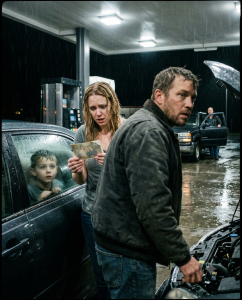
Mara had always hated the sound a car makes right before it dies.
There was a moment, always, a kind of shuddering surrender from deep inside the engine. The vehicle stopped sounding mechanical and started sounding personal, like a warning that had spent too long being ignored.
That sound came just after ten o’clock on a rain-lashed back road outside Hartford.
Her windshield was a sheet of water. The highway lines had dissolved into blurred streaks. Her gas light had been on for twenty minutes, the check-engine light for two weeks, and the money to deal with either had belonged to some other woman with some other life.
Her son was asleep in the back seat under his blue winter jacket and a blanket that had long ago lost its softness. Mara had one hand on the wheel, one on the useless climate knob, and a headache building behind her eyes from exhaustion, rain glare, and the private arithmetic of poverty.
How far to payday.
How late rent already was.
How long a nearly-broken car might pretend not to be broken.
Then the engine coughed.
Lurched.
Rolled dead.
She coasted into the dim lot of an almost-closed gas station and let both hands fall onto the steering wheel. For one second, she laughed. It was not because anything was funny. It was the short, empty laugh of someone too tired to cry in front of a child.
Mara was thirty-two. Divorced. Waitressing double shifts. Tipping just enough into survival that actual stability remained a rumor told by better-rested people. She had become expert at saying, “It’s okay,” in tones that ended conversations. She had also become expert at pushing panic down until it showed up later as heartburn and headaches.
Theo woke when the rain got louder.
“Are we home?”
“Not yet, baby.”
He rubbed one eye with his fist. “Did the car break?”
“A little.”
He accepted that with the old-souled calm children develop when adult problems have been the wallpaper of their lives for too long.
Inside the gas station, a teenager with acne and earbuds told her no tow truck was coming, no mechanic was open, and the owner had already left. He apologized in the vague, helpless way of someone too young to know the difference between inconvenience and danger.
She bought a stale granola bar, took two paper napkins for no reason except the need to leave with something, and stepped back outside into the rain with her chest tightening.
That was when the pickup truck pulled in.
The man who got out looked like he’d come straight from work. Late thirties, maybe. Dark hair damp from the weather, work jacket zipped to the throat, boots slick with mud. He saw her standing by the open hood, saw the child in the back seat, and hesitated just long enough for her to notice the hesitation.
Decent men still approached carefully. Women gave them reasons.
“You okay?” he asked.
Mara almost said yes automatically.
Instead, exhausted enough to tell the truth, she said, “No.”
Something changed in his face. Not pity. Recognition.
“Can I take a look?”
She glanced at Theo.
The man followed her eyes and nodded toward the car. “You stay where you are. I’ll just tell you what I’m checking.”
That helped.
So did the way he narrated everything he did, the way he never stepped too close, the way he seemed to understand caution without taking offense at it.
Five minutes later he straightened with rain running from his jawline.
“Battery connection’s shot,” he said. “Could be more, but that’s the first thing.”
Mara nodded like she knew what that meant.
“I can tighten it enough to get you moving,” he added. “There’s a garage ten minutes from here. If the road stays clear, you might make it.”
Relief caught in her throat. “Thank you.”
He shrugged. “My daughter and I got stranded once. Somebody helped us.”
He said daughter, and something about the way he said it made Mara wonder whether the girl was at home waiting for him or gone in some other, harder way. But she didn’t ask. Adults with tired eyes often carried stories best left folded.
Theo had climbed out of the car by then, blanket trailing behind him like a little cape. He stood under the station awning watching the stranger with solemn concentration.
“What’s your name?” he asked.
The man glanced up. “Jonah.”
“I’m Theo.”
“Good to meet you, Theo.”
Theo moved closer to Mara but kept staring.
At first she thought it was the usual child-curiosity. Jonah was interesting in the way grown men become interesting to boys who notice competence. The tools. The jacket. The ease with engines. The confidence of somebody who could make dead things work again.
Then Jonah turned under the station light.
And Mara’s stomach dropped.
Theo had her chin. Her freckles. Her hairline. But his eyes had always been a mystery.
Gray-blue, bright in strange lighting, the kind of eyes cashiers and pediatric nurses commented on as if unusual coloring itself were a blessing. Nobody in Mara’s family had them. Nobody on her ex-husband’s side either, though that had ceased to matter before Theo was old enough to ask questions.
Now Theo was staring at a man under a gas station light.
And the man had those eyes.
The exact shade.
The exact shape.
The same pale ring around the iris that made them look silver in cold weather.
Theo took one more step.
Mara’s whole body tightened.
Jonah smiled at him, unaware of anything except the rain and the engine.
Then Theo asked, in the clear voice only children possess, “Why do you have my eyes?”
The wrench slipped from Jonah’s hand and clanged against the concrete.
Mara stopped breathing.
Jonah looked at Theo. Then at Mara. Then back at the boy.
The rain became thunder on the metal awning. Somewhere inside the station the cashier laughed at something on his phone. A semi hissed down the highway. The world, rude as ever, continued.
“That’s enough,” Mara said too quickly.
Theo looked up at her. “But—”
“Inside the car. Now.”
He obeyed, startled by the edge in her voice.
Jonah did not move.
“How old is he?” he asked.
She should have lied. She would think that for a long time afterward. But fear made some people clever and others honest, and Mara had never once become clever under pressure.
“He turned seven in March.”
Jonah’s face emptied.
Seven years ago, Mara had spent one messy, grief-drenched weekend at a lakeside house after her marriage collapsed. There had been too much liquor, too much humiliation, too much need to be wanted by anybody for one night so she didn’t have to go home feeling erased. There had been a man with kind eyes and a soft voice who seemed out of place among the louder ones. She had remembered his hands more than his name.
Afterward there had been no romance, no number saved, no dramatic search.
There had just been real life descending with both feet.
Bills.
Morning sickness.
A landlord.
A mother too tired to help.
A job where missing a shift meant not eating properly next week.
When she discovered she was pregnant, she had considered searching for him exactly twice: once at three in the morning over a sink, and once in the parking lot of the clinic where she went for prenatal paperwork. Both times she reached the same conclusion desperate people often do. Survival first. Mystery later.
Later never came.
“What’s his full name?” Jonah asked.
Mara stepped back. “No.”
He nodded once. “Fair.”
Then he reached slowly into his wallet and pulled out an old folded photograph.
“I’m not asking to scare you,” he said. “I’m asking because if I’m right… that weekend didn’t end the way you were told it did.”
Mara took the photo with fingers that already knew they were about to shake.
The image was old and creased, faded at the corners. In it stood a younger version of herself, hair wild from lake air, smiling with the dangerous carelessness of a woman in active free fall. Beside her stood Jonah, slimmer and grinning. And next to Jonah stood another man.
He looked so much like Theo it was almost obscene.
Same eyes. Same mouth. Same long bridge of the nose. Even blurred by age and poor lighting, the resemblance struck with immediate violence.
“I don’t understand,” she whispered.
“That’s my brother,” Jonah said. “Elias.”
The name meant nothing to her. That, somehow, made it worse.
Jonah inhaled slowly. “He died almost seven years ago.”
Mara looked up. “What?”
“He met a woman that weekend,” Jonah said. “He told me about her afterward. Didn’t use your full name. Didn’t know much. Just said he wanted to find you again.”
Her mind snagged on the phrase wanted to find you again. It sounded far too gentle for the wreckage that came next.
“But he didn’t.”
“No.” Jonah’s eyes turned cold in a way that wasn’t about her at all. “Two days later he was arrested.”
“For what?”
“A hit-and-run.”
Mara stared.
“He swore he wasn’t driving,” Jonah said. “Swore it was our father. Drunk, angry, impossible as ever. But Elias took the blame. That’s what he always did. He stepped in front of consequences like he was born for it.”
Rainwater slid down the photo and across Mara’s knuckles.
“He thought he’d be out soon,” Jonah went on. “He wasn’t. And before he ever got the chance…” He looked away. “They said he died in county lockup. Aneurysm. But when I saw him before the funeral, there were bruises nobody explained.”
Mara felt sick enough to bend.
“He never knew,” she said. “About Theo.”
“No,” Jonah replied. “But someone else may have.”
She looked up again.
“My father saw that picture once,” Jonah said. “He knew Elias met someone. He knew Elias wanted to look for her. Then Elias died, and everything connected to that weekend started disappearing. The people from the house claimed they didn’t remember names. A camera I know existed vanished. Elias’s notebook disappeared from his apartment. My father told me to let it go so many times it started sounding rehearsed.”
Mara shook her head, because denial is reflex when the alternative is terror.
“You think your father tracked me down?”
“I think he was always trying to figure out whether Elias left behind anything that could talk.”
The words made no sense for one beat.
Then they did.
A child.
A witness by blood.
A face carrying the wrong man’s truth.
Mara turned toward the car. Theo was kneeling on the back seat, drawing shapes in the fogged glass with one finger. She suddenly remembered things she had dismissed because poor women cannot afford paranoia unless it becomes undeniable.
The phone call last year where no one spoke after Theo said hello.
The old sedan parked across the street two nights in a row.
The school receptionist casually mentioning a man asking whether Theo’s father “was involved.”
At the time it had all seemed flimsy. Coincidence. Background noise. The harmless static of a life lived in public.
Now those scraps aligned with brutal precision.
“Three months ago,” Jonah said, “a man came to my garage asking whether anyone ever confused me with Elias.”
Cold traveled through Mara’s body so fast it felt electrical.
“Who?”
Jonah didn’t need to answer. His expression did.
“My father.”
He started working under the hood again with abrupt urgency.
“What are you doing?” Mara asked.
“Getting you moving.”
“Why?”
He looked at her, and for the first time she saw fear strip everything else off his face.
“Because if he found you once, he can find you again. And if he’s been asking about me lately, it means he’s still cleaning up.”
The engine coughed.
A pair of headlights turned off the road and into the gas station lot.
Neither of them spoke. They simply looked.
The truck moved slowly, not with uncertainty but with possession, as if the driver had already decided what belonged in this place and what did not. It parked at the far pump under the broken lamp.
“Jonah,” Mara whispered.
He had gone still.
“That’s him.”
An older man stepped out. Tall. Heavy through the shoulders. Dark hair gone iron-gray at the temples. Same eyes as Jonah and the dead man in the photograph, but flattened by something meaner than age.
He looked first at Jonah.
Then at Mara.
Then at the back seat where Theo sat visible in the interior light.
The smile he gave was neat and bloodless. Not warmth. Not surprise. Recognition sharpened into decision.
Mara opened the rear door and crouched. “Theo, get on the floor.”
“Why?”
“Now.”
Something in her voice reached him. He slid down quickly, blanket tangling around his sneakers.
Jonah stepped in front of the car just as the engine came fully alive.
“Listen to me,” he said without looking back. “He’ll sound calm. He’ll make this seem reasonable. Don’t believe a word.”
The older man approached at a measured pace through the rain. In his left hand he carried a thick folder sealed with a rubber band.
When he stopped a few feet away, he looked past Jonah toward Mara and smiled again.
“You should’ve left some things buried,” he said.
Jonah’s voice came out low and dangerous. “You should’ve let Elias live.”
The old man’s face did not flicker. “Your brother made poor choices.”
“No,” Jonah said. “You did.”
For a second the rain seemed to hush around them.
Then the man shifted his gaze to Mara. “You must be Theo’s mother.”
She said nothing.
“I’m not here to hurt anyone,” he went on in the polished tone of practiced liars. “I’m here because Jonah has spent years inventing stories about our family, and I would prefer not to see a child dragged into delusions.”
Jonah laughed once, ugly and disbelieving. “There it is.”
The man lifted the folder slightly. “There are records in here. Police files. Statements. Things Elias hid from people who wanted to believe the best in him.”
Mara felt the trap in the sentence before she understood its design. Make the dead guilty. Make the living doubt. Reframe the story before anyone else could tell it straight.
“What do you want?” she asked.
The older man studied her face. “To make sure the boy is safe.”
Jonah moved half a step closer. “You mean silent.”
The man ignored him. “You don’t know anything about our family. My son was unstable. He involved himself in dangerous people, dangerous situations. The less your child is connected to that, the better.”
“Connected?” Mara snapped. “If Theo is his son, he’s already connected.”
That landed. The old man’s gaze sharpened.
In the car, Theo made a small frightened sound from the floor.
The man heard it and softened his expression instantly, turning that false gentleness toward the back seat. “Theo? I’m a friend of your father’s family.”
Jonah stepped sideways, blocking the view. “Don’t talk to him.”
The older man’s eyes iced over. “Move.”
“No.”
Mara’s own fear began curdling into anger. She was tired. Broke. soaked through. Running on granola bar dust and adrenaline. She had spent years making herself smaller to survive. Something in this man’s smooth voice pressed against the oldest bruise she had—the expectation that if someone said it confidently enough, she should surrender her own instincts.
She didn’t.
“What’s in the folder?” she asked.
He held it closer to his chest. “Nothing that concerns you.”
“Then you brought it to scare me.”
A flicker. Tiny, but real.
Jonah saw it too. “Open it.”
“No.”
“Open it,” Jonah repeated, louder.
The cashier inside the gas station finally looked up.
The old man glanced at the window, recalculated, and sighed as if burdened by childish people. “Elias was at the wheel the night that girl died,” he said. “He said otherwise, but Elias lied when it suited him.”
“And the bruises?” Jonah shot back. “Did he lie about those too?”
The old man’s jaw tightened.
“Did he lie when he told me you were drunk?” Jonah demanded. “Did he lie when he said you begged him to switch seats before police came?”
Mara watched something cold move behind the old man’s eyes. Not guilt. Strategy.
He shifted the folder to his other hand. “Your brother was always weak.”
It was the wrong choice.
Jonah lunged.
They collided in the rain, not like movie fighters but like family—messy, furious, intimate with each other’s worst angles. The folder hit the ground and burst open, papers skidding across wet concrete.
Mara ran forward on instinct and grabbed the first plastic-sleeved packet before the rain could turn the ink to ghosts.
Inside was a copy of an old witness statement.
Not from Elias.
From a gas station clerk twenty miles away.
The statement said the driver who came in for cigarettes after the crash was an older man, bleeding from the knuckles, smelling strongly of whiskey. It said a younger man had followed him inside, pale and shaking, calling him Dad.
Mara looked up, stunned.
Jonah had the old man pinned against the side of the truck.
“You kept this?” Jonah yelled. “You kept proof?”
The old man shoved him hard enough to break free. “I kept what I needed.”
“For what?”
“To survive,” he snarled. “The way everybody does.”
He was breathing hard now, mask slipping. “Your brother was always going to ruin himself. I merely chose which son could still be useful afterward.”
The sentence landed like a blow.
Jonah froze.
Even the old man seemed to hear what he had admitted, because his expression changed a fraction too late.
Inside the station, the teenage cashier had come to the door with his phone raised.
Good, Mara thought wildly. Record it. Record everything.
The old man saw the boy filming and made another decision. He turned toward the truck.
Jonah grabbed his sleeve. “You’re not leaving.”
The older man swung hard. Jonah stumbled. Mara shouted. Theo cried out from the car.
Then headlights flooded the lot from the road.
A patrol cruiser.
The cashier had done more than film. He’d called.
The old man stopped moving.
Two officers stepped out, hands near their belts, scanning the scene: wet papers across the pavement, two men squared off in the rain, a woman clutching a file, a child crying in the back seat.
One officer barked, “Everyone step apart. Now.”
For one horrible second Mara thought the old man might still talk his way free. Men like him had made lives out of calm voices and selective truths.
Then the younger officer bent, picked up one of the soaked documents, and frowned.
“Where did you get this?” he asked.
The old man said nothing.
The officer lifted another page. “This file was marked missing in an internal review two years ago.”
Everything changed in the space of that sentence.
The old man’s composure collapsed into something uglier and more familiar: contempt for being cornered.
Jonah stood shaking, rain plastering his hair to his forehead. “Tell them,” he said. “Tell them what you did to Elias.”
The man looked at his surviving son, and for one brief second Mara understood that whatever else he felt, love was not among it. Control, possession, resentment, self-preservation—yes. But not love.
“He made his choice,” the man said.
“No,” Jonah answered. “You made it for him.”
The officers took the folder. Separated them. Asked names. Asked who the child was. Asked whether anyone was hurt. The old man tried once more to steer the narrative, to call Jonah unstable, to call the scene a misunderstanding, to say family tensions had been exaggerated by grief.
Then the witness statement surfaced. Then another paper. Then a letter in Elias’s handwriting, half-finished, never sent, describing the crash, his father’s threats, and his plan to find “the woman from the lake” because he could not keep living under a lie.
That broke whatever was left.
The old man was arrested that night on evidence tampering and charges connected to the original case reopening. The rest took months—investigators, interviews, exhumed records, the slow humiliating machinery of truth forcing its way through systems that had once found it easier to accept the wrong story.
Mara gave a DNA sample because by then there was no point pretending she did not need the answer as much as anyone else.
Theo was Elias’s son.
When the result came, Mara sat at her kitchen table with the paper in both hands and cried so hard she scared herself. Not because she had wanted a fantasy father to appear. Not because paternity fixed anything. But because for seven years Theo’s origins had been a blank she had trained herself not to look at too closely, and now the blank had a face, a name, a brother who remembered him, and a grief attached to it that was real.
Jonah entered their lives awkwardly after that.
Not all at once. Not in a neat montage. He brought groceries once and left them at the door because Mara looked wrung out. He took Theo to a hardware store and came back with a birdhouse kit neither of them knew how to assemble. He showed Mara the picture of Elias when it had not yet been folded and carried into ruin. He told stories in pieces—how Elias used to sing wrong lyrics on purpose, how he once fixed a school principal’s lawnmower just to avoid suspension, how he’d always stepped between Jonah and their father when anger started climbing the walls.
Theo listened to those stories with huge solemn eyes.
“Did he know about me?” he asked one night.
Jonah answered honestly. “No. But he would have wanted to.”
Children handle truth strangely. Sometimes better than adults. Theo accepted the shape of it over time: the father he would never meet, the grandfather he would never be allowed near, the uncle who arrived because a broken car died in exactly the right terrible place.
As for Mara, she spent months angry in rotating directions.
At herself for not searching.
At circumstance for making search feel impossible.
At Elias for being kind and then gone.
At a system that let an abusive man weaponize his own son’s loyalty.
At the rotten unfairness of discovering the truth only because her car broke down in a storm.
But underneath the anger sat something else.
Grief for a man she barely knew and somehow could now imagine with aching clarity.
She pictured him younger, laughing in the photograph. She pictured him reaching for her name again after that weekend, meaning to come back, meaning to do one decent thing in the middle of a life built around someone else’s damage. She pictured him in a jail cell understanding too late what taking the blame had cost.
The case made local news once it reopened. There were comments online, arguments, people pretending hindsight had always been obvious. Some called Mara foolish for never looking. Some called Jonah heroic for never letting go. Some called Elias weak.
That last one made her furious.
Weak men did not take blows for years to shield a brother.
Weak men did not try to protect a woman they barely knew from being dragged into a violent family.
Weak men did not leave behind letters that could still tell the truth when they no longer could.
Months later, on a dry afternoon, Mara took Theo to a small cemetery on the edge of town.
They stood before a simple headstone.
Theo set down a little blue toy car from his pocket, his own idea.
“Hi,” he said to the stone, shy but steady. “I’m Theo.”
Mara nearly broke right there.
Jonah stood a few steps back, giving them room. Wind moved through the trees. Somewhere in the distance a lawnmower droned. Ordinary life again, infuriatingly ordinary, as if whole bloodlines had not just been torn open.
Theo looked up at her. “Was he nice?”
Mara thought about the photograph. The gas station. The letter. The life he’d lived under a father who turned love into leverage.
“I think,” she said carefully, “he was better than what happened to him.”
Theo seemed satisfied with that. Children often understand the core of a thing before adults finish dressing it in language.
On the drive home, he fell asleep in the back seat, face turned toward the window, those gray-blue eyes finally closed.
Mara kept glancing at him in the mirror and then back at the road.
A broken car had given her son a history.
A stranger under a gas station light had turned into family.
A dead man she had known for one reckless weekend had become one of the central truths of her child’s life.
It was almost unbearable to think how narrowly it had all been missed.
And maybe that was the part that stayed with her most. Not just the cruelty. Not just the secret. But how much of life is decided by timing, by weather, by one machine failing in the right place, by one child noticing what adults are too frightened to name.
Who was right? Who was wrong? That part looked obvious on paper. But families rarely break in clean lines. Elias had lied and paid for it. Jonah had looked away too long before he started digging. Mara had survived by refusing to search for answers she couldn’t afford to find. Every one of them had mistaken endurance for safety at least once.
Still, when she thought back to the beginning, the biggest red flag was not the missing years or the vanished records.
It was a father who taught his sons that love meant carrying his guilt.
And maybe the hardest question was not whether forgiveness was deserved.
It was whether anyone raised inside that kind of darkness ever truly learns the difference between saving someone… and disappearing for them.