“Ms. Reyes,” he said, “before I ask you to leave this house immediately… I need you to tell me why your daughter just repeated the exact words my wife wrote in the last journal entry she left in her bedroom.”
For a moment, no one in the sunroom moved.
Not Isabel, whose fingers had gone numb around the edge of her chair.
Not the estate manager, who stood by the doorway with the stiff, pale look of someone realizing a routine interview had veered into territory no etiquette handbook covered.
Not even Oliver, who sat on the rug holding Poppy’s stuffed lamb with both hands, as if it were the first soft thing he had trusted in months.
Poppy alone looked perfectly at ease.
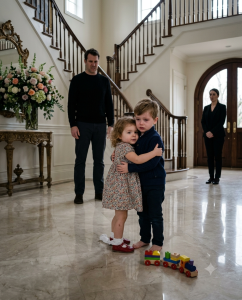
She sat beside Oliver in her little red shoes, one sock sagging around her ankle, blinking up at the adults with the untroubled calm of a toddler who had no idea she had just detonated the center of a grieving household.
Isabel forced herself to breathe. “I don’t know what you mean.”
Adrian Ashford studied her face without blinking. He had the kind of composure that made emotion look dangerous when it slipped. Tall, controlled, dressed in dark clothes that made his exhaustion seem even sharper, he looked like a man who had been surviving on discipline for so long he no longer recognized softer things as useful.
“My wife wrote that line down three nights before she died,” he said. “No one outside this family has read it.”
“I haven’t,” Isabel said, and that part at least was simple truth. “I’ve never been in this house before today.”
Poppy lifted the lamb and pushed it toward Oliver again. “For sad,” she said.
Oliver took it without hesitation.
That, more than anything else, seemed to strike Adrian. His son hadn’t warmed to six carefully selected candidates. Six professional, polished women with excellent references and calm voices and years of experience. Yet this morning, without warning, he had allowed a stranger’s toddler to hug him in the middle of the foyer and had not let go of her presence since.
Adrian’s gaze moved back to Poppy. “What did the lady in white say?”
Isabel felt a cold jolt in her stomach. “Poppy, sweetheart—”
“The lady in white was crying,” Poppy said, unfazed.
Oliver’s head snapped up. “Mama?”
The word landed in the room like glass.
Adrian’s jaw tightened. “Who told her about my wife?”
“No one,” Isabel said, more sharply now, because she could hear how this sounded and hated it. “She’s two years old. She says odd things sometimes. She mixes dreams with whatever she sees during the day.”
Poppy leaned against Oliver’s shoulder as if they had known each other much longer than fifteen minutes. “He waits by the door,” she said quietly.
Adrian’s expression changed.
Not disbelief. Not anger.
Recognition.
He turned away for a second and pressed a hand to his mouth. When he spoke again, his voice was lower. “My son sits outside my wife’s dressing room some nights. No one told you that either.”
“No one told me anything except basic details for the interview,” Isabel said. “I knew your son lost his mother. I knew he’d had trouble accepting caregivers. That’s all.”
The estate manager cleared his throat. “Sir, perhaps this has gone far enough.”
But Adrian wasn’t listening to him.
He crouched down in front of Poppy, moving carefully, as though afraid of startling something fragile. “Poppy,” he said, “is the lady in white here now?”
Poppy nodded.
“Where?”
She pointed upward. “Upstairs.”
Every muscle in Isabel’s body wanted to leave. Gather Poppy, apologize again, walk out before security cameras and suspicion turned this into something uglier. Yet Oliver had shifted closer to Poppy, almost hidden against her side. He looked more alert than withdrawn now. More present. As if something in him had woken up the moment she appeared.
Then Poppy said, “She said Daddy didn’t open the blue door.”
Adrian went completely still.
The estate manager blinked. “Blue door?”
Adrian didn’t answer immediately. He was staring at Poppy as if she had spoken in a language he thought only one person in the world knew. When he finally did speak, his voice had gone distant.
“My wife’s studio,” he said. “At the end of the east hall. She painted the door blue herself.”
Isabel’s pulse kicked hard.
“She locked it before…” He stopped, then started again. “Before the end. I haven’t opened it since.”
Oliver looked at his father. “Mama said it was her thinking room.”
Adrian closed his eyes briefly.
Isabel saw then what grief had done to this family. Not just the obvious ache of absence. Not just the lonely child and the exhausted father and the staff walking too softly around old wounds. It had frozen them around one locked room, one sealed-off place where everything unfinished had been left to thicken into fear.
Poppy rested her cheek against Isabel’s shoulder. “She said don’t be mad.”
At that, something in Adrian cracked.
Not dramatically. Not with tears or raised voices. Just a subtle collapse in the posture of a man who had been holding himself upright through force alone.
“Please don’t leave,” he said.
The words surprised all of them, maybe even him.
Oliver immediately looked between them. “Can they stay?”
Adrian looked at his son for a long moment, then at Isabel. “I know how this sounds. I do. But my son hasn’t responded to anyone in months. And your daughter…” He exhaled slowly. “Whether this is coincidence or something else, I need to understand it.”
The estate manager looked deeply uncomfortable. “Sir—”
“Bring the keys,” Adrian said.
They went upstairs together.
The east hall was quieter than the rest of the house. The kind of quiet untouched spaces develop when sorrow is allowed to keep its own hours. Family portraits lined the walls, but not recent ones. Isabel noticed that instinctively. The smiling photographs stopped before the year of the mother’s death, as though no one in the house had found the strength to replace them.
At the end of the corridor stood the blue door.
It wasn’t bright or whimsical. It was a rich, storm-dark shade, hand-painted in visible strokes beneath the varnish. A door someone had made herself, refusing blandness even inside a grand house that seemed otherwise curated into perfection.
Adrian stood before it with the keys in his hand and did not move.
Oliver, still holding Poppy’s hand, looked up at him. “Daddy?”
Adrian swallowed. “I haven’t been in there since your mother died.”
Oliver nodded as if he already knew that.
Poppy pointed at the bottom of the door. “She’s in there.”
The estate manager took a small step backward.
Isabel wanted to tell everyone this was enough, that children echoed moods and invented stories and stumbled into strange truths by accident all the time. But even she could feel the pressure in the hallway, the awful sense that this house had been holding its breath for months.
Adrian fitted the first key into the lock. It didn’t turn.
Neither did the second.
The third clicked.
He paused with his hand on the knob, then pushed the door open.
The room smelled faintly of old paint, cedar, and something floral so soft it felt more like memory than fragrance.
Sunlight filtered through high windows veiled by sheer curtains. Canvases leaned against one wall beneath draped cloths. A half-finished painting sat on an easel, untouched, its brushstrokes frozen mid-thought. Shelves held sketchbooks, ceramics, jars of brushes gone stiff with neglect. Everything looked paused rather than abandoned, as if the woman who had used the room had meant to step back in after lunch.
Oliver let go of Poppy’s hand and stood in the doorway without crossing the threshold.
“Hi, Mama,” he whispered.
Adrian flinched.
Isabel had no right to be there. She knew that. This was too private, too raw. But Adrian had asked her to stay, and now she stood just behind him holding Poppy while the room opened around them like a confession no one had wanted to hear.
Poppy wriggled down from Isabel’s arms and toddled straight to the far side of the studio.
“Poppy,” Isabel said, following fast.
But the little girl was already kneeling by a low reading chaise near the windows. She slapped one palm against the hardwood floor.
“Here,” she announced.
Adrian stared at her. “What is here?”
“Under the floor thing.”
His face changed instantly.
He crossed the room in three strides and dropped to one knee beside the chaise. Isabel saw what he was seeing: one section of floorboard, just beneath the edge of the rug, had a slightly different finish than the rest. Not noticeable unless you were close. Not noticeable unless you knew to look.
The estate manager muttered, “Good God.”
Adrian pushed the rug back. A narrow groove ran beside one plank. He hooked his fingers into it, lifted, and the board rose with a dry scrape.
Beneath it lay a shallow compartment.
Inside was a sealed envelope, a silver key, and a slim black recorder.
No one spoke.
Adrian picked up the envelope first.
On the front, in neat handwriting, were four words:
For Adrian, when ready.
He sat back on his heels as though the floor had shifted beneath him. The air in the studio seemed to thin. Isabel could hear only Oliver’s small breaths and the pulse beating hard inside her own ears.
Adrian opened the envelope carefully.
A folded letter slid into his hands.
He read the first line in silence, then stopped and shut his eyes.
Oliver looked frightened. “Daddy?”
Adrian opened them again. “It’s from your mother.”
The boy’s mouth trembled, but he stayed very still.
Adrian read the rest more slowly, his face draining and tightening by turns. When he reached the end, he didn’t move for several seconds. Then he handed the page to Isabel with a look that was almost dazed, as though he needed another adult to confirm the words existed outside his own head.
She hesitated, then took it.
Adrian,
If you are reading this, it means two things happened exactly as I feared they would: I ran out of time, and you waited too long because pain always makes you retreat behind decisions instead of feelings.
You’ll hate that I’m right.
I know you. You’ll preserve my room like a monument and call it respect when really it’s fear. You’ll tell yourself you’re protecting Oliver when you are also protecting yourself from the last truth I couldn’t make you face while I was still here.
So I’m forcing your hand.
There is something I never finished telling you about the firm, about Daniel Mercer, and about the transfers I found three months ago. I copied everything I could and locked the evidence separately because I didn’t know how far it went, only that it involved your name and would destroy you if it surfaced without context.
You trusted him. I did too, once.
Don’t anymore.
Use the silver key for the flat file drawer under my worktable. Everything is there.
If I’m wrong, you’ll forgive me from the privacy of your outrage.
If I’m right, then grief will not be the only thing trying to bury this family.
And Adrian, listen to me carefully: Oliver does not need a perfect shrine. He needs a father who will come back into the world. Do not leave him standing outside closed doors just because I am behind one.
I loved you even when you made it difficult.
I loved our boy most in the moments he did not know I was watching.
And I am leaving this hidden because sometimes the only way to make you look is to make you believe you found it too late.
Elena
By the time Isabel finished, her fingers were unsteady.
Daniel Mercer.
Even she knew the name. Adrian Ashford’s business partner. Mentioned in magazine profiles, charity galas, financial interviews. Trusted lieutenant. Friend, if public appearances meant anything.
Adrian was already at the worktable.
The silver key fit the lowest flat file drawer. Inside were neatly organized folders, labeled in Elena’s handwriting. Bank statements. Printed emails. Copies of wire transfers. Notes in the margins. Dates circled. Account names highlighted. One folder thicker than the others bore a single word across the tab:
Mercer.
The estate manager leaned over Adrian’s shoulder and went white.
“What is it?” Isabel asked softly.
Adrian slid out a page and stared at it in disbelief. “Transfers routed through one of my dormant charitable subsidiaries,” he said. “Millions.” His voice sharpened. “Structured to look like approved disbursements. If regulators found this without explanation, it would point straight to me.”
“Could your wife have misunderstood?” Isabel asked, though she already suspected the answer.
“No.” Adrian’s eyes moved quickly over the pages. “She noted dates, offshore connectors, fabricated signatures. This is deliberate.” He looked up at the estate manager. “How long has Daniel been asking for copies of Elena’s studio contents to be inventoried?”
The manager swallowed. “Twice that I know of. He said he was helping settle personal and business matters.”
Adrian laughed once, without humor. “Of course he did.”
Oliver had inched closer now, confused by the tension but unwilling to leave. Poppy stood beside him, solemn at last, tiny hand wrapped around two of his fingers.
“Is Daddy mad?” Oliver whispered.
Adrian looked at his son and everything in his face softened. “Not at you.”
He took out the slim recorder from the hidden compartment and turned it over in his hand. There was a dated label on the back in Elena’s writing.
“If she left this too…” he murmured.
He pressed play.
Static crackled for half a second, then a woman’s voice filled the studio.
Warm. Tired. Intelligent. Too intimate for any stranger to hear without feeling they had intruded.
“If you found this, Adrian, then you finally opened the floor compartment. I knew you would need proof you could hear instead of paper you could explain away.”
Adrian’s breath caught.
Elena continued, each word steady despite the faint strain underneath. “Daniel has been moving money using your inactive entities. I confronted him indirectly first, to see if I was wrong. I wasn’t. I think he assumed I’d be too ill to follow it properly. He was wrong about that too.”
The room was silent except for her voice.
“I haven’t told you yet because every time I tried, Oliver was in the room, or a doctor was calling, or you looked like you were one more impossible thing away from breaking open. That’s not an excuse. It’s just the truth.”
There was a pause, the sound of fabric shifting, a small shaky exhale.
“If something happens before I can tell you myself, protect Oliver first. Then protect your name. Daniel will present himself as indispensable. He will offer to handle everything. Don’t let him. Don’t sign anything he puts in front of you without independent review.”
Another pause.
“And my love, if grief turns you into a locked house, our son will learn to live outside your doors. Don’t do that to him. Let him touch what hurts. Let him talk about me. Let him remember me laughing, not just disappearing.”
The recording ended with one final line, spoken softer than the rest.
“I am not afraid of dying as much as I am afraid of leaving you unfinished.”
Silence rushed back in.
Adrian sat down hard on the chair beside the worktable, the recorder still in his hand. For the first time since Isabel met him, he looked stripped of all the structures he had built to remain functional. Not weak. Just naked in his grief, forced to meet both his wife’s absence and her final act of protection at the same time.
Oliver crossed the room slowly.
“Daddy?”
Adrian opened his arms.
The boy went into them instantly.
It was such a small thing, such an ordinary movement, but Isabel understood from the way the estate manager looked away that it had not been ordinary in this house for a long time.
Adrian held his son tightly and pressed his face into the child’s hair.
“I’m here,” he said, voice breaking on the last word. “I’m here. I’m so sorry, Ollie.”
Oliver began to cry then. Quietly at first. Then with the full-bodied grief of a little boy who had been careful for too many months because everyone around him was already so wounded. Adrian held him through it, not shushing him, not deflecting, just staying.
Beside them, Poppy leaned against Isabel’s leg and yawned.
The spell of the morning shifted.
Not vanished, but changed. The impossible strangeness of how they had arrived here gave way to practical action. Adrian stood a few minutes later with new steel in him, grief redirected into purpose.
He called his attorney first. Then a forensic accountant outside his firm. Then, after a brief and pointed conversation, security.
By late afternoon, Daniel Mercer was denied entry to the estate and all company systems linked to the accounts in question were frozen pending review.
Over the next week, Elena’s evidence proved devastating.
The transfers were real. The shell pathways were deliberate. Daniel had siphoned money for nearly a year, using Adrian’s dormant subsidiaries as cover while trusting that Elena’s illness and Adrian’s distraction would keep scrutiny low. He had already drafted fallback explanations that would have left Adrian exposed if the fraud surfaced publicly.
But Elena had seen enough before she died to build the case against him.
And because she had hidden it where only Adrian would eventually find it, Daniel never had the chance to destroy the proof.
The scandal did not disappear quietly. It never could. There were lawyers, auditors, whispered articles, abrupt board resignations, reputational salvage operations. Daniel insisted on innocence, then procedural misunderstanding, then partial blame, before the paper trail cornered him completely. In the end, he was charged, disgraced, and publicly severed from everything he had touched.
But for Adrian, the greater reckoning was at home.
He opened the blue door every day after that.
Not all at once. Not heroically. Some mornings he lasted ten minutes before memory drove him out. Some afternoons he sat in the chair by the window and listened to Elena’s recorder messages with tears he no longer bothered hiding. Sometimes Oliver painted at the small table while Adrian reviewed documents nearby. Sometimes they said her name over lunch. Sometimes they cried. Sometimes they laughed at things only a wife and mother would have taught them to notice.
The room stopped being a mausoleum.
It became part of the house again.
And through all of it, Isabel remained.
At first, only provisionally. Adrian insisted the formal interview could be completed later, under more rational circumstances. But by the second morning, Oliver had asked whether “Poppy and Miss Isabel” were coming back, and by the third, Adrian stopped pretending the answer might be no.
Isabel was not polished in the way the agency usually placed. She was capable, warm, observant, and occasionally flustered. She arrived with snacks in her bag and practical shoes and a toddler who left toy animals under expensive furniture. She did not glide through rooms invisibly. She made them lived in.
That turned out to be exactly what the Ashford house needed.
Poppy and Oliver became inseparable in the bizarre, wholehearted way small children sometimes do. He grew less watchful around her. More willing to laugh. More willing to sleep in his own bed. On the nights he still drifted toward the east hall, he no longer sat outside the closed dressing room waiting for someone lost. Sometimes Adrian found him outside the studio instead, where the door now stood open.
One evening, nearly two months after the interview, Isabel found Adrian in the kitchen long after dinner, staring at a mug of untouched coffee.
“You should fire me,” she said lightly, leaning against the counter. “No professional childcare plan includes accidental ghost-assisted financial crime discovery.”
To her surprise, he laughed.
It changed his whole face.
“I considered putting that in the contract,” he said.
She smiled, then sobered. “Do you ever think there’s another explanation?”
“For Poppy?” he asked.
“Yes.”
Adrian looked toward the hall where the children’s voices were drifting from the playroom. “Every day.” He paused. “Children notice things we train ourselves to ignore. Maybe Oliver had spoken more than we realized. Maybe your daughter picked up details no one noticed and repeated them in a way that felt impossible.”
“And the floor compartment?”
He held her gaze. “I don’t know.”
Neither did she.
Poppy eventually stopped mentioning the lady in white.
Not dramatically. Just less and less, as if whatever needed saying had already been said.
Months later, when Isabel asked her about the Ashford house on that first day, Poppy only frowned and said, “Oliver was sad.”
That was all.
No grand mystery. No second revelation. Just the simple fact that grief, when it sits too heavily in a room, can sometimes be recognized first by the smallest person in it.
The official employment papers were signed in autumn.
By then, the decision had very little to do with references.
On the day Adrian handed Isabel the final contract, Oliver was sprawled on the nursery rug building train tracks while Poppy kept handing him the wrong pieces with absolute confidence. The broken wooden train from their first meeting had been repaired, though the faint crack line still showed if you knew where to look.
Adrian watched the children for a long moment before speaking.
“I dismissed six candidates because they all seemed determined to manage my son,” he said. “You were the first person who saw him.”
Isabel looked at Oliver, who was now patiently explaining to Poppy why curved track mattered.
“Honestly,” she said, “I think Poppy saw him first.”
Adrian smiled, but only for a second. Then his gaze drifted toward the east hall, where the blue door stood open at the end of the corridor, visible from the nursery if the light hit right.
“Elena would have liked you,” he said quietly.
Isabel did not know how to answer that, so she let the silence hold it.
Some hurts never become tidy. Some betrayals arrive too late to prevent the damage they were designed to do. Some acts of love are so inconvenient, so persistent, so strange in their timing that they seem almost cruel before they reveal themselves as rescue.
Maybe that morning in the foyer had been coincidence layered on grief layered on the eerie wisdom children sometimes carry without understanding.
Or maybe a dead woman who knew her husband better than he knew himself found one last way to force open the door he could not.
Either way, a toddler in red shoes walked into a house drowning in silence, hugged a grieving boy without hesitation, and changed the future of everyone inside.
And in the end, the biggest red flag was not the hidden money or the locked room.
It was how easily a family can mistake preserving pain for honoring love.