The deputy walked through that door at exactly the right moment.
But I’m getting ahead of myself. Let me back up eight months.
—
My name is Carolyn Reese, and I am what most people would call a quiet woman.
I wear sensible shoes. I drive a sensible car. I keep sensible hours.
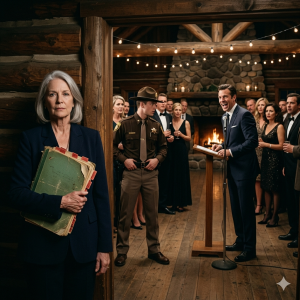
For eleven years, I co-owned a mountain lodge outside Durango, Colorado with my second cousin, Mitchell Hale — and for eleven years, I kept every single book, every receipt, every deed, every handshake agreement, in a faded green ledger I carried everywhere.
Mitchell called it my “little hobby journal.”
He said it with a smile, the way men like Mitchell say everything — like the whole world is a joke only he’s in on.
“Carolyn and her journal,” he’d laugh to guests. “She never goes anywhere without that old thing.”
He was right about that part.
—
The lodge had been in our family since 1987. My grandmother left it to both of us, equal shares, names on the deed side by side.
Mitchell managed the bookings. I managed the books.
We were a team. Or so I believed.
Then, two Januaries ago, a pipe burst in the east wing and we had to close for renovations.
Mitchell said he’d handle the permits. Handle the contractors. Handle the paperwork.
“You just rest, Carolyn. You’ve been working too hard.”
I should have known then.
But I trusted him. I went home to Denver. I tended my garden and walked my dog, Biscuit, and I kept writing in that faded green ledger — dates, amounts, conversations I thought were routine.
I had no idea I was already documenting a crime.
—
It was my neighbor Linda who found it first, actually.
She was helping me scan old documents into my laptop when she stopped and said, “Carolyn. Honey. Is this right?”
She was pointing at a county property record she’d pulled up online.
One name on the deed now.
Mitchell Allen Hale.
Mine was gone.
I sat very still for a long moment.
Then I opened the green ledger to a fresh page.
And I started writing.
—
Eight months.
Eight months of phone calls I recorded on my little digital recorder.
Eight months of emails I printed and hole-punched and filed.
Eight months of trips to the county clerk’s office in La Plata County, where a very kind woman named Brenda helped me understand exactly how a quit-claim deed gets filed — and exactly what has to be proven to contest one.
Mitchell never called to check on me.
I think he assumed I was too timid.
He wasn’t entirely wrong about who I used to be.
But the woman who drove back up that mountain road last Saturday was not the same woman who left.
The green ledger was on my passenger seat.
Every page tabbed in red.
—
Mitchell had thrown himself quite a party.
He called it a “Grand Reopening.” Catered. String lights on the porch. Investors from Denver, from Scottsdale, from somewhere in Texas driving big black trucks.
He had a microphone set up near the stone fireplace — our grandmother’s fireplace, the one she’d had built by hand in 1989.
I stood near the back of the room in my good navy blazer.
I’d made a phone call on Thursday. A quiet one. To an old friend who works out of the Durango field office.
Mitchell didn’t know about that phone call.
He tapped the microphone and grinned that grin.
“Friends,” he said, “welcome to MY lodge.”
The emphasis on that word sent a ripple through the room.
I watched him.
He hadn’t seen me yet.
He raised his glass.
“I built something here that —”
The front door opened.
The room shifted.
A La Plata County Sheriff’s deputy stepped inside, boots tracking a little snow from the porch. Young, serious-faced, unhurried.
He stood just inside the doorway and let his eyes move slowly across the room.
Mitchell’s mouth was still open.
The deputy’s gaze settled.
And started moving — directly, deliberately, toward the man at the microphone.
That was the moment Mitchell finally looked up and found me standing in the back of the room.
I watched his face change.
And I watched his eyes drop.
To the green ledger tucked under my arm.
Every page tabbed in red.
He looked back at the deputy.
He looked back at me.
And I have never in my life seen a man’s smile disappear that completely.
—
The deputy’s name was Tanner. Deputy Cole Tanner, twenty-six years old, maybe twenty-seven. He had the kind of calm that comes from good training, not indifference.
He did not rush. He did not raise his voice.
He simply walked up to the microphone and said, quietly enough that only the front half of the room could hear, “Mr. Hale. I wonder if we could step outside for a moment.”
Mitchell looked at his investors. He looked at his caterer. He looked at the string lights on the porch that he’d hung over my grandmother’s porch rail.
Then he looked at me one more time, and I held up the ledger just slightly, the way you’d hold up a book to show someone the cover.
He went outside.
—
I did not follow them immediately.
I stood by the fireplace for a moment, my hand on the stone mantle — the same rough gray stone I had touched ten thousand times since I was a girl — and I let myself feel it.
The warmth of the fire. The weight of the ledger. The smell of pine and woodsmoke that had meant safety to me my entire life.
Then I walked outside.
—
Deputy Tanner had a second deputy with him by then. They had parked quietly on the far side of the lot, which is why Mitchell hadn’t noticed the cruiser pulling in.
My old friend from the Durango field office — a woman named Gail Marchetti, who I’ve known since we both served on a library fundraising committee fifteen years ago and who has since become a title fraud investigator with the Colorado Bureau of Investigation — was standing beside her own car, a plain gray sedan, watching.
She gave me a small nod.
Mitchell was talking fast. He does that when he’s scared. His voice goes up half a register and the words start running together.
“This is a misunderstanding, this is clearly some kind of — she’s confused about the dates, she’s always been confused about —”
“Mr. Hale.” Deputy Tanner had a clipboard. He looked at it, then back at Mitchell. “Do you know what a fraudulent conveyance is?”
Mitchell stopped talking.
I had learned what a fraudulent conveyance was in February, sitting at Brenda’s counter at the La Plata County Clerk’s office with a highlighter and a notepad.
It is when you transfer property — through forgery, deception, or the fraudulent procurement of a signature — to deprive someone of what is legally theirs.
It is a felony in the state of Colorado.
—
What Mitchell had done was not complicated, which I think is part of why he thought he’d get away with it.
During the renovation closure, when I was back in Denver and trusting him completely, he had found a notary — later identified as a man named Terry Pruett, who had since lost his commission for reasons that will become clear — and together they had filed a quit-claim deed with my signature on it.
Not my real signature.
A signature.
One that, if you weren’t looking closely, might pass for Carolyn L. Reese on a rushed afternoon at a county office.
Brenda had not been working that day.
The clerk who processed it was a part-timer who has since left the office. She didn’t know me. She had no reason to question it.
It sat in the records for fourteen months before Linda pointed at her laptop screen and said, “Carolyn. Honey. Is this right?”
—
In my ledger, I had the following.
I had a forensic handwriting analysis — paid for out of my own pocket, eight hundred and forty dollars, to a certified examiner in Colorado Springs — confirming the signature was not mine.
I had phone records showing eleven calls between Mitchell and Terry Pruett in the two weeks before and after the deed was filed.
I had a recording of Mitchell, from a phone call four months ago, saying — and I wrote this down verbatim in the ledger the moment the call ended — “Carolyn, the lodge is mine now, legally, and there’s not a thing you can do about it. You never paid attention to any of this stuff anyway.”
That recording was forty-four seconds long.
I had listened to it perhaps two hundred times.
Not out of grief. Out of preparation.
I had printed and filed every renovation invoice Mitchell submitted to our shared business account, totaling sixty-one thousand dollars in contractor payments — and I had the contractor’s own records, obtained through a public records request, showing the actual work billed was thirty-eight thousand.
The difference had moved into an account I traced, with Gail’s help, to an LLC Mitchell had registered in his wife’s name.
I had tabbed that section in red too.
—
They arrested him that evening.
Not dramatically. Not with shouting or handcuffs snapped in front of all his investors. Deputy Tanner was professional to the end.
Mitchell was allowed to go back inside briefly to retrieve his coat. I watched through the window as his guests stood in confused clusters, the caterer hovering near the kitchen doorway, the string lights still burning warm and gold over the porch.
He came out with his coat and his car keys and he looked at me and he said, very quietly, “I didn’t think you’d actually do it.”
I have thought about what to say in that moment for eight months.
In the end I didn’t say anything at all.
I just held the ledger.
—
That was eleven days ago.
Mitchell has been charged with first-degree forgery, fraudulent conveyance, and theft by deception. Terry Pruett was charged separately, two days later. Mitchell’s attorney has already contacted Gail’s office twice.
The deed is in the process of being contested and will almost certainly be voided. Gail tells me the forensic evidence alone is more than enough. The phone records and the recording make it what she called, in her professional opinion, “a fairly clean case.”
I go back to Durango next week to meet with a real estate attorney. There will be civil proceedings on top of the criminal ones, related to the renovation funds.
I am not naïve enough to think this will be simple or fast.
But I have good shoes for a long walk.
—
Last night I sat at my kitchen table in Denver with Biscuit at my feet and the green ledger open in front of me.
I turned to the very first fresh page I’d written on, the one I’d opened to the night Linda found the county record, the night I sat very still and felt the floor drop out from under eleven years.
The date at the top is in my handwriting. The ink is slightly smeared where I pressed too hard.
I read back through every entry. Every date. Every amount. Every quiet, unremarkable note I had written down because writing things down is simply what I do.
Mitchell called it my little hobby journal.
He laughed about it in front of guests for eleven years.
I closed the ledger.
I ran my hand over the cover — that worn green cloth, faded at the corners, soft from a decade of being carried.
And I thought about my grandmother, who built that lodge by hand with money she saved for twenty years, and who left it to both of us because she believed in family, and who taught me, without ever saying it directly, that the most powerful thing a quiet woman can do is pay attention.
I paid attention, Grandma.
Every single day.
—
The lodge is still standing.
The fireplace is still there.
And soon enough, so will my name.