The lawyer’s face went the color of old ash the moment he saw what was written on the index card.
It happened in a room full of people who had paid good money to celebrate themselves.
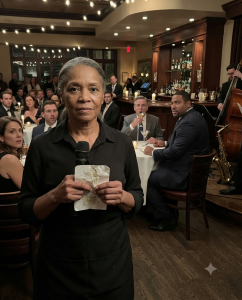
Crystal glasses gleamed under warm pendant lights. A jazz trio had just stepped away for a break. Investors in pressed jackets and women in silk blouses stood around polished tables, smiling over cocktails and congratulating one another on the success of The Cornerstone Kitchen, Clarkton’s newest upscale dining spot. At the center of it all stood Gary Fitch, broad-shouldered, tan, pleased with himself, the kind of developer who loved hearing his own name spoken with admiration.
No one in that room expected an elderly waitress in a black uniform to become the most dangerous person present.
But when Patsy Greer walked toward the microphone with an index card in her hand, one man at the bar recognized it instantly.
Martin Bell, attorney for Pinnacle Hospitality Group, had been in courtrooms, back offices, city meetings, and enough ugly property disputes to know when trouble had a face. He looked at the worn card in Patsy’s hand and went still in a way that looked almost unnatural. His bourbon stopped halfway to his mouth. The color drained from his cheeks so quickly it was visible from across the room.
Because he knew that card.
He knew exactly what he’d written on it.
And he knew, in one sickening flash, that he had made the kind of mistake arrogant men only make when they’re sure no one in the room matters enough to remember.
But that moment only made sense because of everything Patsy had survived to reach it.
For thirty-one years, Patsy Greer had belonged to the Bluebell Diner.
That was how people in Clarkton said it. Not that she worked there. Not that she helped run it. They said she belonged to it, and it belonged to her. The Bluebell sat on Route 9 just outside town, low and bright under a buzzing neon sign that flickered in the rain. The coffee was strong, the biscuits were dependable, and every Friday Patsy sold out of peach cobbler before dusk.
She had helped build the place with her then-husband, Dale Greer, back when they were still young enough to believe struggle was romantic. They got a loan they could barely afford, borrowed a used grill from a cousin in Murfreesboro, and poured every spare dollar into sheetrock, booths, flooring, and secondhand equipment.
Patsy painted the trim herself.
She stitched the curtains that hung in the windows.
She stood behind the counter while eight months pregnant, refilling coffee with swollen ankles.
Dale liked to tell people he had the vision, but the truth was simpler. Dale liked owning things. Patsy liked building them.
At first, that difference didn’t matter.
Then years passed.
The diner got busier. The money got better. Dale started treating the office like a private kingdom. He handled taxes, licenses, payroll, vendor accounts. Patsy trusted him because trust was cheaper than suspicion when you were working twelve-hour shifts. Whenever she asked to see papers, he’d wave her off. “You know I got it,” he would say, as if that were love instead of control.
By the time she realized how much of their life had shifted into his hands, the marriage was already souring.
There were no dramatic affairs that everyone in town whispered about. No shattered dishes. No police lights in the driveway. Their divorce came the quiet way, through contempt, silence, and the slow erosion of dignity. Dale had developed a habit of speaking to her like she was the hired help. He rolled his eyes when she asked questions. He mocked her for not understanding “the legal side” of the business. She got tired of being diminished in the place she had scrubbed, stocked, and held together for decades.
So she filed.
She believed, naively, that filing was the hard part.
The real betrayal came afterward.
It started with a call from a bookkeeper Patsy had known for years, a woman who sounded uneasy before she even got to the point.
“Patsy,” she said carefully, “when exactly did your name come off the property records?”
Patsy felt her stomach drop. “What are you talking about?”
There was a long pause.
Then came the sentence that split her world open.
Her name wasn’t on the deed anymore.
Not now. Not for months.
Dale had retitled the property eighteen months before the divorce filing, transferring ownership through paperwork that made it appear the diner had fallen under sole operational control connected to a revised business structure. It was the kind of bureaucratic trick ordinary people never imagine because they assume signatures and records are supposed to protect them.
Patsy sat at her kitchen table with the phone in her hand and felt something inside her go hollow.
By the time she understood what had happened, the Bluebell was already under contract with Pinnacle Hospitality Group.
Within weeks, the sale closed for $1.2 million.
Patsy got almost nothing.
No meaningful share. No real compensation for the business she’d spent three decades building. Just a legal mess wrapped in technical language and the humiliating realization that she had been tricked not only by her husband, but by a system that let him do it.
She drove to the diner the morning demolition started.
The excavator clawed through the roof like the building was rotten. Men in safety vests moved with efficient indifference. The sign came down before noon. By sunset, the counter was exposed to open air.
Patsy stayed in her car with both hands on the steering wheel.
She didn’t cry until they knocked down the wall where the old clock used to hang.
Over the next months, a new place rose from the lot.
Everything about it felt designed to insult memory.
The new name was The Cornerstone Kitchen, as though inventing a word like cornerstone made them builders instead of buyers. There were black-framed windows, exposed brick, imported light fixtures, artisan cocktails, and a menu full of tiny portions described with twenty-dollar vocabulary. The gravel lot where truckers had parked muddy semis became a valet circle lined with planters.
People in town called it progress.
Patsy called it what it was: a polished theft.
Then she did something no one expected.
She applied for a job.
The manager, Trevor Lang, glanced at her application with polite hesitation. He couldn’t have been more than twenty-eight. His collar was too tight, his smile too rehearsed. He said they were cultivating a certain atmosphere. He talked about brand energy and guest alignment and concepts Patsy found both silly and revealing.
She listened without flinching.
Then she said, “I’ve been feeding this town since before you had a driver’s license. You need a waitress or a mascot?”
Trevor blinked.
Patsy walked to the service station, lifted six plates at once without a tray, carried them the length of the room, and set them down without so much as a rattle.
Trevor hired her the next day.
From that point on, Patsy became the calm center of the restaurant.
She opened on Tuesdays. She worked brunch shifts with younger servers who forgot half their orders until Patsy quietly fixed the flow of the room before anyone noticed. She knew which regular wanted his eggs over-medium but would only say “same as usual.” She knew how to talk to cranky customers without inflaming them. She knew when to leave people alone and when to ask if they needed pie.
Even customers who had never been to the Bluebell found themselves requesting her section.
Gary Fitch loved to point at her when touring investors through the dining room.
“That’s the kind of staff continuity you can’t manufacture,” he once said, as though Patsy were a decorative feature he had thoughtfully preserved.
She smiled each time and kept moving.
What Gary didn’t know was that Patsy carried something in her apron pocket every single shift.
An index card.
Old. Folded. Grease-softened. Covered in tidy blue handwriting.
She touched it whenever the room got too loud inside her head.
Whenever someone praised Gary for transforming the property.
Whenever Trevor asked her to smile bigger or referred to the land beneath her feet as “our vision.”
Whenever she thought of Dale cashing that sale money while she tied on an apron and served cocktails under a roof built over the bones of her own life.
One evening after close, Donna Ramirez, another server, noticed Patsy pressing her hand to her pocket again.
Donna was a good-hearted woman in her forties with quick eyes and a quicker mouth. “All right,” she said, tossing a roll of silverware into the bin, “I have to ask. What’s in that apron? You touch it like a rosary.”
Patsy glanced down.
“Insurance,” she said.
Donna laughed, thinking it was a joke.
Patsy didn’t.
The truth traced back to one night during the divorce, before Patsy understood what she was hearing.
Dale had asked Martin Bell over to the house after close. Martin was already a well-known attorney around the county, especially in property and corporate matters. Patsy had made coffee and left the mugs on the kitchen table. Dale told her he needed “grown-up business talk” and asked her to give them some privacy.
She’d gone toward the pantry but stopped when she heard Martin say, in a low voice, “The timing matters. If the property is transferred before filing and recorded under sole operational control, she can be kept from claiming business equity she doesn’t know still exists.”
Patsy stood behind the pantry door, frozen.
Dale muttered something she couldn’t fully hear.
Then Martin said, “You need the paperwork clean and the correction request buried before anyone starts sniffing around.”
Patsy didn’t step back into the kitchen. She didn’t confront them. At that point she didn’t even understand the full legal meaning of what she had heard. She only knew, deep in her gut, that the men were discussing her as if she were an obstacle and not a wife.
When they left, she returned to clear the mugs.
Martin had left behind an index card beside his empty coffee cup.
On it, in careful blue handwriting, were the key points of what they had discussed. Not a full confession. Not a letter. But enough. More than enough, as it turned out, when paired with records and timing and the vanished paperwork Patsy would later begin piecing together.
She kept the card.
At first she kept it because it felt dangerous.
Then because it felt important.
Then because, once the diner was sold and demolished, it became the only thing she had that tied intent to action.
She started making calls quietly.
A retired title clerk she knew from church explained what records to request. A former county employee, embarrassed by what she’d heard about the Greer sale, hinted that there had once been a correction filing submitted regarding the Bluebell transfer. That filing had disappeared from the chain. Patsy paid a small fee for archival copies, then another fee for certified timestamps. She spent evenings at her kitchen table comparing dates, names, signatures, and recording logs.
The picture that emerged was ugly.
Dale had transferred the property into a structure designed to cut Patsy out shortly before the divorce.
A correction request challenging the transfer timing had indeed been submitted.
Then it vanished from processing.
The sign-off trail touched people who should never have been anywhere near it.
And Pinnacle’s attorney, Martin Bell, had knowledge so early and so specific that his role could no longer be brushed away as routine legal representation.
Patsy took everything she found to a lawyer in Nashville recommended by a cousin.
The woman, Andrea Sloane, was patient, sharp, and impossible to impress. She read the index card twice, then asked Patsy if she had any documentary support. Patsy slid over the filing records she’d collected. Andrea sat back in her chair and stared at the desk for a few long seconds.
“This,” Andrea finally said, tapping the card, “is not a guarantee.”
Patsy’s shoulders fell.
Then Andrea added, “But with the right paper trail, it is a door.”
For months, Andrea worked quietly. She verified signatures. Confirmed filing anomalies. Identified the missing correction sequence. The case grew teeth. But she also warned Patsy that men with money often moved faster behind closed doors than justice did in daylight.
So Patsy waited.
She waited while Andrea built enough to make a public denial dangerous.
She waited while Gary Fitch threw money into branding and expansion, unaware that his polished showpiece sat on a legal sinkhole.
Then Pinnacle announced the grand re-opening gala.
Gary wanted a full house. Press. Officials. Investors. Cameras.
Andrea called Patsy the moment she saw the event notice.
“That’s your stage,” she said.
Trevor, of course, thought Patsy’s request to say a few words was adorable.
A long-tenured staff member offering a welcome toast fit perfectly with Pinnacle’s fake love of local heritage. Gary approved it at a glance. Why wouldn’t he? Men like him never saw women like Patsy as a threat until it was too late.
The night of the gala, Cornerstone looked almost absurdly beautiful.
Candles glowed on every table. White lights traced the roofline. Servers floated between guests balancing trays of cocktails topped with rosemary sprigs. Gary laughed too loudly near the bar. The mayor posed for photographs near the host stand. Trevor straightened forks that had already been straightened.
Patsy moved through the room in black shoes and quiet purpose.
In her apron pocket, the index card rested against the second folded document she had decided to bring: the filing history Andrea said would matter the moment the first denial started.
At eight forty-five, the microphone came alive with a faint pop.
Trevor introduced Patsy with a sentimental smile. “One of our most beloved team members,” he said.
She walked to the front with the card in her hand.
At first, the crowd gave her the soft, distracted attention people give ceremonial remarks. They expected gratitude. Nostalgia. Maybe a sweet story about service and community.
Then Martin Bell saw the card.
The transformation in him was immediate and devastating.
Patsy watched the recognition hit him like a blow. He knew the handwriting because it was his. He knew what line was on the front. He knew, perhaps even before she did, how bad it would look if spoken aloud in a room full of witnesses.
Patsy reached the microphone.
“Before we toast new beginnings,” she said, her voice steady, “I thought it might be nice to read a little note tied to this property’s history.”
A few people smiled.
Gary raised his glass.
Martin set down his bourbon with a hand that had begun to shake.
Patsy looked straight at him and read from the card:
“If the property is transferred before filing and recorded under sole operational control, she can be kept from claiming business equity she doesn’t know still exists.”
Silence dropped over the room so fast it felt physical.
A woman near the center table whispered, “What?”
Gary turned, still smiling at first, waiting for context that would save him.
It didn’t come.
Patsy lifted her eyes from the card. “I made coffee the night this was written. Mr. Bell and my husband were in my kitchen discussing how to keep me from my share of the Bluebell Diner. They thought I was in the pantry. I wasn’t.”
Martin stepped forward. “This is out of context.”
Patsy didn’t flinch. “Then let’s add context.”
She unfolded the second document and laid it beside the card on the podium.
“This,” she said, “is the county filing history showing when a correction request was submitted on the Bluebell transfer. And this line here is where that request disappeared before processing. The authorization trail on that disappearance leads to the same office your firm contacted two days earlier.”
Now people were taking out their phones.
The local reporter from the Clarkton Ledger had already moved closer.
Gary’s expression had changed from confusion to fury, but it was the fury of a man who had just realized the fire was already visible from the road.
Martin reached the front then, voice low and urgent. “Patsy, stop.”
She turned toward him for the first time that night.
“No,” she said. “You built a restaurant on top of my life and expected me to carry plates across it forever.”
The room exhaled.
Someone in the back actually applauded once before thinking better of it.
Andrea Sloane, who had entered quietly through the side door ten minutes earlier, stepped forward from the rear of the room and identified herself in a calm, carrying voice. She stated that her client had preserved documentary evidence relevant to a forthcoming civil action involving fraudulent transfer, concealment of material ownership facts, and tortious interference tied to the Bluebell sale. She also noted, with lethal politeness, that any further public statements denying prior knowledge would be discoverable.
That was the moment Gary Fitch understood this was not a scene.
It was a detonation.
The mayor slipped away from the front.
The reporter started recording.
Trevor stood immobilized near the service station.
Donna looked at Patsy with tears in her eyes.
Martin Bell stopped trying to interrupt because the one thing good lawyers know is when not to deepen the crater.
The gala ended in pieces.
Investors left in angry clusters. Guests whispered by the doors. Gary disappeared into a private office with Martin and did not emerge for nearly forty minutes. By then, the reporter had already spoken to half a dozen witnesses and emailed her editor.
The story broke online before midnight.
By morning, Clarkton was on fire with it.
People who had mourned the Bluebell shared the article with vindicated rage. Former county employees began talking. One of them, seeing the coverage, contacted Andrea with records he had kept after feeling uneasy about the missing correction filing. Another admitted that pressure had been applied from outside the office to treat the Bluebell paperwork as “sensitive.”
Dale Greer stopped answering his phone.
Pinnacle’s investors panicked.
Within a week, emergency legal filings landed in court.
Martin Bell tried to argue that the note was informal attorney brainstorming taken out of context and that Pinnacle had relied in good faith on the apparent legality of the sale. But the timeline was brutal. The correction request. The vanished filing. Contact logs. Dale’s transfer maneuver. Martin’s presence in Patsy’s kitchen. The index card. The witness testimony from gala attendees who had seen his reaction before he could mask it.
Good faith became a very hard phrase to say with a straight face.
Gary Fitch turned on everyone.
He blamed Martin. Martin blamed Dale. Dale blamed the county office. The county office blamed incomplete records and “procedural anomalies.” Every man involved suddenly sounded helpless, which would have been more convincing if helplessness hadn’t arrived only after exposure.
The court battle lasted months.
It was messy, expensive, and humiliating for the people who had counted on Patsy giving up. The judge didn’t simply look at ownership percentages in isolation. He looked at fraudulent intent, concealment, unjust enrichment, and the chain of conduct that had deprived Patsy of her lawful claim.
In the end, the ruling did not magically rebuild the Bluebell.
Nothing could do that.
But the court found the transfer scheme had been structured to improperly strip Patsy of her equitable interest before divorce proceedings. The sale proceeds became subject to redistribution and damages. Additional sanctions followed once document suppression and improper handling of correction records were established.
Dale lost heavily.
Martin Bell’s reputation cracked in exactly the places he had spent decades polishing.
Pinnacle settled faster than Gary originally swore he ever would.
The Cornerstone Kitchen closed six months later.
The official explanation mentioned restructuring and unresolved litigation.
In Clarkton, no one bothered pretending not to know the truth.
For a while the building sat empty.
People drove by and pointed.
Then something strange happened.
A community fund started quietly. One of the truckers who had eaten at the Bluebell for twenty years mailed fifty dollars with a note that said, Bring back the pie. Others followed. A church group organized a dinner. Former customers contributed what they could. Patsy never asked for any of it, but the town had watched her be robbed in public and finally fight back in public, and some debts bothered people until they were answered.
A year later, on a smaller lot just off the old highway exit, Patsy opened a new place.
Not the Bluebell. She said there was only one Bluebell and it deserved to remain itself in memory.
She named the new diner Greer’s Table, because for the first time in her life, the name on the sign was hers without condition.
The building wasn’t large. The booths didn’t match perfectly. The coffee was still strong. On Fridays, she served peach cobbler until it sold out.
Near the register, framed behind glass, hung an old grease-softened index card.
Most customers never knew exactly what it was.
Those who did looked at it a little longer.
One afternoon, Donna came in for lunch and stood staring at the frame.
“You really kept it out here?” she asked.
Patsy wiped her hands on her apron and smiled. “Spent too long hiding it.”
Donna looked around the diner, full of conversation and clinking plates and the ordinary kind of life money can never fake. “Do you ever wish you’d burned them all to the ground?”
Patsy thought about Dale. About Martin Bell. About Gary Fitch in his expensive suit going pale under restaurant lighting. About the Bluebell reduced to rubble. About the years she lost.
Then she looked around at the room she’d built back with her own name over the door.
“No,” she said. “I wanted them to watch me get it back.”
That was the part people in Clarkton still argued about.
Some said Patsy was too generous for not pushing harder after she won. Some said Gary Fitch got off easy because money cushioned men like him from the kind of shame ordinary people carried for life. Some said Dale deserved worse than what the court gave him. They were probably right.
But others said the true punishment had already happened the night the truth found a microphone.
Because there is a particular humiliation in realizing the woman you underestimated was never defeated at all.
She was only waiting.
And maybe that was the red flag from the beginning. Not Dale’s temper. Not Gary’s vanity. Not Martin’s confidence in paperwork and private rooms.
Maybe it was the simple fact that each of them looked at Patsy Greer and saw someone too ordinary to be dangerous.
They were wrong.
And by the time they understood just how wrong, the card was already in her hand.