By the fifth apartment showing in ten days, Renee Harper had learned how to make her face go blank before someone could embarrass her.
At the first place, the landlord called an hour before the appointment and said the unit had just been taken. At the second, the manager smiled until she learned Renee had two children and then suddenly required a deposit large enough to cover half a year. At the third, a woman who had promised on the phone that the apartment was “perfect for a small family” looked at Malik and Tessa in the doorway and decided the rooms were probably too cramped after all.
The fourth was worse. The landlord had glanced at the pale strip on Renee’s finger where her wedding ring had once sat and asked whether the children’s father would be “showing up unexpectedly.” He had said it in a voice meant to sound practical and had failed.
Renee had smiled because she needed somewhere to live and had no energy left for pride.
That was the thing no one warned her about when a marriage ended badly. Not the paperwork, not the court dates, not the endless rearranging of money that was never enough anyway. It was the humiliation. The way grown adults looked at a woman with two children and saw risk instead of rent.
So when she parked outside the brick building on Weller Street with Malik in the back seat clutching his school folder and Tessa in her faded purple bunny backpack, she had already prepared herself not to hope.
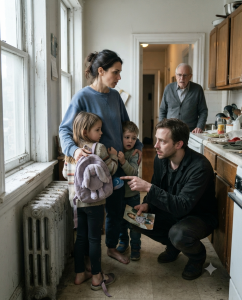
The building smelled like old heat and dust. The stairs creaked, but not alarmingly. The second-floor apartment had scuffed floors, a narrow galley kitchen, and sunlight pooling on the window ledges despite the cold day outside. There was a radiator that clicked and popped as if it had opinions, and a patch of wall by the door where hooks could hold coats.
It was small. It was plain. It was exactly the kind of place where a tired woman could imagine safety.
That was dangerous.
“Try not to touch anything,” Renee said quietly as Malik drifted toward the window.
He peered at the sill. “Could we put plants there?”
Her throat tightened. “Maybe.”
Mr. Hoffman, the landlord, was a thin old man with a hard mouth and a clipboard he consulted as if it were evidence against everyone. He looked at Malik, then at Tessa, then back at his paper.
“You said one child.”
“I said two,” Renee corrected.
He checked, frowned, and seemed irritated to find she was right. “So you did.”
There was contempt in those three words. Renee knew it well. The kind people offered when they believed rules should exist for women like her.
Before he could decide whether to reject her politely or cruelly, the apartment door opened and a younger man walked in carrying a toolbox.
He was tall, broad-shouldered, wearing work boots and a dark flannel shirt. He looked to be in his early thirties. Nothing about him was dramatic at first glance, but there was a stillness around him that made Renee think of rooms after funerals. He set down the toolbox and nodded toward the landlord.
“The sink in 2B is fixed.”
Mr. Hoffman gave the smallest nod. “My grandson, Daniel. He helps with the building.”
Daniel offered Renee a courteous glance, then looked at the kids. Something softened in his expression. He crouched in front of Tessa, careful not to crowd her.
“That’s a fierce-looking rabbit,” he said, pointing to the bunny face on the backpack.
Tessa narrowed her eyes. “She bites mean people.”
Daniel nodded seriously. “Then she’s very useful.”
Renee almost smiled.
Then Daniel’s gaze shifted to a frayed opening in the side seam of the bag.
Inside that tear, a tiny hand-sewn patch showed through the lining. Yellow thread. Blue crescent moon.
He went pale.
He reached toward it, stopped himself, and looked up at Renee. “Where did you get this backpack?”
The question wasn’t casual. It landed like an accusation and a plea at the same time.
Renee stiffened. “Why?”
Daniel didn’t answer immediately. “Where did you get it?”
Tessa answered for her. “It was in the car.”
Renee frowned. “Tessa.”
“The nice lady put it there,” Tessa added with perfect innocence.
Something cold slipped down Renee’s spine.
Two weeks earlier, after a long morning at family court, she had buckled the children into the car and found the backpack on the back seat. She had assumed it had been left by mistake by another child, or that one of the clerks had handed it through the open door while she was distracted. Malik said it wasn’t his. Tessa insisted “a lady” had given it to her. Renee had meant to sort it out later.
Later never came.
She washed the bag, filled it with snacks and crayons, and kept moving.
Now Daniel looked like the floor had opened beneath him.
“My wife made that patch,” he said quietly. “For our daughter.”
Mr. Hoffman’s head jerked toward him. “Danny—”
Daniel swallowed, and the next words broke on the way out. “Before they died.”
Renee felt Malik move closer against her side.
Daniel pulled out an old photo from his wallet. In it, a little girl with dark curls grinned at the camera. She wore the same purple bunny backpack. Same blue moon patch. Same frayed seam. Beside her stood a woman with a dark braid over one shoulder, one hand resting on the child’s shoulder.
Renee stared at the woman and felt the room tilt.
She knew that face.
Not personally. Not well. But she knew it.
Two weeks ago in the parking lot outside family court, Renee had seen that exact woman speaking to a court clerk near the side entrance. She remembered because the woman had looked toward Renee’s car and smiled at Tessa through the glass.
“That woman,” Renee said. “I saw her.”
Daniel stared at her. “Where?”
“Outside family court.”
Mr. Hoffman’s hand tightened on the back of a chair. “That’s impossible.”
Daniel’s face changed. “My wife and daughter died three years ago.”
The radiator ticked in the silence.
Renee looked again at the photo. It was the same woman. Same braid, same calm face, same soft coat. No doubt.
“I saw her,” Renee repeated. “She was talking to the clerk. I went back inside because I forgot a folder at security. When I came out, she was near my car.”
Daniel took one step closer. “Was the clerk Sandra Pike?”
Renee nodded.
Daniel shut his eyes for a moment. “She handled all the paperwork after the accident,” he said.
The word accident sounded wrong. Thin. Practiced.
Renee heard it. So did he.
“How did they die?” she asked.
Mr. Hoffman snapped, “That is not your concern.”
Renee met his stare. “Your dead family’s daughter’s backpack ended up in my car after I saw his dead wife with a court clerk. That made it my concern.”
The old man said nothing.
Daniel looked at Tessa. “May I see the bag?”
Tessa looked up at her mother. Renee hesitated, then nodded.
Daniel took the backpack gently and turned it over in his hands. He pressed his fingers inside the torn seam, deeper than the patch, and suddenly stopped. Very carefully, he pinched something hidden in the lining and pulled out a tiny folded square wrapped in tape.
He unfolded it with shaking hands.
There were only a few lines in faded blue ink.
Daniel read them once and went white.
“What does it say?” Renee asked.
He swallowed. “It says, ‘If Sandra ever comes near another mother in court, call the number on the back and do not trust anyone who says my daughter’s grave was sealed because of rain. She was never buried with this bag because she was never in that coffin when they closed it.’”
His voice failed on the final line.
Mr. Hoffman lunged for the note. Daniel yanked it back.
“You knew,” Daniel said.
The old man staggered a step. “I knew there were things that didn’t make sense. Sandra told us the hospital made mistakes. She said the body was damaged. She said a closed casket was best. She said your wife’s sister signed off on everything.”
Daniel stared at him with horror. “And you let me bury them.”
“I let you survive,” Mr. Hoffman shot back, then looked like he regretted saying it.
Renee took the note. On the back was a phone number and six words beneath it.
Don’t call from your own phone.
Before anyone could speak, Malik tugged her sleeve and pointed toward the apartment door.
A woman stood in the hall.
Dark braid. Gray coat. One hand lifted in warning.
Renee spun. Daniel rushed to the doorway.
The hall was empty.
But on the floor just beyond the threshold lay an old motel key card. In black marker, someone had written:
She took the wrong child first.
Daniel grabbed the card with trembling fingers. The motel name was from the edge of town, a place Renee had driven past a hundred times without seeing it. The room number was 214.
Mr. Hoffman said, “No police.”
Daniel rounded on him. “No?”
“If Sandra is involved,” the old man said, voice suddenly low and urgent, “then you do not know who else is.”
Renee should have left. She knew that. She should have taken Malik and Tessa, driven to her sister’s house, and forgotten every impossible thing that had happened in that apartment.
Instead she heard herself say, “There’s a pay phone at the laundromat two blocks over.”
That was how, twenty minutes later, with her children sitting beside her in the back of her car and Daniel standing in the cold outside the laundromat, she dialed the number from the note.
A man answered on the second ring.
“I was wondering when that bag would turn up,” he said.
Renee nearly dropped the receiver. “Who is this?”
“My name is Elias Voss. If you found the note, then Mara got to you before Sandra did.”
Daniel went rigid at the name. “Mara” was his wife.
Renee tightened her grip on the phone. “Daniel’s wife is dead.”
There was a pause. “That is what Sandra wanted him to believe.”
The laundromat fluorescent lights buzzed above them. Through the window, Renee could see Malik watching her with solemn eyes while Tessa hugged the bunny backpack to her chest.
“What are you talking about?” Daniel demanded.
Elias’s voice was rough with age and fatigue. “Three years ago, your wife discovered that Sandra Pike was moving women and children through a fake legal assistance network tied to family court referrals. Women in custody fights. Women with no support. Women easy to isolate. Some were told they were being moved to safe housing. Some vanished. Some had their names changed in emergency filings. Children were reassigned to relatives or foster placements under fraudulent paperwork. Sandra knew how to hide it because she controlled the documents.”
Renee felt ill.
“My wife found this out?” Daniel asked.
“She found a child who had been listed dead but was alive under another name,” Elias said. “When she pushed, Sandra came after her. Mara contacted me because I used to investigate probate and guardianship fraud. We were building a case. Then there was the crash.”
Daniel pressed a fist to his mouth.
“It wasn’t an accident?” Renee asked.
“No. But the goal wasn’t to kill Mara. It was to take her daughter.”
The words from the motel card slammed back into Renee’s head.
She took the wrong child first.
Elias continued, “Mara had suspected Sandra might use the funeral process to cover what she’d done. That’s why she hid the note in the backpack. She sewed that patch as an identifier. If the bag surfaced, it meant the burial had been staged.”
Daniel looked as though each sentence was tearing away something he had depended on to stay sane.
“If my daughter wasn’t in that coffin,” he said, voice hollow, “where is she?”
“I think Sandra placed her under another identity,” Elias said. “And I think Mara stayed alive long enough to keep searching.”
Renee’s breath caught. “The woman in the parking lot.”
“Yes,” Elias said. “If she approached your child, it was because she trusted you or was desperate. Sandra watches the mothers who come through court. Mara was probably trying to warn one before Sandra reached her.”
“Why me?” Renee whispered.
“Because you were being targeted,” he said.
Everything inside her went cold.
“By who?”
“By Sandra,” Elias replied. “Your case file was flagged. Emergency relocation. Fast housing referral. Guardianship review. It’s an old pattern. Mothers under pressure are easiest to separate from their children.”
Renee gripped the metal shelf under the phone so hard her hand hurt.
She thought of Sandra’s kind clerk smile. The extra forms. The strange insistence that Renee might qualify for temporary placement while she “stabilized.”
Daniel took the receiver. “Where do we go?”
“Room 214,” Elias said. “If Mara left the key card herself, she wanted you there before Sandra cleaned it out. And Daniel—don’t trust the sister.”
Daniel froze. “Lena?”
“She signed papers she had no right to sign.”
The motel smelled like stale smoke and old carpet. Renee kept the children locked in the car with the doors secured while Daniel and Mr. Hoffman went up first. Then Daniel called down, voice shaking, and said, “Renee. You need to see this.”
Inside room 214, taped beneath the desk drawer, they found an envelope. Inside were copies of court transfer forms, altered death reports, photographs of children at different ages with different names scrawled beneath them, and one recent photo that made Daniel sit down hard on the bed.
A girl of about seven stood outside a small church in another county, holding a stuffed rabbit.
Dark curls.
Daniel’s eyes.
Mara’s smile.
His daughter.
Alive.
On the back of the photo, Mara had written: Lily now called Grace. Placed with Sandra’s cousin. St. Jude’s outreach house, Bellmere. If I don’t make it back, tell Daniel I never stopped.
There was also one more note, this one addressed directly to him.
Danny,
If this reaches you, it means I ran out of time. I let them think I was broken after the crash. I let Sandra believe I believed the burial lie. I stayed close so I could follow where she moved our daughter. I tried to come back sooner. I am so sorry. Please don’t let Lily think I left her. Don’t let my father-in-law bury the truth because it hurts less. And if Renee is with you, trust her. Sandra had already marked her.
Daniel cried without sound.
Mr. Hoffman sat on the edge of the chair, old and suddenly small. “I didn’t know,” he said hoarsely. “I knew there were lies, but not this.”
“Not knowing enough was still a choice,” Renee said, and he nodded because there was nothing else he could do.
This time they did call the police—but not locally. Elias gave them the number of a state investigator he trusted. By midnight, Bellmere deputies and state agents were moving toward the outreach house while Sandra Pike’s apartment was being searched.
Sandra tried to run.
She was arrested at a gas station forty miles away with case files, cash, forged guardianship documents, and two phones full of names.
Lena, Daniel’s sister-in-law, had helped sign false paperwork in exchange for money and lies about “protective placement.” She claimed she believed Lily would be safer elsewhere after the crash, but the records told a darker story. She had known far more than she admitted.
And Mara?
They found her the next morning at a church shelter outside Bellmere.
Alive.
Thin, bruised, exhausted, and furious that she had been caught before she could bring Lily out herself.
When Daniel saw her across the shelter hall, he stopped as if his body no longer understood motion. She looked older than in the photograph, worn down by fear and pursuit, but unmistakably herself.
For one second neither of them moved.
Then Mara crossed the distance between them and put both hands over his face like she needed to prove bone and skin were real.
“I’m sorry,” she said, crying now. “I’m sorry I let you think—”
He pulled her against him before she could finish.
Renee turned away, suddenly aware that some reunions were too private to witness, even when you had accidentally become part of them.
Lily was found two hours later at the outreach house under the name Grace. She had been told her parents were dead and she was lucky to have been “chosen” by people who wanted her. She remembered the bunny backpack. She remembered the patch. She remembered her mother singing while sewing it. When Daniel knelt in front of her and said, “Your name is Lily, and I’m your dad,” she stared at him for a long time.
Then she touched his beard and whispered, “You got older.”
He laughed and sobbed at the same time.
Renee got the apartment.
Mr. Hoffman offered it without deposit, without another question, without pretending generosity erased anything. Renee accepted because she needed a home, and because some practical decisions had nothing to do with emotional neatness.
Weeks later, the kitchen held cereal boxes and homework and a stubborn spider plant Malik swore would survive anywhere. Tessa still wore the bunny backpack sometimes, though Lily had outgrown it and insisted Tessa keep it because “it already knows her.”
Sandra Pike’s case grew larger by the month. More names. More altered filings. More mothers who had been cornered at exactly the worst moment of their lives and told someone else knew what was best for their children.
Renee testified.
So did Mara.
Daniel never quite stopped looking at his daughter as if she might disappear if he blinked too long, but slowly the look changed from terror to gratitude.
Sometimes, after the children were asleep, Renee stood by the apartment window and thought about that first day. About how close she had come to walking out. About how many impossible truths can hide inside ordinary objects. A backpack. A patch. A note folded small enough to disappear into a seam.
She also thought about red flags. Not the dramatic kind. The quiet ones. The helpful clerk who knew too much. The paperwork rushed through because a mother looked tired enough not to argue. The people who called control protection and expected everyone to thank them for it.
Who was right? Who was wrong? That part no longer felt simple. Mr. Hoffman had failed his grandson by wanting a grief he could survive instead of a truth that would destroy him first. Mara had chosen silence to save her child, even though it broke the man she loved. Renee had stepped into something dangerous because leaving would have been easier and living with that might have been worse.
But one thing remained painfully clear.
The biggest warning had never been the ghost story feeling of a dead child’s backpack showing up in the wrong car.
It was how believable it had seemed that a struggling mother could lose her children in plain sight—and no one would question it until it was almost too late.