The single father thought his daughter was just nervous about the new school.
That was how Tyler Brennan explained everything these days—through harmless reasons, manageable reasons, reasons that fit inside ordinary life. Sadie was quiet because she was shy. He was tired because he worked too much. Their apartment felt temporary because all apartments did. The ache in the middle of his chest was grief, and grief was something people survived by outlasting one hour at a time.
So when he parked outside Westfield Elementary on a gray Monday morning and looked at his seven-year-old daughter frozen in the passenger seat, he told himself this was normal too.
First-day nerves.
Nothing more.
“Hey,” he said softly, leaning toward her. “You don’t have to love it today. You just have to get through today.”
Sadie nodded, but barely. Her hands were wrapped around the stuffed fox she still carried everywhere unfamiliar. Marissa had given it to her on Sadie’s fifth birthday, back when birthdays still meant balloons and homemade cake and music in the kitchen instead of carefully managed memories Tyler tried not to disturb.
Tyler climbed out, walked around, and opened Sadie’s door. She let him take her hand, and together they crossed the parking lot toward the front office.
He had already done the practical math a hundred times. This school was closer to their new apartment. The district transfer had gone through. The aftercare program was cheaper. The bus route would help once Sadie settled in. It was the right decision.
Still, the building felt like a betrayal of the life they used to have.
A different neighborhood.
Different teachers.
Different walls.
Another place where no one knew Marissa’s name.
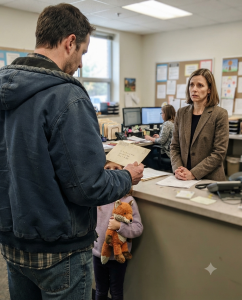
Inside the office, the secretary gave them a bright smile and a clipboard.
“We’ll just have Ms. Palmer come down to meet Sadie.”
Tyler thanked her and started filling out the last page of enrollment paperwork. Emergency contact. Pick-up permissions. Medical notes. He had written those details so many times since Marissa died that the act felt mechanical, almost cruel. Father. Sole guardian. Mother deceased.
He handed the clipboard back.
Sadie had moved closer to him now, pressing herself against his side. Tyler rubbed her shoulder.
“She’s nice,” he said. “It’s just the counselor. She’ll show you around.”
He said it like he knew. Like he believed adults with warm voices could still be trusted without question.
Then the office door opened and a woman stepped in.
Mid-thirties, maybe. Brown blazer. Dark hair pulled neatly back. Smart, attentive eyes. She moved with the calm efficiency of someone used to nervous children and overwhelmed parents.
“Hi,” she said. “I’m Rebecca Palmer. You must be Sadie.”
Sadie looked up.
And went rigid.
Tyler felt it immediately. Her body locked. Her fingers dug into his palm. He looked down, then back up, and saw something small but unmistakable on the counselor’s face.
A pause.
Not confusion. Recognition.
For one bizarre second, Tyler thought maybe Sadie had seen her somewhere around town. At the grocery store. At the apartment complex. At a bus stop.
Then Sadie whispered, “That’s the lady who came to our house after Mommy died.”
The words were so soft Tyler almost missed them.
But Rebecca didn’t.
The secretary didn’t.
And neither did the silence that swallowed the room.
Tyler crouched beside his daughter. “What did you say, sweetheart?”
Sadie’s eyes never left the woman standing three feet away. “She was there. In the kitchen with Grandma.”
Tyler stood slowly.
“No,” he said before he even meant to speak. “No, that’s not right.”
Rebecca had gone pale.
Tyler’s mind moved through that night in hard flashes. Marissa’s last breath. The hospice nurse. The phone calls. His mother-in-law crying in the hallway. His own mother arriving later than he expected and taking over with the ruthless competence she always used when emotions made other people weak. Dishes stacked in the sink. Condolence trays on the counter. Someone making coffee nobody drank.
But this woman?
No.
He would have remembered.
Then Sadie added, “She had Mommy’s yellow mug.”
Tyler felt the blood drain from his face.
There had been a yellow mug. Chipped near the handle. Tiny white flowers printed along one side. Marissa always reached for it first. Her mother had used it that night because every other dish seemed dirty, and nobody had the heart to clean anything.
Tyler had never told Sadie that detail.
He hadn’t told anyone.
He turned to the counselor. “Have we met?”
Rebecca inhaled carefully. “Mr. Brennan, I think we should talk privately.”
“No,” Tyler said.
His voice came out so sharply the secretary pretended to organize papers she wasn’t reading.
Rebecca glanced at Sadie, and when she looked back at Tyler, the professional expression on her face had cracked open into something older. More vulnerable. More dangerous.
“I did come to your house,” she said.
“Why?”
“Because your wife asked me to.”
Tyler stared at her.
The sentence made no sense. Marissa had been dying then. By those final weeks, every conversation had centered around medication, hospice schedules, insurance calls, and the impossible chore of pretending in front of Sadie that any of it might still turn around.
“Asked you when?”
“Two weeks before she died.”
Tyler’s heart pounded so loudly he could hear it.
“What are you talking about?”
Instead of answering, Rebecca reached into the folder she was carrying and pulled out a sealed envelope.
His name was written across the front in Marissa’s unmistakable handwriting.
Tyler stopped moving.
The world narrowed to that envelope.
He knew every detail of Marissa’s handwriting. The slight leftward slant. The loop on the capital T. The way she made the final n in Brennan trail just a little too far.
“This is some kind of mistake,” he said, but the words felt weak even to him.
Rebecca held the envelope out. “She gave it to me the day I came to your house.”
Tyler didn’t take it immediately.
“Why would my wife give a stranger a letter for me?”
“I wasn’t a stranger to her,” Rebecca said quietly. “I was her counselor.”
That stunned him into taking the envelope.
“A school counselor?”
“No. Before that. I worked at the cancer support center where she was referred during treatment.”
Tyler frowned. Marissa had attended one support group early on, but she stopped mentioning it after a few weeks. He’d assumed it hadn’t helped.
Rebecca continued, “She asked me not to deliver the letter unless Sadie recognized me first.”
Tyler looked up sharply. “What?”
“She said that if Sadie remembered me, then you’d know I’d really been there.”
That didn’t sound like Marissa. She hated theatrics. Hated secrets. Hated anything that smelled like manipulation.
But then again, Tyler realized with a creeping sense of shame, the final months of her life contained long stretches he barely understood. He had been exhausted, angry at the disease, drowning in practical tasks. He had listened, but not always carefully. Comforted, but not always well. There were whole emotional territories inside Marissa’s final months he may never have entered.
With unsteady fingers, he broke the seal.
The first line hit him like a blow.
If Sadie is the one who remembered Rebecca, it means I was right to be afraid.
Tyler read it twice before the words settled into meaning.
He kept going.
Marissa’s letter was written in tense, compressed paragraphs—nothing like her normal notes or grocery lists or birthday cards. It read like someone fighting time. Someone trying to leave behind enough truth to matter, but not enough certainty to accuse without proof.
She wrote that during her final month she had overheard a conversation outside her bedroom door. She had been awake, though everyone assumed she was asleep. Two people had been discussing her life insurance policy, the timing of paperwork, and whether Tyler “would notice if things were simplified now instead of later.”
Tyler stopped there, nausea rising.
One of the voices, Marissa wrote, belonged to his mother.
The second she wasn’t fully certain of, but she believed it was a family friend named Alan Cross, an insurance broker Tyler’s mother had trusted for years.
Marissa wrote that when she questioned Tyler’s mother about missing documents a few days later, his mother smiled and said the medication was making her paranoid. Then she kissed Marissa’s forehead and told her to rest.
Tyler’s hands tightened on the page.
He could picture his mother doing exactly that. Calm. Efficient. Gentle in a way that always made disagreement feel childish.
The letter went on.
Marissa had started checking files when she was alone. She discovered copies missing from their home binder—policy summaries, beneficiary updates, a statement she specifically remembered printing. She didn’t know whether she had misplaced them, whether Tyler had moved them, or whether someone had taken them while helping around the house.
Then came the line that changed the air around him.
Check the storage unit key taped under Sadie’s dresser if anything happens to me.
Tyler’s stomach dropped.
They had sold Sadie’s old dresser during the move six months earlier.
He read the rest anyway.
Marissa explained that she rented a small storage unit without telling anyone because she needed a place to keep duplicate records and one audio file she didn’t trust leaving in the house. She wrote that she felt ridiculous even doing it. Dramatic. Suspicious. Mean. But she also wrote that every time she tried to let the feeling go, someone said something that made her skin prickle.
If your mother says I was confused at the end, do not believe her.
Tyler lowered the paper.
His vision had gone unfocused.
Rebecca stood a few feet away, watching him with an expression that mixed regret and patience.
“You kept this for eighteen months?” he asked.
“She asked me to,” Rebecca said. “She told me grief would make you defend the people closest to you first. She said if I brought it immediately, you’d think I was exploiting a tragedy or confusing therapy boundaries.”
“And if Sadie hadn’t recognized you?”
Rebecca hesitated. “Then I still would’ve found a way eventually. But she was very clear about wanting one thing she considered impossible to fake.”
Tyler looked down at the letter again. Marissa had underlined one final sentence near the bottom.
If I’m wrong, burn this and forgive me.
That hurt most of all.
Because it sounded exactly like her.
He folded the page and took Sadie out to the truck.
Once they were inside with the doors shut, the world became quiet enough for panic to breathe. Sadie sat buckled in, fox in her lap, watching him with frightened eyes.
“Is Mommy mad?” she asked.
Tyler swallowed hard. “No, baby. She’s not mad.”
He didn’t know what else to say.
His phone buzzed on the center console.
Mom.
He let it ring.
Then another call came.
Then a text.
Did Sadie get settled in? Call me.
A second text arrived seconds later.
And Tyler, if anyone from Marissa’s past tries to contact you, talk to me first.
Tyler stared at the screen.
Rebecca appeared in the office doorway behind the truck, visible through the windshield.
He got out and crossed back toward her.
“Tell me everything,” he said.
They sat in a vacant conference room while a classroom aide stayed with Sadie in the office. Rebecca explained that Marissa first came to the support center for counseling after chemo stopped working. Most patients wanted help processing fear. Some wanted to talk about family. Some wanted to talk about unfinished things. Marissa, she said, initially spent three sessions pretending she only wanted tips on how to help her daughter cope.
“Then one day,” Rebecca said, “she asked me a question about financial abuse.”
Tyler stared.
Rebecca continued carefully. “She didn’t accuse anyone outright. At first she described it in hypotheticals. A spouse under medication. A family member stepping in to help. Important papers being moved. Signatures on things she didn’t remember authorizing. Then she asked what someone could do if they were too sick to untangle it in time.”
Tyler felt sick.
“Why didn’t you call the police?”
“Because she didn’t have enough. And because the person she was most afraid of wasn’t you.”
He looked up.
“She was afraid if she accused your mother and she was wrong, she’d destroy your relationship with the only parent you had left. But she was even more afraid she wasn’t wrong.”
Rebecca told him about the final visit to the house. Marissa had asked her to come under the pretense of dropping off paperwork from the support center. Tyler had been upstairs with Sadie. Rebecca met Marissa in the kitchen. Marissa handed her the sealed letter, a copy of a storage unit receipt, and the details of where the hidden key would be.
“But I lost the receipt,” Rebecca said, pain flickering across her face. “My apartment was broken into months later. Most of my personal files were scattered. I still had the letter because I’d moved it to a lockbox. But the copy with the unit number was gone.”
Tyler rubbed a hand over his mouth. “So even if the key exists, we don’t know where it goes.”
“I might know where to start,” Rebecca said. “Marissa mentioned the storage place was close enough to reach in a short cab ride from your old apartment.”
That gave them three possible facilities.
Tyler left school with Sadie before noon.
He drove first to his mother’s house because anger made him reckless. But when he pulled into her driveway, he saw Alan Cross’s car parked outside.
He didn’t go in.
Instead he backed out and drove away before either of them saw him.
At the first storage facility, no record. Same with the second. At the third, a woman behind the counter typed in Marissa’s name, paused, then looked up.
“There is a unit,” she said slowly. “It’s in arrears.”
Tyler’s pulse jumped. “Can I access it?”
“Do you have ID and proof of death or next-of-kin documentation?”
He had both in the truck because life after Marissa had turned him into the kind of man who carried folders for grief.
An hour later he was standing in front of a narrow metal door under fluorescent lights that buzzed too loudly overhead.
His hands shook as he slid the lock open.
Inside were three banker boxes, one small plastic tote, and a sealed manila envelope taped to the top box.
For Tyler.
He closed his eyes for one second before reaching for it.
Inside was a flash drive and a second handwritten note.
Tyler, if you found this, it means I ran out of time.
There were copies of insurance documents in the boxes. Original policy papers. Bank statements. Printed emails. One beneficiary update form Tyler had never seen in his life—apparently drafted but not finalized, moving a percentage of the payout into a trust administered temporarily by his mother “for efficiency during minor child adjustment.”
His chest tightened.
He had never signed off on that.
Neither had Marissa.
The signature line on her section looked almost right.
Almost.
Rebecca, who had driven separately after school and met him there, stood beside him in silence while he dug through the files.
Then he found the flash drive.
They took it to Tyler’s truck and plugged it into his old laptop.
The audio file was only four minutes long.
At first there was static and movement, like the phone had been placed down in a drawer or pocket. Then voices.
His mother’s came first.
“Tyler can barely think straight as it is.”
Alan replied, “Then all the better to streamline now while she’s still technically able to sign.”
Marissa’s breathing was audible somewhere close to the microphone.
His mother again, lower this time. “She doesn’t need every detail. She needs peace.”
Then Alan said the sentence Tyler would hear in his sleep for the rest of his life.
“If the trust is in place before she passes, he won’t question it until much later.”
Tyler stopped the recording.
He stared at the dashboard, unable to feel his hands.
Rebecca didn’t speak.
Neither did he.
Everything in his body was ice and fire at once. Shock, rage, humiliation, grief—each feeling rising over the others and collapsing back down. He had defended his mother to Marissa more than once in those final months. Told Marissa she was reading too much into things. Told her his mother was only trying to help.
Now he understood why Marissa’s eyes had looked so tired in those last weeks.
She had been dying while also trying to protect him from something he refused to see.
Tyler called a lawyer before he called anyone else.
By evening, he had emailed copies of every document and the recording to the attorney Rebecca recommended from the support center’s referral list. The lawyer advised him not to confront his mother alone, not to destroy anything, and not to discuss the evidence until emergency motions could be filed regarding policy records and attempted fraud.
But Tyler did confront her—just not alone.
Two days later, in the lawyer’s office, his mother sat across from him in a cream sweater, looking offended more than frightened. Alan Cross was there too, sweating through his collar.
At first his mother denied everything. Then she shifted to minimizing.
“We were trying to protect the money from Tyler’s inexperience.”
“You forged my wife’s signature,” Tyler said.
“No,” she snapped. “Alan prepared options. Nothing was finalized.”
The lawyer slid the printed form across the table. Then the audio transcript. Then the call logs showing repeated contact between her and Alan during Marissa’s final week.
His mother’s composure finally cracked.
“Your wife was suspicious of everything,” she said. “She was sick. She was emotional.”
Tyler leaned forward. “She was right.”
The room went very still.
Alan started blaming everyone else within minutes. Claimed the trust change was exploratory. Claimed no funds were ultimately diverted because Marissa died before final processing. Claimed his wording on the call was mischaracterized.
It didn’t matter.
There was enough for the insurer to launch an internal investigation. Enough for the licensing board to review Alan’s conduct. Enough for Tyler to understand that whether the theft had fully succeeded or merely begun, the betrayal was real.
His mother cried only once—when she realized Tyler was not coming home with her.
He cut contact that week.
The insurance company later confirmed that while the original payout structure had remained legally intact, multiple irregular attempts had been made to alter administrative control over portions designated for Sadie. Because Marissa had flagged earlier paperwork and because final execution requirements were incomplete, the changes never fully took effect.
In other words, Marissa had stopped it.
Even dying, she had stopped it.
Months passed before the legal dust settled. Alan lost his license. His mother, though not criminally convicted on the available evidence, became a person Tyler no longer recognized in any useful sense of the word. Family members split into factions. Some insisted she had only made panicked choices. Others stopped speaking to Tyler entirely after he refused to “keep it private.”
Rebecca remained in their lives, though carefully and appropriately. Sadie saw her at school. Tyler saw her sometimes during parent meetings or hallway check-ins. Their conversations were never dramatic. They didn’t need to be. Both knew their connection had been forged in one dead woman’s last act of protection.
One spring afternoon, almost a year after that first day at the new school, Sadie came home with a family-tree assignment and asked if Grandma should still go on it.
Tyler looked at the paper for a long time.
Finally he said, “You can write the truth.”
Sadie frowned. “What truth?”
He thought about Marissa in that kitchen, frightened and exhausted and still planning ahead. He thought about the letter, the hidden key, the recording, the way she had known he might not be ready to hear her while she was alive but had trusted that one day he would be forced to.
“The truth,” he said slowly, “is that loving someone doesn’t always mean they were safe.”
Sadie nodded as if that made more sense to children than adults ever admit.
That night, after she went to bed, Tyler opened the box where he kept Marissa’s letter and read it again.
The final line still undid him.
If I’m wrong, burn this and forgive me.
She had been wrong about one thing only.
There was nothing to forgive.
But there was a question he doubted would ever leave him, no matter how many years passed or how carefully he rebuilt the shape of their life:
What hurt more—that Marissa had to uncover the betrayal while she was dying, or that Tyler had been standing close enough to the truth all along and still failed to see it?