Hannah never wanted to come to the grief group in the first place.
The museum’s family support program had been recommended three separate times by three separate professionals, all of whom used the same careful tone that made her want to leave the room. Her son needed community, they said. He needed language for loss. He needed a safe place to express what he was feeling.
Hannah thought what her six-year-old needed was his father back.
Everything else felt like a cheap substitute wrapped in therapeutic vocabulary.
Still, she came, because she was running out of ways to pretend Noah was adjusting.
At first it had been the normal things people warned her about after a death. Nightmares. Clinginess. Sudden tears over tiny disappointments. The kind of grief that leaks out sideways because children don’t know how to carry it head-on.
Then it shifted into something stranger.
Noah started waking at two or three in the morning and padding into her room to ask questions no child should have to ask.
Do dead people know what time it is?
Can they miss us, or does missing stop after you die?
If Dad can see me, why doesn’t he answer?
He spoke into vents, closets, and the narrow space behind the curtains. Not dramatically. Not as if he were playing. He spoke with the polite patience of someone waiting for a shy person to finish thinking.
Once, when Hannah asked who he was talking to, he said, “Nobody yet.”
That one stayed with her.
So on a gray Thursday afternoon, she drove to the museum’s education wing and followed paper signs with pastel arrows toward the family bereavement room.
The room was somehow worse than she’d imagined.
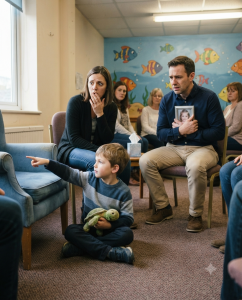
Someone had tried to make it comforting and in doing so had made it unbearable. Bright beanbags. Shelves of emotion-themed books. Tissue boxes displayed like décor. Hand-painted stars stretching across one wall. A smiling laminated chart titled BIG FEELINGS, as if sorrow belonged in a preschool curriculum.
Hannah nearly turned around then and there.
But Noah was already inside, clutching his stuffed turtle and looking around with the solemn curiosity he reserved for doctors’ offices, churches, and any place where adults whispered.
She signed in and sat.
There were only a few other families. A grandmother with trembling hands. A teenage girl with red-rimmed eyes leaning against her father’s shoulder. A silent boy in a hoodie with his knees pulled to his chest.
And then there was the man across the circle.
He sat alone, back straight, both hands wrapped around a photo frame turned facedown in his lap. He was probably close to forty. Neat beard. Sweater too good for a weekday therapy group. The kind of tired face that would have looked handsome if it weren’t held together by discipline.
His nametag read GRAHAM.
Hannah noticed him because he kept glancing at Noah.
Not in a rude way. Not because Noah was misbehaving. It was something more wounded than that, like every look cost him something.
The facilitator, a woman named Elise, welcomed everyone in a voice soft enough to disappear into the carpet. She opened with the usual introductions and reminded the children that feelings could be shared in many forms—speaking, drawing, silence, even movement.
Hannah wanted to laugh at that. Grief as interpretive dance.
The first twenty minutes went exactly as she feared.
Adults spoke in edited versions of the truth. A grandmother missed hearing the hallway floorboards creak under her husband’s steps. The teenage girl missed the smell of her mother’s shampoo. The boy in the hoodie said nothing at all and kept shredding the corner of a worksheet.
When it was Hannah’s turn, she said, “My husband died eighteen months ago. My son has been having a hard time sleeping.”
A clean sentence. Neat. Almost respectable.
It did not contain the full ugliness. That she still bought her husband’s cereal by mistake. That she avoided parking near the soccer field where he used to coach. That she wore mascara to pickup so people would stop speaking to her with pity.
When Noah’s turn came, he sat cross-legged on the carpet and said, “My dad is in the stars, but not really, because stars are gas.”
A few people smiled.
Elise smiled too. “That’s very thoughtful.”
Noah nodded as if he knew that. Then he added, “I don’t like nighttime because the girl comes then.”
Hannah’s entire body tensed.
She had not heard him mention a girl before.
Elise remained calm. “What girl, Noah?”
He looked around the room with slight surprise. “The sad one.”
The man across from them went still.
Hannah saw it happen before anyone else did. The minute freezing of his shoulders. The way his fingers clamped down on the frame in his lap.
Noah went on. “She says she lost her shoes. And she wants her dad to stop sleeping in the chair.”
The silence changed shape.
That was the only way Hannah could explain it later. It stopped being group silence and became something else entirely—recognition, dread, collision.
Elise looked toward Hannah. “Has Noah talked about this before?”
“Kids say strange things,” Hannah replied, trying to sound lighter than she felt.
“No.” Noah frowned. “It’s not strange. She showed me the room.”
The man rose so fast his chair scraped violently across the floor.
Everyone turned.
He looked horrified by his own outburst, but he couldn’t seem to stop the question from coming.
“What room?”
“Elise,” Hannah began, but Noah was already pointing.
“The one with fish on the wall,” he said. “And the bad blue chair.”
Every eye in the room went to the painted fish near the reading nook. To the ugly blue chair by the window.
“This room,” Noah said.
The man sat down again slowly, as if his body no longer trusted itself.
“My daughter died in this room,” he said.
No one knew what to do with that.
Elise closed her eyes briefly. Hannah stared at him, waiting for some explanation that would pull the moment back into ordinary life.
Instead, he continued.
“There was a sibling support event here,” he said, his voice turning rough. “Two years ago. I brought both my children. My son went with one group. My daughter stayed here while I filled out paperwork. She had an allergic reaction. We had an EpiPen. The staff called emergency services. I thought…” His face tightened. “I thought there was time.”
Noah looked at him with a sympathy so naked it made Hannah’s throat ache.
“She says you still sleep in her room,” Noah said softly. “Because if you sleep in your room, it means she’s really gone.”
The man—Graham—went white.
There was no way Noah could know that. None.
Hannah heard the sharpness in her own voice before she could soften it. “Noah. Who told you that?”
He blinked at her. “The girl.”
Elise crouched slightly to be more level with him. “What does she look like?”
“Dark hair,” Noah said. “Yellow socks. No shoes.”
A small sound escaped Graham. It was not loud. But it was the kind of sound people make when pain arrives so directly it bypasses dignity.
He turned the frame around with shaking hands.
The photo showed a girl around seven with dark curls and a bright, fearless grin. She stood barefoot on grass, but around her ankles were unmistakable yellow socks.
“No shoes,” Graham whispered. “She hated shoes.”
Hannah felt the room tilt under her.
Then Graham did something stranger. He peeled away a loose flap on the back of the frame and pulled out a folded sheet of paper. It was handled and softened with age, preserved in the sort of hiding place people use for things they can’t bear to lose and can’t bear to see.
“It’s one of her drawings,” he said.
He opened it.
Crayon fish. A blue chair. A square window. A little girl beside a sleeping man.
At the top were childish block letters: DADDY SLEEPS HERE NOW.
Before Hannah even had time to read it fully, Noah whispered the same sentence under his breath.
The room erupted all at once.
The grandmother began crying. The teenager covered her mouth. The silent boy finally looked up.
Elise raised a hand, trying to steady things, but the center of the room had shifted entirely toward Graham and Noah.
Noah was still staring at the drawing.
“She says that’s not the important part,” he murmured.
Elise knelt beside him. “What isn’t?”
“The sleeping.”
Graham leaned forward without seeming to realize he was doing it.
“What is the important part, buddy?” he asked, his voice almost gone.
“The drawer,” Noah said.
Graham froze.
“There used to be a cabinet,” he said slowly, looking toward the reading corner. “Low storage unit. They got rid of it during renovations.”
Noah shook his head. “Not crayons.”
Graham’s breathing changed.
Hannah could hear it now—shallow, staggered. She turned toward him fully. “What drawer?”
He stared at Noah. “I don’t know.”
But something in his expression said that wasn’t true.
Noah kept talking. “The silver thing. She said he put it there when everyone was running.”
Graham closed his eyes.
Elise looked between them. “Who put what there?”
Noah’s gaze lifted toward the back doorway. Not at a person. At the empty frame of the doorway itself.
“He says he was helping,” Noah whispered. “But she said he was lying.”
Graham made a broken noise in his throat.
Hannah saw the exact second memory collided with denial.
After the session broke in chaos, Elise asked the other families to step out for a few minutes. No one argued. People left reluctantly, glancing back as if they understood they had witnessed something they would spend years trying to explain.
Only Hannah, Noah, Graham, and Elise remained.
“Mr. Lawson,” Elise said carefully, “is there something about that day you haven’t mentioned before?”
He was staring at the old blue chair. “There was a volunteer,” he said at last. “A museum helper. Retired nurse, they told me afterward. He’d been in and out of the room. Everyone said he tried to assist while staff called emergency services.”
“And?” Hannah asked.
Graham swallowed. “My daughter’s medical bag was open. The EpiPen was out. But the cap was still on.”
The room went silent again.
Elise frowned. “Are you saying it wasn’t used?”
“I’m saying I was told it misfired in the panic.” Graham’s voice was flat with remembered horror. “I wanted to believe that. I needed to believe people had done everything right.”
Hannah looked at Noah, who was rubbing one thumb over the turtle’s worn shell.
“What silver thing?” she asked him gently.
He answered without hesitation. “The pointy pen.”
Graham looked like he might be sick.
“Elise,” he said, “the trainer EpiPen is silver and gray. The real one was yellow.”
Nobody spoke for a moment.
Then Elise stood. “I need to call administration.”
What followed felt unreal.
Museum staff arrived first: nervous, defensive, over-polite. Then a director. Then security. The old room had been renovated, but the built-in cabinet that replaced the low storage unit was still there, bolted beneath the reading shelves.
Graham kept insisting he didn’t know what he expected to find. Hannah was no longer sure she believed in anything solid at all.
Maintenance came with tools and removed the bottom panel.
Inside, shoved deep against the back where no one could have seen it without dismantling the unit, was a training injector.
Silver and gray.
And wrapped in a faded tissue beneath it was a real EpiPen with the safety cap still on.
Unused.
Elise sat down hard in one of the little chairs.
The museum director covered her mouth. “Oh my God.”
Graham did not move.
“It was there,” he said, but it was less a statement than a collapse.
The truth unspooled quickly after that, once the object existed in plain sight and denial lost its shelter.
The volunteer had mistaken the trainer for the real injector. In the panic, he had hidden the evidence rather than admit the error. Staff had relied on his account in the confusion before paramedics arrived. The report had been vague. Graham, shattered and desperate, had not pushed for details. He had accepted the official language because the alternative was unbearable.
By evening, police were involved. Old incident files were reopened. The volunteer, now in assisted living, first claimed not to remember. Then he remembered too much.
He had panicked, he said. He had thought someone else would fix it. He had hidden the trainer and the untouched injector in the cabinet when he realized what had happened. He told himself it wouldn’t matter, that the ambulance had already been on the way, that the child might have died anyway.
But even he cried when he said it, which made it worse rather than better.
Because remorse was not the same thing as innocence.
Graham did not speak to him.
He didn’t need to.
The only confrontation that mattered happened days later, when Graham returned to the museum after hours to collect the few belongings administration had found in old archives: a sticker sheet, a faded name tag, and the drawing from the frame, now preserved properly in a sleeve.
Hannah went with him.
She wasn’t entirely sure why. Perhaps because once your child had spoken a dead girl’s secrets into a room full of strangers, ordinary social distance no longer made much sense.
Noah came too. He asked to see the fish wall again.
The room looked smaller without the chairs arranged in a circle. The blue chair remained by the window, ugly as ever, but now it felt less like furniture and more like a witness.
Graham stood in the center of the room for a long time.
“I slept in her room for almost two years,” he said quietly. “Not because it helped. Because leaving felt like betraying her.”
Hannah leaned against the doorway. “Maybe finding the truth was what she wanted instead.”
He gave a broken laugh. “From your son?”
“Apparently,” Hannah said.
Noah wandered over to the blue chair, touched the armrest, then looked back at Graham. “She says you can go home now.”
Graham covered his face with one hand.
Hannah thought he was crying, but when he lowered it, there was something else there too. Relief, maybe. Or the beginning of it.
“You know,” he said to Noah, voice unsteady, “I forgot her shoes that day because she was wearing those yellow socks and pretending the floor was lava. She said shoes made her slower.”
Noah nodded seriously. “She told me.”
Graham laughed once, helplessly, through tears.
Later, outside in the museum parking lot, under a sky the color of wet concrete, Graham knelt and thanked Noah in a way no six-year-old should ever have to be thanked.
Noah accepted it with solemn grace, then asked whether the little girl would still come at night.
Hannah held her breath.
Noah looked up toward the darkening sky, listening to something she could not hear.
Then he said, “No. She found her dad.”
That night, for the first time in months, Noah slept through until morning.
And somewhere across town, in a house that had stayed arranged around grief like a shrine, Graham opened his daughter’s bedroom door, stood there for a long time, and then finally walked past it to his own.
The truth did not give him his daughter back. It did not erase the years stolen by guilt, or the rage waiting for him in the investigations and lawsuits that followed. It did not make forgiveness simple, or grief noble.
But it changed one unbearable thing.
He no longer had to wonder whether he had failed to hear her.
She had been speaking all along.
Just not to anyone who knew how to listen.
And maybe that was the part that stayed with Hannah most after everything settled—after the statements, after the headlines, after the museum quietly removed the mural and redesigned the room again as if paint could outrun memory.
Not whether ghosts were real.
Not whether children saw what adults couldn’t.
But how many lives were built on stories people accepted because the real version was too painful to uncover.
Because the biggest red flag, in the end, wasn’t Noah’s impossible dream.
It was how quickly everyone had once agreed to call a terrible mistake an accident—and how long a dead child had to wait for the truth.