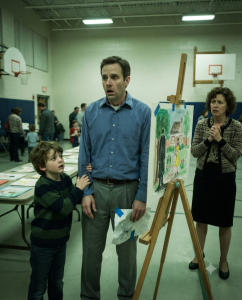
The father at the school art show thought his son had painted another dinosaur.
That was honestly his first thought when Oliver dragged him across the elementary school gym and pointed toward a canvas hanging under the student art display. From a distance, the dark shape on the side of the painting looked oversized and clumsy, like the outline of some prehistoric creature a seven-year-old had wedged into a memory scene because children did things like that all the time.
They added sharks to bathtubs, monsters to playgrounds, and rocket ships to grocery store parking lots. Their imaginations broke rules on purpose.
Miles Reardon was prepared for that.
What he was not prepared for was the moment the teacher turned the canvas sideways and the entire room changed around him.
Because it wasn’t a dinosaur.
It was a man.
And the man was standing beside the painted image of Oliver’s dead mother.
By the time Miles arrived at the school that Thursday evening, he was already in the wrong frame of mind for forced cheerfulness. He had come straight from the office in wrinkled slacks and a shirt that had stopped feeling fresh around noon. The fluorescent lights in the gym were harsh enough to expose every stain, every smudge, every exhausted parent pretending to be emotionally available after a long day.
He almost hadn’t come.
He had stood in the parking lot for a full minute with both hands on the steering wheel, considering the relief of simply driving home. But Oliver had noticed things now. Since Claire died, the boy had developed a quiet way of tracking absences. He never complained directly. Never asked why his father missed one event and made another. He just stored it somewhere behind those observant eyes.
Miles had learned to fear what Oliver noticed.
Not because the boy was dramatic.
Because he was honest.
Adults lied all the time. They lied with soft voices and logistical excuses. They lied by saying things were complicated when they meant painful. They lied by postponing truth until it became impossible to separate from self-protection.
Children didn’t have that machinery yet.
They told the truth in whatever medium they had. Crayons. Glue. Questions at the dinner table. Odd details dropped casually into conversation like lit matches.
Oliver had always loved drawing, but after Claire’s death, the pictures changed.
Before, the house had filled with paper rockets, exploding volcanoes, sharks with seven rows of teeth, and family portraits where every person looked vaguely rectangular. After the funeral, darker things started coming home in his backpack. Gravestones under rain clouds. A woman in the sky. A playground slide leading into the clouds. A tiny church with no roof and a boy standing outside it alone.
Miles saved every drawing.
At first because he told himself Oliver might want them later.
Then because he started studying them after Oliver went to sleep, wondering if his son was trying to tell him things he didn’t know how to say out loud.
That was why he didn’t laugh when he saw the sign over the display that read OUR MEMORY LANDSCAPES.
He just felt tired.
Oliver ran to him the moment he walked in.
“You came.”
The words were small. Not dramatic. Just relieved.
Miles swallowed the guilt that followed. “Of course I came.”
“Come see mine.”
Oliver pulled him through clusters of chatting parents and folding tables covered with self-portraits and clay animals. Near the back wall stood Mrs. Dalton, the art teacher, waiting beside Oliver’s canvas with an expression Miles didn’t like at all. Too cautious. Too prepared.
“Oliver’s piece is very thoughtful,” she said.
Miles almost sighed.
Thoughtful.
That word again. The polite adult replacement for unsettling.
He looked at the painting.
It showed a grassy field under a bright blue sky. A tree on one side. A woman in yellow near the center. Brown hair. Long skirt. Thin arms. There was no need for a label. Even in childish brushstrokes, Miles recognized Claire immediately.
The sight of her on canvas hit him hard enough to make him lose breath for a second.
Claire had died fourteen months earlier in what the hospital called a sudden cardiac event. Thirty-five years old. Healthy by every visible measure. The kind of death that doctors could explain medically and no one could accept emotionally.
People had called it tragic, shocking, senseless.
Miles had called it impossible, though only to himself.
Claire was not the kind of person you imagined gone. She had presence. Movement. Opinions about everything. She hummed while folding laundry. She left half-finished tea cups in strange places. She corrected grammar on cereal boxes for fun. A woman that vivid should not have disappeared into a sentence like sudden cardiac event.
Yet there she was now in Oliver’s painting, still and distant in a yellow dress.
Then Oliver tugged his sleeve.
“Turn it,” he said.
Miles frowned. “Turn what?”
Mrs. Dalton gave a strained little smile. “He asked that we hang it sideways first.”
Something inside Miles tightened.
Mrs. Dalton lifted the canvas and rotated it.
Everything changed at once.
The tree became a hand.
The layered shadow became the outline of a coat.
The dark shape that had seemed like random background resolved into a tall, half-hidden adult figure standing beside Claire, almost blended into the landscape so that he disappeared unless the painting was viewed from the proper angle.
A man.
Watching her.
Watching them.
Miles felt his stomach drop so sharply it was almost a physical blow.
“Who’s that?” he asked.
Oliver answered immediately.
“The man from the funeral.”
Mrs. Dalton looked at Oliver in alarm. “Sweetheart—”
Miles crouched down to his son’s level. His knees hit the floor harder than he intended. “What man?”
“The one who stood by Mommy when everybody left.”
At Claire’s funeral, Miles had barely remained upright. He remembered rain threatening but never quite falling. The smell of cut flowers. The pressure of too many hands on his shoulders. Oliver sleeping in the car afterward. Beyond that, memory turned unreliable.
He did not remember a stranger.
He did not remember any lone man near the grave.
But grief had destroyed his confidence in memory. There were weeks after Claire died that he could barely reconstruct. He had paid bills he didn’t remember opening. Answered emails he didn’t remember reading. Signed forms with a hand that didn’t feel attached to his body.
“Did somebody tell you about him?” Miles asked carefully.
Oliver shook his head. “He talked to me.”
Mrs. Dalton stepped farther back.
“When?” Miles asked.
“At the cemetery.” Oliver lowered his voice. “He said he was sorry he came late.”
A memory flickered through Miles’s mind. One week after the funeral, Claire’s sister Jenna mentioned a flower arrangement delivered to the house with no card. White lilies and peonies. Expensive. Anonymous. Miles had assumed it came from a colleague or client and never followed up.
He had not followed up on many things back then.
That was one of grief’s cruelest tricks. Everyone expected heartbreak. No one prepared you for administrative failure. For all the little unanswered questions that turned into permanent blanks because you were too broken to chase them.
“What did he look like?” Miles asked.
Oliver pointed not at the painted face, but at the wrist.
Mrs. Dalton leaned in. “Is that a watch?”
The detail was astonishingly specific. Dark strap. Gold-rimmed circular face.
Oliver nodded. “He had the shiny circle watch and the mean-sad face.”
Miles rose too quickly. The blood rushed in his ears.
Mean-sad face.
Claire had used those exact words once.
Months before she died, she had gone to a professional conference in Boston. On the second night, she called Miles from her hotel room sounding off in a way he hadn’t understood at the time. Distracted. Uneasy. Trying too hard to sound normal. She had mentioned a man she’d met after a panel and laughed while saying, “He has this mean-sad face. You know, like he practices apologies. Very expensive watch. Weird energy.”
Miles had asked who the man was.
Claire had changed the subject so clumsily it bothered him.
He forgot about it eventually. Or buried it.
Now a seven-year-old had dragged the memory back into daylight with a single painted wristwatch.
Mrs. Dalton touched Miles’s arm. “There’s something else.”
She reached behind the easel and produced a folded piece of paper.
“We found this taped to the back of the canvas.”
Oliver brightened at once. “I told you I put it there.”
The note was folded twice and sealed with blue painter’s tape. On the front, in Oliver’s careful block printing, were the words:
For the man Mommy knew.
Mrs. Dalton’s face had gone pale enough to warn him before he even opened it.
“Did you read this?” Miles asked.
Her silence answered first. Then she nodded once, miserably. “I only saw the first line. I thought you needed to take it immediately.”
Miles peeled back the tape.
Inside was another sheet, covered in Oliver’s handwriting and a few sentences written in larger letters that were not his son’s at all.
The adult letters were uneven, as if copied quickly.
He read the first line.
If Oliver ever gives this to you, read it alone.
His hand went cold.
Below it, in Claire’s handwriting—or something agonizingly close to it—was a short message.
Miles, I don’t know if I’m overreacting or finally reacting correctly. There is a man named Adrian Voss who keeps finding reasons to be where I am. If I tell you everything, you’ll think I let it go too far before saying something. Maybe I did. He says he only wants to explain. He keeps apologizing for things he won’t name directly. If anything feels wrong later, please don’t trust the loudest grief in the room.
Miles read the line twice.
Don’t trust the loudest grief in the room.
He looked up just as Oliver whispered, “Don’t open it here. He might still be watching.”
At that exact moment, footsteps sounded behind them.
Miles turned.
Jenna had just entered the gym.
Claire’s younger sister was still wearing her work blazer and carrying a leather tote bag over one shoulder. She smiled when she spotted them, but the expression faltered almost instantly when she noticed the painting, the note, and Miles’s face.
“What happened?” she asked.
Oliver’s hand clamped around Miles’s wrist.
“That one,” he whispered. “Mommy said she’d cry the loudest.”
Miles went so still it hurt.
Jenna blinked. “What?”
Mrs. Dalton stepped back again, openly uncomfortable now. Parents nearby began pretending not to listen in the exaggerated way that meant they were hearing every word.
Miles folded the note and slipped it into his pocket. “When were you going to tell me about Adrian Voss?”
Jenna’s face drained of color so quickly it looked unnatural.
“I don’t know what you’re talking about.”
It was a bad answer. Too fast. Too polished.
“Claire wrote his name down,” Miles said.
Jenna’s eyes flicked to Oliver, then to the note in Miles’s hand. Just for a fraction of a second. But it was enough.
Oliver tugged harder at Miles’s sleeve. “He came to the house.”
Miles looked down. “Who did?”
“The man in the picture.” Oliver’s voice was quiet, certain. “After the funeral. Aunt Jenna let him in. But he didn’t know I was awake.”
Jenna actually took a step backward.
“Oliver,” she said sharply, “that isn’t—”
“Yes it is,” Oliver said, and for the first time that night his voice had a child’s trembling anger in it. “You were crying in the kitchen and he said she wasn’t supposed to leave it there.”
The room tilted around Miles.
“Leave what there?” he asked.
Oliver frowned, searching memory. “The silver thing. The thing in the blue book.”
Jenna closed her eyes briefly.
And that was the moment Miles knew.
Not the whole truth. Not even close.
But enough to know there was one.
He took Oliver’s hand. “We’re leaving.”
Jenna reached for his arm. “Miles, please. Not here.”
He pulled away. “Then where? At Claire’s grave? In my kitchen? Another place where you thought I wouldn’t notice?”
“Listen to me,” Jenna hissed, dropping her voice. “You don’t understand who he is.”
“Then explain.”
But Jenna’s eyes weren’t on him anymore.
They were fixed over his shoulder, toward the gym entrance.
Miles turned.
A man stood just inside the doorway.
Tall. Dark coat. Mid-forties, maybe. Composed in the deliberate way of someone who knew how to occupy space without seeming intrusive. On one wrist was a round watch with a gold rim that caught the gym lights for one sharp second.
The man’s expression was exactly as Claire had once described it.
Mean-sad.
A face built from regret and entitlement in equal measure.
Oliver made a small sound and pressed against Miles’s side.
“That’s him,” he whispered.
The man didn’t approach immediately. He just looked at the painting. Then at Miles. Then at Jenna.
And when his gaze landed on the folded note in Miles’s hand, something changed in his face. Not surprise.
Recognition.
Miles took one step forward before Mrs. Dalton grabbed his sleeve. “Don’t,” she whispered.
But he was already moving.
The man raised both hands slightly, like someone preparing to calm a frightened animal. “Mr. Reardon,” he said. “You should hear the truth before your sister-in-law tells her version.”
Jenna’s voice cracked. “Don’t you dare.”
Miles stopped three feet away from him. “Who are you?”
The man’s eyes slid briefly toward Oliver, then back to Miles. “My name is Adrian Voss. And your wife did not die thinking you were the one she needed protection from.”
The sentence hit with such force that Miles almost missed what mattered most.
Protection from.
Not from me.
From someone else.
Jenna made a strangled sound. “Stop talking.”
Adrian ignored her. “Claire kept records. Messages. Dates. Meetings. She started documenting things when she realized what Jenna had dragged her into.”
Miles turned slowly toward Jenna.
She looked nothing like the woman who had clung to him at the funeral and sobbed the loudest of anyone there. Nothing like the devastated sister who brought casseroles, called twice a week, helped sort Claire’s clothes, and cried over old photos at the kitchen table.
Now she just looked cornered.
“What did you drag her into?” Miles asked.
Jenna shook her head, tears already forming. “It wasn’t supposed to hurt her.”
That was answer enough to terrify him.
Adrian spoke carefully, as though choosing each word for effect. “Your wife discovered financial fraud tied to Jenna’s nonprofit. Donors. Grant money. Transfers routed through shell accounts. Claire found documents she wasn’t meant to see.”
Jenna lunged toward him. “You were part of it!”
“Yes,” Adrian said. “At first.”
The admission stunned even Jenna into silence.
He continued, voice flat now. “Then I tried to get out. Claire knew that. She also knew Jenna was panicking.”
Miles felt the floor disappear beneath him.
Claire had worked part-time as a financial compliance consultant. She reviewed records, audited systems, and noticed patterns other people missed. He had always admired that about her, the precise way she saw through mess.
Apparently someone else feared it.
“She thought Jenna would confess,” Adrian said. “Instead, Jenna begged for time. Then she begged for help. Then she started making threats disguised as breakdowns.”
Jenna’s tears spilled over. “I never wanted her dead.”
No one moved.
Miles heard his own voice as if from a distance. “How did she die?”
Jenna covered her mouth.
Adrian answered quietly. “I don’t know exactly what happened that night. Claire called me because she was frightened. She said Jenna came over, crying, demanding the blue ledger. There was shouting. Then the line went dead. By the time I got there later, the ambulance had already gone.”
Miles felt physically ill.
The hospital had called it cardiac arrest triggered by an undetected arrhythmia. Stress could have accelerated it, they’d said. Tragic but plausible.
Now every word sounded different.
“Blue ledger,” Miles said slowly. “Oliver mentioned a blue book.”
Jenna broke then. Not dramatically. Not loudly. She just collapsed into a folding chair like something inside her had snapped.
“She found transfers I hid,” Jenna whispered. “She said she was giving me one day to turn everything in. One day. I went to her house. I begged. I screamed. She screamed back. She said she was done protecting me.” Jenna looked up, face ruined. “Then she grabbed her chest.”
Miles stopped breathing.
“I thought she was panicking,” Jenna said. “She fell. I called 911. I did call. I did. But before they came, I found the ledger and I took it.”
The gym was silent now. Totally, unnaturally silent.
“She was still alive?” Miles asked.
Jenna nodded violently, sobbing. “Barely. She looked at me and said, ‘Oliver’s awake.’ That’s all she said. I didn’t know he heard anything. I didn’t know—”
Oliver buried his face in Miles’s side.
Adrian spoke again, but softer this time. “Claire gave me copies of enough evidence to expose the fraud if anything happened to her. I came to the funeral because I was too late to help her. I sent the flowers because I didn’t know how else to say that. I went to the house with Jenna because she insisted she wanted to make things right. Instead she tried to find what else Claire had left behind.”
Miles’s hands shook.
“Where is the evidence now?”
Adrian looked at Oliver.
Then he looked at the painting.
“In the frame,” Oliver said quietly.
Every adult in the room turned toward him.
Oliver stepped closer to the canvas and touched the bottom edge. “Mommy told me if I was scared, hide the paper where people only look if they know the secret picture.”
Mrs. Dalton gave a startled laugh of disbelief. “Oh my God.”
Miles lifted the painting off the easel with numb hands. The back frame was sealed with thick layers of tape under the brown backing paper. Mrs. Dalton handed him a pair of classroom scissors. He cut through the tape, peeled the backing open, and a slim envelope slid into his palm.
Inside were photocopied bank records, printed emails, and a handwritten statement signed by Claire.
By then the principal had called school security, and someone had already phoned the police.
Jenna didn’t run.
That, Miles would remember later more than the sobbing. She didn’t run. She sat there with her face in her hands while Oliver’s painting leaned against a folding table under cheap gym lights and exposed everything she had spent more than a year trying to bury.
The investigation that followed took months.
The records were real. The missing donor funds were substantial. Jenna had rerouted money from restricted accounts to cover private debts and then falsified internal reports to delay discovery. Claire found the discrepancies while helping review documents for a fundraising audit. At first she kept quiet, hoping Jenna would come forward on her own. When that failed, she documented everything.
Adrian Voss had been involved in the same network initially through consulting work and off-book transfers he later claimed to regret. The evidence showed he had tried to distance himself before Claire’s death and had indeed provided her with copied records. Whether guilt or conscience motivated him hardly mattered to Miles by then.
Jenna was charged with fraud, evidence tampering, and obstruction. The medical examiner’s original ruling on Claire’s death did not change; there was no proof Jenna physically caused the cardiac event. But the final investigative findings described the confrontation that night as severe emotional stress surrounding criminal coercion and concealment.
That phrasing enraged Miles when he first read it.
Severe emotional stress.
A bureaucratic way of saying Claire died in the middle of being betrayed by her own sister.
In the months after, people asked complicated questions with simple faces. Had Jenna meant for any of it to happen? Was Adrian more guilty than he admitted? Would Claire have wanted Oliver to know the truth? Could stress kill, morally speaking, even when the law stopped short of saying so?
Miles had no clean answers.
What he had was his son.
Oliver stopped drawing graves after the arrests. He still painted Claire sometimes, but now she was usually moving—walking on a beach, laughing in a kitchen, reading on a couch with one sock missing. Once he painted her standing under a yellow umbrella while rain fell everywhere except on her.
Miles framed that one.
Months later, when things were quieter, he asked Oliver if he understood why his mother hid the papers in the painting.
Oliver thought about it seriously before answering.
“Because grown-ups miss things when they’re sad,” he said.
The sentence hit too close to the truth to argue with.
Miles still kept the original canvas in the hall closet, wrapped in plastic, hidden behind winter coats and an old suitcase. Sometimes he considered throwing it away. Sometimes he considered hanging it where he could see it every day.
He never did either.
Because the painting had become more than evidence. It was accusation, warning, memorial, and miracle all at once. A child’s artwork that had done what grieving adults could not: tell the truth before it disappeared.
And in the end, that was the hardest part to live with.
Not that Claire had seen danger before Miles did.
Not that Jenna had cried the loudest.
Not even that a stranger at the funeral had known more than the husband standing at the grave.
It was that the person who finally protected Claire’s voice was a seven-year-old with a paintbrush, a secret, and the terrifying honesty adults spend their whole lives trying to outgrow.
Even now, Miles sometimes stood outside Oliver’s room at night and watched him sleep, wondering what else children saw while the rest of the world was busy explaining things away.
And every time he thought back to that gym, that canvas, that hidden figure emerging from the branches, the same question returned.
Who was right, in the end—the guilty sister who swore she never meant for it to go that far, or the dead woman who understood too late that the biggest threat was the person mourning her the hardest?
Miles never found that answer.
But he knew exactly where the first red flag had been.
Not in the forged records.
Not in the anonymous flowers.
Not in the expensive watch.
It was in the tears that came too easily, too loudly, from the one person Claire had already tried to warn him about.