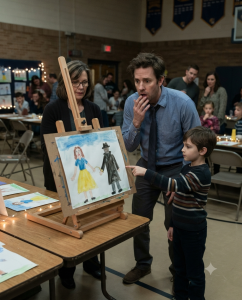
By the time the principal approached, polite concern arranged across his face, Miles had already made up his mind.
He thanked Mrs. Dalton for telling him. He apologized for the scene he hadn’t fully caused yet. He collected Oliver’s painting with hands that didn’t feel steady enough to carry cardboard, much less the weight of what it suggested. Then he signed Oliver out early from the event and walked him to the car as if nothing unusual had happened.
That was the performance of the evening. Not calm. Not strength. Just the act of an adult trying not to let his child see panic take shape.
Oliver buckled himself into the back seat while Miles placed the painting carefully across the trunk. The note stayed in his inside jacket pocket, hot against his chest. He still hadn’t opened it. He wanted to. Every nerve in him wanted to tear it apart immediately and read whatever his seven-year-old had hidden there. But Oliver was watching him in the rearview mirror, and the last thing Miles wanted was for that note to become another memory his son carried forever.
The drive home was only eleven minutes. It felt much longer.
Streetlights flashed across the windshield in steady intervals. Oliver hummed under his breath for the first few blocks, then fell silent. Miles kept glancing at him, at the pale oval of his face in the dark, at the small shoes kicking lightly against the seat. He looked like any tired first grader after a school event.
That made it worse.
Children that age should be thinking about snacks and cartoons and whether their painting got a good spot on the wall. They should not be able to identify strangers from funerals. They should not know what secret apologies sound like.
When they reached the house, Miles told Oliver to change into pajamas and pick a movie. His voice sounded almost normal. Oliver obeyed, which worried him more than if the boy had argued. Too easy meant Oliver already sensed the gravity of the night.
Miles carried the painting inside and set it on the dining table. The house was quiet in the way it had been since Claire died—never fully empty, never fully alive. Her absence had changed the acoustics. Even footsteps seemed more careful now.
He checked the locks on the front and back doors, then did something he hadn’t done in months: he went to the hall closet and pulled down the cardboard boxes marked CLAIRE / OFFICE.
He found the blue book in the second box.
Not an appointment book, exactly. More like a leather-bound organizer filled with old receipts, business cards, conference agendas, and loose papers Claire had tucked into every pocket. He sat at the table staring at it for a full ten seconds before opening the note first.
The blue painter’s tape came away with a dry peel.
Inside was one sheet of construction paper torn in half. In Oliver’s blocky handwriting, there was a drawing of a man beside Claire’s grave. Beneath it were the words:
You said to tell my dad if you came back.
Mommy said you were sorry before but sorry does not fix dead.
I know where the picture is.
For a long time Miles didn’t move.
The sentence in the middle hit the hardest. Mommy said you were sorry before but sorry does not fix dead.
Oliver had not invented that. The rhythm was too adult, too bitter, too precise. He had overheard it somewhere. Or Claire had said it in front of him, never imagining he would hold onto it.
Miles opened the blue book.
At first there was nothing. Calendar pages. Hotel receipts. Notes from parent-teacher meetings. Then, tucked into a zippered pocket at the back, he found a photograph.
It had been folded twice.
He opened it carefully.
Claire stood outside what looked like a hotel entrance, half turned away from the camera, her expression tense and unhappy. Beside her was a man in a charcoal coat, one hand gripping her elbow. He wasn’t violent about it. That somehow made it more disturbing. Familiarity sat in the gesture. Ownership. The kind of touch people use when they assume they won’t be challenged.
The man wore a dark watch with a gold rim.
Miles knew immediately he had seen the face before, though not in person. After several seconds he placed it. The man had appeared, briefly, in the background of a company gala photo Claire once posted and later deleted. Senior consultant, maybe. External advisor. One of the polished men who drifted through conferences and board dinners.
On the back of the photograph, in Claire’s handwriting, were six words:
If anything happens, ask Daniel Cross.
Miles read them three times.
Daniel Cross.
The name stirred nothing at first, then a faint memory clicked. Claire had once mentioned a Daniel from compliance, a man she found “annoyingly decent,” which had made him laugh. He searched his phone, found an old email thread about a holiday charity event, and there it was: Daniel Cross, copied on some message from nearly two years earlier.
Miles called.
It was nearly 9:30 p.m. He expected voicemail. Instead, a tired man answered on the fourth ring.
“Hello?”
“Daniel Cross?”
“Yes.”
“My name is Miles Reardon. My wife was Claire Reardon.”
Silence.
Then a sharp inhale. “Claire.”
Miles stood up without meaning to. “You knew her.”
“Yes,” Daniel said carefully. “I knew her. What happened?”
The question was strange enough to cut through the panic. “She died fourteen months ago.”
Another silence, heavier this time. “I know she died,” Daniel said. “I meant what happened tonight.”
Miles stared at the wall. “How do you know something happened tonight?”
When Daniel spoke again, his voice had changed. “Because if you’re calling me now, then he’s come back.”
Miles told him to come over.
Daniel arrived thirty-five minutes later in a rain-dark jacket, carrying the brittle tension of a man who had been expecting a call for a long time and still dreaded receiving it. He was younger than Miles expected, maybe early forties, with glasses and the exhausted look of someone who had spent years trying to do the right thing too late.
Oliver was asleep on the couch by then, movie flickering silently because Miles had muted it after the first ten minutes. Daniel looked at the child, then at the painting on the table, and whatever he saw there seemed to confirm his worst fears.
“That’s him,” he said.
He did not need to ask which figure.
They sat in the kitchen. The same kitchen Oliver had said the stranger entered while Miles slept.
Daniel’s name had been written on the photograph because Claire had trusted him, though not enough to tell him everything early. At first, he explained, Claire had only hinted that a consultant named Adrian Vale was making her uncomfortable during a joint restructuring project. Adrian was important, connected, and very skilled at sounding charming in rooms full of people. The kind of man who could humiliate someone softly enough that witnesses doubted themselves afterward.
Then the messages started.
Nothing overtly criminal at first. Just relentless. Personal comments. Suggestions to meet privately. References to conversations Claire hadn’t realized he had overheard. She rebuffed him. He apologized. Then he appeared where he had no reason to be. Hotel bar. Airport gate. Lobby outside sessions he wasn’t attending.
“Why didn’t she tell me?” Miles said, hearing the rawness in his own voice.
Daniel’s answer was immediate and painful. “Because she thought if she handled it quickly, it would never become something you had to carry.”
That sounded exactly like Claire. Brave in the practical way that often looks, in hindsight, like loneliness.
According to Daniel, Claire finally confided in him after Boston. Adrian had cornered her outside the hotel, angry that she was documenting his messages. She threatened to report him. He apologized again. Told her he was under pressure. Told her she was misreading him. Then, according to Claire, he said something that frightened her more than the pursuit itself: that people always turned him into the villain after they accepted his help.
“He had this whole story about himself,” Daniel said. “Wounded, misunderstood, suffering. He used it to excuse everything.”
Mean-sad face, Miles thought.
Claire had begun collecting screenshots and notes. She planned to file a formal complaint once she had enough that no one could dismiss it as misunderstanding. Daniel offered to go with her. She delayed. There was a merger. Then another trip. Then, suddenly, she was dead in what everyone called a tragic traffic accident on a wet road two towns over.
Miles had accepted that explanation because there was nothing else to hold. A truck crossed the line. Claire’s car spun. End of story.
Except now Daniel was looking at him with an expression halfway between pity and dread.
“She called me the day she died,” he said. “She left a voicemail. Said Adrian had found out she saved everything. Said he wanted to meet and talk. She sounded scared, but also furious. I called back three times. She never answered.”
Miles sat perfectly still.
“Did the police know any of this?”
Daniel’s mouth tightened. “I told them Claire had been dealing with harassment. I didn’t have the messages. Without her phone, without the records, and with the accident looking straightforward, it went nowhere.”
“What happened to her phone?”
“It was never recovered.”
Claire’s phone had been listed as missing after the crash, likely thrown from the vehicle, lost in runoff, one more chaos item in a catastrophic scene. Miles remembered nodding numbly while someone explained it.
The kitchen felt colder.
Miles showed Daniel the note from Oliver and the photograph. Daniel read both with visible strain. “If Adrian came to the funeral, he was checking whether she’d hidden anything. If he came here…” He stopped and looked toward the hall where Oliver slept. “Then he thinks a child knows where she put it.”
Miles stood so abruptly his chair scraped hard across tile. “He came into my house.”
Daniel rose too. “Then call the police now.”
The responding officers were polite, skeptical in the controlled way officers often are when a case sounds dramatic but arrives without current proof. Miles could hear how thin it all sounded from the outside: a child’s painting, an old photograph, a dead wife’s note, a stranger allegedly seen outside a school. But the officers took a report, checked the house, recommended cameras, and promised to flag the name Adrian Vale for follow-up.
It was not enough. Miles knew it. Daniel knew it.
The break came from Oliver the next morning.
He ate cereal in the fragile sunlight of the kitchen as if the world had not shifted. Children did that. They could carry terror in one pocket and ask for strawberries in the next breath.
“Do you know where Mommy’s picture is?” Miles asked gently.
Oliver nodded. “Not the picture. The other thing.”
Miles’s pulse jumped. “What other thing?”
“The thing behind the picture.”
It turned out Claire had hidden a second envelope inside the frame of an old seaside photograph hanging in the downstairs guest room—a room no one used and therefore no one noticed. Oliver knew because months earlier he had walked in on Claire taking the back off the frame. She told him it was a secret game and that if anything bad ever happened, he should tell Dad only if “the man with the shiny watch” came back.
Miles nearly sat down on the floor when Oliver said it.
Inside the frame was a flash drive and a folded letter addressed to him.
Miles read the letter alone in the study while Daniel waited outside the door.
Claire’s handwriting was steady, but he could hear her fear beneath the neatness.
She wrote that Adrian Vale had harassed her for months, then escalated when she rejected him and threatened to report the messages. He had begun following her, showing up near Oliver’s school once, and apologizing in the same unnerving cycle every time she pushed him away. She had documented everything: emails, texts, photos, voice memos, even two recordings of conversations in which he implied he could ruin reputations if cornered.
She also wrote something that split Miles open with guilt: I didn’t tell you because you would have tried to protect me immediately, and I was afraid that would make him fixate on you too.
At the end, she added: If this reaches you, then either I was too late or he was worse than I wanted to believe.
The flash drive was worse.
It held screenshots of hundreds of messages. Some needy, some hostile, some written in the manipulative language of a man who thought his pain entitled him to access. There were calendar screenshots showing Adrian somehow knew Claire’s travel changes. There were photos she had secretly taken when she spotted his car near places he had no reason to be. And there was a voicemail timestamped the afternoon of her death.
In it, Adrian’s voice was low and tight.
“You are making a mistake, Claire. You don’t get to turn me into this. Meet me and end it properly. If you go to them, I promise you’ll regret how ugly this becomes.”
Miles listened once. Daniel listened once. Then they called the detective assigned to the old crash.
This time the response changed.
Digital evidence has a way of converting intuition into procedure. The police obtained warrants. Adrian Vale’s firm cooperated less from morality than from fear. Internal complaints surfaced—small ones, buried ones, a pattern of women describing boundary violations and retaliatory behavior that had never quite reached prosecution. Security footage from the night of Claire’s funeral eventually confirmed that a man matching Adrian’s build and coat had remained in the cemetery after most mourners left.
And the school had a camera.
Not good footage. Grainy. Partial. But enough.
A dark-coated man passed the gym entrance at the exact time Miles had looked toward the doors. When the frame sharpened for one bright second under the exterior light, the gold-rimmed watch flashed.
Adrian was arrested six days later at a condo forty miles away.
The charge that held first was stalking, harassment, unlawful entry connected to the visit to Miles’s home, and witness intimidation by implication. The larger question—whether he had any criminal role in the events surrounding Claire’s fatal accident—took longer.
That answer came from a traffic camera file no one had thought to revisit until investigators compared Adrian’s location history, obtained through old vehicle records and toll data. His car had been on the same route as Claire’s that afternoon. Minutes before the crash, witnesses recalled a dark sedan following too closely in heavy rain. The truck that crossed the line still caused the final collision, but evidence suggested Claire had sped up and attempted an unsafe lane change while trying to get away from the vehicle behind her.
It was not murder in the simple cinematic sense. It was something uglier and, to Miles, almost harder to absorb: terror as pressure, pressure as pursuit, pursuit as the force that pushed everything toward catastrophe.
Legally, that mattered.
Humanly, it mattered more.
Adrian never made it to a full public trial on the most serious counts. Faced with the digital evidence, the unlawful entry, the corroboration from Daniel, the cemetery footage, and the reopened crash investigation, he entered a plea that acknowledged years of stalking and coercive conduct leading up to Claire’s death. His statement in court was full of the same poisoned sorrow Daniel had described. Regret without ownership. Misery treated like mitigation. He said he loved Claire. He said he never meant for anything terrible to happen. He cried.
Miles watched and felt nothing he could use.
Claire’s sister cried enough for three people. Daniel stared straight ahead. Miles kept thinking of Oliver at seven years old, painting a hidden man into a landscape because his memory had no other safe place to put him.
Afterward, the house changed.
Not magically. Not all at once. But truth altered the air.
Miles installed cameras and then, months later, stopped checking them every night. Oliver started drawing different things. Not cheerful things exactly, but open things: soccer balls, strange birds, a robot with five feelings. Once he painted Claire again, but this time she was on a bench under a tree and no one stood in the shadows beside her.
Mrs. Dalton asked if she could keep a photo of the original canvas for a seminar on children and symbolic art. Miles said yes, though he never told her how close that painting came to being dismissed as grief.
The hidden figure had done what adults failed to do. It had forced everyone to turn the picture and see what was there.
A year later, Miles finally asked Oliver why he hadn’t spoken up sooner.
Oliver thought about it carefully before answering.
“Because Mommy looked scared when she told me,” he said. “And when grown-ups are scared, they always say everything is okay. So I thought maybe I had to wait until someone looked properly.”
Miles never forgot that.
For a long time he had wondered what the biggest red flag was—the unknown flowers, Claire changing the subject, the missing phone, the unease he translated into stress because that was easier to live with. In the end, maybe the worst part was not one clue but how grief and politeness together can make dangerous things look almost ordinary.
He still kept the painting in the hall closet, wrapped in brown paper.
Not because he wanted the reminder.
Because sometimes the truth arrives in the only voice that hasn’t learned how to hide it, and sometimes the person who sees everything clearly is the child everyone assumes is only drawing dinosaurs.