By 6:10 that Friday morning, Maya had already decided the day was cursed.
Her phone alarm had failed. Harper had somehow managed to smear toothpaste across the only clean hoodie Maya could find, the plain navy one without sequins, glitter, or a cartoon face peeling off in the wash. The permission slip for the class field trip had vanished under a mess of receipts, utility notices, and unopened envelopes Maya no longer had the emotional strength to sort through before coffee. She found it finally, folded beneath a grocery coupon and a red warning from the electric company, signed it with a pen that barely worked, and shoved it into Harper’s backpack with a level of aggression that made her daughter glance up in silence.
It wasn’t Harper’s fault.
None of it was Harper’s fault.
That only made Maya feel worse.
She was thirty-two, divorced, permanently tired, and trying to raise an eight-year-old without letting stress become the loudest thing in their home. Some days she managed. Some days she caught her own voice getting too sharp over spilled milk or missing socks and saw Harper go quiet in that small, careful way that children do when they start adapting themselves to an adult’s exhaustion.
This field trip had almost become one of those moments.
Maya had only volunteered because the teacher’s final reminder email had sounded desperate. Two parents had canceled. Another couldn’t get off work. The aquarium needed more adults for supervision. Maya had read the message while standing in the break room at the dental office, chewing on stale crackers and staring at a schedule already packed too tight.
She had nearly ignored it.
But that night, Harper had stood in the kitchen in mismatched pajamas, holding her permission slip with both hands.
“You’re really coming, right?” she had asked.
Not whiny. Not demanding.
Hopeful, but braced.
That expression was enough to make Maya say yes before her practical brain could protest.
So by 7:15, they were in the car. By 8:40, they were following a line of second graders off a school bus and into the aquarium.
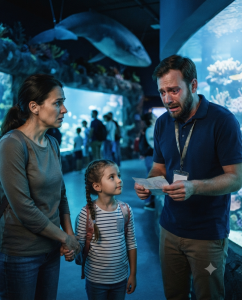
The place was already overloaded with noise and motion. School groups filled the lobby in clumps of neon backpacks and untied shoelaces. The floor smelled faintly of saltwater and industrial cleaner. Blue light spilled from every exhibit corridor, flattening people into moving silhouettes. Somewhere nearby, a gift shop playlist chirped relentlessly, as if cheerful ukulele music could make her forget she still had to clock into her second job that evening.
Harper seemed to love it instantly.
Unlike the other children, she didn’t race ahead or pound on glass. She just stared. Quietly. Deeply. She had always been like that, more interested in details than excitement. She noticed things adults missed. A cracked shell on a beach. A bird’s limp in a parking lot. The way one fish in a tank seemed to keep circling back to the same rock.
At the jellyfish exhibit, she stood so still that her teacher had to gently guide her onward.
At the touch pool, she barely brushed the water, then withdrew and smiled to herself as if keeping a private thought.
Under the shark tunnel, she turned in a slow circle while the other kids screamed over every passing shadow.
Maya followed, doing the job of parent chaperone on autopilot. Count heads. Keep up. Remind them not to run. Make sure nobody licked anything. It was the kind of morning that blurred quickly, one small emergency after another.
Then they reached the giant suspended whale model.
Another class was already there, lying on the floor and looking up while a guide talked to them about migration patterns and feeding behavior. He had the practiced ease of someone who had been doing the job a long time—calm tone, patient smile, clear projection without sounding fake. He wore a navy aquarium polo and a name badge that read BEN.
Maya barely registered him at first.
Harper did.
She drifted slightly away from her group and tipped her head back to look up at the whale.
Ben turned mid-sentence.
He saw Harper.
And everything in his face changed.
His mouth remained open, but no words came out. The sentence he had been speaking collapsed in the air between one fact and the next. The children on the floor waited. One little boy actually raised his hand and said, “What happened next?”
Ben didn’t answer.
He wasn’t looking at them anymore.
He was staring at Harper with a level of shock so immediate and naked that Maya reacted before she even understood why. Every protective instinct in her body snapped awake.
Then he whispered, “Lena?”
Harper blinked up at him. “That’s not my name.”
The moment lasted only a second longer before one of the teachers jumped in, clapping her hands and steering children onward with bright, strained efficiency. “Okay! Reef tunnel time!”
The groups began moving.
Ben did not.
Maya took Harper’s hand at once. “Come on.”
But Harper leaned slightly into her and whispered, “Mom, why is he crying?”
Maya turned back.
He was indeed crying—silently, without any attempt to hide it, as though grief had simply hit too hard and too fast to be managed.
“I’m sorry,” he said, voice unsteady. “I’m so sorry.”
Maya’s response came out sharper than intended. “Do you know my daughter?”
“No.”
The answer arrived too quickly.
Harper looked up. “He said Lena.”
Ben closed his eyes for a brief second, then opened them again with the expression of a man who understood he had already crossed a line and there was no undoing it.
“My daughter’s name was Lena,” he said.
Maya felt the air change.
“She died two years ago.”
Harper’s gaze did not hold fear, only curiosity. “How old was she?”
“Seven.”
Maya’s stomach twisted. Harper had just turned eight.
“I think we’re done here,” Maya said.
Ben nodded faintly, as if he agreed.
That should have been the end.
Instead, Harper said, “Was she the one with the turtle shoes?”
The silence after that question felt almost violent.
Ben’s face emptied of color. “What did you say?”
Harper frowned, confused by the adults’ confusion. “The girl. In the dream room.”
Maya’s throat tightened.
Dreams.
There had been dreams for months now. Harper had mentioned them in fragments, usually when Maya was distracted. A blue tunnel. Fish on the ceiling. A girl sitting on the floor. Wet shoes. Maya had assumed children’s television, imagination, or stress. It was impossible to give every strange detail the attention it deserved when life felt like one long sprint from bill to bill.
But now Ben looked like someone standing on the edge of collapse.
“She had green turtle shoes,” Harper said. “And she said her dad still doesn’t go to the last tank.”
Ben’s breathing turned shallow. “There was a last tank,” he said. “The sea turtle rescue room. Lena died before we got there.”
Maya wanted to stop this. She wanted to put both hands over Harper’s ears and walk out of the building.
Then Harper said, “She told me you left her drawing in your car.”
Ben made a sound that came from somewhere so deep it startled even him.
His hand disappeared into his jacket pocket.
When he pulled out a folded paper, his fingers were trembling badly enough that he struggled to open it. Inside was a child’s drawing: blue water, a whale overhead, a little girl holding hands with an adult figure, and bright green shoes that stood out even through fading marker.
Lena.
The name was scrawled crookedly in a child’s hand.
Harper studied it and whispered, “That’s the one.”
Maya crouched in front of her daughter, forcing her voice to stay level. “Harper, have you ever seen this before?”
“No.”
“Have you seen him before?”
“No.”
“Did anyone talk to you about a girl named Lena?”
Harper shook her head each time.
Ben looked destroyed. “What else did she say?”
Maya started to object, but Harper answered first.
“She said it wasn’t your fault.”
Whatever composure Ben still had vanished.
He turned partly away, hand over his mouth, shoulders rigid. Maya had the sudden, awful sense that this was not a sentence any stranger could have invented correctly. This was a sentence with history attached to it—one that landed in a place already wounded.
“What happened to her?” Maya asked quietly.
Ben swallowed and stared at the drawing in his hands. “She drowned.”
Harper’s face changed. “She said she got tired.”
Ben’s eyes squeezed shut.
The noise of the aquarium seemed far away now. Maya could still hear it—children laughing, staff making announcements, rolling carts somewhere behind the exhibits—but it no longer felt connected to the small circle they were standing in.
Ben reached into his wallet and held out a photo with obvious reluctance, as if even showing it to strangers was a kind of betrayal. Maya took it.
A smiling little girl stood in front of the aquarium’s old sea turtle rescue display. She had damp curls, bright eyes, and green shoes with tiny turtle faces on the toes.
Harper touched the edge of the photograph. “That’s her.”
Maya pulled the photo back by reflex.
“We’re leaving,” she said.
Ben nodded immediately, but before anyone moved, Harper went very still.
She was looking past Ben now, toward the staff hallway near the side exhibit entrance. Maya followed her line of sight.
A woman in a gray cardigan stood half in shadow beside a door marked STAFF ONLY. She wore an aquarium badge and had one hand curled around the handle as if she had been about to slip away unnoticed. Around her wrist glinted a thin silver bracelet.
Harper spoke in a near whisper.
“She says the lady with the silver bracelet was there.”
Ben turned.
The woman froze.
For one long second, nobody moved.
Then Ben said, “Claire?”
The name cracked out of him, louder than he intended.
Claire’s expression shifted too slowly. Not surprise first, Maya noticed. Calculation.
That single detail unsettled her more than anything else.
Ben stepped forward. “Why did she say you were there?”
Claire lowered her voice at once. “Not here.”
Maya was done with quiet voices. “What is she talking about?”
Claire looked at Harper, then at the drawing in Ben’s hand, then back at him. “This isn’t appropriate in front of children.”
Harper leaned into Maya’s side and whispered, almost apologetically, “She says you told her not to tell.”
Claire flinched.
It was small but undeniable.
Ben saw it too. Maya watched the grief in his face make room for something else—something sharper, more dangerous. Rage, perhaps, but not blind rage. The kind that comes from a truth taking shape.
“What didn’t she tell me?” he asked.
Claire pressed her lips together. “Ben—”
“No.”
The word landed hard.
Maya’s heartbeat felt unsteady now. She didn’t understand what was happening, but she understood enough to know it was no supernatural coincidence. There was history here. Secrets. A dead child. An adult who looked cornered.
Harper spoke again before anyone else could.
“She says it wasn’t the water she was scared of. It was what she saw before she fell.”
Claire’s face drained.
Ben stared at her. “What does that mean?”
Claire’s eyes darted toward the staff hallway.
That glance was all it took.
Ben moved first, blocking the door. “You don’t get to walk away again.”
Again.
That word landed heavily too.
Maya caught it. So did Claire.
“Again?” Maya repeated.
Ben kept his eyes on Claire. “She was there that day.”
Claire inhaled slowly, as though trying to steady herself. “I was a junior marine care technician. Everyone knows that.”
“Not everyone knows you were the last adult Lena spoke to.”
Maya felt Harper clutch her harder.
Claire’s composure cracked for the first time. “That is not fair.”
Ben laughed once, without humor. “Fair?”
He looked at Maya then, and she saw the shift in him—a man rearranging years of guilt in real time. “The report said Lena wandered off while I was buying her a drink. That she slipped past the safety gate near the old rescue room and fell into a maintenance access section that had standing water below. I blamed myself because I was supposed to be holding her hand.”
Maya’s chest tightened.
Ben continued, eyes fixed on Claire. “But Lena loved that place. She knew the route better than most staff. She was scared of heights, scared of dark water, scared of every alarm in the building. She would never have gone near that closed section alone.”
Claire whispered, “You don’t know what a frightened child might do.”
Ben’s voice sharpened. “Then why didn’t you say you saw her?”
Maya stared at Claire.
Claire closed her eyes briefly. “Because by the time I realized—”
“You realized what?” Maya demanded.
Claire opened her eyes. For the first time, she looked less guarded than exhausted. “I saw her near the door. I told her she couldn’t be back there. She was crying.”
Ben’s face twisted. “Crying why?”
Claire didn’t answer.
Harper looked at the floor. “Because she saw the buckets.”
The adults went silent.
Maya had no idea what that meant, but both Ben and Claire did.
Ben’s face hardened with dawning horror. “The sick turtles.”
Claire’s throat moved as she swallowed. “There was an outbreak in quarantine. We weren’t supposed to discuss it publicly. Some of them were dying. We had them in temporary holding containers while the filtration system was being repaired.”
Ben stared. “She saw them?”
Claire nodded once, tears finally forming in her eyes. “She came through the wrong side while I was carrying supplies. She saw one of them thrashing in a shallow transfer bin. She got scared. I told her she needed to go back out front and not tell anyone she’d been there because guests weren’t allowed in that corridor. I thought I was avoiding a panic, avoiding trouble with management, all of it. She ran before I could stop her.”
Maya felt sick.
Ben’s voice dropped. “And then?”
Claire’s tears spilled. “There was a wet floor sign down, but not the chain. Maintenance had moved it and never put it back. She bolted toward the service ramp. I heard her slip.” Claire covered her mouth. “By the time I got there—”
Ben looked like he might break apart.
“You let me believe I killed her,” he said.
Claire shook her head wildly. “No, the investigation—”
“The investigation asked whether anyone saw her after she left me.” His voice was shaking now. “Did you tell them?”
Claire said nothing.
That was answer enough.
Maya understood then. Not every tragedy came from one monstrous act. Sometimes it came from cowardice in layers. A missed safety step. A hidden mistake. A frightened employee protecting a job. A grieving father blamed because he was the easiest person to blame.
Harper tugged on Maya’s sleeve. “She says he kept saying sorry.”
Ben closed his eyes.
Claire whispered, “I was twenty-three. I thought if I told them she’d come through my corridor, I’d be fired. I thought maybe the cameras would show enough. I thought maybe they’d figure it out anyway. Then they didn’t. And after the funeral…” Her voice collapsed. “After I saw what it did to you, I couldn’t make myself come forward.”
Ben’s face went white with fury. “So you stayed.”
“I thought leaving would make it look worse.”
Maya almost laughed at how obscene that sounded.
A security guard appeared at the far end of the hall, responding to the raised voices. Claire saw him and seemed to fold inward, like resistance had suddenly become pointless. “I’m done lying,” she said quietly.
The next half hour moved in fractured pieces. Management arrived. Then another staff member. Then security guided them into a private office far from the children and the exhibits. Maya should have left. She knew that. Harper’s teacher texted twice asking where they were. But Maya couldn’t pull away from what had opened in front of them.
Claire gave a statement.
At first it came haltingly, then all at once. She admitted Lena had entered the restricted corridor through an improperly secured side access point. She admitted Lena became frightened after seeing distressed sea turtles in temporary containers and ran. She admitted she had failed to report the interaction because she panicked about violating procedure and exposing the facility’s internal problems. She admitted she had watched the investigation settle around Ben’s self-blame and said nothing.
Management looked horrified in that particular way institutions do when they realize a buried truth is now a legal one.
Ben didn’t interrupt her again.
He sat with both hands clasped so tightly that his knuckles turned colorless and listened to the final shape of the worst day of his life.
When it was over, the room felt airless.
Claire was escorted out to wait with security.
No one spoke for several seconds.
Then Ben turned toward Harper.
Maya instinctively moved closer, but his expression held nothing dangerous. Only grief. And gratitude. And the bewilderment of a man who had just been handed truth by a child who should never have had any part in this.
“I don’t understand how you knew any of it,” he said softly.
Harper looked down at her shoes. “She was lonely.”
The simplicity of that answer undid Maya more than the entire morning had. She sat beside her daughter and wrapped an arm around her shoulders.
Ben nodded slowly, tears slipping down his face again. “Thank you.”
Harper hesitated. “She said you can go to the last tank now.”
Ben made a broken sound and laughed through it, as if pain and relief had finally tangled too tightly to separate.
Later, after statements and apologies and too many adults using careful voices, Ben led Maya and Harper quietly through a side corridor to the sea turtle rescue room.
It was closed to the public that day, but someone unlocked it for him.
The room wasn’t dramatic. That seemed important somehow. No thunderous revelation. No haunted atmosphere. Just filtered light through deep water, one rescued sea turtle gliding slowly through a recovery tank, and the hum of life-support systems doing their quiet work.
Ben stood in the doorway for a long moment, unable to enter.
Then Harper took one step forward and slipped her hand into his.
Maya started to stop her, then didn’t.
Ben looked down in surprise.
“It’s okay,” Harper said.
Together, they walked to the glass.
Ben cried openly then, the kind of crying grief experts probably had names for but ordinary people only recognized as the sound of something finally giving way. He rested a hand against the tank and stared at the turtle swimming in slow, weightless circles.
“I should have brought her here first,” he whispered.
Maybe he was talking to Harper. Maybe to Maya. Maybe to Lena.
No one answered.
When they eventually left the aquarium, the school buses were already loading. Teachers were frazzled. Children were sticky with melted ice cream and gift shop sugar. The ordinary world had resumed, indifferent as ever.
Maya buckled Harper into the car and sat in the driver’s seat for a moment without turning the key.
“Did you really see her in dreams?” she asked quietly.
Harper shrugged in the rearview mirror. “Kind of.”
“What does that mean?”
“It means…” Harper searched for words. “Not like movies. More like when I’m almost asleep and someone’s sad nearby.”
Maya did not know what to do with that answer.
So she didn’t force it into anything.
A week later, the aquarium released a statement announcing an internal review into historical safety failures connected to a prior child fatality. Maya didn’t read most of it. Legal language had a way of scraping the human shape off tragedy. She did hear, through one of the teachers, that Claire had formally confessed and that the old report was being reopened.
Ben called once, carefully, just to thank Maya again and tell her that he had finally visited Lena’s grave without apologizing for leaving her hand. He said he still had plenty to mourn, but guilt and grief were not the same thing, and he had only learned that because Harper somehow carried a message no adult had been able to deliver.
That night, Maya sat on the edge of Harper’s bed after lights out.
“Do you still see her?” she asked.
Harper, already drowsy, shook her head. “No.”
“Why not?”
Harper’s eyes stayed closed. “Because she found her dad.”
Then she fell asleep.
Maya remained there in the dark for a long time, listening to her daughter breathe.
She still didn’t know what she believed.
Maybe children understood certain kinds of sorrow in ways adults trained themselves out of. Maybe grief left traces. Maybe guilt made rooms feel crowded. Maybe the world was stranger than she had ever let herself consider because practical people with unpaid bills and two jobs do not usually have the luxury of mystery.
But she knew this much:
A little girl had died frightened.
A father had been drowning beside her memory ever since.
And the truth, for two long years, had been standing silently in a hallway with a silver bracelet, hoping no one would ever ask the right question.
The hardest part, Maya thought later, was deciding which was worse—that Claire had stayed quiet, or that everyone around her had found it so easy to believe a grieving father’s guilt was the whole story.