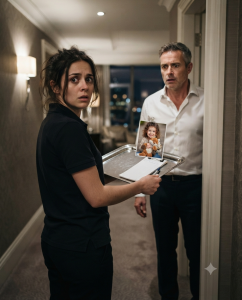
The single mom only took the night shift at the hotel because the daycare opened early enough for once.
That was the kind of sentence Julia would have laughed at years ago, back when she still believed life moved in straight lines. Back when a schedule problem was just a schedule problem, not a minor miracle that decided whether she could take a shift, pay rent, or buy another week of breathing room.
Now everything in her life depended on small openings.
A neighbor who didn’t mind staying with Wren after bedtime.
A manager willing to swap one shift for another.
A daycare that opened at six-thirty instead of seven.
A bus that wasn’t late.
A paycheck that stretched three more days than it should have.
That particular week, the daycare adjusted its hours because of a staffing trial. Julia saw the sign taped to the front desk and nearly cried. Early drop-off meant she could finally accept two night shifts at the Halcyon Grand, the downtown hotel where she worked room service. Conference guests tipped better. Rich men in suits were rude in a polished way, but they tipped better, and right then that mattered more than dignity.
So she smiled when she had to smile, nodded when she had to nod, and carried silver trays through expensive silence while thinking about electricity bills and preschool shoes and the fact that Wren needed a winter coat before the weather turned.
She was thirty-one years old and permanently tired.
Not tired the way people joked about being tired.
Tired in the bones. Tired in the soul. Tired in the tiny pause she took before every bill, every text from an unknown number, every knock at the door after dark.
She lived in a rented studio on the third floor of an old brick building where the pipes moaned all winter. Her daughter’s bed sat behind a curtain Julia had hung to create the illusion of separate rooms. Wren was four, with dark curls, a crooked grin, and a stuffed fox she dragged everywhere by the tail. Julia loved her with a force so pure it sometimes bordered on panic.
That was why she kept the photo on her order pad.
Wren in the park, one sock half falling down, one front tooth missing, fox tucked under her arm, eyes bright and gray-blue in the late afternoon light.
The eyes.
People noticed them.
They always had.
But Julia had learned to answer questions casually. “Oh, she gets them from somewhere in the family.” That was easier than admitting she didn’t know. Easier than thinking too long about the man she had run from before Wren was born and the things he’d said when he realized she was pregnant.
He had called the baby Robin before there was even a sonogram.
He had said it with a certainty Julia hated.
He had repeated it until the name felt less like affection and more like a claim.
That was around the same time Julia started understanding that love had never really been the right word for what he felt.
Control was closer.
Ownership was closer.
Fear came later, then faster, until it crowded out everything else.
By the time she left him, she was seven months pregnant, bruised in places clothing could hide, and so careful with every move that even now she barely remembered the logistics of getting away. A number slipped to her in a parking lot. A shelter bed in another part of the city. A social worker who helped her change paperwork. A prepaid phone. Silence.
Then one envelope arrived.
No return address she could trace. Just a cashier’s check she never cashed and a note in handwriting she didn’t recognize.
If the child is his, don’t let him find her.
She had burned the note out of terror.
But she kept the envelope.
Avery.
She didn’t know why. Maybe because some part of her knew names mattered.
Five years later she was working a conference night at the Halcyon Grand when Room 814 ordered a late meal.
Club sandwich.
Sparkling water.
Black coffee.
No dessert.
She loaded the tray in the service pantry and rolled it to the elevator. The hotel on finance nights had a strange electricity to it. Men with expensive watches and careful haircuts drifted through the lobby talking about risk as if it were a game. Women in silk blouses leaned over bar counters smiling at people they didn’t like. Laughter came in bursts. Money floated everywhere, unseen but heavy enough to feel.
The eighth-floor hallway was quieter.
Soft carpet.
Warm lamps.
That faint hotel smell of citrus cleaner and expensive air freshener.
Julia balanced the tray and knocked.
When the door opened, she saw a man around forty in an open-collar white shirt. He had the composed face of somebody used to being taken seriously the instant he entered a room. Everything about him said wealth without trying. The watch. The shoes. The stillness.
But his eyes were wrong for the setting.
Too tired. Too human. Like he’d been running on discipline for longer than discipline was supposed to last.
He barely looked at her before reaching for his wallet.
Then his gaze landed on the photo under the plastic cover of her order pad.
He froze.
It was not mild surprise. Not curiosity. Not even shock at first.
It was recognition so violent it looked like pain.
Julia felt herself go alert immediately.
“Sir?”
He didn’t answer.
He stared at the picture of Wren with such intensity that Julia shifted the pad behind the tray. Only then did he seem to come back into his body.
“Where did you get that child?” he asked.
The words were grotesque enough that she stepped backward without meaning to.
“What?”
His expression changed. He heard it too late. “I’m sorry. I mean—who is she?”
“My daughter.”
The man went still.
Not skeptical.
Struck.
“How old is she?” he asked.
Julia’s voice sharpened. “Why?”
He swallowed once. “Because she has my sister’s eyes.”
There were a hundred possible strange encounters in hotel work.
This was not one of them.
Julia hardened instantly. “No. She has mine.”
But the truth pricked under her skin. Wren had her chin, her mouth, her stubbornness. Those eyes had always felt borrowed from somewhere else.
The man stepped back from the door. “Come in.”
“No.”
“That’s fair.”
He held up one hand, not pressing, and said, “My name is Nathan Avery.”
The name landed like a stone dropped in deep water.
Avery.
Suddenly Julia was back in the shelter room with cinderblock walls and a buzzing fluorescent light, holding that envelope with trembling hands. Avery typed in neat block letters on the front. She remembered tracing it once with her thumb before burning the note inside.
Nathan saw the recognition move through her face.
“You know the name.”
“I need to go,” Julia said.
“Please wait.”
Something in his voice stopped her.
Not authority.
Desperation.
He lowered it to almost a whisper. “My sister died six years ago. A month before she died, she told me she was trying to protect a pregnant woman.”
The hallway seemed to narrow around them.
Julia’s arms ached from gripping the tray, but she didn’t lower it.
Nathan looked at the picture again. Grief shifted across his face now, unmistakable. “She said that if I ever saw those eyes again, I was supposed to ask one question.”
Julia felt cold all the way through. “What question?”
His jaw tightened like the words hurt.
Then he asked, “Did the father call your daughter Robin before she was born?”
The tray nearly slipped out of her hands.
No one knew that.
No one alive, at least.
Robin was the name he used the night he discovered she was pregnant. The night he didn’t celebrate, didn’t panic, didn’t ask what she wanted. He simply smiled in that controlled way of his, put his hand on her stomach, and said, “Robin. Strong name. Family name.” He started using it immediately. Over dinner. In text messages. While talking to her body instead of to her.
Julia had hated it from the first second.
Mostly because it told her something was wrong before she had enough proof to call it danger.
She had never told anyone that name.
Not Mrs. Calder.
Not the shelter counselor.
Not the nurse at the clinic.
Not even the lawyer who helped her file a protective order that never went anywhere because he vanished before he could be served.
“Who was your sister?” Julia whispered.
Nathan answered after a beat. “His wife.”
The world tilted.
Everything she had been told about the man she escaped from had been built on fog. He kept his life segmented, his work vague, his history selective. There were always reasons he couldn’t be seen somewhere, reasons he couldn’t stay over, reasons she couldn’t meet certain people. When she first suspected another woman, he laughed and turned it back on her. Called her insecure. Called her unstable. By the end, she barely trusted her own instincts.
Now a stranger in a hotel hallway had just handed them back to her, sharper than ever.
Nathan watched the realization hit. “My sister found out he was hiding something long before you disappeared. She found medical records, sealed payments, messages to private investigators. She told me there was a pregnant woman he was tracking, and whatever he wanted from that baby had nothing to do with being a father.”
Julia’s mouth went dry. “Then why would he say he was?”
“Because men who want control use the simplest lie first.”
Nathan reached slowly into his pocket and pulled out a worn leather card case. From inside he removed an old photograph and handed it to her.
His sister stood beside him in the picture. She had his eyes—those unmistakable gray-blue eyes—but softer somehow, shadowed by worry. She held something small between her fingers and turned it toward the camera.
A hospital bracelet.
Julia squinted at the faded print.
INFANT FEMALE.
TEMPORARY NAME: ROBIN.
MOTHER STATUS: UNDISCLOSED.
A cold wave rolled through her body.
Nathan’s voice dropped lower. “She took that photo the week before she died.”
“How did she die?”
His silence answered before his words did.
“Officially? Car accident.”
Julia looked up sharply.
“And unofficially?” she asked.
Nathan’s expression became very still. “She called me the night before. She said if anything happened to her, I was to remember two things. First: the baby was never his. Second: if I ever found the woman, I had to tell her not to trust anyone who came asking as family.”
The air seemed to flatten. “What does that mean?”
“It means,” Nathan said, “someone else had legal paperwork prepared before the child was born. Guardianship documents. Contingency custody arrangements. I only saw references, not the files themselves. My sister believed there was a plan to take the baby and bury the truth under wealth, lawyers, and sealed records.”
Julia stood speechless in the corridor.
For years she had believed she escaped one violent man.
Now it sounded like she had escaped an operation.
She nearly dropped the photograph when Nathan said, “He’s in this hotel.”
Every muscle in her body locked.
“What?”
“Checked in under another name. I recognized one of his security people in the lobby tonight. Then I saw you.”
She thought of Wren at Mrs. Calder’s apartment and suddenly every minute between now and getting back there felt like a cliff edge.
“I have to go.”
Nathan nodded immediately. “Yes. But you shouldn’t go alone.”
She almost laughed in his face. “I’m not trusting a stranger because he knows one impossible thing.”
“That’s wise,” he said. “So don’t trust me. Trust what he’ll do if he sees that photo.”
And then, as if the night had not already split open enough, the elevator at the end of the hallway chimed.
Nathan looked past her.
All the blood left his face.
Julia turned.
A man stepped out alone. Mid-forties. Dark coat over a suit. Calm in the way certain dangerous people were calm—like they didn’t need to hurry because they already believed the outcome belonged to them. He didn’t glance around to get his bearings.
He looked straight down the hall at Room 814.
At Nathan.
Then at Julia.
And even from that distance, Julia knew.
Some recognitions are physical. The body remembers before the mind catches up. Her skin prickled. Her stomach dropped. For one sickening second she was twenty-six again, pregnant and trapped in a kitchen while a man smiled without warmth and asked where she thought she could go.
He began walking toward them.
Nathan’s voice changed. “Go into the room. Now.”
Julia should have run the other way. Should have screamed. Should have pulled the nearest alarm.
But instinct overrode thought. She backed into 814 as Nathan took the tray from her and shoved the service cart sideways into the hallway, a flimsy barrier that meant nothing.
The man kept coming.
His face sharpened under the corridor lights.
Age had touched him, but not softened him. He was still handsome in a way that made strangers trust him for five minutes too long. Still perfectly composed. Still carrying the chilling patience of somebody used to getting exactly what he wanted.
His eyes landed on Julia.
Then dropped briefly to the order pad in her hand.
He smiled.
“Robin,” he said.
Julia felt something hot and furious crack through the terror.
“She is not Robin.”
The man stopped ten feet away.
For the first time, his expression changed—just slightly, but enough. Not grief. Not love. Annoyance.
Like a clerk had misplaced something expensive.
Nathan moved subtly in front of the doorway. “You need to leave.”
The man ignored him. “Julia, you look tired.”
Her whole body revolted at the sound of her name in his voice.
“I changed my mind years ago,” he continued almost gently. “You made this harder than it needed to be.”
“You lied to me,” she said.
A tiny tilt of his head. “About which part?”
Nathan spoke through clenched teeth. “Tell her.”
The man looked at him then, and contempt slid cleanly across his face. “Your sister should have stayed out of matters she didn’t understand.”
There it was.
Not denial. Not outrage.
Confirmation.
Nathan went pale with rage. “She died because of you.”
“She died because she panicked.”
Julia’s breath caught.
In the silence that followed, the man’s gaze returned to her with an almost tender intensity that made her skin crawl. “You were never supposed to keep the child.”
Nathan lunged before Julia even registered the movement.
Not wildly. Not stupidly. Just enough to shove him back and buy a second. The two men collided against the wall, then the service cart. Silverware crashed to the carpet.
Julia stumbled inside the room and grabbed the hotel phone with shaking hands.
No dial tone.
The line had been cut.
Nathan hit the man once. The man recovered faster than expected and slammed Nathan hard into the doorframe. Julia saw blood at Nathan’s mouth. The older man stepped inside the room at last, breathing harder now, composure fraying.
“Listen to me,” he said to Julia. “You were selected because you fit every parameter. No close family. No financial support. No stable housing history. Healthy. Fertile. Easy to isolate. It should have been straightforward.”
The words landed one by one like ice against bone.
Selected.
Fertile.
Easy to isolate.
He wasn’t even pretending anymore.
Julia backed toward the desk, horror giving way to something sharper. “What was Wren?”
For the first time, something almost reverent entered his face.
“A miracle,” he said. “And a legal impossibility unless everything was handled correctly.”
Nathan, half doubled over near the door, looked up and spat blood onto the carpet. “Tell her the truth.”
The man exhaled once, irritated. “You were carrying a child created for another family.”
Julia’s mind refused the sentence.
He continued anyway. “A highly private arrangement. Embryo transfer. Sealed compensation. Confidential medical oversight. Then you disappeared before final custody could be secured.”
“No,” Julia whispered.
He gave her a patient, chilling look. “You were not supposed to remember the clinic details. The contract was structured through intermediaries. There were medications. Counseling. Legal waivers. Your instability complicated things.”
Julia nearly retched.
Fragments flashed through her memory in broken, useless pieces. The fertility center she thought was a women’s clinic offering free prenatal services. Papers she signed while exhausted and nauseous. A doctor who never looked at her twice. Injections she was told would “support the pregnancy.” The dizzy spell after one appointment. The strange conversations that blurred at the edges.
She had believed she conceived naturally.
She had believed every violation came afterward.
Nathan forced himself upright against the wall. “My sister found out they used women who wouldn’t be believed. Women they could classify as unreliable if anything went wrong.”
Julia’s knees weakened.
The man took another step forward, softer now. “Whatever else you think happened, the child deserves the life she was meant for.”
That did it.
Something in Julia hardened beyond fear.
The desk lamp was heavy brass. She grabbed it with both hands and swung.
It smashed into his shoulder, not his head, but the force sent him staggering sideways into the minibar cabinet. Bottles shattered. Nathan surged forward and drove him into the wall again, buying enough time for Julia to run.
She bolted into the hallway, heart punching against her ribs, and screamed.
Not once.
Again and again.
For security.
For help.
For anyone.
Doors opened.
A woman in silk stepped into the hall with a hand over her mouth. Two men from another room turned at the noise. Somewhere at the far end, a hotel employee shouted into a radio.
Everything exploded at once.
Security came running from the elevator bay. The man tried to recover his calm, tried to say this was a misunderstanding, but Nathan shouted over him. Julia screamed that he was trying to take her daughter. That cut through everything. One of the security guards went straight for restraint.
Police arrived fast because wealthy hotels know how to sound urgent.
Statements were taken until almost dawn.
Mrs. Calder woke Wren and brought her to the station wrapped in a blanket with the stuffed fox under her chin. Julia broke down the second she saw her. Wren, still sleepy, just patted her shoulder and said, “Mama, your face is wet.”
The investigation that followed tore open more than Julia thought any one life could contain.
The fertility clinic had operated through shell corporations and confidential “family-building agreements.” Several women had been recruited through deceptive programs offering housing assistance, healthcare, or trauma support. Some had signed documents they didn’t understand. Some were pressured. Some disappeared from the system before transfers were complete. Julia’s case was among the messiest because she had run while pregnant and gone off-grid before birth.
The man she knew had posed as a romantic partner to monitor her compliance after the procedure. When genuine attachment complicated the arrangement, he pivoted to coercion. His wife, Elena Avery, discovered enough to realize the operation was criminal and tried to expose it quietly before gathering proof. She warned Julia in the parking lot, arranged the envelope, and began documenting everything she could. Weeks later she died in what investigators no longer called an accident.
Nathan spent months helping prosecutors untangle the evidence his sister left behind. He handed over emails, backup drives, account numbers, and the photo of the hospital bracelet. Without him, Julia knew, the truth might have drowned in paperwork.
The most devastating part was also the strangest.
Wren was biologically related to none of the people who had tried to claim her.
Not the man who stalked Julia.
Not Elena.
Not even the unnamed intended parents the contracts referenced.
Embryos had been mislabeled inside the clinic’s private storage system. Whether by negligence, fraud, or sabotage remained unclear. By the time anyone realized it, documents had already been forged to force the outcome they wanted. Wren had never been “theirs.” She was simply a child powerful people thought they could assign to themselves.
Julia was her mother in every way that mattered and, under the law, the only parent who had protected her from the first real moment of danger.
That finding should have felt purely victorious.
Instead it felt like standing in the wreckage of a building and realizing you had survived because you ran before you understood what was collapsing.
The criminal cases stretched on. So did the civil suits. Julia testified in rooms full of men who wanted timelines and signatures and hard distinctions between coercion, fraud, consent, and abuse. She learned how often systems failed women who were poor, frightened, and easy to call unstable. She learned how much money could be spent trying to redefine exploitation as misunderstanding.
She also learned she was not alone.
Other women came forward.
Different cities. Different names. Same patterns.
One had received “reproductive care assistance” that turned into months of surveillance. Another had been told her pregnancy ended, then later discovered sealed paperwork suggesting a live birth. A third recognized the man immediately from a news photo and vomited in her kitchen before calling a reporter.
The story became public in bursts.
The hotel incident.
The clinic.
The dead wife.
The little girl with the impossible eyes.
Reporters wanted interviews. Julia declined most of them. She had lived too long being watched. She wasn’t about to turn survival into content.
Nathan remained in her life cautiously, respectfully, almost apologetically. He never pushed past the boundaries she set. Sometimes he brought files. Sometimes groceries. Once, six months after the arrests, he showed up at the playground with a shoebox full of Elena’s things.
Inside were letters.
Not many.
Just a handful Elena had written and never sent.
One was addressed simply: To the woman if I find her in time.
Julia sat on a bench while Wren climbed a plastic ship nearby and read it with shaking hands.
Elena wrote that she was sorry.
Sorry she had not understood sooner.
Sorry she had once looked away from the kinds of men who could make horror sound like policy.
Sorry that Julia might one day have to explain to a child why adults with power treated children like assets.
At the end she wrote something Julia would think about for years:
If she reaches you safely, then whatever they planned, love interrupted it.
That winter, Julia moved to a better apartment.
Still small, but with a real bedroom for Wren and windows that caught afternoon sun. She got a day job through a victim support nonprofit that needed someone who understood panic, paperwork, and what it meant to rebuild without a safety net. Some nights she still woke at the slightest sound. Some nights she stood over Wren’s bed until her own heartbeat slowed.
Wren remained gloriously herself.
Wild curls.
Crooked grin.
Stuffed fox.
And those gray-blue eyes, inherited from nowhere Julia could neatly explain and no one had the right to own.
When Wren got older, she would ask harder questions. Julia knew that. She would ask where she came from, who lied, who tried to take her, and why. Julia did not yet know every answer. Maybe she never would.
But she knew this: motherhood had never been an arrangement, a contract, or a line in a sealed file.
It was the woman who ran.
The woman who hid.
The woman who worked nights, carried trays, and tucked a photo behind plastic because the child in it was the one true thing in a life built under pressure.
Years later, when the worst of the legal battles had ended and the names involved no longer made the front page, Julia sometimes replayed that night at the hotel in tiny, absurd details: the black coffee, the club sandwich, the blinking red light on the ice machine.
How ordinary the beginning had looked.
How close the past had come.
How one man saw a little girl’s face and accidentally tore the cover off a buried crime.
Nathan once asked her whether she hated Elena for not stopping it sooner.
Julia thought about that for a long time.
“No,” she finally said. “I hate everyone who made it possible for her to be too late.”
That was the part that stayed with her most. Not just the evil of one man, but the network of polished people, clean buildings, legal language, and money that almost swallowed a child whole. The biggest red flag had never been one threat or one bruise. It had been how many respectable systems were ready to cooperate.
And sometimes, when Wren laughed in her sleep from the next room, Julia would stare into the dark and wonder what frightened her more:
that strangers had once tried to decide who her daughter belonged to—
or that if one woman had not finally chosen conscience over comfort, they might have succeeded.