Aaron Price thought he understood the shape of his life, even if that shape had become uglier than he ever imagined.
He understood exhaustion.
He understood grief, or at least the version of grief that let a person continue functioning while quietly hollowing him out from the inside. He understood how to wake before sunrise because a four-year-old needed breakfast, clean socks, and someone to find the stuffed rabbit she only loved on weekdays. He understood how to smile through client calls and school forms and grocery store small talk while carrying the permanent ache of a woman who should have still been beside him.
What he did not understand was why a strict daycare director had gone pale at the mention of his dead wife.
And he definitely did not understand why there was an envelope in Mara’s handwriting locked inside that woman’s office.
It began on a Thursday evening, the kind that already felt ruined before he even pulled into the parking lot.
Aaron was late.
Again.
A meeting had spiraled, traffic had locked up for no reason, and by the time he reached Bright Start Learning Center it was past six. The building was mostly quiet. Children had gone home. Hallway lights glowed with that end-of-day tiredness only schools and offices seem to have.
He hurried through the front doors apologizing out loud.
“I’m sorry. I know, I know. I got stuck on a call and—”
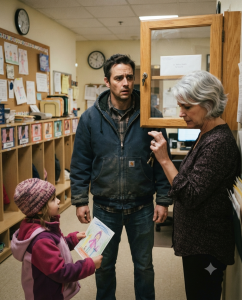
Ms. Whitmore was waiting near the front hall with Lucy beside her.
Even standing next to a shelf of tiny rain boots and cartoon backpacks, she looked impossibly composed. Silver hair in a precise bob. Cream blouse. Dark skirt. Hands folded. Her expression made Aaron feel twelve years old and unprepared for class.
“We close at six,” she said.
“I know. I’m sorry.”
Lucy, oblivious to the tension, held up a folded drawing. “I made her something.”
Aaron almost laughed from relief. Children were merciful that way. One second everything could feel like failure, and the next they were proudly presenting a crayon masterpiece as if the world had no larger problem.
“That’s nice,” he said, reaching for Lucy’s hand. “Go give it to her.”
Lucy walked over and pressed the picture into Ms. Whitmore’s hand.
Then she said, clear as bells, “Mommy said you were the one who kept the letter safe.”
Everything changed.
The hallway seemed to stop breathing.
Ms. Whitmore froze in a way Aaron would remember later with painful clarity. Not surprise alone. Something closer to impact. As if Lucy’s sentence had struck a part of her she had spent years protecting.
Aaron felt his stomach tighten. “Lucy?”
But his daughter only looked at him, puzzled that adults were suddenly strange.
Ms. Whitmore unfolded the paper. It was a child’s drawing, house and flowers and a woman under a tree. In the lower corner, awkward block letters read: FOR THE LADY WITH MOMMY’S PAPER.
Aaron saw the words and felt every protective instinct sharpen at once.
“Where did she hear that?” he asked.
No answer.
Lucy rocked on her feet. “The lady in the blue dress told me.”
The blood drained from Aaron’s face.
Mara had been buried in a blue dress.
That detail was not public. It was not casual. It was not the kind of thing Lucy could have assembled from overheard fragments. She had only been two when Mara died. She remembered pieces, sensations, bedtime songs, the smell of lavender lotion, but not funeral clothes. Not something like that.
“Lucy,” he asked carefully, “what lady?”
“Mommy,” she said.
Aaron looked at Ms. Whitmore then, and what he saw in her face frightened him more than anything Lucy had said.
Recognition.
Grief.
A history he had never been told existed.
“You knew my wife,” he said.
Ms. Whitmore swallowed before answering. “Yes.”
The word cracked open something Aaron did not have time to name.
He had loved Mara deeply. Fiercely. Imperfectly, like most people love their spouses. He knew her laugh, her coffee order, the songs she sang when she cleaned, the exact way her eyes changed when she was trying not to cry. He knew the scar on her knee from falling off a bike at twelve. He knew she hated cilantro, loved old bookstores, and could make strangers tell her their life stories in line at the pharmacy.
But standing there in that daycare hall, Aaron understood with a cold rush that there had been a part of Mara’s life he had never seen.
He followed Lucy’s pointing finger to the office behind the desk.
Inside a locked display cabinet was a white envelope.
His name was written on it in Mara’s handwriting.
For a moment he thought he might faint.
Grief trains you to accept impossibilities in small doses. A voicemail you forgot to delete. An old receipt in a coat pocket. A birthday reminder that still pops up on your phone. But a new envelope, hidden, preserved, waiting? That was not grief. That was interruption. That was the dead reaching into the living world and rearranging it.
“Why is there a letter from my wife in your office?” he asked.
Ms. Whitmore hesitated only a second. “Come inside.”
The office was small, too tidy, too bright. Children’s artwork lined one wall. A reading rug sat near a shelf of picture books. Lucy wandered to the corner and sat with a puzzle, sensing enough tension to stay quiet.
Ms. Whitmore unlocked the cabinet and removed the envelope.
Up close, there was no mistaking the handwriting. Mara’s slanted script. The way she crossed her t’s too high. The final loop of the a in Aaron, which she sometimes made too wide when she was tired.
His chest hurt.
“She asked me to keep it,” Ms. Whitmore said.
“Why?”
“Because she did not trust the truth to come out any other way.”
Aaron stared at her. “What truth?”
Ms. Whitmore held the envelope but did not release it. “Before I answer that, you need to understand who I am.”
Aaron had no patience left. “Then explain it.”
She nodded once, as if accepting something unpleasant but inevitable.
“My name is Helen Whitmore,” she said. “And I am Mara’s mother.”
The room tilted.
Aaron blinked at her, certain he had misheard.
“No,” he said instantly. “Mara’s mother died when she was fifteen.”
“That is what Mara told people,” Helen replied. “Including you.”
Aaron took a step back.
He thought of all the stories Mara had told over the years. The unstable home. The drinking. The shouting. Being sent to live with an aunt for a summer and never truly going back. The final blowup. The silence that followed. Aaron had believed that silence meant death because Mara had once said, in one of her darker moods, “The woman who raised me died to me years ago.”
He had taken it literally.
Apparently he was not the only one.
“She lied?” he asked, though the answer was already clear.
Helen closed her eyes briefly. “She simplified. Because ‘my mother is alive but not part of my life’ invited questions. Sympathy was easier than explanation. And she did not forgive me.”
Aaron looked at Lucy in the corner, then back at Helen. “Why would she leave a letter with you if she didn’t forgive you?”
Helen’s expression changed. “Because in the end she trusted me with one thing she no longer trusted anyone else with.”
That chilled him.
“Not even me?”
Helen did not answer quickly enough.
It was answer enough.
Aaron’s voice dropped. “What is this about?”
Helen set the envelope down on the desk between them. On the back was another line in Mara’s handwriting: If Lucy brings this to light, tell him everything about the hospital.
Aaron read it twice.
The hospital.
Mara had died after what was supposed to be routine follow-up treatment for a cardiac complication that surfaced months after Lucy’s birth. Aaron remembered the rushed conversations, the reassurances, the phrase unavoidable repeated until it turned meaningless. He remembered signing forms with shaking hands. He remembered being told there had been an emergency, then another, then a cascade. Complications. Rare. Tragic. We did everything we could.
He had built his grief around those phrases because there had been nothing else to hold.
“What about the hospital?” he asked.
Helen’s mouth trembled. “Mara contacted me three months before she died.”
Aaron stared. “Why?”
“She had requested medical records.” Helen’s voice was steady now only by force. “She thought something had gone wrong after Lucy was born. Something no one wanted to explain. She asked for help because I have a legal background, and because there were documents she couldn’t access without another advocate.”
Aaron felt a ringing begin in his ears.
“No.”
“She found discrepancies,” Helen said. “Medication notes that didn’t match chart times. A signed refusal form she swore she never saw. Follow-up test results that should have triggered intervention months earlier.”
Aaron looked at the envelope as if it might burn through the desk.
“Mara was preparing to file a complaint,” Helen continued. “Not just about negligence. About concealment.”
He shook his head. “She never told me.”
“I know.”
“Why would she not tell me?”
Helen’s face filled with something so painful it almost looked like pity. “Because she thought you would try to stop her.”
That landed like a slap.
Aaron opened his mouth to deny it, then closed it.
Would he have? At the time, probably yes. Mara had been exhausted, frightened, increasingly obsessed with medical notes and billing discrepancies and names of staff she wrote down at odd hours. He had urged rest, therapy, focus on healing. He had thought the search was consuming her. He had thought it was grief mixed with trauma.
What if it had been evidence?
“She wrote everything down,” Helen said. “Every appointment. Every symptom dismissed. Every time someone changed their story.”
Aaron’s hands curled into fists. “So she found you. After years.”
Helen gave a small humorless nod. “At first she only wanted advice. Then records started disappearing. A nurse who had spoken to her informally stopped returning calls. One administrator claimed not to know her case at all. Mara became certain someone was trying to close ranks.”
The office felt too small.
Lucy had picked up one puzzle piece and was turning it over in her lap, listening in silence.
Aaron lowered his voice. “Why leave a letter instead of just telling me everything?”
Helen looked at Lucy. “Because by the time she understood how serious it might be, she was already getting worse.”
He had known Mara was struggling physically in the months before her death. He had not known she was also fighting something else in secret.
“She asked me to hold the letter,” Helen said, “because she was afraid. Not only of dying. Of what would happen if the records vanished before anyone pushed hard enough. She said if she gave it to you immediately, you might read it through the lens of grief and rage. You might charge into the wrong place with half the information. She wanted time. She wanted Lucy older. She wanted the truth to land when there was at least a chance of doing something with it.”
“And the daycare?” Aaron asked, almost absurdly. “How did you become Lucy’s daycare director?”
A sad smile touched Helen’s mouth and disappeared. “I wasn’t always. I left legal practice years ago. This center belonged to my sister before she retired. After Mara contacted me, I… I tried to stay where I could be useful without forcing my way into your lives. When I learned Lucy needed care, I made sure there was space.”
Aaron reeled from the implication. “You put yourself near my daughter?”
“I watched over her,” Helen said. “At a distance. The only distance Mara allowed.”
That should have enraged him. Instead it complicated everything.
Because he thought of the times Lucy had come home with her hair neatly redone after playground tangles. The extra mittens that had appeared in winter. The way Ms. Whitmore always somehow knew when Lucy was having a hard day even before the classroom teachers mentioned it. He had attributed all of it to efficiency.
Maybe some of it had been blood.
Lucy looked up then and asked in a small voice, “Is she my grandma?”
The room went still.
Helen’s eyes filled instantly.
Aaron turned to his daughter and saw no fear there, only the simple careful curiosity children bring to truths adults have spent years ruining.
Helen answered first, voice barely above a whisper. “Yes.”
Lucy considered that. “Did Mommy know?”
Helen nodded.
“Was she mad at you?”
That question seemed to hit the deepest.
“Yes,” Helen said. “For a very long time. She had good reasons.”
Lucy lowered her gaze to the puzzle. “Did you say sorry?”
Helen made a sound halfway between a laugh and a sob. “I tried.”
Aaron felt something sharp twist inside him. All his anger at Mara for hiding this, all his shock at Helen’s existence, all of it had to stand beside the unbearable fact that Mara had died carrying unresolved history, unfinished questions, and a secret investigation into the circumstances of her own care.
He looked at the envelope again. “What’s inside?”
“Mara’s full account,” Helen said. “Copies of what records remained. Names. Dates. A statement she wanted you to have only if she couldn’t finish what she started.”
“And you kept it locked away for eighteen months?”
“I kept my promise.”
He wanted to hate her for that. He almost did. But promises to dying people had a gravity that mocked the living.
He picked up the envelope.
It was lighter than he expected. Ordinary. Just paper and glue and the weight of everything.
His fingers shook as he broke the seal.
Inside was a letter, several photocopied documents, and a small photo folded in half.
He unfolded the letter first.
Aaron,
If you are reading this, then Lucy led you where I couldn’t.
The first line blurred instantly.
He sat down because his legs no longer trusted him.
The letter was unmistakably Mara: direct when she was scared, gently funny when she thought someone else might be crying, maddeningly clear once she had decided on a course of action.
She told him first that she loved him.
Then that she was sorry.
Then that there was a chance he would hate what came next.
She wrote that after Lucy’s birth she began experiencing symptoms that were repeatedly minimized. Pain, dizziness, episodes of shortness of breath, numbers on tests that were “a little concerning” until suddenly they weren’t discussed at all. She wrote that one physician privately urged further cardiac review, but the referral never appeared in the discharge instructions. She wrote that a consent form regarding medication adjustments contained a signature that was not hers. She wrote that when she pushed back, records were delayed, conversations shifted, and one administrator had asked whether she was “struggling emotionally” in a tone that made the question feel strategic.
Then came the part that made Aaron stop reading and grip the page.
I didn’t tell you because I saw what fear was doing to you too. You were holding us together with your bare hands. If I put this on you before I knew enough, you would have tried to save me from the stress instead of helping me expose it. I couldn’t risk being talked out of what I knew in my body.
He pressed a hand over his mouth.
Helen sat across from him without speaking.
The letter continued.
Mara admitted she had reached out to her mother only after exhausting every other option. She wrote that she had hated herself for needing Helen’s help and hated even more discovering Helen was the one person willing to push through the legal stonewalling with her. She did not forgive her mother fully. She said that plainly. But she also wrote that people can fail you monstrously in one part of life and still stand up in another.
Then the line that changed everything:
If the hospital did what I think they did, my death was not just bad luck. And if that is true, Lucy deserves to grow up knowing I didn’t simply leave her.
Aaron closed his eyes and let the words destroy what remained of the story he had been living in.
For eighteen months he had mourned an unavoidable tragedy.
Now he was staring at the possibility of preventable loss hidden behind bureaucracy and silence.
He read the attached notes next. Dates. Calls. Missing reports. A nurse’s name circled twice. A specialist recommendation never filed. Lab values highlighted in yellow. Helen had added legal notes in the margins, crisp and restrained, identifying potential points where standards of care appeared to have broken down.
By the time Aaron reached the final page, grief had changed shape.
It was no longer only sorrow.
It was fury.
The next three months unraveled the rest.
Aaron retained an attorney recommended by Helen, though not without conflict. At first he resisted her involvement at every step. He did not trust her suddenly because a blood tie existed. She did not ask him to. But the evidence Mara had preserved opened doors he never could have forced open alone.
Subpoenas produced internal emails.
Missing chart updates resurfaced in archived systems.
A nurse supervisor admitted in deposition that concerns about Mara’s postpartum cardiac symptoms had not been escalated correctly.
A physician testified that he had recommended urgent follow-up but could not explain why the referral was absent.
An administrator’s email described Mara as “anxious and fixated,” language Aaron later learned was used repeatedly to discredit complaints from women who questioned their care.
The altered signature became the hinge.
A handwriting expert confirmed Mara had not signed the medication consent form. Once that was established, everything downstream looked different. Delays were no longer unfortunate. They were potentially defensive. Missing records were no longer clerical noise. They were suspicious.
The hospital settled before trial.
The amount was sealed, but the public findings could not be buried completely. Two administrators resigned. The physician board opened a review. Policy changes were announced with polished language that Aaron found sickening. Improved oversight. Revised documentation safeguards. Enhanced postpartum follow-up protocols.
Too late for Mara, he thought every time he heard one.
But not meaningless.
Never meaningless.
The personal aftermath was messier.
Aaron did not become close to Helen overnight. Real life is not a story that heals old wounds because a secret is revealed. He was angry that Mara had hidden so much from him. Angry at himself for not seeing her fear more clearly. Angry at Helen for the damage that had estranged mother and daughter in the first place. Angry that Lucy had lost her mother before she was old enough to keep more than fragments.
Yet Helen stayed.
Carefully.
Respectfully.
Without demanding absolution.
She showed up for school plays and sat in the back unless invited closer. She learned which snacks Lucy liked and which ones made her claim they were “too orange.” She told stories about Mara only when Aaron said yes, and when she told them, they were never self-serving. She spoke of Mara as stubborn, brilliant, too forgiving in some ways, impossible in others, and funny even when she was furious. Slowly, Aaron began hearing pieces of the woman he loved from a time before he knew her.
That hurt.
It also mattered.
One rainy Sunday nearly a year after the letter surfaced, Lucy sat at the kitchen table drawing with fierce concentration. Aaron was making grilled cheese while Helen dried dishes nearby after lunch.
Lucy held up a picture.
Three women this time, not one.
A little girl in the middle.
A man beside her.
A woman in a blue dress under a tree.
And another older woman standing just behind them, not touching, but close.
“Who’s that?” Aaron asked gently, pointing to the older woman.
Lucy rolled her eyes at him the way only children can and answered, “Grandma Helen. She’s in the picture now.”
Helen turned away so quickly Aaron pretended not to notice.
That night, after Lucy fell asleep, Aaron found the original envelope in the fireproof box where he now kept it. He reread the last paragraph of Mara’s letter, the part he returned to whenever anger threatened to consume everything else.
You will want someone simple to blame. Maybe me. Maybe yourself. Maybe her. Maybe all of them. But simple won’t be true. I just need one thing from you: when Lucy asks who I was, don’t let the answer begin with how I died. Let it begin with how hard I fought to stay.
He folded the letter carefully and put it back.
In the end, the lawsuit mattered. The findings mattered. The public apology, though insufficient, mattered. But what lingered longest was not the settlement or the scandal.
It was the quiet cruelty of how many chances there had been to listen to Mara before anyone did.
It was the fact that she had been called emotional when she was accurate, difficult when she was dying, and suspicious when she was simply paying attention.
It was also this: a woman she had every reason not to trust became the keeper of the truth because life is cruel enough to let our worst wounds and last chances sometimes come from the same hands.
Aaron still didn’t know whether Mara had been right to keep the investigation from him.
Some nights he thought no.
Some nights he thought absolutely yes.
He did know this: the biggest red flag had not been one dramatic mistake. It had been the long chain of smaller dismissals, each easy to excuse on its own, until together they became fatal.
And when Lucy was finally old enough to ask the full question — not just where Mommy went, but what really happened — Aaron told her the story the way Mara asked.
Not beginning with death.
Beginning with fight.