Cassie never expected a Saturday errand to split her life into a before and after.
At thirty-four, she had become the kind of woman who could carry three quiet disasters at once and still remember to pack apple slices. The divorce had been finalized nine weeks earlier. She and Daniel had signed papers in a beige office that smelled like stale coffee and copier heat, then walked out with separate folders and separate lives. He moved into a townhouse across town with a patch of decorative shrubs and strict weekend structure. She stayed in the rental house with Nolan, the unpaid electric bill in the kitchen drawer, and the kind of silence that got louder after bedtime.
The divorce itself had been ugly in the way many divorces are ugly—not because of one explosion, but because of a thousand small betrayals, each one too ordinary to sound dramatic on its own. Daniel withdrew first. Then he became cold. Then secretive. Then irritated by questions. By the time Cassie found out he had opened a private account and was sleeping in the guest room more often than their own bed, the marriage was already a hallway full of shut doors. They never recovered.
But what frightened Cassie more than the divorce was what it had done to Nolan.
At six, he had no language for legal separation or emotional estrangement. What he knew was that Daddy no longer lived at home, Mom cried when she thought no one could hear, and some adults lied when they said things were going to stay “mostly the same.” He started wetting the bed again. He snapped at teachers. He asked whether families could crack like plates and whether the pieces ever fit back together right. Once, after a pickup from school, he asked Cassie in a very calm voice whether Daniel would still love him if he became “less expensive.”
That question nearly destroyed her.
So when Nolan made it through his first week at a new school without trouble, Cassie promised him one reward that Saturday. He could choose where they went, and he chose the old toy store downtown, the one they used to pass on the way to the library.
Mercer Toys sat between a shoe repair shop and a bakery, as if it had survived by staying too charming to remove. Its front window displayed tin robots, painted rocking horses, and a mechanical carousel that still turned if someone remembered to wind it. Inside, the store smelled like dust, polished wood, and cardboard. It was the kind of place that seemed to belong more to memory than commerce.
Nolan ran straight to the train table in the back.
Cassie followed, smiling despite herself. He crouched on the floor, completely absorbed within seconds, tracing tracks with one finger, narrating station arrivals under his breath. There was something healing about seeing him want something simple. No fear. No adult questions. Just trains.
She was standing a few feet away, pretending not to check price tags, when she noticed the man behind the register watching Nolan.
He was older, maybe around seventy, slight and neatly dressed in a faded work shirt and dark slacks. His face carried the kind of sadness that had settled there long enough to become part of the architecture. Still, there was warmth in him. He took a small brass train car from the shelf, approached Nolan, and crouched down with the slow care of someone whose body no longer forgave sudden movement.
“Serious engineers always inspect the coupling first,” he said.
Nolan looked up at him as though he had just met the highest authority in train law. “Really?”
The man nodded gravely. “Otherwise the whole route can fail.”
Within minutes they were talking easily—bridges, schedules, station snacks, whether trains got lonely when left in tunnels overnight. Cassie felt grateful in spite of herself. There was no threat in the interaction, only that bittersweet relief single parents know too well: watching a stranger offer your child a shape of kindness you have not been able to provide alone.
Then the man asked, “What’s your name, captain?”
“Nolan Avery Cole.”
The brass train car dropped from the man’s hand and struck the wood with a sharp crack.
The sound cut through everything.
Cassie stepped forward immediately. The man had gone pale. He was staring at Nolan, then at her, then back at Nolan, as if he had been struck by a memory so violent it left him physically unsteady.
“Is everything okay?” she asked.
His mouth opened, but no words came.
Nolan looked worried. “I didn’t break it.”
“No,” the man said quickly, voice catching. “No, sweetheart.”
Cassie froze.
The word itself was innocent. His tone wasn’t. It held the kind of reflexive tenderness that belongs to family, not customers.
Then he repeated one word under his breath.
“Avery.”
Cassie’s spine went rigid. “Yes?”
“Who chose that name?”
Her instincts sharpened. “I did. Why?”
He swallowed. “Because my daughter was supposed to use it for her son.”
Something changed in the room.
“What daughter?” Cassie asked.
He looked at Nolan first, then back at her. “Marianne Cole.”
The name hit like a slap.
Marianne Cole was Daniel’s older sister—the sister who, according to family history, had died of an overdose six years earlier, before Cassie and Daniel married. Cassie knew very little about her because Daniel liked it that way. Marianne’s name was almost never spoken. Once, early in their relationship, Cassie had asked why there was a framed photograph of a young woman turned facedown in the hallway cabinet at his parents’ house. Daniel had replied too quickly, “My sister,” and then shut down so completely she never asked again.
Over time, Cassie learned the shape of the story from fragments. Marianne had been troubled. She had struggled. She had overdosed. The family was devastated. Daniel did not like discussing it. The end.
Now an old man in a toy store was looking at her son as if he had just seen proof that story was a lie.
“I’m her father,” he said.
Cassie grabbed Nolan’s hand. “We’re leaving.”
But Nolan, still holding the brass train car, looked up at the man and asked, “Do you want this back?”
The old man’s face softened with pain. “Did your daddy ever tell you about Aunt Marianne?”
Cassie snapped, “Don’t talk to him.”
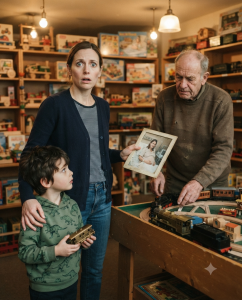
The man flinched, then crouched and reached under the train table. When he stood, he held an old photograph in a wood frame with worn edges.
He turned it toward her.
Cassie saw a pregnant woman smiling into the camera.
It took only a second to recognize Marianne.
She looked younger than the hidden family photo, younger and healthier, with a swollen belly and one hand braced beneath it. A hospital bracelet circled her wrist. The date on it was visible.
Cassie read it once.
Then again.
It was four months after Daniel had said Marianne died.
“That’s impossible,” she whispered.
“No,” the old man said. “It isn’t.”
He told her the picture had been taken at St. Agnes. Marianne had sent it to him herself. Cassie wanted to reject the whole thing instantly, to call him confused or manipulative or cruel. But there was no opportunistic gleam in him, no satisfaction. He looked wrecked.
“She didn’t die when they told you she did,” he said.
Cassie felt the ground shifting under all six years of her marriage. “Daniel told me it was an overdose.”
The man’s expression hardened with bitter recognition. “Of course he did.”
Nolan pressed against Cassie’s side, uneasy now. “Mom, who is that lady?”
Cassie could not answer.
The man reached below the table again and pulled out a second photograph. Marianne stood beside a hospital bassinet, one hand resting on the edge, her face swollen from crying or exhaustion. In the bassinet was a newborn wrapped in a striped blanket. Only part of the baby was visible, but the tiny fist poking free made Cassie’s breath catch.
Across the bottom, in faded handwriting, were the words: For Dad. His name is Avery.
Cassie stared until the letters blurred.
That was Nolan’s middle name.
The name she had chosen on instinct and Daniel had immediately hated. He had argued hard against it at the hospital. She remembered that now with horrible new clarity. Not joking annoyance. Panic. Real, visible panic. He had gone silent for almost an hour when she insisted. Later he told her it reminded him of a bully from summer camp. She had laughed and called him ridiculous.
Now she knew that had been a lie.
“What are you saying?” she whispered.
The old man’s hands trembled. “I’m saying there was a baby. And Daniel knew it.”
Cassie heard the words, but they would not settle into meaning. “No. That makes no sense.”
“He came here three years ago,” the man said. “He found me after I’d reopened the store. I thought he came because he was finally ready to talk about his sister. Instead he begged me never to contact him again, never to go near his family, never to mention Marianne to his wife.” His eyes lifted to Cassie’s. “You.”
A customer approached the counter and then stopped short, sensing enough tension to quietly retreat to another aisle.
Cassie’s voice turned flat. “Why?”
The old man hesitated. “Because Marianne didn’t just die. She disappeared first.”
He told the story in pieces, and each piece made the next one worse.
Marianne had gotten pregnant under circumstances the family considered shameful. No one could agree later whether she had been reckless, manipulated, or simply desperate to love someone who did not deserve her. Daniel became fiercely protective and increasingly controlling. Their parents were furious about the pregnancy. The house became a battlefield of accusation, secrecy, and panic over appearances.
Marianne called her father often during those months, but always in secret. She said she wanted to keep the baby. She said Daniel was the only one who still spoke to her like she was a person. She trusted him. That was the part the old man seemed least able to forgive himself for.
Then, close to the due date, the calls changed. Marianne sounded frightened. She said Daniel had a plan. He said the baby needed a safer life. He said if she signed temporary papers, they could keep the child away from their parents and fix everything later. He said it would all make sense once she had rested.
“She asked me if I thought a mother could sign something and still get her child back,” the old man said, voice breaking. “I told her not to sign anything. I told her I was coming.”
“But you didn’t,” Cassie said before she could stop herself.
The pain in his face answered first. “I had a stroke that winter. Not severe, but enough that I ended up in rehab for weeks. I missed three of her calls. By the time I got to her, she was gone.”
Gone. Not dead. Not at first.
According to him, Marianne vanished from the hospital within days of giving birth. The family told everyone she had relapsed and left. Then months later they said she had overdosed. No service. Closed casket. Minimal details. Her father was not invited. He was informed after the fact.
Cassie leaned against the display table because her knees were giving way. “And the baby?”
The old man’s eyes filled. “No one would tell me. But Daniel came to see me years later, and when I asked him whether the baby had survived, he said one thing.” The man looked directly at Nolan. “He said, ‘The child is somewhere no one can hurt him now.’”
Cassie stared at her son.
Nolan had Daniel’s last name.
He had Daniel’s dark hair, but his eyes—God—his eyes were not Daniel’s. They were a gray-blue she had always secretly loved because they felt like a private miracle in an otherwise exhausting marriage. Now she was looking at those eyes through a completely different nightmare.
“No,” she said. “No. Daniel is Nolan’s father.”
The old man did not argue.
Instead, he pulled out a worn envelope. Daniel’s name was written on the front in careful feminine handwriting.
Inside were copies: a hospital bracelet, intake forms, and a birth certificate request never finalized. The mother listed was Marianne Cole. The infant was marked Baby Boy Avery before a legal name had been filed.
Cassie’s vision tunneled.
There was one more page. Not official. Folded separately.
Daniel’s handwriting crossed the top in thick, angry strokes.
Not hers. Never tell her.
Cassie felt all the air leave her body.
She knew Daniel’s handwriting. She had seen it on tax returns, grocery lists, birthday cards, mediation notes. There was no mistaking it.
“Where did you get this?” she asked.
“He left it behind,” the old man said. “I think he didn’t realize it was in the envelope.”
Cassie could barely think. Pieces crashed together violently in her head.
Her rushed fertility timeline with Daniel after marriage. His strange resistance to photos from Nolan’s first months. His refusal to discuss the exact day Nolan’s birth certificate had been filed. The way his parents always seemed both overly attached to Nolan and weirdly formal around him, as if terrified of saying the wrong thing. His mother crying at Nolan’s second birthday for reasons no one explained. The adoption language one cousin once used by accident before being silenced with a look.
“Oh my God,” Cassie whispered.
Nolan started to cry softly then, confused by the room, by her face, by the trembling in every adult voice. Cassie dropped to her knees and gathered him into her arms. He smelled like crayons and shampoo and childhood. He was warm and real and hers in every way that mattered. But some dark hand had just reached back through time and touched the beginning of his life.
“Am I in trouble?” he asked.
Cassie held him tighter. “No, baby. Never.”
The old man turned away to give them a moment. When he spoke again, his voice was quieter. “I don’t know if Daniel adopted him legally, or took custody some other way, or if Marianne agreed to something and changed her mind. I only know she was alive after the date they gave for her death. And I know there was a baby boy named Avery.”
Cassie stood slowly.
Her fear was changing shape now. It was still fear, but underneath it something hotter was building. Clarity. Fury.
“When did Marianne actually die?” she asked.
The old man stared at the floor. “I don’t know. I only know the date they told people was false.”
That made it worse somehow. A false death date was not a misunderstanding. It was construction. Deliberate. Useful.
Cassie took the envelope.
“May I make copies of these?” she asked.
He nodded. “Take them.”
She hesitated, then asked the question she was now most afraid of.
“Do you think Daniel knows Nolan is Marianne’s son?”
The old man laughed once without humor. “He gave your child the last name Cole and panicked over the name Avery. Yes. He knows.”
On the drive home, Nolan fell asleep in the back seat clutching a cheap wooden conductor Cassie had bought him because she could not leave empty-handed after everything. Cassie drove with the envelope on the passenger seat, glancing at it at red lights as if it might rearrange itself into something less catastrophic.
Instead, every time she looked at Daniel’s handwriting, the truth sharpened.
By the time she pulled into the driveway, she had already made three decisions.
First, she was calling a lawyer.
Second, she was ordering every document related to Nolan’s birth and custody.
Third, she was not confronting Daniel until she had enough proof to survive whatever fresh lie he would tell.
That lasted less than twenty-four hours.
Because Daniel showed up Sunday evening for his scheduled custody handoff and took one look at Cassie’s face before he even stepped onto the porch.
“What happened?” he asked.
Cassie said nothing. She just held up the copy of the photo—Marianne pregnant, bracelet visible.
Daniel stopped breathing.
The silence that followed was so absolute Cassie could hear Nolan’s cartoon from the living room.
“Where did you get that?” Daniel asked.
“At the toy store,” she said. “From your sister’s father.”
Daniel went white.
“You lied to me,” Cassie said. “For years.”
He looked toward the living room as if calculating exits. “Not here.”
“Then tell me right now whether Nolan is your son.”
Daniel closed his eyes.
That was her answer.
Cassie felt something inside her go still. “Say it.”
His voice was barely audible. “Biologically? No.”
She gripped the doorframe to stay standing.
He started talking too fast after that, words tripping over each other. Marianne had been unstable. The baby’s father was dangerous. Their parents were spiraling. Marianne changed her mind every day. Daniel stepped in. There were papers. There was panic. There was a social worker who looked the other way. By the time Cassie came into his life, he told himself it was easier—safer—to let the old story stay buried.
“Safer for who?” Cassie asked.
“For Nolan,” he said immediately.
It was the wrong answer.
Because the truth was now standing in plain sight: safer for Daniel. Safer for the family that had rebuilt itself around a theft and renamed it protection.
“What happened to Marianne?” Cassie asked.
Daniel looked shattered then, genuinely shattered, and for one dangerous second Cassie saw the younger brother inside the liar.
“She came back for him,” he whispered. “Months later. She was sober. She wanted to fight for him. My parents said she’d ruin his life. They said she’d drag us all under.” He swallowed hard. “She died three weeks after that. The overdose was real. The date wasn’t.”
Cassie stared at him with a level of disgust so complete it felt almost calm.
“You let me build a family on your sister’s grave,” she said.
He started crying. She did not care.
The legal aftermath lasted months.
DNA confirmed what Daniel had admitted: he was not Nolan’s biological father. Records, once challenged, exposed emergency guardianship maneuvers, private family pressure, and hospital irregularities that never should have held up the way they did. Cassie’s marriage did not just end—it collapsed under evidence. Daniel’s parents were dragged into depositions. Some of what they had done fell into gray legal territory. Some did not. The full reckoning was messy, expensive, and deeply overdue.
And Nolan?
He remained what he had always been: Cassie’s child in every way that counted.
The law never took that from her. Daniel had become Nolan’s legal parent before Cassie entered the picture, and Cassie had become his legal mother through marriage, custody, and years of care. The court recognized continuity, stability, and the fact that a child is not a package to be re-routed when adults finally confess. Daniel’s rights became supervised for a long time. Cassie kept primary custody. She made sure Nolan saw a therapist who knew how to explain complicated truths without breaking a little boy in half.
When Nolan was old enough, she told him carefully.
Not all at once. Not cruelly. Not like a revelation hurled across a table. She told him he had a birth mother named Marianne who loved him. She told him people around her made terrible choices. She told him families can be made by blood, by law, by love, and sometimes by all three fighting in the same room. She told him none of it was his fault.
Years later, he asked to visit the toy store again.
It was smaller than he remembered. The old man—his great-grandfather, though they did not force the title on day one—was slower now, but he smiled the moment Nolan walked in. This time there were no secrets between them. Just a train table, a brass car, and a history that had finally stopped hiding.
Nolan picked up the old conductor’s hat from a shelf and laughed. “Serious engineers inspect the coupling first, right?”
The old man’s eyes filled. “That’s right.”
Cassie stood nearby and watched them.
There was no clean ending to a story like theirs. Marianne was still dead. Daniel had still lied. Whole years had been built on concealment that no apology could reverse. But truth, once uncovered, had made one thing possible that deceit never could.
It had given Nolan his full story back.
And sometimes Cassie still lay awake wondering which betrayal was worse: that Daniel stole his sister’s child and called it saving him, or that for years he looked at Cassie—the woman he claimed to love—and decided she was someone who could live forever inside a lie.