Theo Bennett had not stepped into the children’s section of the Maple Grove Public Library in almost a year.
The last time had been with Nora.
She had sat on the carpet with Owen between her knees, helping him sound out words from a picture book about foxes and winter moons. Theo remembered the exact way she looked that afternoon: hair tucked behind one ear, boots still damp from snow, laughter ready in her mouth whenever Owen made up a story to match the illustrations.
At the time, it had felt like a normal family memory. Soft. Forgettable in the best way.
After Nora died, it became one of the sharpest ones he had.
So when Owen’s teacher suggested story hour, Theo almost refused immediately. He had become skilled at avoiding bright places where families gathered in neat, ordinary shapes. But Owen had grown quieter over the past few months, and not in the way adults liked to call “mature.” It was the silence of a child learning how to hold pain without dropping it on other people.
That silence scared Theo more than tantrums ever could.
So he drove them to the library on a gray Thursday afternoon, parked under a sycamore tree shedding bark, and told himself this was one hour. One hour in a cheerful room for Owen’s sake. One hour he could survive.
The children’s area was exactly as terrible as he expected.
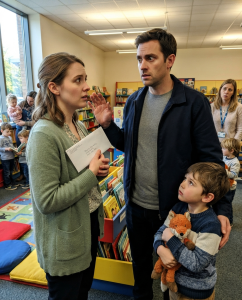
Animal cushions. Murals. Tiny chairs. Shelves low enough for toddlers to wreck in under a minute. Owen clutched his stuffed fox and sat near the front with the serious expression he now wore most of the time, as if childhood itself had become a task requiring concentration.
Theo sat off to the side and prepared to endure.
Then Maren walked in.
She introduced herself to the children, opened a picture book, and began reading with such easy warmth that the room settled around her immediately. Theo noticed the green cardigan first, then the braid, then the sadness tucked quietly beneath the smile. There was something about her that made him think of someone functioning beautifully over a fracture.
He might have forgotten her by the end of the hour if Owen hadn’t spoken.
“That’s not swizzlebright,” his son said.
The word hit Theo like a hand around the throat.
Maren froze. Theo stood. The room changed.
Within minutes, the children were being ushered toward another corner by the volunteer, Owen was clinging to his stuffed fox, and Theo was staring at a sealed envelope in the librarian’s shaking hand.
Nora’s handwriting was unmistakable.
Owen’s name was written across the front. Theo’s on the back.
Maren led them into a small program room behind the children’s desk once the other parents had cleared out. The room smelled faintly of dry-erase markers and old glue sticks. There were paper snowflakes taped crookedly to one wall even though it was spring.
Theo stayed standing.
Owen sat in a tiny plastic chair and swung his feet without understanding the gravity pressing down on the room. Maren closed the door and faced Theo like someone stepping toward a wound she knew she deserved.
“What is this?” Theo asked.
Maren looked at the envelope and then at Owen. “Maybe he should—”
“He stays,” Theo said.
She nodded once. “All right.”
Theo flipped the envelope over and read Nora’s note again.
If Maren is giving you this, it means I was right. And it means you need to let her finish before you decide what kind of man you’re going to be.
He hated the note instantly because it sounded exactly like Nora — calm in the middle of chaos, loving even while preparing to be obeyed.
“Finish what?” he said.
Maren took a breath that trembled on the way in. “I knew your wife from before the nonprofit. Before her marriage, actually. We were close in college, then lost touch, then found each other again years later through work.”
Theo said nothing.
“She didn’t tell many people we’d reconnected,” Maren continued. “Not because she was ashamed. Because by then there were already… complications.”
The word scraped at him. “Be specific.”
Maren clasped her hands so tightly her knuckles blanched. “Three years ago, a man came to the office asking for Nora. He said he was doing genealogical research. At first it seemed harmless. Then he asked questions that weren’t normal. About her son. About birthdays. About medical history.”
Theo frowned. “Why would anyone ask about Owen?”
Maren looked at him with a kind of pity that instantly made him angry.
“Because,” she said carefully, “Owen is not your biological child.”
The sentence detonated in the room.
Theo didn’t react at first, not outwardly. It was too absurd. Too offensive. Too impossible to process. Owen was sitting six feet away, scuffing one sneaker against a chair leg. Theo knew the shape of his ears, the cowlick at the crown of his head, the furrow in his brow when he concentrated. He had cut the boy’s food into tiny pieces, held his feverish body through nights of flu, taught him how to zip a coat. Biology had never entered the question.
“No,” Theo said flatly.
Maren didn’t argue. “That’s why Nora wrote the letter.”
He tore the seal.
Inside were two pages folded around a smaller note written in block letters for Owen to read when he was older. Theo pulled out the pages and recognized Nora immediately — the loops, the pressure marks, the places where she’d paused hard enough to dent the paper.
Theo,
If you’re reading this, I’m gone, and Maren decided the danger of silence finally became bigger than the danger of truth. I’m sorry. I know that sentence already feels like betrayal.
Owen is yours in every way that matters. I need you to hold onto that before you read the rest.
Theo’s vision blurred. He read on.
The letter told a story he had never heard.
Years before Theo met Nora, she had been in a short relationship with a man named Daniel Voss. Charming, brilliant, unstable in ways that revealed themselves too late. When she ended things, he disappeared for a while. Months later, she learned she was pregnant.
But she had already met Theo by then.
The timeline had been close enough that she could not be fully certain whose child she was carrying at first. Then Daniel resurfaced and made certainty feel dangerous. He had become obsessed with lineage, inheritance, “legacy.” He sent long messages about bloodlines and what belonged to him. Nora saw enough of his unraveling to become afraid.
She told almost no one.
By the time Owen was born, Theo was in the room, crying openly when the nurse placed the baby in his arms. Daniel was gone again. And Nora, terrified that giving him any legal or emotional doorway into their lives would put the baby at risk, made a choice she then buried under love, shame, and the false hope that the past would stay buried.
Theo sank into a child-sized chair without realizing he was sitting.
The letter continued.
I wanted to tell you so many times. After our wedding. After Owen’s first birthday. After every night you fell asleep with him on your chest and I thought, he deserves the whole truth. But each year that passed made the truth feel less like honesty and more like a bomb.
Two years ago, Daniel found me again.
He came to my office. He said he’d hired someone to trace public records and timelines. He said he knew Owen existed. He wanted proof. He wanted contact. He wanted “what was his.” I told him I would call the police. He laughed.
Theo’s hands shook.
Nora had written that Daniel never approached the house, never contacted Theo directly, and never got close to Owen. Because she and Maren had made a plan.
Maren had once volunteered with a legal aid network before becoming a librarian. She knew a family lawyer who quietly advised Nora on documentation, restraining orders, and paternity risks. They gathered records. Saved messages. Logged every appearance. Nora kept the worst of it from Theo because she feared two things at once: that Theo would blame her, and that if he confronted Daniel directly, it would escalate.
Then Nora got sick.
The diagnosis came fast. Aggressive. Ruthless.
And with death suddenly closer than the truth, she made one final set of decisions.
“She came to me after her second treatment,” Maren said softly while Theo stared at the letter. “She was terrified she’d run out of time.”
Theo looked up. “You helped her hide this from me.”
“I helped her document everything,” Maren said, tears standing in her eyes. “I told her to tell you. More than once. She kept saying she would, and then she’d look at Owen and panic. By the end she was trying to protect all of you at once, and that’s when people make impossible choices.”
Theo looked back at the page.
If Daniel came back after I died, Maren was supposed to hand you everything. The letters. The records. The attorney’s name. I prayed she’d never have to.
If she did, it would mean he found another way to surface. Or that Owen said something only Maren would recognize as a sign.
Swizzlebright, Theo realized.
Nora had used the word with Maren once, in the parking lot after a meeting, while crying in the driver’s seat. She had talked about the nights she watched moonlight on Owen’s wall and told herself she had chosen the right father even if she had made the wrong beginning. She had taken off her blue scarf, handed it to Maren through the cold, and asked her for one more favor.
If I’m gone when this breaks open, don’t let Theo hear it from a stranger.
Theo covered his mouth with one hand.
Across from him, Owen was watching quietly now, sensing that the room had crossed into something serious. “Daddy,” he said, “why are you crying?”
Theo opened his eyes and looked at his son.
Not my biological child.
The words were supposed to change something. Maybe in some people they would have. But what Theo felt, under the shock and betrayal and raw anger, was something almost feral in its certainty.
Mine.
He stood, crossed the tiny room in two steps, and knelt in front of Owen. “Because Mommy wrote us a letter,” he said hoarsely. “And some parts are sad.”
Owen reached out and touched his cheek with a small hand. “Did she still love us?”
The question split him open.
“Yes,” Theo said. “More than anything.”
Maren turned away, wiping her face.
Theo read the rest of the packet over the next hour in the program room while Owen colored with library crayons at the far end of the table. There were copies of messages from Daniel. Notes from the lawyer. Dates. A draft restraining order Nora had never filed because Daniel disappeared again before the paperwork was complete. And most recently, one chilling addition in Maren’s handwriting: a note from two weeks earlier.
Man in parking lot asking whether Bennett child still attends Maple Grove Elementary. Left when noticed. Dark coat, late forties. I did not engage.
Theo’s blood iced over.
“That was him?” he asked.
Maren nodded. “I recognized him from the photo your wife kept with the file. I hoped I was wrong. Then Owen said the word today, and when he recognized me… I knew I couldn’t hold this any longer.”
“Why didn’t you call me?”
“I tried,” she whispered. “The number Nora had for you was old. I mailed a note to your house last week, but I wasn’t sure it reached you.”
It hadn’t. Theo thought of the overflowing junk mail on the kitchen counter, untouched for days.
Rage rose then — at Nora, at Daniel, at illness, at fear, at the brutal arrogance of being left to inherit a truth after the person who withheld it could no longer answer for it. But even in the center of that fury, he knew something that would remain true no matter what else shattered.
Owen was his son.
Not in sentiment. In fact. In the only fact Theo now cared about.
He left the library with the full packet in a manila folder, Owen’s hand locked in his, and drove straight to the lawyer whose number Nora had underlined twice. By evening, temporary protective steps were already in motion. School notified. Pickup list frozen. Records flagged. House security checked. A police report filed on the parking-lot sighting and the previous documented contact.
Daniel surfaced one final time six days later.
A patrol car was already parked near the elementary school because of the report. Theo was inside the office reviewing updated release instructions when the front desk secretary stiffened and looked toward the glass doors.
A man stood outside, not trying to enter, just watching the hallway where children would soon be dismissed.
Late forties. Dark coat. Stillness that looked practiced.
Theo knew him instantly from the photo in Nora’s file.
Daniel saw Theo, and something like satisfaction flickered across his face. He raised one hand as if greeting an equal.
Theo moved before the officer could stop him, then caught himself two steps short of the doors. Nora’s line flashed through his mind.
Decide what kind of man you’re going to be.
So he stopped.
The officer went out instead. Another followed. Daniel spoke for less than a minute before they turned him, searched him, and placed him in cuffs. He had no legal claim, no court order, no right even to stand there after the warnings already issued from the initial report. The messages on Nora’s record and the new sighting were enough to begin.
Theo watched through glass while his whole body shook.
That night, after Owen fell asleep, he finally read the smaller letter Nora had written for their son’s future.
It wasn’t about blood.
It was about choice.
About the first time Theo held him. About the way he learned to fall asleep better to Theo’s heartbeat than anyone else’s. About love becoming real not in an instant, but in ten thousand ordinary acts so repeated they turned into a life.
You were wanted, she had written. Fiercely. Protected imperfectly, but loved perfectly.
Weeks later, once the legal dust began to settle and Daniel’s path toward any contact was blocked for good, Theo returned to the library with an overdue fox book he barely remembered borrowing in the chaos.
Maren was shelving returns.
For a moment they just looked at each other over the cart that had hidden the envelope.
“I don’t know whether to thank you or blame you,” Theo said.
“That seems fair,” she replied.
He almost laughed, which startled them both.
“I’m angry with her,” he admitted.
“I know.”
“I’m angry with you too.”
“I know that too.”
He nodded. “But you kept your promise.”
Maren’s eyes filled. “I did.”
Theo set the book on the cart. “And for what it’s worth, you were wrong about one thing.”
She went still. “What’s that?”
He thought of Owen asleep in his room with the stuffed fox under one arm. Thought of the school form he had filled out that morning. Father’s name: Theo Bennett. No hesitation.
“You said that once I knew, everything I thought I knew about my family would change.”
Maren waited.
“It didn’t,” he said. “Only one thing changed. Now I know how afraid Nora was.”
Maren pressed a hand to her mouth and looked down.
He left before either of them said anything softer.
That night the moonlight came through Owen’s blinds in pale silver bands across the wall. Theo stood in the doorway a long time, watching his son sleep. The room glowed faintly, dust drifting in the beam like tiny suspended secrets.
Swizzlebright.
The word still belonged to Nora. Maybe it always would. But as Theo looked at the child he had raised, protected, and loved with his whole unguarded heart, he understood something that arrived too late and yet all at once.
The worst betrayal in his marriage had not been that Nora hid the biology.
It was that fear convinced her he might ever love Owen less because of it.
And that was the red flag he would never stop wondering about afterward — not Daniel, not the lies, not even the letter hidden in a library cart.
Just how alone the woman he loved must have felt to believe the truth would cost her the family it was actually built on.