Naomi had not planned to stop.
That was the thought that kept running through her mind later, after everything had split into a before and an after. If Elsie hadn’t gotten sick. If the rain had eased. If the gas tank had been a little fuller. If Naomi had decided she could push another forty miles before looking for food, a restroom, somewhere bright enough to keep exhaustion from feeling dangerous.
But life had a habit of making its biggest turns in places nobody would choose on purpose.
By the time she saw the roadside diner, Naomi had been driving for six hours with the radio low, one hand on the wheel, and the steady pressure of survival sitting behind her ribs like a stone. She was thirty years old, recently divorced, nearly out of money, and heading toward a different state because a cousin she had not seen in years had offered her one spare room and two months to get on her feet.
It wasn’t the future Naomi had imagined when she was younger. It wasn’t even the future she had imagined a year ago. But it was a future, and that was more than she felt she had been promised lately.
In the back seat, her five-year-old daughter had been quiet for a long stretch, clutching a stuffed rabbit by one ear and watching the blur of highway lights through the glass. Naomi had taken the silence as a blessing.
Then she heard the voice.
“Mommy, I don’t feel right.”
One glance in the mirror told her this wasn’t a complaint she could smooth over with crackers and a cartoon voice. Elsie was pale, damp with sweat, and swallowing hard.
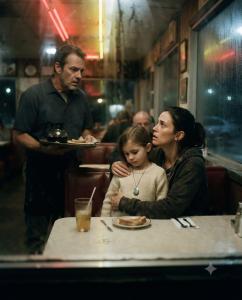
A few minutes later, Naomi had pulled off the interstate into the parking lot of a lonely diner with a neon OPEN sign buzzing in the window and rain slicking the asphalt black.
The place looked tired in a permanent way. Old siding. Fogged glass. A truck parked crooked near the side entrance. Naomi would have passed it by under other circumstances. But motherhood had a way of making almost any place acceptable if it had a bathroom and a booth.
Inside, the waitress took one look at Elsie and pointed them toward a table near the restroom with the efficient kindness of someone who had seen enough life not to waste energy on judgment. Naomi cleaned up her daughter, sat her down, ordered toast and ginger ale, and tried not to think too hard about money.
That had become its own reflex by then. Thinking around money. Bending thoughts away from it until a bill actually had to be paid. Gas, food, medicine, rent, childcare, the cost of moving, the cost of being left, the cost of not having anyone to split the ordinary ugliness with.
Elsie leaned against the booth, weak but apologetic.
“I’m sorry, Mommy.”
Naomi brushed damp hair off her forehead. “No, baby. You don’t say sorry for being sick.”
Elsie nodded solemnly.
She was a soft child. That was the only way Naomi knew to describe it. Not weak. Just tender in all the places the world tended not to spare. She apologized when other children cried. She offered strangers the last cracker in the pack. She had the terrible, beautiful instinct to assume feelings were everybody’s responsibility.
A few minutes later, a man emerged from the kitchen carrying the ginger ale.
Naomi guessed he was the owner before he said a word. He had that look some people in small places carry — not employee, not customer, but someone whose grief and labor had soaked into the walls. He was in his late forties, broad through the shoulders, wearing a faded flannel shirt with the sleeves rolled up. No ring on his finger, but the pale indentation where one had sat for years remained.
“On the house,” he said, setting the glass down.
Naomi thanked him, careful to keep dignity in her smile.
He nodded.
Then Elsie lifted a hand to move her hair.
The silver locket slid free from beneath her shirt collar.
What changed in the man’s face happened so quickly Naomi almost thought she had imagined it. One second he was politely tired. The next, every bit of color had gone out of him.
He stared at the necklace.
Not with curiosity.
With recognition.
“Where did she get that?” he asked.
Naomi straightened in her seat. “It’s hers.”
His eyes lifted to meet hers. “That locket belonged to my wife.”
The words landed like something blunt and cold.
Naomi’s first instinct was disbelief. The locket was old and simple. Plenty of lockets probably looked like it. But then he said, very quietly, “There’s a dent on the hinge. She dropped it in the maternity ward bathroom in 2018.”
That was the moment Naomi stopped hearing the rest of the diner clearly.
Because Elsie had been born in 2018.
At a hospital in the same city.
Naomi looked at the locket, then at the man. “How do you know?”
“My wife cried over it for weeks,” he said. “It had something inside.”
Something inside.
Naomi’s pulse began to pound.
She had gotten the locket in the hospital, though she had never told anyone that outside a few passing remarks. After Elsie’s birth, during one of those long, disjointed hours when medication, panic, and exhaustion had turned time slippery, the hospital returned her belongings in a plastic bag. The necklace had been among them. She remembered questioning it vaguely. A nurse had said it was probably a mix-up. Naomi had been too overwhelmed to push.
The birth itself had been chaotic. Her labor turned dangerous fast. There had been shouting, bright lights, signatures she barely remembered making, a doctor whose face she couldn’t picture later, and the crushing isolation of realizing the baby’s father wasn’t coming after all.
By the time she was discharged, she was functioning on fear and instinct. She didn’t have family at the hospital. She didn’t have anyone to compare details with. She had a newborn, a stack of paperwork, and a body that no longer felt entirely like hers.
So the locket came home.
Months later, when Elsie found it in a drawer and asked if it was magic, Naomi laughed for the first time in days and told her maybe. She let her wear it on special days. Then on more days. Then almost always.
Now the owner of a diner was telling her it belonged to his wife.
“What was her name?” Naomi asked.
“Caroline.”
The name meant nothing to her.
But it should have meant nothing in a harmless way. Instead it landed heavy.
Before Naomi could ask anything else, Elsie touched the locket and said, “The pretty lady told me not to open it till we were far away.”
Naomi turned to her so fast it startled them both. “What pretty lady?”
“At the gas place,” Elsie said.
Naomi replayed the stop in her mind. The rain. Pump number four. The old woman heading inside with coffee. The bored cashier behind the counter. No pretty lady speaking to her daughter.
The owner had gone even paler.
“Open it,” he said.
Naomi hesitated. Everything in her wanted distance. She wanted to leave the diner, leave the state, leave the entire conversation behind. But the pressure in the room had become impossible to ignore, as if the truth had been sitting just beneath the surface of ordinary life waiting for one dented piece of silver to expose it.
She unclasped the locket.
Inside was a folded square of paper.
The owner took a step back as though struck.
Naomi unfolded it carefully.
The handwriting was small and hurried.
If something happens, do not let them take her.
Trust the bracelet. Not the chart.
A cold wave moved through Naomi so suddenly she thought she might faint.
The owner gripped the edge of a nearby booth. “That’s Caroline’s writing.”
Naomi looked up. “What does this mean?”
He swallowed hard, eyes fixed on the note. “After the delivery, she kept saying something was wrong.”
The waitress, sensing something private and terrible had settled over the booth, quietly pulled the coffee pot away from nearby customers and guided them toward the far end of the counter. The diner had not gone silent, but it had grown respectfully thinner around them.
“My wife was admitted at thirty-six weeks,” the owner said. “She was having complications. There was a lot of panic. Monitors. Nurses switching in and out. She said after the birth, they brought her a baby, and she knew something was wrong.”
Naomi’s fingers tightened around the note. “Wrong how?”
“She said the bracelet wasn’t right.”
The words dropped between them.
Naomi stared.
He let out a breath that shook. “Caroline said the name card on the bassinet had one thing, the chart at the foot of the bed had another, and the bracelet on the baby’s ankle didn’t match what she’d seen earlier. I told her she was exhausted. The doctor told her trauma could cause confusion. The staff said there had been no mix-up.”
He stopped. Looked at Elsie.
Then back at Naomi.
“Our baby died two days later.”
The sentence did not sound rehearsed, though he must have said some version of it before, to doctors, relatives, maybe himself. It sounded raw in a way grief only stays raw when part of it never healed correctly.
Naomi’s mouth had gone dry. “And Caroline?”
His face changed again, but this time into something older.
“She never got over what she believed happened in that hospital. She said they handed her the wrong child and then took her back before she could prove it. She said our daughter was alive, that they were covering something up, that nobody listened because they thought grief had made her irrational.”
A dull roaring started in Naomi’s ears.
“Did she…?” Naomi began, unable to finish.
“She spiraled,” he said. “For years. Became obsessed with records, timelines, nurses’ names. I thought I was protecting her by not feeding it. By telling her to let go. Telling her she needed help.” His jaw clenched. “She died last year. Car accident.”
Naomi closed her eyes for one second.
When she opened them, Elsie was looking up at her, frightened but quiet.
“Mommy?”
Naomi grabbed her hand. “You’re okay.”
But even as she said it, another memory flashed in with terrifying clarity.
In the glove compartment of her car was a plastic folder containing every important paper she had not trusted to the moving boxes: lease copies, divorce documents, Social Security cards, vaccination forms, and one small hospital bracelet Naomi had saved because new mothers save strange things when they are afraid of losing the proof that a moment happened.
She had never looked closely enough at it. Not once.
The owner saw something shift in her face.
“You kept her bracelet?” he asked.
Naomi nodded slowly.
Rain tapped harder against the windows.
He said, “Bring it in.”
Naomi should have refused. A reasonable person would have said no. A protective mother would have put her daughter in the car and driven until daylight. But reason had stopped being the strongest force in the room.
She asked the waitress to sit with Elsie for one minute, then went out to the parking lot with the owner a few steps behind. The air smelled like wet asphalt and diesel. Her hands shook so badly she dropped the keys once before unlocking the car.
She found the folder in the glove compartment and stood under the weak glow of the diner sign, flipping through papers until the old hospital band slid loose into her hand.
It was faded.
The ink was lighter than it should have been after all those years.
But still readable.
Baby Girl Hale.
Naomi froze.
Her last name at the time had not been Hale. Hale was the last name the baby’s father carried before disappearing for good. Naomi had never used it. She had refused to put it on paperwork after he left during her pregnancy. She remembered that decision vividly because it was one of the first choices that felt like survival.
Slowly, she turned the bracelet over.
There was a number written beneath the printed line. Room 614.
The owner inhaled sharply behind her.
“Caroline was in 614,” he said.
Naomi looked at him, face numb.
Inside the diner, the neon sign hummed.
Water dripped from the edge of the roof.
And all at once a dozen things she had dismissed over the years came rushing back with sickening force. The nurse who had corrected another nurse on the room number. The chart that had once been wheeled out of her room in a hurry. The awkward discharge delay. The strange question from a pediatrician that didn’t seem to fit her own chart. Fragments. Tiny misalignments. Things a traumatized woman alone in a hospital had not trusted herself enough to challenge.
They went back inside.
Naomi’s legs felt unreliable. The owner — his name, she finally learned, was Ben — made a phone call from the landline behind the counter to a retired nurse he knew still lived in town, someone Caroline had spoken to years ago while trying to get answers. Naomi almost told him to stop. Almost said this had gone too far. But then the nurse answered.
Her name was Judith.
She remembered Caroline immediately.
And when Ben told her what they had found, the silence on the line lasted so long Naomi thought the call had dropped.
Then Judith said, “There was a report.”
Naomi and Ben looked at each other.
Judith’s voice was low and tired. “It was buried. One infant transfer without proper documentation. Two charts temporarily mismatched during an emergency intake overflow that week. Administration handled it internally. We were told the issue was resolved.”
Ben gripped the phone. “Resolved how?”
“I never got a straight answer,” Judith said. “But one of the nurses quit three weeks later.”
Naomi sat down because her knees gave out.
Elsie slid closer in the booth and leaned against her.
Ben asked for names. Judith gave one. The nurse who quit had moved to another town nearby.
An hour later, with the waitress watching Elsie in the diner office and the rain finally easing to mist, Naomi and Ben drove to a small house with a screened porch and a porch light still on.
The woman who opened the door had gray in her hair and alarm in her face even before Ben finished saying the hospital’s name.
Her name was Denise.
At first she denied remembering anything unusual. Then Naomi showed her the bracelet. Then Ben showed her the note. Then he said Caroline’s name.
That was what broke her.
Denise sat down hard in a chair by the door and covered her mouth.
“I thought they fixed it,” she said.
Naomi heard herself ask, “Fixed what?”
Denise began to cry.
During an overloaded shift, she said, two mothers had delivered within minutes of each other during a chain of staffing errors. One infant had respiratory distress and was transferred. Bracelets were printed twice after a scanner issue. A chart had been placed at the wrong bed during a room change. Denise noticed a mismatch, reported it, and was told not to create panic until administration verified identities.
“They said DNA confirmation would be done quietly,” she whispered. “Then I was told later everything matched and I was mistaken.”
Ben stared at her. “You let my wife believe she was losing her mind.”
“I was threatened,” Denise said. “My supervisor told me if I talked, I’d lose my license. I had two kids. I was terrified.”
Naomi was shaking so hard her teeth clicked once. “And nobody contacted me. Nobody.”
Denise looked at her with the face of someone who had rehearsed regret for years and found it useless. “I think they decided the records were too messy, and once one baby was discharged and the other had complications…” She couldn’t finish.
Ben did.
“They buried it.”
Denise nodded.
The next weeks unfolded in a blur of lawyers, record requests, emergency court motions, and DNA tests performed under fluorescent lights while Naomi felt as if her entire nervous system had been peeled raw.
She did not sleep much. Neither, judging by his face, did Ben.
The wait for the results was the cruelest part. Naomi loved Elsie with a force that had been built day by day, fever by fever, bill by bill, lullaby by lullaby. No paper, no blood test, no administrative horror could alter what motherhood felt like in her bones.
But love and truth were not always simple partners.
When the results came, Naomi was sitting in a legal office holding a paper cup of coffee she had forgotten to drink.
Elsie was Ben and Caroline’s biological daughter.
The infant who died in the hospital had been Naomi’s.
For a long time, nobody spoke.
Naomi stared at the page until the letters blurred. She felt grief unlike anything she had ever known surge up from some place deeper than language. Not because she loved Elsie less. Never that. But because somewhere inside those first terrible days, she had been separated from the child she had birthed and never even given the chance to know it.
Ben began to cry the way some men do when it gets past dignity entirely — silent at first, shoulders folding inward, then one broken sound after another.
Naomi cried too.
The law, when it finally moved, did so in cautious, ugly language. There were investigations, sealed settlements, public silence from the hospital, and more than one person quietly resigning before formal consequences landed. Naomi was advised to prepare for custody discussions. Ben was advised to seek rights. Everyone spoke as though this could be arranged into legal categories.
But human hearts did not organize that neatly.
In the middle of the devastation, one fact stood firm: Elsie was not a file to be transferred. She was a child who loved pancakes cut into stars, slept with one sock off, and still reached for Naomi after bad dreams. She was also the daughter Caroline had died believing was alive.
Ben did not try to take her away.
That mattered.
Instead, slowly and painfully, he began to know her.
At first, it was supervised visits in Naomi’s cousin’s living room. Then afternoons at parks. Then dinners. Ben learned she hated mustard and loved drawing foxes. He learned she got quiet when she was overwhelmed. He learned she tilted her head exactly the way Caroline did when listening hard.
Naomi hated him sometimes for existing inside this story. Then hated herself for it. Ben hated himself for dismissing Caroline’s fears. Then hated the hospital. Then hated silence. Grief moved through both of them in unpredictable waves, carrying blame, tenderness, rage, and impossible gratitude all tangled together.
The locket became evidence, then memory, then something else.
Inside it, the note Caroline had hidden remained the clearest proof that a mother on the edge of being dismissed had still tried to leave a trail. She had known something was wrong. She had been right. The world around her had been too arrogant, too rushed, too frightened of liability to listen.
Months later, Naomi sat at her kitchen table while Elsie colored beside Ben on the floor. The legal agreements had finally settled into a strange shared arrangement no one would ever have chosen but everyone now had to honor. Ben had a room prepared for Elsie at his house. Naomi still tucked her in most nights. Some days the arrangement felt generous. Other days it felt like living on top of an earthquake fault.
Elsie looked up from her crayons.
“Mommy?”
“Yes, baby?”
“Did the necklace belong to my other mommy?”
Naomi’s throat tightened.
“Yes.”
Elsie considered that carefully, then asked, “Was she nice?”
Naomi looked at Ben. His eyes had gone wet again.
“She must have been,” Naomi said. “Because she tried very hard to find you.”
That night, after Elsie had fallen asleep, Naomi stood alone in the hallway and held the locket in her palm.
The dent was still there.
The hinge still stuck a little.
Such a small thing, she thought, to carry so much ruin and so much truth.
She imagined Caroline in a hospital bed, frightened, unheard, desperate enough to hide a note in her own necklace because she knew memory could be questioned but an object might survive. Naomi imagined the years Ben had spent thinking grief had made his wife irrational. She imagined the child Naomi never got to know. She imagined how close this entire truth had come to staying buried forever.
People liked to believe the biggest warning signs arrived loudly. With alarms. With villains. With something obvious enough that good people could step in and stop it. But sometimes the red flag was quieter than that. A chart no one double-checked. A mother no one believed. A nurse too scared to speak again. A father mistaking certainty for steadiness. A woman too overwhelmed to push one question further in a room where everybody else seemed sure.
In the end, the truth had come back through a dent in a locket and a child who repeated one strange sentence at exactly the right time.
Naomi still did not know what to call what happened after that — miracle, horror, correction, theft, grace, cruelty. Maybe all of it.
She only knew this:
Love had made a family.
Negligence had broken the truth.
And one dead woman, dismissed in life, had been right all along.
Some nights Naomi wondered whether forgiveness belonged anywhere inside a story like that. Whether Ben deserved it. Whether the hospital did. Whether she herself deserved peace for not asking harder questions when she had been exhausted and alone and barely standing. She never found a clean answer.
But whenever Elsie curled against her and the silver locket flashed once in the lamplight before bed, Naomi thought of Caroline’s note and the line that had survived everything:
Do not let them take her.
In the end, that was exactly what Caroline had tried to do.
And somehow, years too late and by the narrowest possible chance, she finally succeeded.