By the time Bette Calloway drove out of Greenville before sunrise, she had already rehearsed every version of the day in her mind.
In one version, Diane Pruitt denied everything and made Bette look confused, emotional, vindictive. In another, the publisher hustled Bette out before she could say a full sentence. In another, Diane cried and called it a misunderstanding. In the worst version, nobody believed her at all, and Mae’s handwriting—those sixty years of flour-dusted cards, margin notes, and family memory—would be swallowed whole by a glossy hardback with somebody else’s name on it.
But even in the worst version, Bette knew one thing.
She was going to stand up.
She left Greenville in a navy dress, low heels, and her mother’s pearls. On the passenger seat sat a manila envelope secured with a rubber band. Inside were copies of recipe cards, church cookbook pages, photographs, handwritten letters, affidavits, and a timeline so carefully assembled it could survive hostile lawyers. Tucked into a smaller sleeve inside the envelope was the original index card she had carried everywhere for eighteen months.
Bette stopped once for coffee near Walterboro, though she barely drank it. At a red light outside Charleston, she caught sight of herself in the rearview mirror and saw not just her own face but traces of Mae in the set of her mouth. It steadied her.
The ballroom on East Bay Street looked exactly like the kind of place where theft gets renamed curation. White linens, magnolia leaves, wine glasses, polished silver easels displaying poster-size reproductions of Diane’s book cover. The title—Roots & Receipt—was printed in elegant serif lettering above a story about preserving lost Southern traditions. Bette had hated that title from the first moment she saw it. It sounded clever. It sounded respectable. It sounded like the kind of lie people quote approvingly.
Inside, Diane moved from group to group in a cream blazer, smiling and accepting congratulations. She looked radiant, which Bette thought was a remarkable thing to pull off while standing on top of someone else’s dead mother.
Bette checked in, took her seat in the back, and scanned the room until she found the woman they were waiting for: Andrea Vale, a legal investigator retained by the publisher after an anonymous package had reached the house counsel six weeks earlier.
Anonymous had been Gloria’s idea.
“Don’t give them time to bury it,” Gloria had told Bette over the phone. “Send enough proof to scare ’em into looking before the launch.”
Gloria had turned out to be indispensable in more ways than one.
Bette first called her after finding the book announcement. She remembered Gloria being close to Mae in the late 1960s, when both women had young children and no money and traded recipes like practical currency. Gloria, now eighty-three and living with a daughter outside Columbia, answered on the third ring.
“You say Diane Pruitt?” Gloria had asked.
“Yes.”
A long pause.
Then: “That woman was in your mama’s kitchen enough to know better.”
Over the following months, Gloria became both witness and strategist. She told Bette what details mattered, which old church ladies would remember dates, where Mae might have sent duplicate cards, and which cousin kept every scrap of paper out of pure inability to throw things away. She also remembered something Bette had forgotten: after Mae’s funeral, Diane had asked to stop by Gloria’s place on the way home, claiming she had “a surprise from Bette’s attic” to show her.
At the time, Gloria thought nothing of it. Diane came in carrying a banker’s box and set it on the dining table. Inside were notebooks and recipe cards. Diane said she was “helping organize some of Mae’s papers” and wondered whether Gloria recognized a few old recipes. Gloria looked through them, recognized the sweet potato pie, the red velvet cake, and a chicken bog recipe Mae had adjusted for church suppers, and handed them back.
Months later, when the pre-order link started traveling through local circles, Gloria knew exactly what she had seen.
That one memory turned suspicion into timeline.
Bette built the rest piece by piece.
Her cousin Laverne in Spartanburg produced two composition notebooks from a hope chest. Mae had given them to Laverne years earlier “for safekeeping,” then forgotten they were gone. Mrs. Tinsley found a card for tomato aspic tucked inside a 1978 phone book. A cousin in Anderson found Christmas cards with recipes on the back. The 1987 church cookbook came from a flea-market box purchased by Bette’s nephew purely because he recognized the church name.
And every find pointed the same way: Mae had documented these recipes for decades under her own name, in her own hand, long before Diane ever claimed them as heritage.
What truly deepened the case was Diane’s own carelessness. In the promotional excerpts sent to reviewers, several recipes retained Mae’s exact margin notes. One line about adding “a little more butter than you think you need” appeared nearly unchanged. Another headnote preserved Mae’s anecdote about not rushing the roux because “it knows when you’re in a hurry.” Diane had adapted some wording around them, but not enough to disguise the origin from anyone who had lived with those pages.
Bette did consult a lawyer eventually—Tom Bresciani, a quiet intellectual property attorney in Greenville who had the disconcerting habit of sounding calmest when a situation was worst. Tom explained that recipes as lists of ingredients might not be strongly protected, but the original notes, narratives, handwriting, compiled manuscript structure, and false claims of authorship told a much bigger story. Add the physical removal of the box and the promotional representations to the publisher, and the matter widened quickly.
“We don’t need outrage,” Tom said during their second meeting. “We need proof that survives contact with people paid to dismantle it.”
So Bette gathered more proof.
The anonymous package sent to the publisher included side-by-side pages, dates, affidavit summaries, and enough evidence to convince the in-house counsel not to ignore it. That prompted the publisher to hire Andrea Vale to attend the launch and quietly confirm whether Diane would continue making direct claims of family ownership in public while under review. Andrea, a former clerk now working investigations, coordinated with Tom in the background. Her federal court credentials were real; her purpose that night was not to arrest anyone but to ensure the evidentiary chain remained clean once the confrontation began.
What none of them expected was the final crack in Diane’s story to come from inside her own house.
Two days before the launch, Tom called Bette and asked her to sit down.
Diane’s nephew, Travis Pruitt, had contacted him through a referral. Travis had been helping Diane clear garage shelves the previous year when he saw a box labeled “Mae Recipes / attic.” He remembered it because he asked why his aunt had someone else’s name on a box she was guarding so carefully. Diane told him she was “editing a family project for Bette.” He thought that was odd because the box stayed in Diane’s locked study for months, and by the time he next visited, the notebooks were gone and Diane was talking about a book proposal.
At first he kept quiet. Then he saw the launch coverage and the pre-order buzz, and guilt got louder than loyalty.
He signed a statement.
He also forwarded a text from Diane sent ten months earlier: Don’t mention those attic papers to anyone. Bette gets sentimental and confused.
When Tom read that aloud, Bette felt something inside her go cold and precise. Grief was still there. Betrayal was still there. But humiliation finally left. Diane had not merely stolen Mae’s work; she had planned to use age and sorrow to discredit Bette if necessary.
That was the part Bette could not forgive.
So she sat in the ballroom and waited until Diane reached the podium.
Diane’s speech began beautifully. That was part of the horror. She thanked her publisher, her editor, the booksellers, the Charleston literary community. Then she shifted into reverence.
“This book comes from family,” Diane said. “From the women who raised me, from recipes passed hand to hand across generations, from a lifelong passion for preserving Southern food traditions before they disappear.”
Bette stood.
It was astonishing how quickly a room senses real trouble. Conversations ceased not in one clean moment but in waves. Diane saw her, faltered, then recovered with a smile so brittle it seemed to shine.
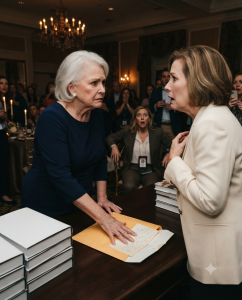
Bette walked to the table and placed the manila envelope in front of her.
“I think,” she said, her hand flat over the papers, “we need to talk about whose family this actually belongs to.”
The silence that followed had weight.
Diane’s face drained. The publicist surged forward for the microphone. Andrea Vale rose from the back and approached the stage. The editor from New York put down her wine glass and came closer, confusion sharpening into alarm as Andrea introduced herself and presented the publisher’s counsel packet.
“Ms. Pruitt,” Andrea said evenly, “the publisher has received documentation raising serious questions about authorship and source materials in this book.”
Diane tried to laugh. It came out breathless and thin. “This is absurd.”
Bette opened the envelope and removed the index card.
Small. Faded. Blue ink. Mae’s hand unmistakable.
She held it up only long enough for the nearby editor to see, then read aloud the note at the bottom. It matched a passage in Diane’s galley excerpt almost word for word.
The editor looked from the card to Diane. “Where did you get this material?”
“It was shared with me,” Diane said.
“By whom?”
Diane said nothing.
Bette spoke then, and everyone in the room heard the steel beneath the hurt. “Tell them what you told me after my mother’s funeral. Tell them why you asked to help sort the attic. Tell them what was in the box you carried out.”
Diane’s eyes flashed—not with innocence, but with calculation. “Bette, you’re upset. You’ve had a hard few years.”
It was the wrong move. Too practiced. Too patronizing. Too revealing.
Andrea handed the editor the affidavits. The editor flipped through handwriting comparisons, dates, photocopies of the church cookbook, Gloria’s statement, Laverne’s statement, and then Travis Pruitt’s signed declaration with the text message attached.
“Who is Travis?” the editor asked.
Diane did not answer.
“My nephew,” said a voice from the side of the ballroom.
Heads turned.
Travis had arrived late and stood near the entrance, pale and miserable in a wrinkled sport coat. He looked like a man who had spent forty-eight hours regretting both silence and speech. He walked forward slowly, not looking at Diane until the last possible second.
“I told them what I saw,” he said. “Because it was hers. All of it was hers.”
Diane stared at him as though betrayal were only shocking when it happened to the person who started it.
The publisher’s counsel asked Bette for the original materials. Tom, who had been standing near a side wall unnoticed until that moment, stepped forward and explained they would provide originals under controlled transfer and receipt. He was calm, crisp, and almost painfully polite. Within minutes the event had ceased being a launch and become a containment operation.
Guests were asked to remain where they were.
Books were pulled from the signing table.
The editor requested a private room.
Diane insisted she had “contributed significant narrative shaping” and that Mae “wanted these traditions preserved.” It might have sounded persuasive if not for the glaring fact that Mae’s name had vanished from the cover while Diane’s had been embossed in gold. Worse, the proposal materials Andrea had reviewed included statements implying the recipes came primarily from Diane’s maternal line.
“Did you remove the manuscript from Ms. Calloway’s house?” counsel asked.
Diane didn’t answer directly. She said Bette was overwhelmed after the funeral. She said materials had been at risk of being lost. She said she intended to “honor” them.
Bette finally asked the question that split the last weak board beneath Diane’s story.
“If you meant to honor my mother,” she said, “why didn’t you put her name on the book?”
No one had a defense for that.
Not the publisher. Not the publicist. Not Diane.
The launch ended before dessert was served.
By midnight, the publisher suspended distribution pending formal review. Within seventy-two hours, the pre-order page vanished. Review copies were recalled. The contract’s morality and representation clauses—rarely mentioned in public, brutal in private—became central. Diane’s agent withdrew. The publisher issued a statement acknowledging “serious attribution concerns.” A week later, they terminated the deal.
The legal settlement took months after that.
Diane avoided trial by agreeing to a sweeping resolution: she surrendered all manuscript files, editorial drafts, correspondence related to the proposal, and any proceeds already advanced. She signed an admission that substantial portions of the submitted work were derived from materials belonging to Mae Calloway’s estate and had been presented under false claims of family origin. She agreed to a permanent injunction against publishing or exploiting those materials without estate authorization.
There was no dramatic perp walk. No headline large enough to match what she had done. Real consequences often look administrative from the outside.
But Bette didn’t care about spectacle.
She cared about Mae.
With Tom’s help and a reputable regional press, Bette began preparing the real book. Not polished into trendiness. Not stripped of the voice living in the margins. The title took her months to choose. In the end she kept it simple: Mae’s Table.
The cover featured one of Mae’s actual recipe cards, blue ink and all.
Bette insisted on including the notes exactly as written, even when they contradicted modern recipe style. She added a foreword about her mother’s kitchen, about flour on the windowsill, about Sunday ham, about women who wrote for family rather than fame. Gloria contributed a short remembrance. Laverne provided photographs. Even Travis, after much hesitation, sent a letter of apology Bette did not print but did answer.
Diane wrote twice during that year.
The first letter blamed grief, pressure, and the seduction of finally being noticed. The second was shorter. Less defensive. She said she had lived so long near the warmth of other people’s gifts that she began to mistake proximity for ownership. Bette read both letters at her kitchen table and filed them away without reply.
Some betrayals are too deliberate to be healed by explanation.
When Mae’s Table was published, the launch was held not in Charleston but in Greenville, in the fellowship hall of Bette’s church. There were folding tables, sheet cake, coffee in silver urns, and more people than fire code probably allowed. Nobody wore a cream blazer. Nobody gave a speech about heritage as branding. They talked instead about Mae. About the fair ribbon. About her biscuits. About the way she wrote instructions as if she were standing beside you, laughing at your impatience.
Bette signed books for nearly three hours.
Every so often someone would ask if she regretted exposing Diane so publicly.
Bette always gave the same answer.
“I didn’t expose her,” she said. “I told the truth in the same room she was using to sell the lie.”
Years later, that may be the part people still argue over. Some said Bette should have handled it privately. Some said forty-three years of friendship deserved a softer ending. Some said Diane’s theft came from envy, loneliness, the panic of growing older and feeling unseen. Maybe all of that was true.
But there is a difference between understanding why someone betrays you and excusing what they chose to do with your trust once they had it in their hands.
Bette still lives in the same house in Greenville.
The cast iron skillet still hangs above the stove. On Sundays she still makes biscuits the way Mae taught her: two folds, never three. Sometimes she opens the first printed copy of Mae’s Table and lays it beside the original index card she carried in her coat pocket for eighteen months. The handwriting matches, of course. So does the voice. That was all she ever wanted preserved.
And if there is any lesson left in the wreckage of what Diane did, it may be this: the biggest red flag was never the book deal, or the title, or even the stolen pages. It was the moment grief opened the front door and trust carried the box out for her.