Ava Moran almost turned the car around three different times before she reached the retreat.
The first time was when Rosie asked, in a voice so small Ava barely heard it over the highway, whether people at the lake would “make Daddy talk.” It was the first full sentence her daughter had spoken in nearly two weeks, and it hit Ava so hard she had to grip the steering wheel with both hands and keep her eyes fixed on the road.
The second time was when she saw the sign for the town where Daniel used to insist on stopping for coffee during summer drives, and her body remembered him before her mind did. The half smile. The hand on her knee. The way he always ordered too hot and drank too fast.
The third time was when the retreat center came into view through the pine trees and she saw families already unloading duffel bags, blankets, stuffed animals, grief arranged into neat portable pieces.
She went anyway because every other option had failed.
Rosie had not screamed after Daniel died. She had not thrown tantrums or asked impossible questions or broken dishes in a storm of childhood pain. She had simply gone quiet. Not absolutely silent, but close enough that every word she did say felt precious and alarming. She nodded. She pointed. She climbed into Ava’s bed every night and slept with one shoe on. When asked why, she only shook her head.
Teachers said she was “internalizing.” A pediatric grief counselor said some children “protect themselves by narrowing language.” Ava hated all of them for talking like textbooks while her daughter stared at the floor and flinched at the sound of car brakes outside the school.
So when someone at the school recommended a weekend grief retreat for parents and children, Ava said yes mostly because no one else had anything better.
The place was beautiful in the overdesigned way grief spaces always were. Pine woods, lake mist, cabins painted in muted colors, a common hall with knitted blankets folded into baskets no grieving child would ever admire. The brochure had promised healing circles and child support sessions and guided art therapy. Ava wanted one useful answer and maybe a full night of sleep.
She checked in, signed forms, took Rosie to a cabin with two twin beds and a screened porch, then spent twenty minutes unpacking clothes she did not care about while Rosie lined up three pebbles on the windowsill with painful concentration.
At noon the children were taken to an art session while the adults attended a discussion about anticipatory grief versus traumatic loss. Ava lasted eleven minutes before she wanted to scream. She slipped out under the excuse of coffee and stood on the back porch watching fog lift from the lake.
That was where she first noticed Dr. Mallory Kent.
The therapist was leading children across the lawn in a loose line, carrying paper and crayons under one arm. She had the composed face of someone who knew exactly how much emotion a room could hold before it spilled. Rosie did not resist going with her, which Ava counted as a victory.
An hour later, one of the retreat staff approached Ava with careful politeness and said Dr. Kent was asking for her privately.
Ava followed her down a hall lined with watercolor paintings and volunteer plaques and entered a small office with children’s books, tissue boxes, and a lamp too soft for the conversation that followed.
Dr. Kent held up Rosie’s drawing.
It showed a cabin, a dock, a lake, and a man standing near the water. Childlike, plain, ordinary. Then Mallory turned the page over and showed Ava the words written on the back.
Bluebird girl.
The room dropped away beneath her.
Her father had given her that nickname when she was twelve and panicking backstage before a piano recital. She had worn a bright blue dress she hated, had started crying before her performance, and had told him she felt stupid. He had crouched in front of her and said bluebirds only sounded cheerful because they sang while shaking. Then he called her Bluebird Girl all through adolescence, whenever she was afraid and pretending not to be.
No one else used that name.
Certainly not Daniel.
But the handwriting on the page was Daniel’s.
That was the first impossible thing.
The second came when Mallory said Rosie had spoken during group and delivered a sentence that made Ava’s blood go cold.
“Daddy told me to give the bluebird back before Grandpa gets here.”
Ava insisted her father was not there.
Mallory quietly informed her that Frank Hale had checked in forty minutes earlier.
Then she revealed a second note clipped behind the drawing, folded and addressed to Frank in Daniel’s unmistakable hand.
Ava opened it with shaking fingers.
Frank—
If Rosie gives you this, it means she remembered the rule better than we hoped.
Do not let Ava read the first box alone.
Tell her I was trying to fix what you did before she knew what it was.
If Mallory is still there, she’ll know where the records went.
And if I’m dead before this comes out, that was never an accident.
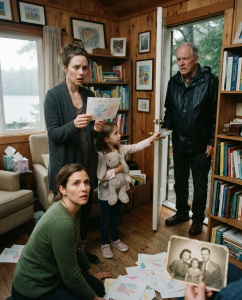
By the time Ava finished reading, the office door had opened.
Her father stood there in his old coat with rain on the shoulders and guilt already on his face.
He did not look like a man surprised to be named in a note from the dead. He looked like a man who had feared this exact moment for years.
Rosie appeared behind him, holding her stuffed rabbit by one ear.
Then the papers fell.
The folder slipped from Ava’s lap, and its contents spilled over the carpet. Drawings, intake sheets, copied maps, and one old photograph that did not belong in a child therapy folder at all.
Ava grabbed it first.
She was in it as a teenager, standing on a dock in the same blue dress from the recital, crying while her father argued with a dark-haired woman. In the background, half out of frame, stood a teenage boy she recognized only after a long stunned second.
Daniel.
Much younger. Watching.
Her chest tightened so sharply it hurt. “This was before I met him.”
No one answered. They did not need to.
Daniel had known something from her past. Something connected to her father. Something he had kept from her.
Then Rosie reached into her sweater pocket and pulled out a faded blue bird patch. Ava recognized it instantly. Years earlier, her father had sewn that patch onto one of Daniel’s flannel jacket sleeves during the summer Daniel practically lived at their house. Rosie held the patch toward Frank.
“Where did you get that?” he asked.
Rosie answered in a clear child voice that sounded like a key turning in a rusted lock.
“From the first box. Daddy said Grandpa hid the rest under the floor where the singing was.”
The singing floor.
Ava remembered the phrase immediately. When she was young, one plank in the old lake cabin hallway whistled softly when stepped on. Her father used to joke that the cabin sang when people lied. The house had been sold eighteen years ago.
Daniel had never been there after it was sold.
No one living should have been able to guide Rosie to anything hidden there.
Ava demanded to know what “first box” meant.
Mallory answered before Frank could stop her. “The one from 1998.”
Then, with visible effort, she said the sentence that split Ava’s understanding of her family in half.
“Your mother tried to leave with you.”
Ava stared at her. “My mother died when I was fifteen.”
“Two years later,” Mallory said. “After she learned what your husband eventually learned.”
Frank told her to stop. Mallory did not.
She explained in broken pieces, enough to wound but not yet enough to heal. A teenage girl named Ellie vanished from the camp property decades earlier, back when the retreat land had still been a summer youth site with staff cabins and a private dock. Frank had worked there in an oversight role. Mallory’s older sister, Eleanor Kent, called Ellie, had been seventeen. She disappeared after a dance one August night. The investigation drifted, stalled, and hardened into local rumor.
Mallory never believed the official version.
Years later, Ava’s mother began asking questions after finding items hidden beneath the floorboards at the family lake cabin—items tied to Ellie’s disappearance and to Frank’s proximity that night. She had tried to take Ava and leave. She died in a crash before she managed it.
At fifteen, Ava had accepted the official story: rain, slippery road, terrible luck.
At thirty-six, standing in a therapy office with her grieving daughter pressed against her side, she watched that story rot in real time.
“He should have burned the box,” Frank muttered.
The words silenced everyone.
Not because they proved guilt on their own, but because they revealed knowledge no innocent man should possess.
Ava’s voice became frighteningly calm. “Daniel found something, didn’t he?”
Frank said nothing.
Mallory looked sick.
Rosie, still solemn and exhausted in the strange way children look after carrying adult terror, leaned toward Ava and whispered another message from Daniel.
“Grandpa lies nicest right before he tells the worst part.”
That was when Ava understood Daniel had been preparing for this. Not casually. Not symbolically. Deliberately. He had turned their daughter into the final messenger because he must have known he might not live long enough to finish what he started.
They went to the old lake cabin before dusk.
Not just the four of them. Mallory insisted on coming. Ava called 911 from the parking area and reported evidence connected to a suspicious death and a historical missing-person case. The dispatcher asked questions Ava could barely answer, but a patrol unit was promised. She did not wait.
The cabin stood at the far edge of the retreat property, preserved as a “heritage space” no guests used. Ava had walked past it earlier and thought only that the porch looked unstable. Now every board seemed to hum with memory.
Inside, the air smelled of dust, cold wood, and lake damp.
Rosie led them down the hallway without hesitation. Halfway to the back room, she stepped on a plank and a thin whistle sounded from beneath it.
The singing floor.
Frank closed his eyes.
Ava knelt and pried at the board with a fireplace poker Mallory found near the hearth. Underneath lay a narrow cavity wrapped in plastic. Inside were two metal document boxes and a thick envelope sealed with electrician’s tape.
Frank tried once to stop her. “Ava, please. Let me explain first.”
She did not even look at him. “Start with Ellie.”
He sat heavily in a chair as if the years had arrived all at once.
Mallory opened the first box.
Inside were photographs, camp staff rosters, journal pages, newspaper clippings, a charm bracelet missing one charm, and a cassette tape in a labeled plastic sleeve. The second box contained insurance records, old police contact logs, two undeveloped film canisters, and one envelope in Daniel’s hand addressed to Ava.
She opened that first.
Ava,
If you’re reading this, I ran out of time or nerve or both. I’m sorry for keeping any of it from you. I thought I could prove it quietly and spare you the choice between your father and the truth. That was arrogant. Maybe unforgivable.
Your mother came to see me before she died. You were at school. She knew I loved you and said if anything happened to her, I was to remember one name: Ellie Kent. She told me Frank had hidden something at the cabin and that if she vanished, it wouldn’t be random.
I thought she was panicked. Years later, while helping Frank clear old storage, I found one photo from the camp and recognized your mother’s handwriting on the back: Don’t let him do to Ava what he did to Ellie.
I started digging after Rosie was born because I couldn’t stand the idea that silence was protecting our family.
If Frank tells you he only covered for someone, maybe that part is true. If he tells you he never touched Ellie, that matters less than what he let happen after.
He lied long enough for your mother to die carrying it and for you to grow up inside a story built to protect him.
Ava lowered the letter with numb fingers.
Mallory had gone completely still over a photograph from the first box. She passed it to Ava.
It showed the dock at night, grainy with flash blur. Three figures stood near the edge of the water. One was clearly Ellie, recognizable from another picture in the box. One was Frank. The third was a broad-shouldered man Ava did not know until Frank spoke his name.
“Gordon Vale,” he said. “Property manager. My supervisor at camp.”
His voice was rough and stripped bare now. “He was drunk. Ellie had threatened to report him for what he’d been doing with two girls on staff. I followed them to the dock because I knew they were arguing. I thought I could get her away from him. He shoved her. She hit her head on the cleat going down.”
Mallory made a sound Ava would never forget. Not quite a cry. Not quite rage. Something older.
Frank kept talking because he finally understood silence no longer served him. “She was alive for a minute. Maybe two. I panicked. Gordon said if I called police, he’d say we were both there with her, both drinking, both touching girls, and everyone would believe him before they believed a maintenance kid with a record for fights. He said I’d lose everything. I helped him move her.”
“You buried my sister in your fear,” Mallory said.
Frank bowed his head.
Ava heard herself ask, “And my mother?”
He looked at her with wet, ruined eyes. “She found the bracelet and one of the photos under the floor years later. She threatened to go to police. I begged her to wait one day so I could tell you first. She left in the rain anyway. I followed. I wanted to stop her. Gordon was still alive then. He’d been paying me for years to keep quiet. He saw us on the road. He hit her car.”
Ava’s knees nearly gave out.
“You knew.”
Frank nodded once, barely.
“You knew he killed her.”
“I knew by the next morning,” he whispered. “He admitted it when he called. Said now we were tied together forever.”
Mallory stared at him with open hatred. Ava had never seen hatred look so exhausted.
“And Daniel?” Ava asked.
Frank’s answer came slower, more painful because the shame was fresher. “Daniel found the boxes after Gordon died last year. He confronted me. Said he was taking everything to police if I didn’t. I told him I would confess. I meant to. But two days later Daniel’s brakes failed on the highway.” Frank looked up, devastated by the words as he said them. “I had Gordon’s old mechanic invoices. He’d used the same shop for years. Daniel had taken his truck there the week before. I think someone there did what Gordon would have paid for if he were alive. A favor. Or an old loyalty. I don’t have proof. Daniel believed I might be killed next, so he started moving pieces. He brought Rosie once when you were out of town, told her it was a treasure hunt, showed her the bird patch, the first box, the hiding place. He said she had the best memory in the family.”
Ava cried then, but not the way she had at the funeral. This was colder, stranger. Grief colliding with understanding until neither could be separated cleanly from rage.
Police arrived before full dark.
The boxes, photographs, letters, tape, and records were turned over. Mallory gave a statement. Frank gave one too, then another, then asked for a lawyer and finally admitted enough to implicate himself in concealment, evidence tampering, and obstruction connected to Ellie’s disappearance and the deaths that followed. The old camp property was searched. Two days later, human remains were recovered near the original service road embankment after survey notes from Daniel’s files matched land changes shown in archived maps.
Ellie came home after twenty-eight years.
The mechanic shop tied to Daniel’s brake failure became part of a criminal investigation. One retired employee eventually admitted he had been paid in cash months earlier to “do a dangerous favor” on a truck that matched Daniel’s. The payment trail led back through old shell accounts connected to Gordon Vale’s estate and, later, to money Frank had quietly moved over the years to keep certain people useful and silent. Whether Frank intended Daniel’s death or merely helped create the network that caused it became the central moral wound of the case. The law would decide one part. Ava had to live with the rest.
Rosie spoke more after that night.
Not all at once. Not like a movie miracle. But the silence loosened. She asked where Daniel was. She asked whether Grandpa would go to jail. She asked if people stayed dead when they had secrets left behind.
Ava learned there was no clean answer to that last question.
Months later, she sat with Mallory on a bench outside the courthouse after one preliminary hearing. The lake wind had followed the season into the city somehow, thin and biting.
“I used to think monsters looked obvious,” Ava said.
Mallory stared ahead. “Sometimes they do. Sometimes they look like men who were weak once and called it love for the next thirty years.”
That stayed with Ava.
So did Daniel’s letter. So did Rosie’s small hand offering up a faded blue patch like proof that children notice what adults bury. So did the terrible fact that Frank had not directly caused every death and still somehow stood at the center of all of them. Fear had made him loyal to the wrong thing so many times it became indistinguishable from cruelty.
When people later asked Ava whether she hated her father, she never knew how to answer.
Hate was too simple for what remained.
He had loved her. Of that she had no doubt.
He had also built her childhood on top of a silence that devoured her mother, consumed her husband, and nearly took her daughter’s voice with it.
Sometimes the biggest red flag is not violence.
It is the person everyone calls gentle.
The one who sounds kind while protecting the worst thing in the room.
And some nights, when Rosie fell asleep without a shoe on at last, Ava still thought about that old nickname from the back of the drawing.
Bluebird girl.
A name for singing while shaking.
It turned out her father had taught her the truth accidentally all those years ago. Courage was never the absence of fear. It was what survived after fear had already cost too much.