Derek Sloan used to think there were only two kinds of chaos.
The harmless kind his wife brought home in cardboard boxes, and the devastating kind that arrived in hospital rooms and never left.
Before his wife died, Derek had been married to a woman who could not walk past something abandoned without stopping. Lost kittens. Injured birds. Neighbors pretending everything was fine when it clearly wasn’t. She was the sort of person who saw need the way other people saw weather. Immediate. Impossible to ignore.
He used to tease her for it.
She used to roll her eyes and remind him that one day he would miss being married to a woman who came home with trouble in her arms.
He had not understood then how much trouble could look like love.
After she died, Derek rebuilt his life into something narrow and stable for their nine-year-old daughter, Emmy. Stability became sacred. They ate on schedule, slept on schedule, and grieved in small contained ways he could survive. He handled every day like a delicate stack of dishes he couldn’t afford to drop.
That was why he hated the shoebox the minute he saw it.
Emmy came through the front door carrying it like a secret and said, “Please don’t say no before you see him.”
Derek already wanted to say no.
There were practical reasons. Money. Time. The sheer unfairness of adding one more fragile living thing to a house that still felt haunted by loss. But beneath those reasons was a fear he didn’t admit even to himself: he could barely keep himself and Emmy standing. He did not want to love something else that might disappear.
Then Emmy lifted the lid.
Inside was a tiny brown puppy with trembling ribs, comically large ears, and dull eyes that made him look too tired to be alive.
“He was at the shelter adoption day outside the grocery store,” Emmy said quickly. “Nobody wanted him because he looked sick.”
Derek sighed. “Emmy.”
“Just foster. Please. Just until he gets stronger.”
The word please landed harder than it should have.
Emmy had not asked for much since her mother’s funeral. She had become frighteningly undemanding. No birthday party. No new bike. No camp. No loud hopes. Children were not supposed to give up wanting things, and every time Derek noticed how little she asked for, guilt pressed into him like a bruise.
“Temporary foster,” he said.
Her face lit so fast it almost hurt to look at. “Temporary.”
He filled out the shelter paperwork that night and told himself this was manageable. The puppy slept in a laundry basket. Emmy named him Bean for reasons she could not fully explain. Derek bought formula, a heating pad, and a stack of puppy pads he resented on principle and used with absolute devotion by morning.
By the second day, Bean stopped eating.
His breathing turned strange around noon. By evening he was limp, and even Derek’s denial could not disguise what his instincts knew. Something was wrong.
He drove them to the emergency veterinary clinic with Bean wrapped in an old white baby blanket Emmy had pulled from a storage bin in her closet.
“He likes this one,” she said. “It smells safe.”
Derek barely glanced at it. In their house, old blankets appeared the way old grief did—suddenly, from places you’d forgotten existed. He assumed it had belonged to Emmy as a baby or been part of one of the bins his wife never fully sorted before she got sick.
The clinic smelled of disinfectant and fear.
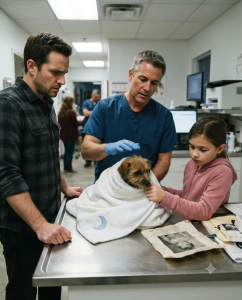
At the intake desk, Derek gave their information while Emmy stood beside him holding Bean against her chest. The puppy’s shelter collar looked absurdly large against his narrow neck. His breathing rasped lightly through the blanket.
The veterinarian came out himself when he heard a very young foster puppy was in distress.
He introduced himself as Dr. Aaron Levine.
He had kind eyes, an efficient manner, and the face of someone who had learned to stay composed in rooms where other people were falling apart. Derek liked him immediately, which made what happened next feel even more unreal.
Dr. Levine examined Bean with quick, practiced movements. He listened to his chest, checked his gums, called for warmed fluids, and then reached for the blanket to lift him more gently.
His hand stopped.
He stared down so intently that Derek thought, for one absurd second, there must be blood on the fabric.
Instead, Dr. Levine touched one corner with two fingers.
White flannel. Tiny yellow stitched stars. A blue moon embroidered by hand in a crooked imperfect crescent.
“Where did you get this?” he asked.
Derek’s first instinct was annoyance. Then defensiveness. Then something colder.
“It’s ours.”
Dr. Levine looked up sharply. “No.”
The receptionist stopped typing.
A vet tech in the hallway slowed and turned.
There was something in the doctor’s face Derek had seen only a few times in adult life: a person caught between hope and devastation so suddenly they couldn’t control either.
“My wife made this blanket,” Dr. Levine said, his voice barely holding steady. “For our daughter.”
Derek stared at him.
The room changed shape around those words.
He looked again at the blanket, really looked this time. The uneven moon. The hand-stitched stars. It did not look store-bought. It looked loved. It looked known.
Emmy, still clutching Bean, said, “It was in my closet.”
Derek turned to her. “What do you mean?”
“In the old bin,” she said. “Behind the games.”
The old bin.
He remembered it immediately. Plastic, cracked at one latch, shoved toward the back of Emmy’s closet. He had seen the blanket there months ago while looking for winter boots. He assumed it was just one more forgotten object from before the house became a museum of careful avoidance.
He had not asked about it.
Now Dr. Levine was white as paper.
“Our daughter disappeared six years ago,” he said. “She was eight months old. This blanket was with her the last time anyone saw her.”
There are moments when the mind rejects reality not because it is impossible, but because accepting it would instantly alter too many other things. Derek felt that rejection rise inside him like a wall.
No. Not possible.
Yet Dr. Levine did not look like a man indulging fantasy. He looked like someone staring at a piece of his own past after years of being told it was gone.
Derek heard himself ask, “What was her name?”
“Lilah.”
The name settled into the room.
Then Emmy made a soft sound.
They both turned.
She was looking at the blanket with strange concentration, as if listening to something far away.
“The puppy likes it because the baby girl sat with it in the rocking chair,” she said.
Every muscle in Dr. Levine’s face tightened.
“What baby girl?” Derek asked.
Emmy frowned at him in mild frustration. “The one in the dream room. She said don’t wash it too much because the stars come loose.”
Dr. Levine covered his mouth with one hand.
Later Derek would learn why that detail shattered him.
When Lilah was a newborn, Dr. Levine’s wife had made a matching set: the blanket, two burp cloths, and a tiny pillow cover they never used. One of the cloths had gone through the dryer on too high a setting and the yellow stars puckered at the edges. It became a family joke. No reporter would have known that. No stranger would have cared enough to remember it.
Derek crouched slightly so he could look Emmy in the face. “Who told you this?”
She looked at him, perfectly calm.
“The lady in Mommy’s blue sweater.”
The sentence went through Derek like ice.
His wife had owned a blue sweater, oversized and soft, one sleeve stretched at the cuff. She wore it constantly the month before she died. He remembered that suddenly with disturbing clarity because she had spent that same month sorting the garage, moving things in and out of storage bins, and crying one night when she thought no one could hear her.
He had found her sitting on the concrete floor with her hands wrapped around a mug gone cold.
“What happened?” he asked then.
She had shaken her head and said, “I found something a child deserved back.”
He had kissed the top of her head and assumed she meant a donated toy or some object from one of her volunteer projects. He had not asked more. He lived with grief already breathing down his neck from her diagnosis; he was learning to let mysteries stay shut if they didn’t demand immediate action.
Now that memory turned poisonous.
Dr. Levine reached into his coat and unfolded an old missing-child flyer.
The paper was soft at the folds from being handled too many times.
The baby in the picture had dark eyes, full cheeks, and the same moon-stitched blanket wrapped around her body.
Emmy looked at it and whispered, “That’s her.”
For a long second no one spoke.
Then Dr. Levine said quietly, “Your wife knew something.”
Derek stood there with the awful feeling of old memories rearranging themselves into a shape he should have recognized years earlier. His wife becoming guarded around that storage bin. His wife asking him once whether he believed people could keep loving someone after learning what they’d done. His wife staring too long at a local news segment about cold cases and switching the channel when he entered the room.
The puppy gave a weak whine, breaking the trance. A tech hurried forward and took Bean gently toward treatment. Emmy reluctantly released him but kept one hand in the blanket as if letting go would lose the thread of something larger.
Derek forced himself to think. “My wife never said anything about a missing child.”
“Maybe she was afraid,” Dr. Levine said.
“Of what?”
Dr. Levine swallowed. “Of whoever had the blanket before it came to your house.”
That was when Emmy spoke again.
“She said the other lady was still alive.”
Both men looked at her.
“Who said that?” Derek asked.
“The blue sweater lady,” Emmy replied. “She said if the dog ever got sick, we had to bring the blanket here. Then her daddy would know where to look.”
Derek’s skin prickled.
“What blue sweater lady?” he pressed.
Emmy blinked, as if trying to understand why he couldn’t keep up. “The one who came after Mom died.”
Dr. Levine’s expression changed first—from grief to alarm.
“No one came after your mom died,” Derek said automatically. Then he stopped.
He could not actually know that.
There had been weeks after the funeral when he moved through the house like a sleepwalker. People came and went. Neighbors, teachers, his sister, church volunteers, women from his wife’s charity group bringing casseroles and folded sympathy cards. A woman could have stood in the kitchen speaking softly to Emmy while Derek signed insurance forms in the dining room and he might never have noticed.
Dr. Levine leaned closer to Emmy. “What did she look like?”
Emmy studied the old flyer. “Like her. Around the eyes.”
Dr. Levine shut his eyes.
“My wife had a younger sister,” he said slowly. “Mara.”
Derek waited.
“We don’t speak anymore.”
“Why?”
Dr. Levine looked at the floor before answering. “Because on the day Lilah disappeared, Mara was the last family member in the house besides my wife.”
The words hit hard.
Dr. Levine explained in a halting voice that six years earlier his wife had gone upstairs after hearing the shower turn off. Lilah had been in her nursery minutes before. Mara had offered to keep an ear on the baby while his wife answered a delivery at the front door. By the time she returned, the nursery window was open, the blanket was gone, and Lilah had vanished.
The police investigated everyone. Neighbors, repairmen, distant relatives. Mara denied knowing anything. She passed a polygraph that later became meaningless when the case went cold. The family shattered under suspicion they could never prove.
“Mara said someone must have taken Lilah through the nursery window,” Dr. Levine said. “But there was one thing that never sat right with my wife. Mara was too calm. Not right away—later. In the days after. She cried when people watched and turned cold when they didn’t.”
Derek listened with a growing sense of dread.
Then a tech rushed back in holding Bean’s shelter file and a microchip scan printout.
“There’s a registered owner,” she said. “The chip was never transferred.”
Dr. Levine took the paper.
The name listed meant nothing to Derek.
The address did.
It was less than twenty minutes away, on the edge of town.
And Derek knew it because his wife had driven there twice in the month before she died.
He remembered standing in the kitchen one rainy afternoon, asking where she was headed.
“To drop off donations,” she had answered too quickly.
What kind of donations required secrecy? What kind of donation made her cry in the garage?
He stared at the address now and felt sick.
“We’re going there,” he said.
But Emmy was already shaking her head.
“No,” she whispered.
Both men turned.
She was looking not at the chip printout, but at the back of the missing-child flyer. Faded writing covered one corner, old and pressed hard enough to leave grooves in the paper. Dr. Levine frowned and turned it toward the light.
The handwriting was his wife’s.
He knew it instantly.
In the margin, beside an address he didn’t recognize, she had written three words:
Check the farmhouse.
Derek felt the room tilt.
Dr. Levine took a step back. “That’s my wife’s writing.”
The second address was different from the one on the chip. Older. Rural. A property outside town that had once belonged to Mara’s ex-boyfriend’s family before being sold after his death. Dr. Levine said the police had searched it years ago, but only the main house. It had stood mostly empty for a long time.
“Why would your wife write this?” Derek asked.
Dr. Levine’s answer came slowly, as though he hated the shape of it.
“Because maybe she found out the first address was a decoy.”
The police were called within minutes.
Derek expected delays, skepticism, procedural caution. There was some of that. But there was also the blanket, the handwriting, the chip linked to an address, and a child who had repeated details she should not have known. Most of all, there was Dr. Levine—a respected veterinarian in town whose daughter’s disappearance was still remembered even after six years of silence.
An officer recognized the case the second he heard the name Lilah Levine.
Within an hour, Derek found himself standing in a parking lot under flashing lights while two patrol cars, an unmarked SUV, and a county investigator coordinated routes. Bean had stabilized enough to remain at the clinic overnight. Emmy sat wrapped in another blanket in the office, drinking juice and answering gentle questions with unnerving certainty.
“She said the baby wasn’t at the first place,” Emmy told them. “She said the first place only matters because of the dog.”
“Who said that, sweetheart?” the investigator asked.
“The lady in the blue sweater.”
It should have sounded absurd.
Instead, in the fluorescent-lit hush of the clinic, it sounded like a message crossing years by whatever means could still carry it.
Derek rode with the investigators to the farmhouse.
The drive took thirty minutes through dark roads lined with fields and skeletal trees. The property sat well off the highway behind a rusted gate and a collapsing fence. Moonlight silvered the roofline. The house itself looked abandoned, windows black, porch sinking, weeds swallowing the walk.
Derek understood immediately why no one would choose this place twice.
It was not where you lived.
It was where you hid something.
The front door was chained from the outside but old enough to yield. Officers moved first, clearing the ground floor with flashlights. Dust. Broken glass. Rodent droppings. A smell of damp wood and neglect.
Nothing.
For one horrible moment, Derek thought the whole thing would collapse into another dead end, one more cruel almost in a case full of them.
Then one of the deputies called from the back structure attached to the house.
There was a locked storm cellar beneath the old pantry.
The padlock had been replaced recently.
Derek was not allowed near the door when they cut it, but he heard the metal snap and the hinges groan. He heard one officer descend the steps, then another. Silence followed.
Then a voice from below shouted, “We need medical now.”
Derek’s knees nearly gave out.
Dr. Levine made a sound Derek would remember for the rest of his life—not a word, not a cry, but the sound a body makes when hope hurts too much to contain.
The girl they found was alive.
She was thin, pale, frightened, and at first believed the officers were lying when they told her she was safe. She looked about six. Her hair was tangled. Her left wrist bore a faded friendship bracelet turned almost gray with wear.
She did not answer to Lilah.
She answered to Lena.
The first few hours after the rescue blurred into sirens, hospital lights, and statements repeated until language lost shape. Mara was arrested before dawn at the registered chip address after officers found children’s clothing, old photographs, and documents linking her to multiple false identities. The puppy—Bean—had come from a litter on the property. Investigators believed he had somehow been separated and brought to the shelter through a chain of events no one had fully pieced together yet. But the chip on him traced back to supplies purchased in Mara’s name, and that mistake cracked open everything.
In the hospital, Dr. Levine and his wife waited behind a pane of glass while trauma specialists sat with the child who might be theirs. Derek stood nearby, feeling like a man who had opened a door by accident and found an entire missing life behind it.
DNA confirmed it the next day.
Lena was Lilah.
She had been raised under a false name and taught a false history by the very woman her family once trusted.
Mara had taken her.
Not for ransom. Not for revenge exactly. For something far uglier and more selfish—an obsession that had deepened into delusion. She had suffered multiple miscarriages in the years before Lilah disappeared. Investigators and later court testimony would show that she had convinced herself she could “save” Lilah from the chaos of her sister’s house, then built a fantasy in which the child was better off as hers. When the first hiding place felt unsafe after renewed interest in the case, she moved her between locations, using isolated properties and forged homeschooling paperwork to keep her invisible.
The blanket had been kept for years in a sealed box she could not bear to destroy.
Derek eventually learned how his wife became part of the story.
Months before her death, she had volunteered with a local donation network that delivered food and supplies to struggling rural households. One of those deliveries took her to the registered address on the puppy’s chip. Mara answered the door. Derek’s wife noticed something off immediately—not because she recognized Mara, but because she saw a little girl in the background holding a white flannel blanket with crooked yellow stars.
She mentioned the blanket casually.
Mara snatched it away so fast that Derek’s wife knew she had touched a live wire.
Later that night, she searched online and found old coverage of Lilah Levine’s disappearance. The blanket in the news photo matched.
She confronted Mara on a second visit, secretly recording part of the conversation on her phone. Mara denied everything at first, then panicked, insisting the child was safer where she was. Derek’s wife left terrified but determined to bring proof to authorities. Before she could, she was hospitalized after a sudden decline in her illness.
The phone recording was never found.
But she did manage to hide the blanket.
According to Mara’s eventual confession, Derek’s wife took it during that second visit while Mara was distracted by the puppy litter in the yard. Mara realized too late and later tried to get it back, but Derek’s wife had already tucked it into a storage bin at home and told Emmy only one thing she thought the child might remember if anything happened to her:
If the little dog ever gets sick, take the blanket to the clinic with the moon sign. Her daddy will know.
The “moon sign” was not mystical. It was the veterinary clinic logo—a crescent moon over a paw print—something Emmy had seen enough times to connect only years later when the puppy needed help.
Memory, grief, and a child’s mind had tangled the rest into something dreamlike: the blue sweater, the lady after Mommy died, the dream room. Derek never decided exactly how much Emmy had remembered, guessed, or carried from conversations half overheard during the worst season of their lives. He stopped needing a clean explanation.
The truth was messy enough.
Lilah’s recovery was not a simple homecoming.
She did not run into her parents’ arms. She did not magically become the baby they lost. She was a six-year-old girl with another name layered over her own, terrified of strangers telling her everything she knew was false. Reunification took months, therapy, patience, and heartbreak. There were setbacks that made everyone cry in private. There were nights Dr. Levine sat in his car outside the hospital because he could not bear the fact that his daughter lived and still didn’t know him.
But there were also small miracles.
The first time she reached for her mother’s hand without prompting.
The day she agreed to keep both names for a while—Lena and Lilah—until one felt less frightening.
The moment she saw the moon-stitched blanket returned from evidence storage and touched the corner with tentative recognition.
Dr. Levine cried then. His wife cried harder.
Derek watched from the doorway with Emmy at his side and understood that rescue did not look like movies. It looked awkward and slow and sacred. It looked like paperwork and therapy appointments and ordinary meals eaten under extraordinary strain. It looked like people choosing each other again and again until trust slowly learned its way back.
Bean recovered too.
Naturally, Derek’s “temporary foster” became permanent.
Emmy said it was because he had done his job.
“What job?” Derek asked.
“He found her dad,” Emmy said simply.
Derek wanted to correct her. The blanket found him. His wife found the first clue. The police found the cellar. Chance and courage and grief had all collided in ways no one could have planned.
But Bean had been part of the path, and sometimes children understood the shape of truth better than adults needed to.
Months later, on a quiet Sunday, Derek found himself sitting in his kitchen while Emmy fed Bean pieces of scrambled egg under the table and sunlight touched the floor in soft squares. The house no longer felt only haunted. It still held grief. It always would. But it also held the afterlife of one good woman’s unfinished act.
He thought of his wife often in those days.
Of the secret she had tried to carry alone.
Of the clue she hid where she hoped it might survive her.
Of the fact that, even dying, she had still been herself—still trying to return something lost to where it belonged.
Derek had once resented that part of her, the part that opened the door to complication.
Now he understood it better.
Sometimes love was not careful.
Sometimes it was inconvenient and risky and badly timed.
Sometimes it arrived in shoeboxes, in old blankets, in clues stitched into fabric by hands long gone.
Sometimes it asked too much of already broken people.
And sometimes it was the only reason the truth made it home.
Years later, people in town would still argue about the case. About what signs had been missed. About whether Derek’s wife should have gone to the police sooner, whether the LeVines should ever forgive Mara, whether love damaged by obsession could still be called love at all.
Derek only knew one thing for certain.
The biggest red flag had never been the farmhouse or the fake address or even the lie that survived for six years.
It was the moment someone looked at a child and decided belonging could be stolen.
Everything after that was damage.
Everything after that was a family learning how to live with what had been taken, what had been found, and the unbearable fact that both could be true at once.