Rachel had always hated events that required a coordinated smile.
School concerts. Holiday breakfasts. Parent craft nights. Anything that turned children into little glowing centers of celebration while adults stood around them pretending life was neat and properly assembled.
The father-daughter dance was the worst of them all.
The title alone felt like a trap.
She had known it would be hard the moment the flyer came home folded in Mia’s backpack, all pastel stars and cheerful promises about magical memories. Mia had carried it into the kitchen with both hands and the kind of excitement only a seven-year-old could have.
“Daddy can take me,” she had said instantly.
Rachel had smiled because mothers learn to delay pain when their children are watching.
“We’ll see,” she said.
By Friday evening, “we’ll see” had become exactly what she feared it would become.
At 5:12 p.m., her phone lit up with a text from her ex-husband, Darren.
Something came up. Can’t make it. Sorry. Tell Mia next week maybe.
Rachel read it while standing at the kitchen counter in one black heel, the zipper of her dress only half up. The microwave clock blinked green. The dishwasher hummed. From the bedroom came Mia’s voice, singing to herself while she got ready for a dance her father had already decided not to attend.
The message was so familiar in tone it almost made Rachel sick. A casual inconvenience. A postponed promise. Six words designed to keep him from feeling guilty without forcing him to actually show up.
She typed three different responses and deleted all of them.
What was there to say? That seven-year-olds remembered these things? That disappointment was becoming the architecture of her daughter’s childhood? That “next week maybe” meant nothing when tonight had already mattered?
Instead, she set the phone face down and walked to Mia’s room.
Mia was in front of the mirror in a pale yellow dress, trying to apply lip gloss with the concentration of a surgeon. Most of it was nowhere near her lips.
“Mom,” she said, smiling at her reflection, “do I look fancy?”
Rachel’s throat tightened.
“You look unforgettable.”
Mia turned. “Is Daddy here yet?”
That was the moment Rachel had to make a choice.
She could tell the truth now and watch hope drain from her daughter’s face before they even left the house.
Or she could do what women like her had been doing forever—swallow humiliation whole, put on a nice pair of shoes, and carry the evening on her own.
“We’re still going,” Rachel said.
Mia’s face brightened. “Really?”
“Really.”
As they headed to the door, Rachel reached for her purse and saw something on the porch through the sidelight window.
She opened the door and found a corsage resting on the top step.
It was delicate and pretty, clearly made with care. Two pale roses, a cloud of baby’s breath, cream ribbon tied in soft loops around the stems and wrist band. There was no envelope, no florist card, no note at all.
For one brief second Rachel imagined Darren had come to his senses and was about to emerge sheepishly from behind a car.
No one was there.
She picked it up and turned it over in her hands. The ribbon had been retied by someone meticulous. The knot was clean and old-fashioned, not the quick pull of a shop employee.
Mia appeared behind her and gasped. “For me?”
Rachel forced a smile. “Looks like it.”
She told herself Darren must have dropped it off and driven away, unable to face them. That explanation fit his style too well to question. Not generous enough to stay. Not cruel enough to forget entirely.
Mia held out her wrist. Rachel pinned the corsage on.
The flowers were cool and fresh.
“Now I really look fancy,” Mia said.
Rachel locked the door and took her daughter to the dance.
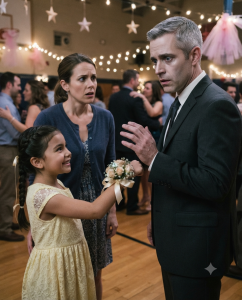
The gym at Bellwood Elementary was barely recognizable. Teachers and parent volunteers had transformed it into a glittering little fantasy of string lights, paper stars, pink tulle, and a silver backdrop for photos. A DJ occupied one corner beside a table of cupcakes and juice pouches. Dads in button-down shirts stood uncertainly near the dance floor while little girls in sparkly shoes whirled around them in circles of satin and sequins.
Rachel felt the familiar sting of being conspicuously alone.
Not literally alone—plenty of adults were there—but alone in the way that mattered. There were fathers bending down to straighten hemlines. Grandfathers with corsages pinned to their lapels. One teenage uncle standing with the trapped expression of someone paying off a family debt.
Near the bleachers, Rachel noticed two other women without male escorts, each carrying herself with the same stiff grace she felt in her own spine. None of them wanted to become the sad story near the punch bowl.
Mia, mercifully, seemed unfazed. She darted toward friends, showed off her dress, twirled for compliments, and accepted the evening as if this arrangement were perfectly natural.
That hurt Rachel more than a meltdown would have.
Children who adapt too beautifully to disappointment are often learning not to expect rescue.
The first thirty minutes were ordinary enough. Mia danced with her classmates. Rachel sipped watered-down punch. Parents took photos under an arch wrapped in fake ivy and glitter ribbon. The principal moved through the room, greeting families with easy warmth.
Andrew Bell was one of those men whose sadness had become public knowledge without ever turning theatrical. Everyone knew his wife, Eleanor, had died the previous spring after a short, brutal illness. Everyone knew he had returned to work faster than anyone expected. He was respected in the district not only because he was competent, but because grief had somehow made him gentler without making him weak.
Rachel had spoken to him before only in passing. He had a calm voice, a steady gaze, and the sort of quiet kindness children trusted immediately.
She saw him speaking to a cluster of parents near the stage, then laughing with a kindergartner over her blinking shoes. Nothing about him suggested instability. Nothing about him suggested the scene that was about to unfold.
When he reached Rachel and Mia, he smiled.
“Glad you both came tonight,” he said.
Mia lifted her chin proudly. “I love the lights.”
“They look pretty magical, don’t they?” he said.
Then his eyes dropped to the corsage on her wrist.
He stopped moving.
Rachel saw the change at once. It wasn’t subtle. His expression emptied. The warmth went out of his face. He stared at the flowers as though he’d been struck.
“Mr. Bell?” Rachel asked.
He didn’t answer.
His attention fixed on the cream ribbon, then the knot, then the faint brown mark beneath one loop.
“Where did she get that?” he asked quietly.
Rachel’s body tightened before her mind caught up.
“It was left on our porch.”
Andrew looked from the flowers to Rachel, then back again. “Who left it?”
“I assumed my ex.”
“You assumed?”
Mia held up her wrist, smiling, unaware of the charge in the air. “Pretty, right?”
Andrew swallowed. “Yes,” he said, and his voice sounded raw. “Very pretty.”
Rachel lowered hers. “Do you know something about it?”
His eyes stayed on the ribbon. “The knot.”
“What about it?”
“That’s mine.”
Rachel blinked. “I’m sorry?”
Andrew exhaled once, slowly, like a man trying not to frighten a child while panic took shape under his ribs.
“My wife’s funeral arrangement came loose before the service,” he said. “The ribbon slipped. I retied it myself in the church basement.”
For half a second Rachel almost rejected the statement on instinct. It was too strange. Too intimate. Too impossible. Yet something in his face stopped her. This wasn’t grief reaching for coincidence. This was recognition.
He crouched slightly, not enough to alarm Mia.
“Sweetheart,” he said gently, “did someone give this to you?”
Mia nodded.
Rachel turned to her. “Someone talked to you?”
“The flower lady.”
“Who?” Rachel asked.
Mia pointed toward the back of the gym, where a memorial display had been set up near the stage curtains.
Rachel had noticed it when they came in: framed photos of former faculty and community members, battery candles, a guestbook, and among them, a recent photograph of Eleanor Bell smiling softly beside a vase of white flowers.
Rachel had not taken Mia near it. She was certain of that.
“The lady by the shiny picture,” Mia said.
Andrew’s face seemed to lose what little color remained.
“What did she say?” he asked.
Mia touched the corsage on her wrist. “She said if my dad didn’t come, you had to dance first.”
Andrew went completely still.
Rachel stared at him.
Something about the wording hit him with the force of recognition. Not just the idea, but the phrasing itself.
He stood up slowly and turned toward the memorial display.
Rachel followed with Mia, unable to stop herself.
From a distance the table looked normal. Up close, it didn’t.
The arrangement beside Eleanor’s photo had been disturbed. Several flowers were missing. The cream ribbon around the vase had been cut and retied. On the white cloth beneath the arrangement sat a faint smear of dark soil.
Andrew touched the vase with two fingers. Then the ribbon. Then the edge of the frame.
“There were more flowers here,” he said.
“Could someone have moved them for another table?” Rachel asked, though even to her own ears it sounded weak.
He shook his head. “No.”
The brown stain on the remaining ribbon caught the light.
Coffee.
Rachel looked down at Mia’s corsage. Same ribbon. Same stain. Same knot.
A cold pressure spread through her chest.
Andrew shifted the photograph slightly and found a cream card tucked behind it.
His hands trembled as he unfolded it.
Rachel saw his eyes move across the page once, then again more slowly. Whatever he was reading had emptied him out.
“What is it?” she asked.
He didn’t answer.
The card slipped, and Rachel caught it before it hit the floor.
She hadn’t meant to read it. She did anyway.
In elegant slanted handwriting, it said: She came anyway. Don’t make her wait this time.
Rachel looked up. “Who wrote this?”
Andrew’s voice came out barely above a whisper. “Eleanor.”
The gym lights glittered overhead. Children laughed on the dance floor. Somewhere, the DJ announced a group photo. But for Rachel, the room had tilted.
“That’s not possible,” she said.
“No,” Andrew said. “It isn’t.”
He took the note back from her carefully, as if the paper itself might bruise.
“This stationery was in my house,” he said. “Packed away after she died.”
Rachel’s mind raced. Someone had access to his home. Someone knew about the funeral arrangement. Someone had removed flowers from a memorial table in the middle of a school event and placed a corsage on her porch at exactly the moment her daughter needed one.
Mia tugged Rachel’s hand.
“The lady said you’d be sad first,” she whispered.
Andrew looked at her sharply. “Sad first?”
She nodded. “Then mad. Then you’d remember.”
“Remember what?” Rachel asked.
But Mia was staring over Rachel’s shoulder now, toward the stage.
Both adults turned.
The left curtain had shifted open by a few inches, showing a narrow seam of darkness behind it.
“That area’s closed,” Andrew said automatically, but his voice lacked conviction.
Then the overhead lights flickered.
A feedback squeal tore through the DJ’s speakers. People looked up in confusion. The music cut out for one second, then came back warped and too loud.
From behind the stage curtain came the sound of something wooden striking the floor.
Andrew slipped the note into his inside jacket pocket and moved toward the stage.
“Stay here,” he told Rachel.
She didn’t.
He pushed the curtain aside and stepped into the dim backstage area. Rachel followed, keeping Mia behind her.
The space beyond the curtain was cooler and smelled faintly of dust, paint, and old curtains. Stacked risers lined one wall. Costume bins sat under black plastic covers. A single work light glowed near the back, throwing long shadows across the floorboards.
At first Rachel saw no one.
Then she saw the chair.
It had been placed beneath the work light, facing the stage entrance. On the chair sat a white gift box tied with cream ribbon. Beside it was a small silver-framed photograph of Eleanor Bell that Rachel had not seen on the memorial table outside.
Andrew stopped breathing for a second.
The ribbon on the box was tied in the same neat double-loop knot.
“Who’s there?” he called.
Silence.
Then, from farther back in the wings, a woman stepped into the edge of the light.
Rachel gasped before she could stop herself.
It wasn’t Eleanor. Not physically. But the resemblance was enough to shock the body before reason could intervene. Same dark hair, though slightly shorter. Same narrow face. Same posture. She was younger by several years, thinner, and there was something frayed about her—like someone who had spent too long inhabiting the outskirts of other people’s lives.
Andrew stared at her with naked disbelief.
“Lena?”
The woman’s mouth twitched. “You remembered.”
Rachel looked between them. “Who is she?”
Andrew didn’t answer right away. His eyes were fixed on the woman as if the years between then and now were rearranging themselves in real time.
“Eleanor’s sister,” he said finally.
Lena stepped fully into the light. Tears had already gathered in her eyes, but her chin was high with defiance.
“You packed up everything,” she said to Andrew. “Her clothes. Her journals. Her stationery. Her life. You folded her away like if you organized it neatly enough it would stop hurting.”
“This is not the place,” Andrew said.
“No,” Lena replied, her voice trembling, “the grave wasn’t the place either, but that didn’t stop you.”
Rachel’s grip on Mia tightened.
Lena noticed the child then, and for the first time some shame crossed her face.
“I didn’t want to scare her,” she said softly. “I only wanted her to bring him here.”
Andrew’s expression hardened. “You took flowers from Eleanor’s memorial display. You went to this woman’s house. You involved a child.”
“I gave her flowers,” Lena snapped. “The exact kind Eleanor loved. I made sure she wouldn’t feel left behind.”
“That wasn’t your choice to make.”
“No?” Lena’s composure cracked. “Because nobody let me make any choices when Eleanor died. Nobody asked what happened to me. Nobody asked why she stopped talking to me before she got sick. Nobody asked why I wasn’t in the room at the end.”
Rachel felt the shape of the real story shifting.
Andrew looked exhausted suddenly, not angry, just deeply tired. “Lena, you disappeared.”
“Because she told me to.”
The words hit the room like a dropped weight.
Andrew blinked. “What?”
Lena laughed once, harshly. “You didn’t know that, did you?”
She walked closer, reaching into her coat pocket. Andrew tensed, but she only pulled out a worn envelope.
“She called me two weeks before she died,” Lena said. “She told me not to come back. She said you hated me, the school board hated me, the whole town blamed me for what happened ten years ago, and if I loved her I’d stay away until it was over.”
Andrew took the envelope slowly.
Inside was a letter, several pages long, Eleanor’s handwriting flowing across each sheet.
Rachel could see the moment he recognized it.
“I found this after my mother sold the storage unit,” Lena said. “She never mailed it to me. Eleanor wrote it and then changed her mind—or someone helped her change it. I don’t know. But in it she said she wanted to fix things. She wanted us both in the same room. She wrote that she was tired of people protecting the peace by telling lies.”
Andrew read in silence. His face changed with every line.
Rachel stood very still, Mia tucked against her side, while the sounds of the dance pulsed faintly through the curtain. The ordinary world was still happening ten feet away.
“What happened ten years ago?” Rachel asked quietly.
Lena shut her eyes. “I was the one driving.”
Andrew looked up from the letter.
Lena swallowed. “The accident that killed their baby. I was driving the car.”
Rachel’s breath caught.
No one had ever said that in public. At least not that she had heard. In town, there had only ever been fragments. A private tragedy. A devastating loss. The Bells had no children. That was all anyone seemed to know.
Lena continued, voice unsteady. “It was raining. Eleanor asked me to pick up decorations for a fundraiser. She was pregnant. Seven months. A truck ran a red light. I lived. She lived. The baby didn’t.”
Andrew closed his eyes once.
Lena kept going because apparently she had held these words in for too many years. “Afterward, she couldn’t bear to look at me. Then she could, then she couldn’t again. Grief made us cruel in turns. She told people we needed distance. I left because every time I came near your house, your pain filled the whole street.”
Andrew opened the letter again, reading more carefully.
“She wrote that?” he asked.
“She wrote that she was wrong to freeze me out for so long,” Lena said. “She wrote that she understood now what fear had done to all of us. She wrote that if anything happened to her, she didn’t want the two people she loved most turning her into a locked room neither could enter.”
Rachel thought of the card: She came anyway. Don’t make her wait this time.
The message hadn’t been supernatural. It had been staged. Painstakingly. Unsettlingly. But not randomly. Lena had designed it to force a confrontation Andrew would never have agreed to.
“That note on the memorial table,” Rachel said. “You wrote it?”
Lena nodded. “With Eleanor’s words. From old letters. Old notes. Things she wrote when she was trying to make peace and never found the courage to finish.”
Andrew lowered the pages slowly. “So you thought terrifying a child at a school dance was the answer?”
Lena flinched. “I never meant to terrify her. I asked if her father was coming. She looked so brave saying no. I thought…” Her voice broke. “I thought Eleanor would’ve hated that. A little girl standing there trying not to be disappointed.”
Rachel’s anger rose fast and clean. “You came to my house.”
“Yes.”
“How did you know where I lived?”
“I volunteer at the district archive sometimes. I saw the emergency contact forms during the fundraiser prep last month.” Shame darkened her expression. “I know that sounds awful. It was awful. I told myself I was borrowing a moment. Just enough to get the flowers there before they left.”
“You used my daughter,” Rachel said.
Lena nodded once, accepting it.
Andrew stepped between them before Rachel could say more.
“That’s enough.”
His voice wasn’t loud. It didn’t need to be.
Something in him had shifted while reading Eleanor’s letter. The shock remained, but a different kind of clarity had taken its place.
“You should have come to me directly,” he said.
“I tried,” Lena whispered. “Twice. I sat in my car outside your house and couldn’t get out. I went to the cemetery and left before you arrived. I stood outside the school at dismissal and watched you laugh with students and I thought, he’s built a life where grief can be folded into schedules and assemblies and paper forms, and there’s no room in it for what I represent.”
“You represent my wife’s sister,” Andrew said. “You always did.”
Lena burst into tears.
Not the careful kind. Not cinematic. The ugly, involuntary collapse of someone who had been holding herself upright on fury alone.
“She wanted us to stop punishing each other,” Lena said. “I know I did this wrong. I know it was wrong. But I couldn’t keep being the ghost nobody let in the room.”
For a long moment nobody spoke.
Mia shifted beside Rachel and whispered, “Is she the flower lady?”
Rachel knelt and smoothed her daughter’s hair. “Yes.”
“Is she sad?”
Rachel looked at Lena, who had both hands over her mouth now, sobbing into the dim backstage air.
“Yes,” Rachel said. “Very.”
Mia considered that. Then she slipped the corsage off her wrist.
The little elastic band snapped lightly against her skin.
She walked past Rachel before anyone could stop her and held the flowers out toward Lena.
“I think these are yours,” she said.
The room went silent.
Lena stared at the corsage as if it were the most unbearable kindness she had ever seen.
“No,” Andrew said softly from behind them. “They’re not.”
He crouched beside Mia.
“You keep them,” he told her. “She gave them to you for the wrong reason. But you keep them.”
Mia looked uncertain. “Are you mad?”
Andrew glanced at Lena, then at the letter in his hand.
“I was,” he said honestly. “I still might be a little. But that’s not the whole story.”
Mia nodded as if that made perfect sense.
Children sometimes understand emotional truth faster than adults.
The music outside swelled again. Someone must have restarted the dance after the technical glitch. Through the curtain came the muffled sound of a slow song.
Rachel would remember what happened next for the rest of her life.
Andrew stood, turned to Lena, and said, “You owe several people apologies. Including this mother. Including her daughter. Including me.”
“I know.”
“But you were wrong about one thing,” he said.
Lena wiped at her face. “What?”
“There was room.”
She broke again at that, quieter this time.
Andrew looked at the photo on the chair, then at the cream ribbon around the box. He untied it and opened the lid.
Inside were copies of Eleanor’s letters, a small pearl earring, a pressed sprig of baby’s breath, and a hospital bracelet Rachel guessed had been kept for years. The private relics of a woman both of them had loved in different, damaged ways.
Andrew put the lid back on.
“We are not doing this here,” he said.
Lena nodded.
Rachel expected him to call security, or the police, or at least a staff member. Instead he pulled out his phone and texted someone from the assistant principal team to cover the dance floor for ten minutes. Then he asked Rachel, with visible embarrassment, if she would be willing to stay a little longer while he spoke to Lena in the front office where there were lights and chairs and no stage curtains.
Rachel should have refused. She was angry. Mia had been frightened. The whole night had been twisted into something surreal and invasive.
But she looked at her daughter, at the little wrist now bare except for the indentation left by the elastic, and something in her softened.
Maybe because Mia had already crossed the bridge adults were still circling.
They walked together to the office wing.
Lena apologized first to Mia, kneeling despite Mia’s obvious uncertainty.
“I should not have talked to you without your mom there,” she said. “That was wrong. I’m sorry.”
Mia looked at Rachel, then back at Lena. “Okay.”
It was not forgiveness exactly. More like acknowledgment.
Lena apologized to Rachel next, and there was no defense left in her voice now.
Rachel accepted the apology without absolving her. It was enough for the moment.
Then Andrew and Lena spoke alone for nearly twenty minutes behind the glass office door while Rachel and Mia sat on a hallway bench under student artwork. Rachel didn’t hear everything. Only fragments when voices lifted.
You should have told me.
I didn’t know how.
She was trying.
So was I.
When the door finally opened, both of them looked changed. Not healed. Not even settled. But rearranged by truth.
Andrew approached Rachel first.
“I’ve called Lena a ride,” he said. “She won’t be returning to school property without permission.”
Rachel nodded. “Good.”
“And I’m sorry,” he added. “For your daughter being pulled into this.”
“I know it wasn’t you.”
He looked down the hallway where Mia was tracing a finger over a paper snowflake display. “She handled tonight better than most adults would.”
Rachel let out a tired breath. “She has too much practice.”
Something flickered across his face at that—understanding, maybe, or recognition of a loneliness adjacent to his own.
When Lena emerged, she paused in front of Mia one last time.
“Your flowers are beautiful on you,” she said.
Mia studied her with solemn eyes. “You should’ve just asked him.”
Lena let out a broken little laugh. “You’re right.”
Then she left.
The rest of the dance should have been impossible after that. Rachel assumed they’d go home immediately. But Mia surprised her again.
“Can we still dance?” she asked.
Rachel brushed a strand of hair from her face. “After all that?”
Mia shrugged. “The cupcakes are still there.”
Rachel laughed despite herself.
So they went back.
The gym looked exactly the same and completely different. Lights still glowing. Music still playing. Fathers still swaying awkwardly with daughters who would someday remember this as sweet instead of mortifying. Yet Rachel now carried the strange private knowledge that beneath every polished school event ran invisible rivers of loss, guilt, longing, and unfinished forgiveness.
Andrew returned a minute later, jacket straightened, face composed but softer around the edges. The assistant principal gave him a quick nod and stepped away.
He crossed the floor toward Rachel and Mia.
Mia looked up at him expectantly.
For a brief second he seemed uncertain, almost shy, and then Rachel remembered what her daughter had repeated earlier.
If my dad didn’t come, you had to dance first.
He offered Mia a hand.
“Would you still like that dance?” he asked.
Mia looked at Rachel for permission. Rachel nodded.
Mia placed her small hand in his and went with him to the center of the floor.
It wasn’t a grand moment. No one announced it. No one gathered around. It was just a principal and a little girl swaying under gymnasium lights to a slow song while her mother watched from the edge of the dance floor with tears she didn’t bother hiding.
Andrew danced carefully, respectfully, like a man handling both a child’s trust and a ghost’s request at the same time.
When the song ended, Mia came running back breathless and happy.
“He’s good at dancing,” she whispered.
Rachel smiled. “I saw.”
Later, as the evening wound down and parents collected goodie bags and jackets, Andrew walked them to the exit.
The night air outside was cool. The parking lot shimmered under the lamps.
“I don’t know how to thank you for staying,” he said.
Rachel glanced at Mia, who was now licking frosting from her thumb in the back seat. “I’m still deciding whether to be gracious about any of this.”
That made him laugh, quietly.
“Fair enough.”
He hesitated before adding, “Eleanor would have loved your daughter.”
Rachel believed him.
She also believed Eleanor had left behind too many people trying to guess what redemption might have looked like if she had lived a little longer.
Andrew looked at the corsage once more. “Keep it,” he said. “Not because of what happened tonight. Because it shouldn’t have started as something haunted.”
Rachel nodded.
On the drive home, Mia fell asleep with her head tipped against the window, the flowers resting in her lap.
Rachel drove through dark neighborhoods thinking about Darren, about Lena, about Andrew, about the impossible weights adults hand children without meaning to. She thought about how quickly people become villains in someone else’s version of survival. She thought about how grief can make cowards of good people and trespassers of broken ones.
By the time she pulled into the driveway, she knew two things with painful clarity.
The first was that Darren’s text had been the smallest betrayal of the night, which was saying something.
The second was that the strangest part of the evening wasn’t the stolen flowers or the hidden letters or the woman emerging from behind a stage curtain like unfinished mourning made flesh.
It was the fact that, underneath all of it, the person who had seen most clearly what needed to happen was a seven-year-old girl in a yellow dress who had already learned too much about waiting.
Rachel lifted Mia from the car and carried her inside.
The corsage slid gently against the child’s wrist as she slept.
Rachel did not throw it away.
She set it in a shallow glass dish on the kitchen counter, where the pale roses could open a little further before they faded.
In the morning, the baby’s breath would begin to dry and the ribbon would curl at the edges, and she knew she would stare at that careful knot longer than was reasonable.
Because some nights leave you with more than one ending.
One version said a disturbed woman crossed a line and finally confessed a buried truth.
Another said grief had been pacing in circles for years until a child unknowingly opened the door.
Rachel wasn’t sure which version was kinder.
She only knew that forgiveness, when it came at all, rarely arrived looking noble. Sometimes it looked frightened. Sometimes angry. Sometimes late. Sometimes it wore someone else’s flowers.
And if there was one red flag she would never ignore again, it was how easily adults convince themselves that protecting their own pain justifies dragging a child through it.
Still, as she stood in the quiet kitchen and looked at the corsage in the dish, she couldn’t deny the hardest truth of all:
The person who had caused the night’s chaos was wrong.
The person who had stayed away for years had been wrong.
The father who canceled had been wrong in the most ordinary, unforgivable way.
But the dead woman at the center of it all had left behind a room full of unfinished love, and by the end of the night, everyone still standing had to decide for themselves what to do with it.