Harold Binner hadn’t turned the “OPEN” sign in six years.
He’d been retired since the bypass surgery, since his daughter moved to Phoenix, since the hardware store became just a building he still owned and couldn’t quite let go of. He came in on Tuesdays to tinker. To feel useful. To drink bad coffee out of a percolator that had seen better decades.
He was not expecting company.
The girl knocked on the back door at 4:17 in the afternoon, which he only knew because he’d just checked the clock on the wall — the one shaped like a wrench that his wife Ruth had thought was tacky and he’d always secretly loved.
She was young. Twenty-something. Soaking wet.
She had a duffel bag so stuffed the zipper had given up halfway, and she was shaking the way you shake when cold has gotten past your coat and into something deeper.
Harold was hard of hearing on his best days. February ice storms were not his best days.
But he read people the same way he’d always read customers — by what their hands were doing.
And what her hands were doing broke something open in his chest.
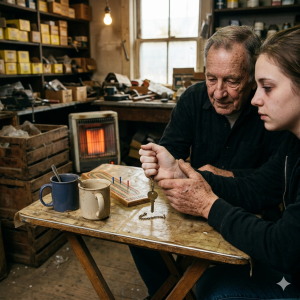
She was pressing a small brass key into her palm. Over and over. Not using it. Not looking at it. Just pressing it — like it was the only solid thing she had left in the world. The key hung from a broken chain, tarnished down to a dull gold, the kind of key that could have opened any door anywhere. An old house key. A mailbox, maybe. Something that used to mean home.
She never once tried to put it in a lock.
Harold stepped back from the door and pointed at the folding chair near the space heater.
She sat down without a word.
He made two cups of the terrible coffee and set hers next to her without asking how she took it. She wrapped both hands around the mug — both hands, which meant for just a moment, the key was resting in her lap.
He pulled out the cribbage board out of old habit. Ruth had taught him to give people something to do with their hands when they were scared. It helped, she always said. Gave trouble somewhere to wait while you steadied yourself.
The girl moved the pegs without knowing what she was doing.
Harold didn’t mind.
He was watching her phone.
She’d pick it up, press the screen, hold it to her ear — and then lower it slowly. Pick it up. Press it. Lower it. Over and over, like a prayer that wasn’t being answered. He could see her lips moving but couldn’t catch the words. He leaned in, the way he used to lean over the counter when a customer was embarrassed about what they needed.
He saw the number on her screen.
Not a name. A number. One he didn’t recognize. She’d called it eleven times in the hour she’d been sitting in his back room.
He wrote on the back of a receipt: Is someone expecting you somewhere tonight?
She looked at the paper for a long time.
Then she shook her head.
He wrote: That number you keep calling — is it someone who can help?
Something moved across her face then. Not embarrassment. Something more like exhausted relief, the way a person looks when they’ve been carrying something alone for so long that just being seen feels like setting down a suitcase.
She typed something on her phone and turned it toward him.
It’s a shelter line. I can’t get through. It’s the storm.
Harold Binner sat back in his chair.
He looked at this girl — her wet coat, her impossible duffel bag, her key to a door she was never going back to — and he thought about Ruth, who would have already had the guest room made up. He thought about his daughter in Phoenix who called every Sunday. He thought about every customer who had ever come into his store not for a bolt or a hinge but because they just needed one person to treat them like they mattered.
He thought about six years of Tuesdays, alone with a wrench clock and a percolator.
He picked up the cribbage board and set it aside.
Then he reached across the table.
He closed his weathered hand — slowly, gently — over her fist, over the key she was pressing into her palm again, and he looked her in the eye the way only a 79-year-old man who has buried a wife and survived a surgery and kept showing up anyway can look at a person.
And he said six words.
You can stay here tonight, sweetheart.
Six words that made her finally, finally stop crying.
She opened her mouth to answer.
And the back door opened.
Neither of them had unlocked it.
Harold turned slowly in his chair.
The girl’s hand went tight around the key.
And standing in the doorway, backlit by the white blur of the ice storm, was someone who clearly knew exactly where she was — and had come to find her.
She was older. Maybe sixty. Heavyset, in a yellow rain slicker that had done its best against the weather and mostly lost. She was breathing hard, the way you breathe when you’ve been walking fast through ice for longer than your body wanted to, and she had snow packed into the crease of every fold in that slicker, and her boots left wet black prints on the concrete floor.
She was carrying a casserole dish wrapped in a dish towel.
Harold stared at her.
The girl stared at her.
The woman in the doorway looked between the two of them, caught her breath, and said, “Dani.”
Just that. Dani.
The girl — Dani — made a sound that wasn’t quite a word. It was something that lived under words, the kind of sound that belongs to people who haven’t heard their own name said with kindness in longer than they can easily calculate.
The woman set the casserole on the nearest shelf — right between a box of toggle bolts and a display of replacement saw blades — and crossed the room in four steps and put both arms around her and the girl went completely still for one moment, the way a person goes still when they’ve braced themselves for impact their whole life and something gentle arrives instead.
Then she wasn’t still anymore.
Harold looked at the clock on the wall. The wrench clock. It was 5:40.
He stood up carefully — his knee had opinions about the cold, always did — and he went and quietly closed the back door against the storm. He turned the dead bolt. He stood there with his back to the two of them and made a project out of finding his coffee mug, which was right where he’d left it and did not need finding.
He gave them a minute.
When he turned back around, the woman in the yellow slicker was sitting in the other folding chair, still holding Dani’s hand, talking low and steady. Dani was wiping her face with her coat sleeve. The duffel bag was still slumped against the wall like it was tired too.
The woman looked up at Harold.
“I’m Patrice,” she said. “I run the Linden Street shelter. Our phones went down with the storm — the landlines. I’ve been getting calls on my cell I can’t pick up fast enough.” She glanced at the casserole like she’d forgotten she was carrying it until just now. “I was already out doing welfare checks in the neighborhood when Dani’s last call dropped. I had her address from her intake form from two weeks ago. I just — I started walking toward it and hoped.”
She said it simply. I started walking toward it and hoped. Like it was the most ordinary thing in the world.
Harold looked at Dani.
Dani had done the intake form two weeks ago. Which meant she’d been trying to get off whatever ledge she was on for two weeks. Which meant she’d been trying.
He was not a man who cried easily. He was 79 years old and he’d learned to keep things level. But something happened behind his eyes right then that he wouldn’t have been able to explain to anybody.
He cleared his throat.
He pointed at the casserole.
Patrice laughed — a short, surprised laugh. “It’s chicken and rice. I brought it to the Overbeck family on Clement Street. They’ve got four kids and the power went out this morning. I had extra.”
Harold went and got two more cups of coffee. Bad coffee. Percolator coffee. The kind Ruth used to say tasted like regret, and drink anyway, every morning, for forty-one years.
He set the mugs down and pulled up a third folding chair and they sat there, the three of them, in the back of a hardware store that hadn’t been open in six years, while the ice storm made a sound like static against the metal roof.
Patrice explained the situation to Harold in plain terms, speaking up so he could follow. Dani had been in an apartment with someone she needed to be away from. She’d left three days ago with the duffel bag and her phone and the key she hadn’t been able to make herself throw away — the key to her mother’s house, which was sold now, her mother gone, nothing to unlock. She’d been couch-surfing through the storm, running out of couches. The shelter had a bed but it had taken her two weeks to make herself call, and now she’d called eleven times and couldn’t get through and the weather had closed in around her and she’d ended up at the first lit window she saw.
That window had been Harold’s.
The fluorescent light he left on over the workbench on Tuesdays because the back of the store got dark by three o’clock in February.
She’d seen it from the alley and knocked because — and this was what she said, quietly, with her coffee mug in both hands again — it looked like someone was still in there. Still keeping something going. Still showing up.
Harold thought about that for a while.
He looked at the space heater, which ticked and glowed. He looked at the wrench clock. He thought about how Ruth used to say that a person’s job was never really what their job was called — that his job wasn’t hardware, it was people, and the nuts and bolts were just the excuse.
He thought she’d have liked Dani. Would have had opinions about that broken chain on the key and known exactly where the jewelry tools were to fix it.
He thought she’d have liked Patrice too. Ruth had always been drawn to people who walked toward things instead of away.
He asked Patrice — wrote it on the back of another receipt — whether there was a bed at the shelter tonight.
Patrice said there was. She said the power was on, the heat was running, there was more chicken and rice. She said she’d driven over in her truck before the roads got bad, and the truck was parked on Birch Street a block over, and she could get them there.
Harold nodded slowly.
He stood up. He went to the cabinet behind the workbench, the one he kept locked, and he opened it with a key from his own key ring. From the top shelf he took down a paper bag, folded closed at the top. He’d put it together three months ago when the woman at church had mentioned that the shelter always needed hygiene supplies. He’d put the bag together and then never gotten around to delivering it.
He set it on the table next to Dani’s duffel bag.
She looked at it.
He wrote: Travel-size. Toothbrush and paste, shampoo, some other things. You can have it.
She looked at the bag. She looked at him.
She nodded once, and the nod said more than most speeches Harold had ever heard.
They got ready to leave. Patrice rewrapped the casserole dish. Dani shouldered the duffel. Harold walked them to the back door.
At the door, Dani stopped.
She reached up and took the brass key off her palm, where she’d been pressing it for the last two hours. She looked at it for a moment in her open hand — that tarnished, chainless, unlockable key. The key to a house that was gone. The key she’d carried anyway.
She held it out to Harold.
He shook his head.
He got out the receipt pad one more time.
He wrote: That belongs to you. Put it somewhere safe, not your palm.
She read it. She almost smiled — almost, but not quite, which was exactly right for who she was and where she was and what this day had been.
She put the key in the small front pocket of the duffel, where it would be safe.
Harold held the door open against the wind.
The ice storm was still going. The alley was a solid white silence. Patrice’s yellow slicker was a bright flag moving through it. Dani followed, the duffel on her back, her steps careful on the ice.
She turned back once, from the edge of the alley.
She raised her hand.
Harold raised his.
Then they were gone into the white, and he was standing alone in the doorway of his store in the February cold, the bad coffee still steaming on the table behind him, the cribbage board pushed to the side, three empty chairs around the space heater like a conversation that had just finished.
He stood there for a moment.
Then he went back inside. He washed all three mugs in the little utility sink, the way he always did. He turned off the space heater and put the cribbage board on the shelf. He put on his coat.
He stood in front of the light switch for a long minute.
He left the fluorescent light on over the workbench.
He locked the back door behind him. He walked to his truck. The ice made every step slow and deliberate, the kind of walking that demands your full attention, which was fine, which was what he needed.
He sat in the truck for a moment with the engine running.
He called his daughter in Phoenix.
She answered on the second ring.
“Dad? Is everything okay?”
“Yes,” he said, and was surprised to find he meant it completely. “I just wanted to hear your voice.”
She talked and he listened, and the heat came up in the truck, and the ice storm moved across the parking lot in slow gray curtains.
He drove home the long way.
He didn’t think about it too much. Some days just arranged themselves in a way that was too precise to be accidental, and the only honest response was to be quiet about it and carry it carefully, the way you carry something that belongs to you now whether you planned on it or not.
Three weeks later, Patrice called him.
He didn’t recognize the number and almost didn’t pick up.
She told him Dani had found a room in a house with two other women, both working, steady situation, good landlord. She told him Dani was working part-time at a bakery on Morrison Street and had applied for a certificate program in bookkeeping starting in March.
She told him Dani had asked her to pass something along.
Patrice mailed it to the hardware store, because that was the address she had.
Harold went in on Tuesday and found it in the mail slot.
It was a small card, plain white. On the front, in handwriting that was careful and a little formal, the way handwriting is when someone wants to get it right, were two lines.
You were the lit window. Thank you for staying open.
Harold stood there in his empty store and read it twice.
He put the card on the shelf next to the wrench clock, where Ruth used to put things she wanted to look at while she drank her coffee.
Then he sat down, and poured himself a cup of the terrible coffee, and for the first time in six years he reached over and turned the sign in the window.
Not OPEN for business. He wasn’t ready for that, might never be. But turned, just the same. Shifted. Aimed at something new.
Outside, the February had finally let go. The street was grey and bright at once, the way streets are when the ice first melts and everything is wet and lit and possible.
Harold Binner drank his coffee.
He was not expecting company.
But he’d decided he wouldn’t mind.