Don Marco had built his life on fear.
He understood numbers, favors, silence, and revenge. He understood what made judges look away, what made businessmen nod too quickly, and what made grown men lower their eyes when he entered a room. In his world, tears were weaknesses, hesitation was fatal, and love was the one luxury that could destroy a man faster than a bullet.
That was why almost no one knew what his wife’s pregnancy had done to him.
For months, the man who ruled the city’s underworld had quietly transformed a wing of his estate into a nursery. He had stood in expensive shops pretending not to care while secretly choosing fabrics, furniture, and hand-carved toys imported from places he’d never visited. He had instructed his security team to triple every protocol around his wife without ever telling them that each extra guard was less about control and more about terror. He was afraid. Not of rivals. Not of prison. Not of death.
He was afraid of wanting this child too much.
His wife, Elena, knew it even when he denied it. She would catch him standing in the nursery doorway late at night, staring at the crib with that unreadable expression he wore when emotion came too close. She would smile and ask, “Practicing being a father?”
And he would scoff. “I already know how to run a house.”
But she saw through him every time.
“You know how to command people,” she once told him, taking his hand and placing it over her stomach when the baby kicked. “This is different.”
She was right.
It was different enough that Marco had made a private promise no one heard. If the child was born healthy, he would begin stepping away. Not fully—men like him were never allowed clean exits—but enough to give his son distance from the stain of his name.
That promise was still echoing somewhere inside him the night everything nearly ended.
The delivery had turned difficult after midnight. What began as nervous expectation shifted into alarm as Elena’s labor dragged on and complications multiplied. Doctors moved faster. Nurses stopped smiling. Orders became sharp, clipped commands. Marco paced so hard outside the operating suite that one of his own guards asked him to sit down.
Marco answered with a stare that sent the man backward.
When the first cry finally came, Marco felt his knees weaken in a way that shocked him. For one glorious second, the world narrowed to one sound: his son, loud and furious, alive.
Then the room changed.
The cry cut out.
Voices rose.
Someone shouted for assistance.
The baby was taken to the neonatal station, and within seconds too many people were around him. Marco tried to push forward, but a nurse blocked him, trembling as she did. Machines were brought in. A doctor said something about respiratory collapse. Another mentioned cardiac instability. The phrases slammed together in Marco’s head without meaning. All he could see was the movement—the terrible movement of professionals trying not to panic.
A few minutes later, one of them did the unforgivable thing.
He looked at Marco with pity.
That was how Marco knew.
The infant was transferred to a private recovery room with emergency equipment. Elena, exhausted and heavily sedated after the birth, was moved next door before she fully understood what was happening. The doctors worked. More specialists came. They checked medication levels, blood oxygen, the umbilical line, the lungs, the heart.
Then the monitor flattened.
And stayed that way.
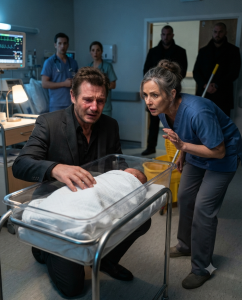
Marco had experienced enough death to recognize the finality in the room before anyone spoke. The doctors slowed in that particular awful way people do when they have crossed from action into failure. One nurse removed her gloves and looked down. Another turned off a setting on one of the machines. Nobody wanted to say it.
The senior physician finally did.
“We did everything we could.”
Marco could still hear the sentence later with perfect clarity, but in the moment it reached him as if through water. He remembered walking to the crib. He remembered gripping it. He remembered looking at the tiny, still face of the child he had imagined for months and feeling something inside himself tear open with a violence no enemy had ever managed.
He accused the doctor of incompetence. It was the only response he had left.
But anger dissolved quickly in the presence of the small body before him. He leaned over the crib, lowered his head, and whispered an apology to a son who had not even lived long enough to know his father’s voice.
That was when Rosa entered.
She was supposed to be invisible. That was how the hospital saw her, how most people saw her. A cleaner with a mop bucket and sore feet. Fifty years old, maybe a little older if life had been especially hard on her. She worked night shifts because they paid slightly more, and because night workers were less likely to be spoken to unless someone wanted a floor dried quickly.
She had been cleaning the corridor outside the neonatal rooms when she noticed unusual commotion. Nurses moved with the kind of stiffness that follows bad news. Men in dark suits stood at the door. She might have avoided the room entirely, but one of the housekeeping supervisors had complained earlier that this suite had been missed.
So she entered.
At first she registered only the tension. The armed guards. The doctors. The man on his knees. Then she looked into the crib.
What she saw hit her with such force she nearly dropped the bucket.
The baby’s face was pale and still. But Rosa’s attention snagged on the tiniest details. The faint tone of the skin. The unnatural chill suggested by the doctors’ handling. The slight rigidity that looked wrong for death and wrong for life. Somewhere in the back of her mind, buried under decades of exhaustion and survival, an old memory surged forward.
She had once worked in a rural maternity ward when she was very young. Not as a full nurse—she had never finished formal training—but as an assistant who learned by doing, by watching, by helping older staff through shortages, emergencies, and bitter winters when power outages turned newborn care into improvisation and prayer. One winter night, a baby declared lost had shown almost no detectable pulse after the building went cold. An aging pediatrician had taught them that life can hide in terrifying ways, especially in newborns whose bodies slip into profound hypothermic shock.
The lesson had never left her.
Neither had something else.
When Rosa looked into the crib, she felt the same instinct she had felt decades earlier. She set down her bucket and stepped toward the child. The room treated her as an intruder. The senior doctor ordered her out. One of the guards took a threatening step.
But Rosa touched the back of the baby’s hand and whispered, “He’s not gone.”
Everyone stared at her.
The physician dismissed her at once. He listed the checks already performed, offended at the idea that a cleaner could question him. But Rosa had noticed the fingers. She had seen one nearly imperceptible movement, not the loose randomness of reflex but something more deliberate, more hidden.
She insisted.
There are moments when authority survives on habit alone. This was one of them. The senior doctor clung to certainty because the alternative was admitting he might have been wrong with consequences too huge to measure. But Marco heard something he had not heard from anyone else in that room.
Hope.
He turned that hope into an order.
Within minutes the team restarted intervention. A handheld Doppler was fetched. Warming measures were begun. One younger doctor, shaken enough to trust possibility, followed Rosa’s direction and searched lower on the chest.
At first there was only static.
Then a faint sound pulsed through the room.
Slow. Unsteady. Fragile.
A heartbeat.
What followed was chaos. Controlled, technical, desperate chaos. The neonatal team rushed back in. Heat packs were prepared carefully. Oxygen support resumed. Blood work was redrawn. The infant’s body, thought lost, began to answer.
The baby’s chest rose.
Then again.
Marco wept openly, and no one in the room dared react.
The child—his child—had been minutes from being mourned when he should have still been fought for. Marco felt gratitude so intense it bordered on fury. Gratitude at life. Fury at how close he had come to burial. Both settled on the same target: Rosa.
The doctors asked her name once the baby stabilized enough to be transferred for further monitoring.
“Rosa,” she said.
She did not add a surname. She did not need to. Marco was already studying her.
He noticed her composure after crisis, the way people who have seen real emergencies go quiet instead of dramatic. He noticed that she did not bask in praise. Mostly, he noticed that when the baby’s blanket slipped and revealed a crescent-shaped birthmark near the shoulder, Rosa reacted in a way no stranger should.
She went pale.
And she whispered, “No.”
Marco saw the mark and felt a second shock.
He knew that mark.
Years ago, before he became Don Marco in full, before he learned how expensive love could be, there had been another woman in his life. Her name was Sofia. Fierce, reckless, impossible to forget. She had a crescent-shaped birthmark near her collarbone, small and pale against her skin. He had once kissed it and teased her that the moon had signed its name on her.
Sofia had vanished after a violent period in his life, a disappearance tangled in betrayal and blood. Marco had been told she fled the country. Later he heard she was dead. Eventually he stopped asking because in his world, unanswered questions were sometimes safer than the truth.
Yet Rosa had looked at the same mark on his son as if she had seen a ghost.
Before Marco could question her properly, Elena woke in the next room screaming for her baby.
He rushed to her.
She was half-conscious, panicked, trying to rise despite the pain. Marco held her and told her the child was alive. At first she thought he was lying to spare her. Then she saw tears in his eyes and understood. Relief shattered her. She sobbed into his hand, whispering the baby’s name over and over as if repeating it would keep him anchored to the world.
During those minutes, Rosa disappeared.
By the time Marco sent a guard to find her, her cart remained in the hall but she was gone.
Every exit was locked. Cameras were checked. Staff were questioned. The hospital folded under the pressure of Marco’s command. Rosa was eventually found not outside but in the old laundry basement, standing between industrial dryers, her hands shaking so badly she could barely hold the metal shelf beside her.
She did not run when Marco entered.
Maybe she knew she couldn’t. Maybe she was too tired.
“You saved my son,” Marco said.
Rosa lowered her eyes. “Yes.”
“You recognized that mark.”
Silence.
Marco stepped closer. “Who are you?”
Rosa looked up then, and in her face he saw the answer before her mouth opened.
“I was Sofia’s mother,” she whispered.
The words landed harder than a gunshot.
Marco stared at her. For years Sofia had existed in his memory like an unfinished wound. To hear her name in that basement from the mouth of a cleaning lady made reality warp. He demanded details. Rosa gave them in broken pieces.
After Sofia disappeared, Rosa had been warned never to contact Marco. Men connected to one of Marco’s old rivals had convinced her that Sofia had been killed because of him. Rosa, terrified and grieving, vanished into poor districts, changed jobs constantly, and tried to survive. Years later she learned bits of the truth: Sofia had not died immediately. She had been hidden while pregnant.
Marco felt the air leave his lungs.
Pregnant.
Rosa nodded through tears. Sofia had given birth to a daughter in secrecy. A girl who carried the crescent mark. But Sofia herself died soon after from untreated complications while being moved between safe houses controlled by men who wanted leverage over Marco. The child disappeared into a chain of false documents and private placements. Rosa had spent years trying to trace her granddaughter and failed. She eventually accepted that whoever took the child had buried the trail too deep.
Then, months earlier, Rosa found work at the clinic.
She had seen Elena arrive for prenatal visits. She had once glimpsed Marco in the corridor and recognized him instantly despite the decades. She never approached. What could she say? That the woman he once loved had died carrying his child? That somewhere out there he had a daughter he never knew? Rosa stayed silent out of fear—fear of him, fear of what old enemies might still do, fear of tearing apart the life he had built.
Until she saw the newborn’s crescent birthmark.
That was why she gasped. Not because the child was impossible, but because the mark confirmed something else she had not yet understood. The daughter stolen from Sofia was not lost to the world.
She had grown up to become Elena.
Marco went completely still.
Rosa, weeping now, explained what she had pieced together too late. Years before, a wealthy couple with forged papers had adopted a baby girl through intermediaries. That child later entered the orbit of respectable families, changing names as records were cleaned. Rosa had once seen a younger photo of Elena at a charity gala in a hospital magazine. The birthmark. The age. The timing. The chain of names. She had suspected it then but buried the thought because it was too monstrous to voice without proof.
Now Marco’s son bore the mark from both lines.
Because Elena was Sofia’s daughter.
Because the woman Marco had married was the child he never knew existed.
Because the newborn in the intensive unit was not just his son.
He was also his grandson.
The revelation should have shattered logic entirely, but the pieces clicked with cruel precision. Elena had entered Marco’s life as an adult through circles arranged by people who benefited from keeping old truths hidden. She had no idea who her biological mother was; she had been told she was orphaned early. Marco, older but worn by power and time, had never imagined the impossible. No one had.
Rosa had.
And now she had spoken.
Marco’s first reaction was denial so fierce it felt like survival. He accused Rosa of inventing madness. She answered with names, locations, dates, and one final proof: a silver medallion Sofia had worn, hidden for years in Rosa’s apartment. Inside it was a photograph of Sofia and a younger Marco, folded behind a note written in Sofia’s hand about the baby she carried.
The truth detonated quietly and completely.
Marco left the basement unable to feel his own feet.
He went first not to Elena but to the neonatal unit and stood outside the glass, staring at the tiny child fighting beneath warm lights and careful machines. The baby had no fault in any of it. None. Marco pressed his hand to the glass and felt horror, grief, and love tearing at each other inside him until all three became one unbearable weight.
When he finally entered Elena’s room, she looked up with exhausted joy, still asking when she could see the baby.
Marco sat beside her bed.
There was no clean way to say what came next. No merciful sequence. He asked questions instead—about her childhood, about the documents she had, about what she had been told of her birth parents. Confusion crossed her face first, then annoyance, then fear as his questions turned sharper. When he mentioned Sofia’s name, something deep in Elena’s memory shifted. She remembered a lullaby. A crescent moon pendant from childhood that had gone missing. A woman in a faded dream she had always thought was imagination.
Rosa was brought to the room.
The truth unfolded in pieces, each one worse than the last. Elena listened, white as the sheets beneath her. At one point she laughed once in disbelief. Then she began to shake. When Rosa placed the medallion in her hand and Elena opened it, whatever fragile doubt remained vanished.
The breakdown that followed was total.
Elena screamed at Marco to tell her it was a lie. He could not. She screamed at Rosa for waiting so long. Rosa collapsed in apology. Elena turned away from both of them and sobbed with a grief so strange and absolute that none of them could touch it.
The hospital became a locked fortress by morning. Records were seized. Old associates were hunted. A surviving fixer from Marco’s past was dragged in and confirmed what greed had engineered decades earlier: keeping Sofia’s child hidden and later steering Elena into Marco’s adult orbit had been part revenge, part long game. Men who hated Marco had built a trap so twisted it outlived them.
There was no revenge satisfying enough for that truth.
By the end of the week, Marco arranged the best care possible for the baby and the best legal and psychological support for Elena, though support felt like an insult beside what she had suffered. Their marriage ended in all but paperwork the moment the truth was undeniable. Elena could barely stand to hear his voice, not because he had knowingly harmed her, but because his existence had become unbearable to her identity. She asked to leave the city. Marco let her go with full protection and without argument.
The child remained in specialized care and eventually stabilized. Healthy. Strong. Beautiful. The doctors called him a miracle baby.
Marco never used that phrase.
Miracle implied grace. This felt more like a warning wrapped around a blessing.
Months later, Elena agreed to one final meeting in a neutral place with lawyers present and Rosa seated near the window, older and smaller than ever. The subject was the child’s future. Elena did not want Marco erased from the boy’s life, but she could not bear a conventional family structure around a truth so catastrophic. Arrangements were made for guardianship, trust control, and distance. The baby would be raised with the truth protected until he was old enough for it. Not hidden forever. Just delayed until it would not destroy him in childhood.
When the meeting ended, Elena paused at the door and looked at Marco for a long time.
“We were both used,” she said.
Marco nodded once.
But she added, “You had a lifetime of enemies. I had a lifetime stolen.”
There was nothing he could say to that.
Rosa visited the child often after that. She sang the old lullaby Sofia used to sing. Sometimes Marco listened from the hall, unable to enter. He had lost the future he imagined, discovered a daughter he could never truly father, and gained a child whose existence would forever be tied to the cruelest secret of his life.
Yet the boy lived.
Because a woman everyone ignored walked into a room at the exact moment grief was about to become final and refused to accept what the powerful had declared.
Years later, people in the city would still whisper about the night Don Marco cried in a hospital. Some said it was because his son came back from death. Some said it was because he learned a secret that broke even him. The truth was both, and neither version captured the full cost.
The doctors had almost buried the baby.
The enemies had buried the past.
And in the end, the only person who saw clearly enough to stop both was a tired cleaning lady with gray in her hair and courage no title could measure.
Some stories make you ask who the villain really was. The men who plotted? The doctors who missed the signs? The mother who stayed silent out of fear? Or Marco himself, whose violent life created the shadows where such horrors could grow?
Maybe the ugliest answer is that one evil act rarely stands alone. It survives because pride, fear, secrecy, and power all agree to protect it.
But if there was one red flag no one should ignore, it was this: the most dangerous lies are the ones built patiently enough to look like fate.