The black van arrived at 10:47 p.m., slipping into the hospital’s service lane with its headlights off until the very last moment. It looked less like an official vehicle and more like something that wanted to be forgotten. By the time the night security guard noticed it on the basement monitor, the rear doors were already opening.
Three men in dark coats stepped out first. Their movements were quick and disciplined, but not medical. They scanned the alley, checked the loading dock, and only then reached inside to pull out a covered stretcher. Two uniformed police officers followed close behind, one carrying a sealed evidence box. The last man out of the van was Detective Sean Hayes, a veteran homicide investigator with tired eyes and the kind of rigid posture that suggested control was the only thing holding him together.
Nobody on the loading dock asked questions.
Nobody needed to.
The covered body on that stretcher belonged to Daniel Moretti.
For years, Moretti had existed in the city as both rumor and reality. He owned no visible empire, signed no public checks, and never spoke to reporters, yet his influence touched construction contracts, clubs, shipping routes, debt collections, and half the neighborhoods where witnesses suddenly forgot what they had seen. His name passed from mouth to mouth in lowered voices. He was not simply feared. He was treated like a fixed law of nature.
And according to the police, he was dead.
The official report stated that officers had responded to gunfire at an abandoned warehouse near the river district. Multiple shell casings were recovered. Blood was found throughout the structure. Daniel Moretti had been discovered on the concrete floor with apparent gunshot wounds and no detectable signs of life. Emergency personnel on scene confirmed death. The case, to the relief of nearly everyone in law enforcement, appeared effectively over before it even began.
But the law required an autopsy.
That was how Daniel Moretti ended up in the basement morgue of St. Catherine’s Hospital.
Dr. Emily Carter did not care about legends. At fifty-eight, with twenty-five years in forensic pathology behind her, she had lost patience for noise, drama, and reputation. The dead did not impress her. The living only occasionally did. She trusted evidence because evidence did not flatter, manipulate, or lie for its own survival.
On most nights, Emily liked the morgue.
Not because it was cold or isolated, but because it was honest. Upstairs, grief could distort memory and fear could silence facts. Downstairs, a body always revealed what had really happened, provided the examiner was willing to look long enough.
She arrived in the autopsy suite just after 11:30 p.m., tying back her hair as she reviewed the intake paperwork. Cause of death was listed as gunshot trauma sustained during a criminal confrontation. Detective Hayes had signed the release. Two responding officers had witnessed transfer of the body. Everything was in order.
Too in order, Emily thought.
The report was unusually streamlined for a case involving someone as politically dangerous as Moretti. There was no rambling note from emergency responders, no attached argument over chain of custody, no frantic handwriting from an overworked physician in the field. It read like someone had wanted the paperwork completed quickly.
“Busy night?” asked Ava Lin as she entered behind her.
Ava was the night nurse assigned to assist. She was in her late twenties, intelligent, efficient, and still new enough to the morgue that certain cases got under her skin. Tonight was clearly one of them.
“You could say that,” Emily replied.
Ava placed the sterilized instruments on the tray. “The whole hospital knows.”
“They always do.”
“I heard one of the officers tell security this was the end of an era.”
Emily fastened her gloves. “Cities survive lots of eras.”
Ava managed a faint smile, but it didn’t last. “You really aren’t nervous?”
Emily glanced at the covered body. “I’ve never had a corpse attack me.”
That got a short laugh, and for a moment the tension lifted.
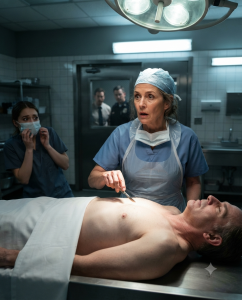
Then Emily drew back the sheet.
Daniel Moretti looked older than the newspapers ever showed. His face carried deep lines around the mouth and eyes. Stubble shadowed his jaw. His hair was threaded with more gray than the public would have guessed. Death had flattened him into what all bodies eventually became—still flesh, stripped of myth.
Emily began the external examination. Apparent wound to the upper chest. Another lower along the torso. Dried blood. Bruising. No visible defensive injuries on the hands. She noted each detail aloud while Ava recorded them.
Then Emily paused.
She leaned closer to the chest wound, then to the skin around it. Something bothered her, but it was not yet a thought she could name. She looked again at the discoloration along the rib cage. The lividity was wrong. Or rather, not absent—but not settled in the way she expected. The skin temperature also seemed inconsistent. Cool, yes. But not uniformly.
She pressed two gloved fingers at the neck.
Nothing obvious.
She should have moved on.
Instead, she studied the center of the chest under the surgical lamp.
There.
A rise so faint it could have been illusion.
Emily said, “Wait.”
Ava looked up. “What’s wrong?”
“Come here. Closer.”
Ava stepped beside her and followed Emily’s gaze. For a second she frowned, not seeing it. Then the chest moved again. Barely a whisper of motion, but unmistakable once noticed.
Ava jerked backward, knocking a clamp from the tray. “Oh no. That can’t be.”
Emily dropped the scalpel and pressed more firmly at the carotid artery.
A pulse answered her.
Weak. Threadlike. Hidden beneath collapse, shock, and blood loss—but real.
“Call ICU now,” Emily said sharply. “Tell them I need respiratory support and a crash team in the morgue. Move.”
Ava sprinted to the phone.
Emily tore open the top buttons of Moretti’s shirt and listened with her stethoscope. Faint cardiac activity. Shallow respirations. Impossible, yet present. Her mind raced through every error chain that could create such a catastrophe. A rushed scene assessment. Massive physiological suppression. Misread death signs. Maybe a sedative or paralytic. Maybe exposure to cold. Maybe plain negligence.
But one fact overrode all of it: somebody had sent a living man to the morgue.
Within three minutes, the autopsy suite was full.
Respiratory therapy arrived first, followed by two ICU nurses, an anesthesiology resident, and a paramedic team. Oxygen was placed. Monitors were attached. An IV was started in the left arm. Warm fluids began flowing. The room filled with motion, commands, and the shrill activation tone of machines waking up to the presence of life.
Then the monitor produced a rhythm.
Irregular. Weak. But organized.
Ava stared at the screen as though it had spoken. One of the ICU nurses crossed herself under her breath. Emily ignored them all and focused on stabilizing the patient long enough to transfer him upstairs.
Security locked down the basement corridor. Hospital administration came running. Someone called legal. Someone else called the chief of medicine. Detective Hayes returned so quickly he must have still been in the parking lot.
He entered the room pale and furious. “What exactly is happening?”
Emily did not look at him. “Your dead man is alive.”
For once, Hayes had no answer.
He stared at Moretti, then at the monitor, then at the wound sites as if expecting the body to expose the trick. “He had no pulse at the warehouse.”
Emily finally turned toward him. “Then someone missed one.”
The detective’s jaw tightened. “That scene was secured.”
“Was it?” she said.
Before he could respond, Moretti’s right hand twitched.
Every person in the room went still.
The hand twitched again, then slowly curled against the sheet. His eyelids fluttered under the overhead light. The oxygen mask fogged with each shallow breath. Emily leaned closer while the anesthesiology resident prepared for emergency transport.
“Daniel,” Emily said, using the name only because sometimes the body followed familiar sound back toward consciousness. “Can you hear me?”
His eyes opened.
Only halfway at first. A dull, fractured awareness looked through them. Then suddenly they sharpened—not fully, but enough to register the room.
Enough to register the detective.
Moretti’s expression changed.
Not relief. Not confusion.
Fear.
Emily noticed it before anyone else, and once she saw it, she could not unsee it. Daniel Moretti, the man whose name could empty restaurants and silence neighborhoods, looked terrified.
He lifted one hand with visible effort and caught Emily’s wrist. His grip was shockingly strong for a man hovering near death.
Ava gasped. One of the officers moved forward, but Emily snapped, “Stay back!”
Moretti tried to speak. The first sound was useless air. Blood stained the edge of the oxygen mask. Emily bent lower until she could feel the heat of each ragged breath.
“Don’t waste energy,” she said. “Nod if you understand me.”
He didn’t nod.
His eyes stayed locked on Detective Hayes.
Then he forced out two broken words.
“Not… police…”
Hayes stepped back as if struck.
One of the uniformed officers frowned. “What the hell does that mean?”
No one answered.
Moretti tightened his grip on Emily’s wrist again, desperate now. He looked from her to the ceiling, then toward the hallway beyond the morgue doors, as if he expected someone to come through them at any second.
“Who?” Emily asked quietly. “Who did this to you?”
His lips moved again. This time the sound was little more than a shredded whisper.
Emily heard a name.
So did Hayes.
The detective lost what little color remained in his face.
It was not the name of a rival mob lieutenant. Not one of the men publicly linked to Moretti’s organization. Not any suspect listed in the report from the warehouse shooting.
It was Dr. Victor Lang.
Chief of Surgery at St. Catherine’s Hospital.
For one suspended second, Emily thought she must have misheard. Victor Lang was one of the most respected physicians in the building. Brilliant, controlled, polished. He had chaired fundraising events, trained residents, and spent years building a reputation so clean it almost gleamed.
Then Emily remembered two things at once.
First, Victor had left unusually early that evening after claiming a migraine.
Second, his signature appeared on the preliminary emergency consult that had been attached—oddly, unnecessarily—to Moretti’s intake file.
A surgeon had no reason to touch a body headed directly for autopsy.
Unless it had not been a body yet.
“Get him upstairs now,” Emily said.
The gurney rolled into the corridor. Security officers moved ahead to clear the path. Detective Hayes followed, but he no longer looked like a man escorting a criminal case. He looked like a man realizing the floor beneath his investigation had vanished.
As they neared the elevator bank, the lights flickered.
Once.
Twice.
Then half the basement dropped into emergency power.
The elevator doors, which should have opened automatically on override, stayed shut.
A voice came across the security radio in a burst of static: “South corridor breach—repeat, south corridor breach—”
Then the feed died.
Emily turned just in time to see one of the basement fire doors swing inward.
Victor Lang stood there.
He was still in surgical scrubs under a dark overcoat. No migraine. No rush to leave. He held no weapon, nothing obvious or dramatic, and somehow that made him more frightening. His face was calm in a way only certain men could manage—men who had convinced themselves they were acting logically.
The officers nearest him straightened. One reached for his radio. Another hesitated.
“Step away from the patient,” Hayes ordered.
Victor smiled faintly. “You should listen to him, Detective. He’s unstable.”
Moretti made a raw choking sound behind the oxygen mask and tried to lift himself.
Emily stepped between the gurney and Victor without thinking. “You signed off on this transport,” she said. “Why?”
Victor’s eyes shifted to her. “Because sometimes the city improves through unpleasant necessities.”
Ava, who had come up from the morgue with the supply cart and had more courage than anyone gave her credit for, whispered, “Oh my God.”
Hayes drew his sidearm then, not pointing it directly but enough to make the hallway snap tight with danger. “You’re done, Victor.”
Victor did not look at the gun. “Am I?”
That was when one of the uniformed officers moved—fast, deliberate, and in the wrong direction.
Toward Hayes.
The betrayal happened so quickly it barely registered as choice. The officer struck Hayes’s arm, sending the weapon clattering across the floor. The second officer lunged for Emily and the gurney. Ava screamed. Security crashed into the wall trying to respond. The hallway exploded into struggle.
Victor had planted people inside the escort.
Of course he had.
Emily shoved the gurney backward with all her strength while Moretti, half-conscious and bleeding, clawed weakly at the side rail. Hayes drove his shoulder into the corrupt officer and slammed him into the elevator doors. One of the security guards tackled the second man at the knees.
Victor turned and ran.
“Don’t let him out!” Hayes shouted.
Emily made a choice in that instant that would haunt her no matter how it ended. She left the others to restrain the officers and sprinted after Victor.
Years in pathology had not prepared her for a chase through a failing hospital corridor, but fury carried her farther than training ever could. Victor cut through a supply room and into the old surgical wing, where half the lights were dark and the hallways echoed.
“Why?” Emily shouted after him.
He stopped at the end of the corridor near a window overlooking the ambulance bay. For the first time, he looked tired.
“You think men like Moretti belong in courtrooms?” he asked. “You think the law was ever going to hold him?”
“That wasn’t your decision.”
“No,” Victor said. “It became my responsibility.”
He spoke then with the brittle conviction of someone who had rehearsed his morality until it sounded pure even to himself. Years earlier, his younger brother had testified against a trafficking ring linked to Moretti’s network. Before trial, the brother vanished. No body was ever found. No conviction followed. Victor had spent years carrying grief he could not prove and rage he could not legally use. Eventually, he discovered what powerful people always discover: institutions had seams. Records could be altered. sedatives could be acquired. crime scenes could be nudged. Dying men could be finished quietly and declared beyond saving.
The warehouse shooting, Victor admitted, had not gone as planned. Moretti was supposed to die there. When he did not, Victor used the confusion, his emergency credentials, and help from compromised officers to ensure the “body” was never truly examined until it was too late.
Only Emily had ruined that.
“You sent a living man to be cut open,” she said.
Victor’s eyes hardened. “I sent a monster where monsters belong.”
“And what does that make you?”
He did not answer.
Behind Emily, footsteps thundered. Hayes and security were closing in. Victor looked toward the stairwell, calculating his last options. For a heartbeat Emily thought he might jump the rail, run, or fight.
Instead, he sagged.
Not with remorse. With defeat.
By sunrise, the story had broken across every station in the city.
Mafia boss found alive on autopsy table.
Prominent surgeon arrested in hospital conspiracy.
Detective unit under internal investigation.
Two officers were taken into custody before dawn. Search warrants spread through departments, warehouses, private accounts, and phone records. The warehouse “shootout” was revealed to be something far messier: an attempted execution arranged through a web of corruption, revenge, and convenient paperwork.
Daniel Moretti survived emergency surgery.
That fact complicated everything.
For days he remained under guard in intensive care while prosecutors negotiated, investigators circled, and half the city waited to see which secrets he would trade to stay alive. In the end, he gave them enough to tear open networks that had operated in shadow for years. He did not become innocent. He did not become noble. But the myth around him cracked, and once myths crack, people begin talking.
Victor Lang was charged with attempted murder, conspiracy, evidence tampering, and multiple counts tied to the compromised transport. During questioning, he never denied what he had done. He only denied that it was wrong. The city argued about that for months.
Emily went back to work.
People called her a hero. She hated the word. She had not solved corruption. She had simply done the one thing her job required: she had looked closely enough to notice the truth before someone buried it.
Still, she could not shake one final image.
Not Victor in handcuffs.
Not Hayes staring at the wreckage of his own case.
Not the chaos in the corridor.
It was Daniel Moretti on the autopsy table, eyes opening in horror, terrified not of death but of who had been trusted to certify it.
That was what stayed with her.
Because evil, she had learned all over again, was rarely at its most dangerous when it arrived wearing its own face. Sometimes it came in a white coat, carrying credentials and speaking softly about procedure. Sometimes it hid inside the systems built to protect everyone else.
And if Emily had made that incision thirty seconds earlier, the entire city would have gone on believing the wrong man had won.