When Lina Moreau accepted the private nursing assignment, she told herself it was temporary.
That was the only way she could do it.
Temporary meant she could survive anything for a little while. Temporary meant she could ignore the whispers surrounding the case, the warning in the recruiter’s voice, and the fact that the pay was almost absurdly high for a single-patient post. Temporary meant she didn’t have to think about why so many nurses had already refused.
She needed money, not comfort.
Six months earlier, her mother had died after a long battle with kidney disease. The treatments had stretched on far beyond what the family could afford. By the end, Lina had used every bit of savings she had, borrowed from relatives who could barely spare it, and signed papers she didn’t fully understand just to keep the care going. It still hadn’t been enough. Now the bills kept arriving as if grief itself had a due date.
Her younger brother, Theo, was finishing his final year of school. He was bright, careful, and far too observant. He never complained when the refrigerator was half empty or when Lina lied and said she had already eaten. He knew she was drowning. He just didn’t know how badly.
So when the agency offered her the position at the Voss Medical Residence—a luxury private wing attached to one of the most exclusive clinics in the city—she said yes.
Only afterward did she learn the patient’s name.
Adrian Voss.
Even Lina had heard of him. He had built an empire from technology investments and strategic acquisitions, the kind of man whose face appeared in magazines next to words like visionary and ruthless. Two years earlier, he had survived a car crash on a coastal highway. His driver died at the scene. Adrian was found barely alive. The headlines lasted for weeks. Then came the official statement: severe neurological trauma, prolonged coma, uncertain prognosis. Eventually the public moved on.
But money, Lina learned quickly, did not move on. Money waited.
The first time she entered Adrian’s room, she understood why the assignment paid so much.
The space looked more like a private suite than a hospital room. There was a sitting area with expensive furniture, a wall-mounted television that stayed dark, framed abstract art, shelves with untouched books, and discreetly hidden medical equipment worth more than Lina’s apartment. The bed itself sat in the center like a throne no one acknowledged. A guard stood outside at all times. Access was logged. Visitors were limited. Every movement in and out was documented.
It should have felt safe.
Instead, it felt controlled.
The attending physician, Dr. Marcus Weller, gave her the briefing in a tone so practiced it sounded memorized. Adrian had severe brain injury, no reliable consciousness, no meaningful motor activity, and no expectation of recovery. Lina’s role was straightforward: hygiene, repositioning, passive mobility exercises, monitoring, line care, feeding tube maintenance, pressure sore prevention, and immediate reporting of any physical change.
“Don’t read into involuntary movements,” Weller added while signing the chart. “Families and new staff often mistake reflexes for recovery.”
Lina nodded, embarrassed that he had spoken as if correcting a mistake she hadn’t even made.
Then she looked at Adrian.
He was thirty-eight, according to the chart, but looked younger in stillness. Strong shoulders. Dark hair kept neatly trimmed. A face that would have been severe if not for the unnatural peace imposed on it. He did not look like a man vanishing. He looked like a man trapped.
Lina hated the thought as soon as it came to her.
Over the next few weeks, the work consumed her. Long-term coma care was demanding in ways outsiders never understood. It required discipline, patience, and a willingness to keep doing intimate, exhausting tasks for someone who gave nothing back except breath. Lina bathed him, changed him, repositioned him every few hours, massaged stiffness from his limbs, monitored his vitals, and adjusted his pillows so his spine stayed aligned.
At first, she kept her distance emotionally.
Then she started talking.
It happened by accident. One morning while changing his IV dressing, she muttered, “You know, this tape is worse than any patient.” Later, while brushing his hair back from his forehead, she caught herself saying, “My brother would laugh at this room. He thinks rich people all sleep on gold pillows.”
The silence no longer felt empty after that.
She told Adrian small things while she worked. The weather. The bus route she hated. The fact that the coffee downstairs was terrible. Once, after a call from a debt collector left her shaking, she stood by the window and whispered, “I’m trying. I swear I’m trying.”
He never responded.
Still, she kept talking.
The first odd detail appeared during a night shift in her third week. She had just finished a passive range-of-motion exercise when she felt a slight resistance in Adrian’s right hand, as if his fingers were trying not to open. It lasted less than a second. She told herself it was muscle tone.
The second came two days later. She had tilted his head to prevent pressure buildup and stepped away to sanitize her hands. When she turned back, she was almost certain his face had shifted slightly toward the window.
Almost certain wasn’t enough.
She mentioned both incidents to a senior nurse named Elise.
Elise barely glanced up. “Don’t start that.”
“Start what?”
“Believing you’re the one who spots a miracle.”
Lina flushed. “I’m not saying miracle. I’m saying maybe we should note—”
“Elise’s expression sharpened. “Listen carefully. This case is political. Rich family. Legal disputes. Endless rumors. You chart facts, not hopes.”
Facts. Lina understood that.
But the facts began troubling her too.
The medication records showed frequent sedative adjustments, and not minor ones. The dosage levels seemed unusually aggressive for a patient with supposedly no meaningful awareness. When Lina asked Dr. Weller about it, he answered without pausing. “Autonomic fluctuation control.”
The explanation was technically possible. It just didn’t satisfy her.
She started comparing his responses before and after medication rounds. On lighter windows, his fingers seemed less rigid. His breathing changed. Once, when she mentioned his brother aloud, she thought she saw the faintest shift at the edge of his mouth, not a smile exactly, but strain. Every time she almost convinced herself, a fresh dose would send him back into that heavy stillness.
Then came the morning that destroyed any possibility of doubt.
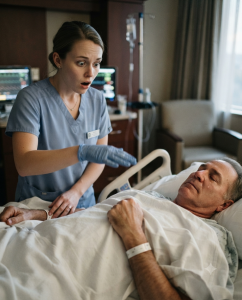
Dawn had barely broken. The room was washed in pale gray light, and the hallway outside was unusually quiet. Lina had completed his routine checks and begun the hygiene change she had performed countless times before. It was clinical, familiar, almost automatic.
Then she saw it.
Adrian’s right hand had curled into the sheet.
Not with spastic tension. Not with a random jerk.
With intention.
She went still so abruptly her breath hurt. His fingers tightened again, weak but unmistakably controlled. Then, from the corner of his left eye, a tear slid slowly toward his temple.
Lina nearly dropped everything.
“Adrian?” she whispered.
His eyelids fluttered.
Her mind split in two. One part screamed for her to call a doctor. The other remembered the altered sedative chart, Elise’s warning, and the unsettling fact that every possible sign of awareness seemed to vanish under physician supervision.
She stepped closer. “If you can hear me, move your fingers again.”
A pause.
Then the fingers moved.
Once.
Lina’s chest tightened so hard it almost hurt. She looked toward the door, then back to him. “Are you awake?”
His index finger dragged weakly across the sheet. At first she didn’t understand. Then she realized he was trying to form letters.
She grabbed a notepad and tried to place a pen in his hand, but he was too weak to hold it. His lips parted. No sound came.
Lina leaned close enough to hear the effort in his breathing.
“Don’t…” he whispered.
The door opened.
Dr. Weller entered.
For one unguarded second, his face changed. Lina would remember that look for the rest of her life. It wasn’t surprise. It was alarm sharpened by anger, gone almost before she could name it.
“Everything all right?” he asked smoothly.
Lina forced her expression flat. “I was just finishing care.”
Weller checked the monitor, but his eyes went first to the medication pump. “His heart rate is elevated. Reflex response.”
He reached toward the line.
Lina heard herself say, “Shouldn’t we assess him first?”
The doctor turned to her slowly. “Are you questioning protocol?”
“No.”
“Good.” His voice softened in a way that felt like threat polished into courtesy. “This case requires discretion. Staff sometimes become imaginative. I’d be careful what you put in writing.”
He adjusted the pump and increased sedation.
Lina said nothing. But while he worked, she saw Adrian’s fingers twitch twice against the sheet.
Deliberate.
Weller straightened. “Take your lunch break after this. Another nurse will cover the next round.”
After he left, Lina slipped her hand beneath the blanket and touched Adrian’s cold fingers. He pressed back faintly. Then he dragged one nail across the inside of her wrist.
W I—
Footsteps returned before he could finish.
Lina covered the mark with her sleeve just as Elise entered to take over. “Dr. Weller said you were done.”
The message was clear: leave.
Instead of going to lunch, Lina went to the records room. She knew she was risking her job, maybe more, but the half-written letters on her wrist burned hotter than fear. W I. There were only a few staff names that fit. One of them was Weller. Another was Adrian’s wife, Isabelle Voss.
Lina requested archived accident reports under the excuse of checking long-term medication orders. Most files were restricted, but one clerk, distracted by a phone call, left a screen open long enough for Lina to read a note that made her stomach drop.
The original ER report from the night of the crash documented “intermittent eye opening to voice” during transport.
Intermittent eye opening.
That had never appeared in the official summary she had been given.
She dug deeper. Over the next hour she found consulting notes mentioning “inconsistent command response” in the first ten days after the accident, followed by sudden medication escalation and a final neurology assessment declaring nonresponsive wakefulness. That assessment had been signed by Dr. Weller.
Lina printed nothing. She was too frightened. Instead, she photographed the screen with her phone and emailed the images to a private account.
When she returned upstairs, security stopped her.
“Mrs. Voss wants a word.”
Isabelle Voss was waiting in the family lounge beside Adrian’s room. She was elegant in a way that made Lina suddenly aware of her cheap shoes and tired face. Tall, perfectly dressed, composed. Her concern looked expensive and practiced.
“I’m told you’ve been unusually interested in my husband’s case,” Isabelle said.
Lina kept her voice neutral. “I’m doing my job.”
“Then do only that.” Isabelle folded her hands. “You’re well paid. I suggest you remember why.”
There it was—no denial, no confusion, just warning.
Lina met her eyes. “Did Adrian ever wake up after the accident?”
For the first time, Isabelle’s expression hardened. “Be very careful, Nurse Moreau.”
Lina left before her own fear showed.
That evening she called the only person she knew who still believed rules meant something: Daniel Reeve, a former hospital compliance officer who had once taught part of her ethics training. They had not spoken in years, but when she told him she suspected suppressed neurological recovery in a private patient with financial exposure, his silence turned immediate and serious.
“Do not confront anyone else,” he said. “Document everything. And do not stay alone.”
Too late on the second point.
When Lina arrived for the next shift, her access card failed. Security claimed it was a technical error, but she saw another nurse already inside Adrian’s room. The replacement avoided her eyes. Elise stood nearby, tense and pale.
Lina called Daniel from the hallway.
He arrived with two investigators from the clinic’s legal oversight board and a court emergency order he had pushed through based on probable medical concealment and patient endangerment. Lina had not known such speed was possible. Apparently neither had Dr. Weller.
The room turned chaotic.
Weller argued. Isabelle demanded names, threatened lawsuits, and insisted Adrian’s condition was hopeless. But the independent neurologist brought in under the emergency order performed a bedside exam before anyone could further medicate him. He asked for hand movement.
Nothing.
Then he asked Lina to speak.
Her throat tightened. She stepped to the bed. “Adrian, it’s Lina. If you can hear me, move your fingers.”
His right hand twitched.
The room went silent.
“Again,” the neurologist said.
Adrian moved two fingers.
Not much. Barely enough. But enough to shatter the lie that had kept him imprisoned in plain sight.
What followed unraveled fast. The investigators seized medication logs, internal emails, and insurance communications. Over the next two days, the truth surfaced in fragments too ugly to soften. Adrian had shown signs of partial awareness much earlier than publicly disclosed. Weller had documented them privately but altered the official interpretation. The reason was tied to money and control.
If Adrian regained legal capacity, even partially, several transactions made after the accident could be challenged—including power-of-attorney transfers that benefited Isabelle. There were also pending board decisions and trust arrangements worth tens of millions. Keeping him “nonresponsive” kept him voiceless.
Weller insisted he had acted conservatively to prevent agitation and autonomic instability. The medication history suggested something else: repeated oversedation at moments when awareness became more likely to emerge.
Under independent care, Adrian’s sedation was reduced and rehabilitation began. The progress was painfully slow. He was not miraculously restored. He remained profoundly weak, his speech damaged, his movements inconsistent. But he was conscious. He could answer yes-no questions with finger movements. Later, with enormous effort, he learned to form a few hoarse words at a time.
One of the first clear sentences he managed took three attempts and left him shaking.
“She knew.”
He was talking about Isabelle.
The official investigation expanded into a criminal inquiry. Weller’s license was suspended, then revoked. He was later charged with medical falsification, unlawful chemical restraint, and conspiracy. Isabelle denied everything publicly, claiming she had trusted the doctors, but the messages recovered from her phone told a different story—questions about “keeping him stable,” frustration when “responses” complicated estate matters, and panic whenever outside consultation was suggested.
The marriage, Daniel eventually told Lina, had not been what it looked like in magazines. Adrian had been preparing to restructure his company and personal holdings before the crash. Isabelle had stood to lose influence. Whether the crash itself had been an accident remained unproven, but enough remained suspicious that investigators reopened parts of the original case.
Months passed.
Lina visited Adrian even after she was no longer assigned to him. At first he could manage only short sessions before exhaustion overtook him. But he always recognized her. Sometimes with a finger tap. Later with the faintest nod. Eventually, with a strained half-smile.
The first time he said her name, she cried in the hallway afterward where no one could see.
Theo finished school that year. The clinic’s victim compensation fund—created hastily after the scandal broke—covered a portion of Lina’s debts. Daniel helped her file the rest through legal channels, and for the first time since her mother’s death, the future stopped looking like a wall.
Adrian never fully returned to the man he had been before the crash. The damage was real. Recovery was incomplete. But he regained enough strength to testify by video at a civil hearing, enough to revoke the powers taken from him, enough to make his own decisions again. When Isabelle saw him speak publicly for the first time, even in broken phrases, the composure she had worn like armor finally cracked.
In the end, the thing that saved him was not a machine, a specialist, or a family member with perfect motives.
It was a young nurse changing a diaper at dawn, noticing a hand where everyone else had trained themselves not to see one.
People later called Lina brave. She never liked the word. Brave sounded clean and certain. The truth had felt nothing like that. She had been frightened almost every second. She had doubted herself. She had nearly stayed quiet.
That was the part she couldn’t stop thinking about.
How easily a human life could be buried under the language of expertise. How quickly “protocol” could become a cage. How many people had seen pieces of the truth and looked away because the room was expensive, the doctor confident, the family powerful, and the patient silent.
Adrian once asked her, in halting speech during rehab, why she had kept watching.
Lina thought about it for a long time before answering.
“Because you looked lonely,” she said.
He laughed then—a weak, broken sound, but real.
Years later, when people discussed the scandal, they argued over the biggest crime. Some said it was greed. Some said it was medical corruption. Some said it was the cruelty of turning a living man into an object because he could not fight back loudly enough.
Lina thought the worst part was simpler than that.
It was how close everyone had come to succeeding.
And how terrifyingly easy it would have been for the truth to stay silent forever.