The blanket hit the puddle with a sound that was somehow louder than it should have been.
In the women’s barracks, even small humiliations had a way of echoing. Maybe it was because everyone understood what they meant. Maybe it was because prison had a way of stripping objects of their size and turning them into symbols. A spoon became leverage. A pair of shoes became status. A blanket became warmth, privacy, dignity, survival.
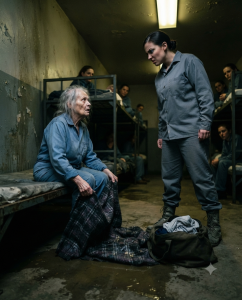
So when Vanessa tore the old checkered blanket off the elderly woman and flung it into the dirty water on the concrete floor, the entire room understood exactly what she was doing.
She was not just taking cloth.
She was reminding everyone who had power.
The old woman had been asleep on the lower bunk, folded tightly under that blanket as if she were trying to disappear into it. She was small, far too small for the coarse prison uniform she wore. Her shoulders seemed to sink inward, as if years of carrying burdens had finally pressed them down for good. Deep lines marked her face, but the most striking thing about her was how quiet she was. Not peaceful quiet. Erased quiet. The kind that came from learning that speaking changed nothing.
Vanessa stood over her with a satisfied smile.
Vanessa had earned a reputation long before anyone in that barracks met her. She was clever, brutal when necessary, and always three moves ahead. Some women ruled through alliances, some through charm, some through violence. Vanessa ruled through fear sharpened by precision. She studied weaknesses the way other people studied maps. She knew who was lonely, who was ashamed, who was hiding contraband, who was desperate for protection. She made herself necessary to some, terrifying to others, and untouchable to most.
The elderly woman had become her easiest target.
“Get up,” Vanessa said, throwing a sack of dirty laundry beside the bunk. “You’re washing my clothes.”
A few inmates laughed, though not loudly. No one wanted to sound too entertained. Vanessa liked obedience, but she disliked competition for attention.
The old woman opened her eyes and stared at the soaked blanket on the floor. For a brief moment, something passed across her face that looked less like fear and more like tired recognition. As if she had known even in sleep that rest would not last.
She sat up slowly, every movement careful, painful.
The barracks watched with the detached hunger people develop in places where mercy is scarce. Some looked guilty. Some looked relieved it wasn’t them. Some looked interested for the first time all night.
Everyone knew what the old woman’s days looked like. She scrubbed the communal sinks until her knuckles split. She rinsed uniforms in freezing water. She mopped corners no one noticed. She dragged buckets across the floor with both hands and paused only when dizziness forced her to. If anyone complained, the work shifted to her. If anything went missing, she was the first one searched. She had become a dumping ground for demands because she rarely resisted.
The prison had reduced her to labor and silence.
Only a handful of women knew how she had ended up there.
Her name was Elena.
Years earlier, she had lived alone in a small apartment full of old furniture and carefully folded tablecloths. She was not rich, but she was orderly, proud, and trusting in the fatal way some people from another generation still were. Her nephew, Denis, had visited with flowers and paperwork. He had spoken warmly, called her auntie, sat at her kitchen table, and explained that some inheritance documents needed signatures. There had been mention of taxes, deadlines, legal language she didn’t fully understand. He handled everything so confidently that asking questions felt almost rude.
She signed where he pointed.
Months later, police arrived.
By then Denis had vanished. Money had been transferred, accounts emptied, names forged, businesses defrauded. Elena’s signature appeared on every critical page. She insisted she had not understood. She said her nephew had handled everything. She repeated it in interviews, hearings, and finally in court. But Denis was gone, and the documents were real. The law saw signatures, not trust. Intent was blurred by evidence she could not untangle.
She was convicted.
At first she believed the mistake would be corrected. Then she believed Denis would return and confess. Then she believed someone would at least care.
Eventually she stopped believing.
Prison finished what betrayal had started.
Vanessa liked that about her. A person who had stopped expecting rescue was easier to control.
“If the clothes aren’t clean by tonight,” Vanessa said, leaning closer, “tomorrow you lose the blanket entirely.”
Elena bent down and picked the blanket out of the puddle. Water streamed from the edge. The concrete had stained one corner brown. She lifted it with both hands as though it were much heavier than cloth had any right to be.
And then Vanessa noticed something strange.
Elena did not beg.
She did not apologize.
She did not hurry.
Instead, she draped the blanket carefully over the rail of the bunk and looked at Vanessa with a steadiness that felt entirely new.
That change was small enough that a careless person might have missed it.
Vanessa did not miss things.
“What?” she said sharply.
Elena stood. It took effort, and the effort seemed to make the moment more powerful rather than less. Her body shook, but her gaze did not.
“I washed your white shirt three days ago,” Elena said softly.
Vanessa frowned, thrown by the sudden topic. “So what?”
“The one with the loose button,” Elena continued. “The pocket had something inside.”
The room quieted.
No one knew why, not yet. But something in Elena’s tone made attention gather around her.
Vanessa’s face changed only slightly, yet in that place a slight change was everything. “What are you talking about?”
“A key,” Elena said.
No one laughed now.
Vanessa stepped closer. “You should think very carefully before you keep speaking.”
Elena didn’t look away. “It had blue thread around it.”
A woman on the top bunk sat up fully. Another swung her legs over the side. Across the room, two inmates exchanged a long, loaded stare. Blue thread was not decoration. In prison, people marked hidden things for speed, not beauty. A coded detail like that meant purpose.
Vanessa lowered her voice. “Where is it?”
Elena’s answer came with unnerving calm. “Safe.”
What most people never understood about cruelty was that it depended on predictability. Vanessa humiliated Elena because she expected submission. She expected lowered eyes, trembling hands, muttered apologies. The instant Elena failed to provide those things, the balance shifted.
Not publicly yet. Not completely. But enough.
The other inmates felt it.
Vanessa felt it most of all.
She tried the old methods first. Threat. Proximity. Pressure. “You don’t understand what you found,” she said. “Give it back.”
Elena sat down on the bunk, the wet blanket spread over her knees. “I understand enough,” she replied.
“What does that mean?”
“It means,” Elena said, “that some people confuse silence with blindness.”
That line moved through the room like a spark.
Vanessa slammed a hand against the bed rail. “Who have you told?”
“No one,” Elena said.
It should have relieved Vanessa, but it didn’t. Because Elena was not speaking like a frightened woman bargaining for safety. She was speaking like someone who had already made a decision.
And that was dangerous.
The truth was that Elena had seen much more than anyone suspected.
Weeks earlier, while rinsing Vanessa’s shirt in a gray basin, she had felt the weight in the pocket and pulled out a small brass key bound with blue thread. She had intended to return it immediately. But before she could, voices had approached the laundry room. Elena had remained behind the half-open door, invisible the way older women often become in the eyes of the careless.
Vanessa had entered with another inmate named Rina.
Rina’s whisper had been tense. “The corridor camera was down for only six minutes.”
“Six was enough,” Vanessa replied. “The lockbox is secure.”
“And the list?”
“Inside.”
Elena had stood frozen, the key hidden in her palm, while they continued.
There had been mention of bribes. Deliveries. A guard with debts. Items being moved through the maintenance corridor that prisoners had no business controlling. Names were not all spoken, but enough details were. Enough for Elena to understand this was bigger than cigarettes or stolen medication. Vanessa was managing access, routes, and leverage. She had built a small empire inside the prison, one hidden transaction at a time.
Elena had slipped away with the key still in her hand.
At first, she told herself she would return it later. Then she heard more. An inmate transferred suddenly after crossing Vanessa. Another one beaten in the shower block under circumstances nobody believed. A guard reassigned after rumors of missing evidence. Every thread led back toward Vanessa, and every thread seemed to touch that hidden lockbox in some way.
So Elena kept the key.
Not because she was brave. Not at first.
Because for the first time since entering prison, she possessed something that made a dangerous person vulnerable.
That realization frightened her. It also awakened something in her that had been dormant for years: judgment.
She began watching. Listening. Remembering. She stitched details together the way she once stitched old linens at home. Dates. Faces. Exchanges. Which guard lingered too long near the maintenance wing. Which inmate delivered notes but never read them. Which laundry items came back heavier than before.
And all the while Vanessa continued ordering her around, never realizing the old woman kneeling at her feet had become the keeper of one catastrophic secret.
Elena might have continued waiting even longer.
But the blanket changed everything.
It was not just the insult. It was the casualness of it. The certainty that Elena could be stripped of the last little comfort she had and still be expected to scrub someone else’s stains before dawn. Something in that cruelty clarified the room. It showed Elena exactly what would happen if she kept surviving quietly until her body gave out: nothing would change, and Vanessa would keep choosing another victim after her.
So when Vanessa demanded the laundry again, Elena finally spoke.
And then the guard arrived.
Officer Markov had the broad, weary look of a man who had seen too much and trusted too little. The moment Elena mentioned the maintenance corridor lockbox, his posture changed. Weariness fell away. In its place came focus.
“What did you say?” he asked.
Vanessa moved fast, trying to retake control. “She’s confused. She makes things up.”
But Elena repeated the detail about the blue thread, and that was enough. Markov knew instantly this was not random invention.
“Step away from the bed,” he ordered Vanessa.
She hesitated.
That hesitation condemned her more than panic would have.
Markov’s hand went to his radio. “Now.”
Vanessa stepped back, but her eyes never left Elena. Rage burned there, mixed with something she almost never displayed: fear.
“Where is the key?” Markov asked Elena.
Elena looked down at the wet blanket in her lap. She slid her fingers into the folded seam she had carefully stitched shut two nights earlier with thread pulled from the blanket’s own edge. She had hidden the key there because no one ever searched a poor old woman’s bedding unless they intended to punish her. The hiding place had seemed almost ridiculous.
Now it felt inspired.
She opened the seam and let the key fall into her hand.
Metal glinted under the yellow lights.
Several inmates gasped.
Vanessa took a half-step forward before stopping herself. “Officer, she stole that from me,” she said.
Elena met his eyes. “No. I found it in her shirt. Then I heard what it was for.”
Markov took the key carefully. “What did you hear?”
The room held still.
Elena told him about the laundry room conversation. About the lockbox. About the camera outage. About Vanessa and Rina. About deliveries through the maintenance corridor. About names she didn’t know and details she did. She did not dramatize anything. She simply laid out facts, one after another, in the same quiet tone she might have used to recite a shopping list years ago.
That made it more believable.
By the end, even the inmates who hated authority looked shaken. Everyone had known Vanessa controlled favors and fear. Few had understood how organized she really was.
Markov called for backup.
What happened next tore the prison open.
The maintenance corridor lockbox was found behind a loose metal panel near the boiler room. Inside were ledgers, coded notes, contraband records, payment tallies, and a list of names linked to both inmates and staff. Enough to trigger internal investigations. Enough to expose smuggling, extortion, and manipulated disciplinary reports. Enough to destroy Vanessa’s network from the inside.
Rina was pulled from her bunk before sunrise.
Two guards were suspended by noon.
Vanessa was transferred to segregation pending investigation, and for the first time since arriving at the prison, she had no audience, no followers, and no lower bunk to stand over.
Before they led her out, she turned once toward Elena.
There was no smirk now. Only a stunned hatred that seemed unable to comprehend what had happened.
Elena looked back at her without triumph.
That was what unsettled Vanessa most. Elena did not look victorious. She looked finished.
As if a long chapter of endurance had simply ended.
In the days that followed, the barracks changed in small, almost embarrassed ways. No one openly apologized. Prison did not turn gentle overnight. But the women who had laughed no longer laughed. The chores stopped piling at Elena’s feet. Someone left her an extra piece of bread. Someone else brought dry socks. Another inmate repaired the torn corner of her mattress without being asked.
Respect had entered the room quietly.
Weeks later, a legal aid volunteer came to speak with prisoners whose cases involved possible procedural failures. Elena’s name surfaced during the wider investigation because of her role in exposing the smuggling operation. That attention reached old files. Then financial records. Then unanswered discrepancies in her conviction. The nephew’s trail, cold for years, resurfaced when one of the names in Vanessa’s seized ledger connected to a man already under fraud investigation outside the prison. The chain of review widened.
For the first time in years, someone reopened Elena’s case seriously.
There was no miracle. No instant release. Real systems moved too slowly for that.
But this time, the movement was real.
Months later, Elena sat in a small legal office across from a young attorney who slid a folder toward her and said, with visible care, “We found evidence your nephew forged additional declarations after the original signatures. It changes everything.”
Elena stared at the papers for a long time before touching them.
“What happens now?” she asked.
The attorney smiled softly. “Now we correct what should have been corrected years ago.”
When Elena finally left prison, the sky looked too wide. She stood outside the gate holding a small bag that contained her few belongings, including the old checkered blanket, cleaned and folded. She had almost thrown it away. Instead she kept it.
Not because she wanted to remember the humiliation.
Because she wanted to remember the line.
The exact point where silence stopped protecting anyone.
People later told the story in different ways. Some said the most dangerous inmate fell because she underestimated the weakest woman in the prison. Some said cruelty finally chose the wrong victim. Some said Elena had been patient. Others said she had simply reached her limit.
All of them were partly right.
But the detail that lingered longest was this: Vanessa had controlled the entire barracks until the moment she decided to throw an old woman’s blanket into a puddle.
That tiny act of contempt forced hidden things into the light.
And maybe that was the most unsettling truth of all.
Not that evil collapses under grand heroism.
But that sometimes it is undone by the person everyone stopped seeing — the one who noticed everything, remembered everything, and finally chose the one moment when fear would no longer speak for her.
Was Vanessa the monster everyone believed she was, or just someone who kept being rewarded until she became one? Did Elena forgive her nephew, or did freedom simply leave no room for that question? And if you had watched that blanket fall, would you have stayed silent too, right up until the instant the quietest person in the room changed everything?