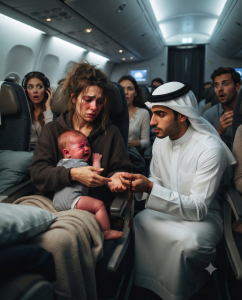
During a long-haul flight packed with exhausted passengers and unspoken tension, no one expected a crying child to become the center of a story they would remember long after the plane landed.
At first, it seemed like the kind of situation everyone has witnessed before. A baby crying on an airplane. An overwhelmed parent. A cabin full of tired people trying to be patient until patience begins to crack. It was uncomfortable, irritating, and painfully familiar.
But by the time the flight crossed deep into the night, what happened in that small row of seats changed the mood of the entire plane—and revealed a truth no one could have guessed from the outside.
The aircraft had been in the air for hours. The overhead lights were dim, the windows were black with darkness, and the cabin carried that stale stillness that settles in once people surrender to the long distance between takeoff and landing. Some passengers had reclined their seats and wrapped themselves in airline blankets. Others scrolled aimlessly through old movies, too tired to focus on any of them. A few tried to sleep in awkward angles, heads tilted against windows or slipping forward every few minutes.
Then there was the crying.
It had started not long after the meal service ended. At first, the baby had fussed in the normal way young children do when they are overtired and confused by strange surroundings. A few people glanced over and then returned to their own business. No one was upset yet. Most assumed it would pass.
It didn’t.
Minute after minute, the crying only became more intense. It was sharp, desperate, relentless. The little boy—no more than a year old—seemed to be crying from somewhere deeper than discomfort. His cheeks were flushed, his eyes swollen with tears, his body stiff with distress. He would pause just long enough to catch a shaky breath before crying all over again.
Soon, the tension began to spread.
A middle-aged man in business class standards but economy seating rubbed his forehead and muttered under his breath. A young woman dug through her tote bag and took out expensive headphones, pressing them over her ears with visible relief. Across the aisle, another passenger kept drumming his fingers against the armrest until even that small rhythm started to mirror the agitation in the cabin.
People didn’t need to speak. Their expressions said enough.
The child’s mother saw all of it.
She looked like someone barely holding herself together. Her hair was messy, pulled back in a hurried knot that had long since fallen loose. Dark shadows sat under her eyes. Her sweater was wrinkled, one sleeve damp where the baby had rubbed tears and saliva against it. She held her son against her chest and rocked him with the automatic motion of a mother who had been trying everything for too long.
She whispered to him. Kissed his forehead. Shifted him from one shoulder to the other. Loosened his blanket. Wrapped him up again. Stroked his back. Checked his tiny hands and feet as if maybe some hidden discomfort had escaped her. She tried standing once when the seat belt sign was off, pacing in the narrow aisle until a flight attendant gently asked her to sit again because turbulence was expected.
Nothing helped.
Several times, she looked up and apologized to the passengers nearby.
“I’m sorry,” she said softly. “It’s his first flight.”
Her voice trembled each time she repeated it.
Most people gave polite, strained nods. Some avoided eye contact. Others didn’t bother hiding their frustration. The mother saw all of that too, and it only made her more shaken. Shame has a way of deepening helplessness.
About an hour into the ordeal, her composure finally broke.
The baby let out another piercing cry, and tears spilled down her face. She turned slightly away as if she could conceal it, but the people around her had already noticed. In a voice rough with exhaustion, she murmured words that changed the mood around her instantly.
“We’re flying to my parents,” she said. “His father passed away.”
The sentence was short, but it carried the weight of weeks.
Several nearby passengers fell silent at once. The woman with the headphones lowered them slightly. The man rubbing his forehead looked down at his lap. A flight attendant who had been approaching with practiced concern stopped a few steps away, her expression softening.
No one had expected grief to be sitting there among the diapers, the blanket, and the pacifier that kept falling uselessly into the mother’s lap.
And still, the child cried on.
Beside them, at the window seat, sat a man who had not spoken once.
He was clearly a person of means. His traditional white robe was immaculate despite the long flight. A subtle but expensive watch shone at his wrist. His posture remained perfectly straight, his movements measured, his expression composed. He was young, perhaps in his early thirties, with the kind of stillness that often comes from a lifetime of being observed.
A few passengers recognized him from earlier conversations near the gate. He belonged to a prominent Gulf family—wealthy, influential, and known well enough that some people had whispered his title after he boarded. A sheikh, and not just in name. An heir.
People assumed many things about men like that. That they were insulated from inconvenience. That they were used to comfort. That they had little patience for disruptions.
As the crying stretched on, more than one passenger glanced toward him, curious how long he would tolerate it. His face remained serious, almost stern. He did not glare, but neither did he smile. He looked at the child from time to time, then at the mother, then away again. His jaw tightened once or twice. To anyone watching, he seemed just as annoyed as everyone else—maybe more, because unlike the others, he had not tried to distract himself.
He simply listened.
The mother noticed his silence more than anyone else’s. Silence from a powerful stranger can feel heavier than open criticism. Once, when their eyes met, she offered him the same apology she had given everyone else.
“I’m sorry,” she whispered.
He gave a small nod, but said nothing.
That almost made it worse.
Time dragged. The baby’s cries turned ragged. The mother’s hands shook when she adjusted the blanket around him. She looked frightened now—not only embarrassed, but genuinely afraid something was wrong and powerless to fix it thirty thousand feet above the ground.
Then the sheikh unfastened his seat belt.
The click drew attention immediately. Heads turned.
He stood slowly in the narrow space beside the row. The mother’s face drained of color. She looked at him with the expression of someone bracing to be scolded in front of strangers. One of the flight attendants began moving toward them, clearly prepared to intervene if necessary.
Instead, the sheikh reached into the inner pocket of his robe and pulled out a small set of prayer beads. Dark wooden beads, smooth with age and use. He placed them gently into the mother’s palm.
“Hold these,” he said quietly.
She stared at him, confused.
Then he asked, “May I try something?”
The mother hesitated for only a second before nodding.
To the astonishment of nearly everyone watching, the sheikh lowered himself into the aisle beside her seat. Not for show. Not theatrically. He knelt because it brought him level with the child.
He looked at the boy with calm focus and began to hum.
The sound was low and steady, just above a whisper. It was not a lullaby most people on the plane recognized, but it carried a softness that seemed to settle into the air. The melody had an old-world gentleness to it, something intimate, something remembered rather than performed. The child’s cries did not stop all at once, but they changed. The sharp edges softened. His sobs became shorter. His little fists loosened.
The mother watched in stunned silence.
The sheikh did not touch the child immediately. He simply kept humming, rocking slightly where he knelt, allowing the rhythm to create a pocket of calm around them. When the boy looked at him through tears, he murmured something in Arabic and then in English.
“It’s all right. You know this song, don’t you?”
The mother’s brows drew together.
Then he looked up at her and asked, “Did his father sing to him before he slept?”
She went completely still.
“How did you know that?” she asked.
The sheikh was quiet for a moment before answering.
“Because his father used to sing it with me.”
The mother stared at him as if the entire plane had vanished around them.
For a second, it seemed impossible. Then recognition flickered across her face—not because she suddenly knew him, but because she remembered hearing stories. Her late husband had spoken, long before his illness, about studying abroad for a short period and forming an unlikely friendship with a young man from a family very different from his own. They had lost touch over the years. She had always assumed those stories belonged to another season of life, one with no connection to this one.
“What was his name?” she asked in a trembling voice.
The sheikh said it.
She covered her mouth and began to cry all over again, only now from shock instead of humiliation.
The child, perhaps responding to the familiar melody, had gone nearly silent. He stared with wide, wet eyes at the man kneeling before him. Then, in one final hiccupping breath, he leaned forward slightly, as if something in him recognized safety.
The sheikh smiled for the first time.
“He sang this on a long drive once,” he said gently. “He told me if he ever had a child, this would be the song.”
The mother shook her head in disbelief. “He never told me who taught it to him.”
The sheikh looked down at the child. “We taught it to each other.”
The plane cabin, once so full of irritation, had gone completely quiet. Even the passengers who had spent the last hour fuming were now watching with the stunned stillness of people witnessing something unexpectedly tender.
The flight attendant who had approached stopped beside the row and crouched down. “Is everything all right?” she asked softly.
The mother let out a broken laugh through tears. “I think… I think maybe it is.”
The sheikh rose only when the child had fully calmed. But before returning to his seat, he did something even more surprising. He reached for the call button—not to complain, but to ask for warm water, milk, and anything the crew could offer to help the mother through the rest of the flight. Then he asked if there was an empty seat nearby so she would have more room.
There was one in the next row.
He gave it up without discussion.
When the crew protested and offered to relocate someone else, he refused with quiet politeness. “The child needs space more than I do.”
Word spread quickly through the cabin, the way remarkable things always do in confined spaces. The same passengers who had exchanged irritated looks earlier now softened visibly. The woman with the headphones took them off and tucked them away. The tapping man offered to lift the mother’s bag into the overhead bin so she could settle more comfortably. Another passenger handed over a fresh pack of baby wipes. A grandmotherly woman across the aisle smiled and said, “He looks much better now.”
The atmosphere had changed completely.
Later, once the child had finally fallen asleep against his mother’s chest, the sheikh and the widow spoke in hushed tones. He told her about meeting her husband years ago, when both of them were younger and less defined by what their families expected of them. They had studied together for one summer program, then spent weeks traveling with mutual friends. Her husband had been the one person who treated him as a man rather than a title. They had laughed, argued, shared meals, and made promises common to young men—keep in touch, visit, write. Life, of course, had interrupted those promises.
“I searched for him once,” the sheikh admitted. “But I was too late.”
The mother looked down at her sleeping son. “He remembered you,” she said. “Sometimes he talked about a friend who knew songs from home and songs from everywhere. I didn’t know it was you.”
For the first time that night, the sheikh’s composure wavered. “I wish I had known sooner,” he said.
When the plane finally landed, most passengers remained seated in that restless half-stand people do after long flights. But several turned to look back at the mother and child as if they were no longer strangers. The people who had once been most annoyed now seemed almost protective.
The sheikh waited until the crowd thinned before retrieving a slim leather card case from his bag. He handed the mother a card and wrote a number on the back himself.
“There are things a child should have after such a loss,” he said. “Education. Security. Support. Let me help.”
She looked startled. “I can’t ask that.”
“You didn’t,” he replied. “He was my friend.”
At first, she refused politely. Then more firmly. Pride, grief, and caution all rose together in her face. But the sheikh did not insist in a way that felt performative. He spoke simply, directly.
“This is not charity,” he said. “It is a debt of love.”
That was what broke her resistance.
Months later, the story would spread in fragments online because another passenger had recognized him and quietly described what happened. No names at first. Just an account of a crying child, a humiliated mother, a powerful man who seemed annoyed until he stood up and transformed the mood of an entire cabin.
But the truth was deeper than strangers on the internet knew.
The sheikh did help. Not with a public gesture or dramatic headlines, but privately and steadily. He arranged support for the child’s education. He ensured the mother had legal and financial guidance during the difficult months after her husband’s death. More importantly, he stayed in contact. Not every day, not intrusively, but enough that she no longer felt abandoned in her grief.
And for the child, the melody remained.
Whenever the little boy became restless at night, his mother would hum the same tune that quieted him on the plane. As he grew older, she told him where it came from: from his father, from friendship, from a moment when kindness arrived wearing the face of a stranger.
In the end, what the passengers remembered most was not the crying.
It was how quickly people had decided who the mother was. A nuisance. A disruption. Someone failing publicly at the hardest job in the world while trapped in a metal cabin with a hundred opinions around her.
And it was how wrong they had been about the sheikh too.
They thought his silence meant judgment. They thought his serious face meant irritation. They assumed wealth had made him cold.
Instead, he had been listening closely enough to recognize a lullaby tied to someone he had once loved like a brother.
Long after the flight, those who witnessed it kept returning to the same uneasy thought: how often do we mistake quiet for cruelty, or exhaustion for incompetence, or grief for inconvenience? How many people around us are carrying stories heavy enough to break them while we reduce them to the role they happen to play in our discomfort?
On that plane, the biggest red flag was not the crying child. It was how easily everyone had forgotten that suffering can look messy, loud, and impossible to contain.
And the most unsettling question left behind was the simplest one of all:
If the sheikh had not stood up, would anyone else have chosen compassion before judgment?