Thomas had spent most of his life believing that routine was a kind of protection.
On a farm, routine meant control. It meant the animals were fed on time, the gates were secured, the tools were where they belonged, and nothing unexpected had room to creep into the day. For years, that belief had carried him through lonely winters, dry summers, and the slow, repetitive grind of work that began before sunrise and ended long after dark.
His farm sat at the edge of a small village where the houses grew sparse and the road eventually narrowed into little more than dirt and stone. Beyond the property stretched a field, a patch of woods, and, farther out, the remains of older land no one used anymore. Thomas worked it alone. He had inherited the place from his parents after they were gone and had never seriously considered leaving. The land was difficult, but it was familiar. And familiar things did not usually frighten him.
Until the chickens began to disappear.
The first one went missing on an ordinary morning in late autumn.
Thomas woke before dawn, dressed in the dark, and stepped into air cold enough to sting his lungs. He fed the cows first, as always, then crossed to the coop with a basket under one arm. The chickens stirred and clucked around him, but before he even bent for the eggs, he noticed the number was wrong.
He counted again.
Then once more, slower.
One chicken was gone.
He frowned, checked the door, and found it latched. He looked around the coop for signs of a struggle. There were none. No feathers. No blood. No broken slats in the wood. He muttered to himself, carried out the eggs, and searched the yard, expecting to find the bird pecking through weeds somewhere behind the barn.
He found nothing.
That should have been the end of it—a loose chicken, a mistaken count, some small farm inconvenience. But the next morning another bird had vanished. Then another the day after that.
By the end of the week, what should have been impossible had become undeniable.
Thomas had started with thirty chickens. Now he was down to twenty-two.
He stood in the coop one morning staring at the remaining birds, all of them huddled more tightly than usual, and felt the first real pulse of fear move through him. A fox could kill several in one attack. A dog could tear through a coop in minutes. Even a human thief would take more than one if they were already on the property.
But this was different.
One bird per night.
Always one.
No noise. No damage. No trace.
He reinforced everything. He replaced a rusted latch, nailed fresh boards over old cracks, checked the fence line, even spread ash near the doors and windows in the hope of catching tracks. In the morning the ash remained untouched, and still another chicken would be gone.
He asked a few neighbors whether they had seen anything unusual on the road at night. Most shrugged. One man suggested a weasel or a fox. Another joked that maybe Thomas’s birds had learned to count their own bad luck and were fleeing one by one.
Only old Marta, who lived near the chapel, looked troubled.
She asked him where the coop stood in relation to the old well behind the property.
Thomas told her not to start with superstitions.
Marta only said, “Some ground doesn’t forget.”
He laughed at the time. But that night, as the wind moved through the dry grass and the barn creaked in the dark, her words returned to him with irritating persistence.
The barn was old, built by his grandfather, then expanded twice over the decades. One side housed the cow, and the other had been partitioned for feed, tools, and a secure chicken coop inside. Thomas knew every board and hinge in that structure. He knew which plank swelled during rain, which beam moaned in winter, which nail had been driven crooked twenty years ago and never fixed.
Lately, though, the place felt wrong.
His cow, Bess, had become unsettled after dark. She would stop chewing, lift her head, and stare toward the far back wall of the barn as if listening to something just beyond it. The chickens, too, had changed. They were quieter at sunset, reluctant to roost, clustering together with a nervousness Thomas had never seen before.
One evening he stood in the doorway with a lantern and felt a sudden, unreasonable certainty that he was interrupting something.
The barn was empty except for the animals.
Yet the silence inside it did not feel empty at all.
He began sitting outside at night with a flashlight and an old stick across his knees. For hours he watched the barn and listened to the land breathe around him. The wind brushed the grass. An owl called once from the trees. Somewhere distant, a branch cracked.
Nothing approached the coop.
Nothing left it.
But no man can hold back exhaustion forever. Around three in the morning, the cold would bite too deeply, or his eyes would burn, or he would drift for what felt like a few seconds. And every time he lost that battle, the same result waited with dawn.
One more chicken gone.
At last, angry and sleep-deprived, Thomas drove into town and bought a small hidden camera from a hardware shop. The clerk barely looked up while explaining how to insert the memory card and set the recording mode. Thomas didn’t tell him why he needed it.
Back home, he mounted the camera under a roof beam in the barn, high enough to capture the coop, Bess’s stall, and most of the floor. He tested the angle twice. The image wasn’t perfect, but it was enough. He would finally have proof.
That evening he locked everything with obsessive care. He checked the coop. He checked the barn doors. He checked the windows. He even stood with his hand on the main latch for a full minute before forcing himself to leave.
He slept badly and rose early.
The sight that greeted him at dawn made his chest hollow out.
Another chicken was missing.
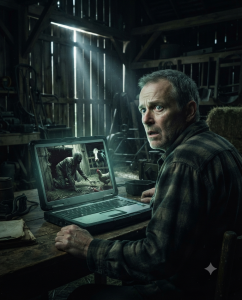
The others were crowded together in rigid panic, and Bess looked as though she had spent the whole night awake. Thomas grabbed the camera, hurried to the house, pushed his breakfast aside, and jammed the memory card into his laptop.
The footage began in grainy darkness. The barn sat quiet under weak moonlight leaking through gaps in the boards. For several minutes nothing happened. Chickens shifted on their roosts. Bess swished her tail once and settled.
Thomas watched with mounting irritation. He had been so certain.
Then, just after midnight, every chicken stopped moving.
Not one by one. All of them at once.
Bess lifted her head sharply.
Thomas leaned forward.
The far back corner of the barn lay in partial shadow, barely visible beyond stacked feed sacks and an old broken crate. For a second he thought the camera was glitching. The darkness there seemed to ripple, as though something behind it was breathing.
Then a narrow section of wall moved.
Thomas froze.
One of the boards behind the coop—an old panel he could have sworn had been nailed shut years ago—shifted inward from the bottom. Slowly, silently, it opened just enough for something to slip through.
At first only a hand appeared.
It was too long, too thin, the fingers bending at strange angles as they gripped the edge of the opening. Then an arm. A shoulder. A head kept low. The figure eased into the barn on all fours with the careful confidence of something accustomed to tight spaces and darkness.
Thomas’s skin turned to ice.
It was human in outline, but wrong in every movement. The limbs seemed too jointed, too loose, unfolding with a boneless, insect-like grace. It crept along the wall without sound. The chickens pressed into one another, not screaming, not fleeing, just shaking.
Then the figure moved beneath a shaft of dim light.
Thomas made a choking sound in his empty kitchen.
He knew those clothes.
A faded dark jacket. Torn at the sleeve near the elbow. Mud-stained work pants. Heavy boots, one with a damaged buckle bent outward.
They had belonged to Elias.
Thomas’s older brother had vanished nearly ten years earlier during a brutal winter storm. He had gone out after an argument—Thomas still remembered the slam of the door, the sound of their mother calling after him, the wind devouring everything—and never returned alive. Days later, authorities had recovered remains near the old well beyond the fields. The coffin at the funeral had remained closed. Thomas’s father had said it was better that way.
Time had covered the memory, but not erased it. Thomas still remembered Elias’s laugh, his temper, his habit of disappearing for hours into places no one else liked to walk. As boys, they had once dared each other near the old well, and Elias had claimed he heard whispers from inside it. Thomas had called him a liar. Elias had only smiled.
Now that same jacket crawled across Thomas’s barn floor.
“No,” Thomas whispered to the screen. “No.”
On the video, the figure did not behave like a starving animal. It behaved like something performing a ritual it had perfected. It reached the chicken wire and paused. One hand slid through the gap with shocking delicacy. The birds flinched away, except for one—a speckled hen cornered against the side. The long hand closed around it. A beat later, the bird was pulled back through the wire without noise, without struggle large enough to explain the terror in the others.
Just one.
Always one.
Thomas stared, heart hammering, as the figure turned away with the chicken tucked against its chest. It passed near Bess’s stall. The cow trembled but did not cry out. And then, as if sensing the camera at last, the figure slowly raised its face.
The footage was grainy, the light poor, but the glimpse was enough.
Sunken cheeks. Mud-dark streaks. Eyes reflecting pale and flat. A mouth stretched in a way that looked almost like recognition.
Thomas jerked back from the laptop.
The thing looked directly into the camera.
Then its lips moved.
There was no sound in the clip. But Thomas knew what he saw.
It had said his name.
A hard blow crashed against his kitchen door.
He shouted and half rose from the chair. Another hit followed, heavier, rattling the frame. Across the yard, through the thin walls of the house, he heard the chickens erupt in frantic noise.
For a moment Thomas could only stand there, trapped between the screen and the door.
Then instinct took over. He snatched the fireplace poker from beside the hearth and moved toward the kitchen entrance. The back door handle trembled once.
Twice.
Then stopped.
Silence flooded the room so completely he could hear his own pulse in his ears.
He waited.
Nothing.
After a long minute, he forced himself to step closer. The door showed no crack, no broken wood. He unlocked it with shaking hands and pulled it open a few inches.
The yard lay empty under pale morning light.
But the mud just outside the step held a mark.
Not a boot print. Not exactly. It looked like a bare human foot pressed too hard at the front, the toes elongated, as though the shape had been stretched.
Thomas slammed the door shut and staggered back.
He should have gone to the police immediately, and part of him knew that. But what would he say? That his dead brother had been stealing chickens through the walls of the barn? That he had a blurry recording of something impossible? Even spoken aloud, it sounded insane.
Instead, he drove to the church.
The priest there was old enough to have known Thomas’s parents. He listened without interruption while Thomas, pale and sweating, explained everything except the video itself. When Thomas finally mentioned Elias, the priest’s expression changed.
He asked one question.
“Was the body ever truly identified?”
Thomas stared at him.
The priest folded his hands and said carefully, “After the storm, what they recovered was… limited. Your father insisted on handling much of it privately. There were rumors of collapse near the well. Of tunnels under the old part of the property. Things people used to use and then seal.”
Thomas left the church feeling worse, not better.
At home he watched the footage again, this time frame by frame. That was when he spotted another detail. Behind the opening in the wall, beyond the loose board, there was not solid earth as there should have been. There was space. A narrow passage descending into darkness.
By late afternoon Thomas had armed himself with a lantern, rope, a shovel, and all the courage he could force into his shaking body. He went to the barn and stood before the loose board from the footage. In daylight it looked ordinary, almost mocking. But when he pried at it with the shovel edge, the wood shifted.
The panel opened inward.
A cold smell rolled out, damp and stale, like earth sealed for years.
Behind it was a narrow crawlspace reinforced with old timber. It sloped down beneath the barn toward the back field—toward the old well.
Thomas tied the rope around his waist and descended.
The tunnel was barely wide enough in places. Mud clung to his boots. Old roots pushed through the ceiling. Several times he nearly turned back, especially when he began finding signs that the passage was not abandoned at all: a rusted lantern, gnawed bones too small to identify, bits of cloth caught on splintered wood.
Then he found the feathers.
Dozens of them lay scattered in a chamber where the tunnel widened. The remains of his missing chickens were there, not eaten cleanly like prey, but stripped and piled as if someone—or something—had sorted them. Thomas gagged and lifted the lantern higher.
At the far end of the chamber sat a narrow cot made from old boards and feed sacks.
On it lay the faded jacket.
Thomas stopped dead.
It was empty.
A voice behind him said, “You shouldn’t have looked.”
Thomas spun so fast he nearly dropped the lantern.
A man stood in the tunnel entrance, half hidden in shadow, thinner and older than memory but unmistakable.
Elias.
Not dead. Not buried. Alive.
His face was gaunt, his beard ragged, his skin almost colorless after years away from light. One shoulder sat higher than the other. His eyes were the same, though—sharp, feverish, and fixed on Thomas with a mix of accusation and something like shame.
Thomas could barely speak. “You— We buried you.”
Elias laughed once, but there was no humor in it. “You buried what Father told you to bury.”
Piece by piece, in the foul underground chamber, the truth came out.
On the night of the storm ten years ago, Elias had discovered that their father had been hiding things in the old tunnels—traps, stolen livestock from neighboring land, even money taken from deals no one in the village had ever questioned closely. They fought. Their father struck Elias with a shovel near the well and left him for dead in the collapse that followed. But Elias survived, injured and trapped below. By the time he clawed his way through another passage days later, he had heard enough from above to understand what had happened: their father had claimed Elias was dead and sealed the story shut with a closed coffin and silence.
“Why didn’t you come back?” Thomas asked, horrified.
Elias’s eyes flashed. “Come back to what? To him? To all of you believing whatever he said?”
Their father had died three years earlier. By then, Elias explained, hatred and isolation had twisted into something uglier. He had remained in the tunnels and abandoned structures beyond the fields, emerging only at night. He stole chickens because they were easy. Because no one looked too hard for one missing bird. Because facing the village felt impossible after so many years of being treated like a ghost.
“You could have come to me,” Thomas whispered.
Elias looked at him for a long time. “I almost did. The first night, I stood outside your house. Then I heard you laughing with neighbors. Talking about the past like it was finished.”
Thomas remembered none of that. But guilt still hit like a blow. Elias had suffered beneath the farm while Thomas went on living above it, never questioning the closed coffin, never questioning their father’s version of events. He had been younger, frightened, eager to believe what hurt least.
The lantern shook in Thomas’s hand.
“What did you mean on the camera?” he asked. “You said my name.”
Elias’s face changed. For the first time, he looked tired rather than frightening.
“I wanted you to find me.”
All at once the horror of the footage shifted into something more devastating. The crawling, the hiding, the stolen chickens, the eyes in the dark—it had all grown from a decade of injury, rage, and a life lived underground until even a human being could move like a creature.
Thomas lowered the poker he had carried into the tunnel.
He should have called the police. He knew that too. But when he looked at Elias, he no longer saw a monster. He saw a man broken by violence, isolation, and ten years of being erased.
The confrontation might still have gone badly if not for one final detail Elias revealed: their father had kept records in the tunnel—proof of the thefts, the money, the lies surrounding the “burial.” Enough to clear Elias’s name and explain everything. Enough to expose the dead man Thomas had spent years remembering as harsh but honest.
By evening, the police were indeed called. This time Thomas spoke plainly. He showed them the footage, then the tunnel. They found the records, old stolen property markers, and evidence that the remains buried under Elias’s name had never been properly identified. The village reeled from the scandal. Some people refused to believe it at first. Others admitted they had always suspected Thomas’s father knew more than he said.
Elias was taken to a hospital, then to a psychiatric evaluation unit, not as a criminal first but as a survivor of prolonged trauma and unlawful concealment. There were legal questions, of course, and hard ones. He had stolen livestock. He had hidden. He had terrified Thomas whether he meant to or not. But what weighed most heavily on everyone was what had been done to him and how easily the truth had been buried.
Thomas repaired the barn himself after the investigators finished. He sealed the tunnel entrance. He replaced boards, cleaned the coop, and bought new chickens months later, though the place never felt exactly the same.
Sometimes, even after everything was exposed, he would replay that first footage in his mind: the shadows moving, the board opening, the impossible shape crawling through. He understood it now, but understanding did not erase the image.
Elias eventually returned to the surface in the smallest steps—day visits first, then supervised work, then longer stays. He and Thomas spoke often, though never easily. Too much had been lost for easy things. Some conversations ended in silence. Some ended in anger. A few ended in tears neither man wanted seen.
Yet beneath all of it lay the same unbearable truth: the thing Thomas had feared in his barn was not a creature from some old village nightmare. It was his brother, made unrecognizable by cruelty, abandonment, and ten years spent surviving where no one thought to look.
The farm carried on, because farms always do. But nothing on that land was ordinary to Thomas anymore. Not the barn. Not the old well. Not even routine.
He had once believed that familiar things kept a man safe.
Now he knew something far worse—that the most terrifying discoveries were often not supernatural at all. Sometimes they were human, hidden just out of sight, living inside the lies a family chose because the truth was too ugly to face.
And that left Thomas with the question he still couldn’t answer completely: was Elias a victim, a thief, a ghost of the life stolen from him, or all three at once?
Anyone hearing the story had to decide for themselves where the real horror began—down in the tunnel, on the night Elias survived, or much earlier, in the moment a father realized he could bury the truth and trust everyone else to help him keep it there.