After my parents died, I thought the worst pain would be learning how to live without them. I was wrong. The grief was unbearable, yes, but what came after made it even harder to breathe: the quiet, creeping feeling that my father had made one final decision before he died—and that decision had been to leave me behind.
My parents died within days of each other after a terrible highway accident. Even now, I hate reducing their lives to one sentence like that, as if two entire people could be compressed into one brutal fact. But that is how tragedy works. It tears a hole through the middle of your life and then hands you paperwork.
A week after the funeral, my older brother and I sat in the office of my parents’ longtime lawyer. It was one of those places designed to look reassuring—dark wood, heavy bookshelves, framed degrees, filtered sunlight. None of it helped. I barely heard the man when he began reading the will. My mind was still trapped in the house we had cleaned out, in the coats still hanging by the door, in my mother’s half-finished shopping list still stuck to the refrigerator.
Then the details began to register.
The family house went to my brother, Daniel.
The business went to Daniel too. My parents had spent thirty years building it from nothing—a regional supply company that had grown into something stable, respected, and profitable. My father had always said it was his proudest achievement after his family. Hearing it handed over so cleanly made my stomach tighten.
Then came the bank accounts. Investment properties. Savings. Land parcels I barely remembered my parents owning.
All of it went to Daniel.
The lawyer paused before reading the final item.
My father’s personal vehicle, a forty-two-year-old restored sedan stored in the detached garage, was left solely to me.
That was it.
I remember lifting my head slowly, convinced there had to be more. A clarification. A second page. Some separate trust. But there wasn’t. The lawyer set the papers down and looked at me with the kind of polite sympathy people use when they know something hurts but have decided it isn’t their place to say so.
Daniel, however, had no trouble speaking.
He immediately asked about ownership transfers, signatures, time frames, and his authority over the company. He was composed, efficient, almost energized. He didn’t even glance at me when the lawyer mentioned the car. It was as if that strange split in our parents’ estate made perfect sense to him.
I said very little. I signed what I had to sign. And then I left before my brother could offer me one of his controlled, reasonable explanations.
Outside, the air felt sharp and unfamiliar. I stood beside my car in the parking lot and stared at nothing for several minutes. I told myself money didn’t matter. Property didn’t matter. My parents were dead, and no inheritance could make that less true.
But I was lying to myself.
It wasn’t greed that hurt. It was rejection. It was the sick feeling that my father had looked at everything he owned and decided I was worthy of only one old machine sitting in a garage. My brother had always been the serious one—the one who understood business, who enjoyed responsibility, who could talk numbers with my father for hours. I had gone another way. I worked in design. I moved around more. I didn’t have Daniel’s discipline, at least not in ways my father valued.
For weeks, then months, I replayed every conversation I’d ever had with my father, searching for clues. Had he been disappointed in me? Had he thought I was unreliable? Had he believed Daniel was simply better suited to carry on the family legacy?
Daniel wasted no time settling into his new role. He began attending meetings at the company, making changes at the house, reviewing properties, and talking about “making the estate efficient.” Every time I saw him, he seemed more confident, more rooted, more like someone who had been waiting for authority to finally land in his hands.
I stopped visiting.
I took a job in another part of town. I rented a small apartment. I did what grieving people often do: I organized my pain into manageable tasks and called it healing.
But one question refused to disappear.
Why the car?
It wasn’t just any old vehicle. My father had loved that sedan in a way that had always struck me as excessive. He kept it covered, serviced, polished, even when he barely drove it in his later years. He never let anyone store boxes on it. He hated people leaning against it. When I was thirteen, I remember tossing a toolbox onto the hood and getting the sharpest lecture of my childhood.
At the time I thought he was being absurdly protective.
Months later, I began to wonder if he had been protecting more than paint.
One evening, unable to shake the thought any longer, I drove back to my parents’ house. The place looked almost unfamiliar. Daniel had replaced the front porch light, trimmed the hedges too neatly, and changed the curtains in the front room. It looked like a house being prepared for someone else’s version of memory.
The detached garage sat at the back of the driveway, exactly as it always had.
When I lifted the door, it resisted at first, then rolled upward with a rusty groan. Dusty air drifted out. The smell hit me instantly—oil, gasoline, old wood, stale cloth. It was the scent of my father’s weekend afternoons.
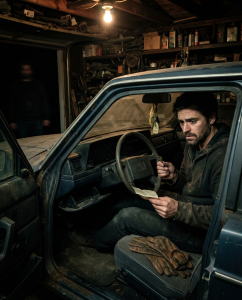
The car sat under a weak yellow bulb, covered in dust but otherwise untouched. My father’s keychain still dangled from the mirror. His leather driving gloves were folded on the passenger seat.
For a moment, grief overtook curiosity. I just stood there, hand on the door frame, remembering him wiping down the windshield with absurd care, humming to himself, calling me over to hold a flashlight while he checked some part I never understood.
Then I opened the driver’s door and sat inside.
The leather creaked beneath me. I ran my fingers over the dashboard, over the old radio knobs and the worn wheel, and that was when I noticed it: a small section of trim that didn’t quite match.
The difference was tiny. Slightly darker wood. A newer screw. A panel not fully flush with the rest. Someone else would have missed it. I noticed because I had spent years watching my father work with his hands, and I knew how exact he was.
I leaned down and touched the edge.
A loose panel.
My pulse jumped.
Carefully, I slid my fingers under it and felt around inside. Dust. Cold metal. A wire. Then something small, hard, and wrapped in old tape. I pulled it free.
A brass key.
Attached to it was a folded note. My father’s handwriting was unmistakable.
Don’t trust your brother until you open what this key belongs to.
For a second, I thought my grief had finally broken me. I read the line three times. My father and Daniel had not been close in the last year, but they weren’t openly at war. They had argued, yes—about the company, about “modernizing” things, about selling off land my father insisted should stay in the family—but I had assumed it was ordinary conflict between a stubborn father and an ambitious son.
Now, suddenly, those arguments looked different.
I turned the note over and found three more words.
Check the trunk lining.
I got out and moved to the rear of the car. The trunk opened stiffly. Inside were old tools, a worn blanket, a jack, and a flashlight with dead batteries. At first it looked exactly as I remembered. Then I saw it: one corner of the lining sat unevenly.
I peeled it back.
Beneath was a narrow metal compartment built into the body of the trunk. Hidden, custom-made, and invisible unless you knew exactly where to look. My father had created a secret compartment inside the one thing he knew would eventually belong to me.
The brass key fit perfectly.
Inside were several sealed envelopes, a stack of official-looking documents, a flash drive, and one letter with my name written across the front.
I opened the letter first.
If you are reading this, the worst has happened, and I was right not to trust Daniel. I pray I am wrong in what I fear he has done, but if he inherits everything easily, then you must read every document in this compartment before speaking to him.
My hands began to shake.
The letter was several pages long. My father wrote that, during the year before his death, he had discovered irregular transfers within the company accounts. At first he assumed they were errors. Then he traced them to a series of shell vendors and asset movements initiated under Daniel’s authority. Money had not disappeared outright, at least not in ways that would trigger immediate alarms. Instead, properties were undervalued in side agreements, inventory was rerouted, and profits were quietly redirected to outside entities.
My father confronted him once. Daniel denied everything. They argued viciously.
According to the letter, my father intended to revise the will again and expose what he had found. But he didn’t want to move too quickly without securing proof. He believed Daniel had access to too many records and too much influence in the company. If Daniel sensed what my father knew, he might destroy evidence.
So my father did what only he would have thought to do. He gathered copies of everything and hid them in the one place Daniel would never value enough to search.
The car.
I kept reading.
My father wrote that he had left the visible estate to Daniel temporarily on purpose—not as a reward, but as a trap. The final packet of documents included a prepared legal challenge, evidence of fraud, and a notarized statement directing that if the hidden materials were found after his death, the entire estate was to be frozen and reexamined. There was even a second signed document, held valid under a specific clause, transferring controlling interest in the business to me upon presentation of the evidence to the family lawyer and the court.
My father ended the letter with words that made my eyes burn.
I know this will wound you at first, and I am sorry. But I needed Daniel to believe he had won. He would move quickly, and in moving quickly, he would reveal himself. I left the truth where only you would think to look, because you were the one person I could still trust to stop him.
I had barely reached the end of the page when I heard footsteps outside the garage.
I shoved the papers back into the compartment just as Daniel appeared in the doorway.
He looked at me, then at the open trunk, and smiled too slowly.
“So,” he said, “you finally came back for the car.”
I closed the trunk. “Just feeling sentimental.”
His eyes lingered on my face. Daniel had always been good at reading people when he wanted something. “You should have called,” he said. “I could’ve had it towed to your place months ago.”
“I didn’t want to bother you.”
A tiny pause.
Then he stepped closer and rested one hand against the workbench. “Dad always did care more about that thing than it deserved.”
There was something in his voice now—careful, probing. Not casual.
I forced myself to shrug. “Maybe.”
Daniel studied me for another second, then smiled again. “Take whatever old junk you want from here. I’m clearing the garage next week.”
He left a minute later, but not before glancing once more at the trunk.
I waited in the garage until his footsteps disappeared. Then I took everything from the hidden compartment, sealed it in a duffel bag, and drove straight to the lawyer’s office the next morning before Daniel could guess what I had found.
The lawyer, Mr. Hensley, looked stunned when he saw the letter. He read the first page, removed his glasses, and read it again. Then he examined the documents one by one: account records, signed statements, backup ledgers, copies of internal communications, ownership transfers, and the notarized directive my father had prepared in secret.
By the time he reached the flash drive, his expression had gone from shock to something colder.
“This,” he said carefully, “changes everything.”
Within forty-eight hours, court orders froze the sale of several estate properties and suspended Daniel’s immediate control over the company. Forensic accountants were brought in. The records on the flash drive matched the paper trail in the envelopes almost perfectly. There were hidden transactions, manipulated valuations, and entities linked back to Daniel through layered registrations.
When Daniel learned the estate had been frozen, he called me thirteen times in one night.
I answered on the fourteenth.
“What did you do?” he demanded.
“What did you do?” I asked back.
Silence.
Then anger poured out of him. He called me paranoid, ungrateful, pathetic. He accused me of misunderstanding harmless tax strategies. He said Dad had been old, confused, suspicious. He said I was letting lawyers destroy the family out of spite.
But he never once asked what evidence I had.
That told me enough.
The investigation dragged on for months. More information surfaced. Daniel had been preparing for years to assume full control of the business, and somewhere along the way, ambition had turned into entitlement. He had convinced himself he deserved everything because he was the only one “capable” of running it. In his mind, he wasn’t stealing. He was correcting what he saw as inevitable.
The courts didn’t share that view.
He was removed from operational authority. Civil proceedings followed. Criminal charges were considered after further review of the fraudulent transfers and falsified reporting. Several assets were recovered. Others had to be untangled through a mess of legal filings and third-party claims.
The hidden directive my father created held. The estate was restructured under the court’s supervision. The company was placed under temporary administration, and once the major claims were settled, controlling interest transferred to me.
I never imagined I would end up in that position. Unlike Daniel, I hadn’t spent my life preparing to run my father’s business. For the first time, I almost wished he had simply divided everything equally and left us to grieve in peace.
But that had never been the reality my father was facing.
He saw something dangerous in Daniel before anyone else fully did. And instead of confronting it in a way that might have destroyed the proof, he created a final test and hid the answer inside the one inheritance no one else wanted.
The car.
Months after the legal storm quieted, I went back to the garage alone. Most of the house had been restored to the way my parents kept it. Not perfectly. That would be impossible. But close enough that walking through it no longer felt like entering a stranger’s property.
I opened the car door and sat behind the wheel again.
This time, I didn’t feel rejected.
I felt chosen.
My father hadn’t left me less. He had left me the truth. He had trusted me with the one thing that mattered more than money: the chance to protect what he and my mother had built from someone willing to hollow it out from the inside.
I still miss my brother, or at least the version of him I thought existed before all of this came to light. Some days I wonder whether greed changed him gradually or whether the signs had always been there and I simply didn’t want to see them. I wonder whether my father carried the weight of that knowledge alone for too long. I wonder whether any inheritance is worth what our family became by the end.
The old sedan still sits in the garage, polished now, no longer buried under dust. I keep my father’s gloves in the passenger seat. Sometimes I run my hand over the dashboard and think about the day I first noticed that tiny mismatch in the wood trim.
One dark screw. One hidden key. One sentence in my father’s handwriting.
That was all it took to expose the person who thought he had inherited everything.
And even now, when I think back on it, the part that haunts me most is not that my father knew Daniel might betray us.
It’s that he knew exactly which son would search for the truth—and which one never would.