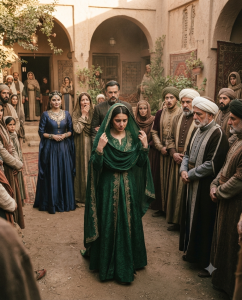
Everyone in the neighborhood knew which daughter mattered.
It was never Leila.
Even as a child, she understood the order of things inside her home. First came beauty. Then charm. Then status. Everything else was dust. Her older sister Samira had beauty enough for three daughters, according to their mother. Her second sister, Noura, had a quick laugh, bright eyes, and a talent for making people like her within moments. Together they were treated like ornaments from a wealthy house, even when the family itself was not as prosperous as it pretended to be.
Leila had none of the traits her parents valued.
She was quiet where others were bold. She preferred listening to speaking. She noticed when someone was tired, hungry, embarrassed, or lonely. She remembered small kindnesses and never forgot cruel words, even when she acted like she had. A scar marked the left side of her face, a pale twisted line from temple to cheek, the result of a fall when she was still an infant. She had no memory of the accident. But she remembered everything that came after.
Children stared.
Women sighed.
Relatives spoke in lowered voices that were never quite low enough.
Such a pity.
Poor thing.
Who will marry her?
Inside her own home, pity quickly hardened into contempt. Her mother began introducing her differently than the others. This is Leila, she would say, with a tone that suggested apology. Her father rarely looked at her unless there was work to be done. Her sisters learned early that mocking her earned laughter, and so they did it often.
Leila became useful.
Useful girls are rarely celebrated, but they are heavily depended on.
She rose before dawn to knead dough, sweep the floors, and bring water in before the sun grew too hot. She learned how to cook well because no one else wanted to spend the time. She mended torn sleeves, polished trays, and cleaned every room after her sisters had turned them upside down searching for ribbons or perfume bottles. The family’s life ran more smoothly because of her, and still they treated her as though she were a burden.
Sometimes, late at night, Leila sat alone in the little storage room where she slept and touched the scar on her face. She would try to imagine a different life, one in which someone looked at her and saw more than damage. But by morning, the dream always felt childish, so she folded it away and returned to work.
Then the sheikh announced he would choose a wife.
The city changed overnight.
Mothers started counting their daughters’ strengths out loud. Tailors found themselves flooded with urgent requests. Jewelers saw fathers arrive with serious faces and empty promises. Every family with ambition began dressing hope in silk.
Leila’s home became unbearable.
Her mother opened her locked cedar chest and spread out treasured fabrics she had not shown the girls in years. Her father began receiving neighbors with false modesty, as if he were already trying on the role of relative to power. Samira transformed completely. She walked through the house as though the palace belonged to her already. Even Noura, who usually hid her envy behind jokes, became sharper, watching Samira like someone measuring how close she might stand to greatness.
No one said Leila’s name except to give her tasks.
Steam the blue gown.
Find the gold bracelets.
Wash the red veil carefully.
Bring in the mirror.
Stand aside.
Don’t touch that.
The sheikh’s envoys were expected on a Thursday afternoon. By noon, the house vibrated with nerves. Samira had changed her dress twice. Their mother fussed over every fold and pin. Their father repeatedly reminded the girls how to stand, when to lower their eyes, and how to speak respectfully.
Leila stayed near the kitchen, invisible as usual.
Then she heard the whispering.
Samira and Noura were in the next room, laughing into their hands. There was a tone in their voices that made the air feel colder. A few minutes later, Samira appeared in the doorway with an expression so falsely sweet that Leila’s stomach tightened at once.
“Come,” Samira said. “We need help.”
Leila followed reluctantly.
On the bed lay a gown finer than anything she had ever worn. Deep green, with delicate embroidery around the sleeves. For one impossible second, she thought they might want her to mend it.
Instead, Noura lifted it and smiled. “You are going to wear this.”
Leila stared.
Samira began pulling jewelry from a tray. “You will greet the envoys first.”
The room erupted in laughter before Leila had even responded.
She stepped back. “No.”
Her mother, seated by the mirror, smirked. “Don’t act dramatic.”
“I don’t want to,” Leila whispered. “Please. Let me stay inside.”
Samira crossed the room in two quick steps and grabbed her wrist. “This is your chance to be useful on an important day.”
Their father, standing by the window, didn’t even turn fully toward them. “Enough delay,” he said. “Do what your sisters say.”
Leila’s chest tightened. She looked from one face to another, hoping to find even a trace of mercy. There was none. Only anticipation. They wanted her humiliation. They wanted to see noblemen recoil. They wanted to tell the story later and laugh harder each time.
They dressed her quickly, almost roughly. The fine gown slid over her shoulders. A necklace was fastened at her throat. Bangles were pushed over her trembling hands. Finally, Samira lowered a veil over her face.
“There,” Noura said. “Now she almost looks worthy.”
When the knock sounded at the gate, Leila nearly stopped breathing.
The envoys entered with three attendants and two guards. They were neither old nor young as a group, dressed richly but without excess. Their composure unsettled Leila more than mockery would have. They looked like men used to being obeyed, but also used to seeing behind performances.
The eldest envoy stepped forward. “We have come to meet the daughter presented to the sheikh.”
Before anyone else could speak, Leila felt Samira’s hand shove her between the shoulders.
She stumbled into the center of the courtyard.
Her pulse thundered. Beneath the veil, the air felt thin.
The envoy studied her carefully. “Your name?”
“Leila,” she said.
“And do you come willingly?”
The question hit her with such force that for a moment she forgot where she was. No one ever asked what she wanted. No one in her family cared enough. She knew the truthful answer would destroy the fragile order of the house. She could already feel her sisters’ eyes on her back.
So she said, barely above a whisper, “Yes.”
The envoy’s gaze sharpened. “If the palace opened to you today, what would you ask for first?”
Samira had coached herself for this. Leila knew the proper answers: loyalty, honor, service, gratitude. Or, if one wished to sound charming, perhaps books, gardens, music. But what came out of Leila’s mouth was neither polished nor strategic.
“A locked door,” she said. “And a place where no one is cruel.”
No one moved.
Her father’s face tightened. Samira inhaled sharply. Noura stared as if Leila had suddenly started speaking another language.
The envoy said only, “Lift the veil.”
Leila’s hands shook as she obeyed.
The scar caught the light.
She braced for the usual sequence: surprise, pity, discomfort, dismissal.
Instead, the envoy stepped closer with a look she did not recognize at first. It took her a moment to understand it.
Respect.
Not for the scar. Not in spite of it. For the honesty in the answer she had given.
“You will come with us,” he said.
Samira actually laughed. “Very amusing.”
No one joined her.
Her father stepped forward. “There is some misunderstanding. My eldest daughter is the one prepared for—”
“The sheikh’s household chooses whom it wishes,” the envoy said.
Samira moved fast, pulling back her veil and lifting her chin to display the face that had always opened doors. “Then you should look properly.”
The envoy did look.
And then he looked away.
“The sheikh instructed us to observe more than beauty,” he said. “He asked to see the heart of the household.”
That sentence changed everything.
A sealed letter was produced and handed to Leila’s father. His fingers broke the seal clumsily. As his eyes moved across the page, color drained from his face.
The envoy spoke clearly enough for everyone to hear. “The girl taken today is to be honored as a palace guest until the sheikh meets her. Any insult directed at the daughter presented under this roof will be treated as an insult to the palace.”
Leila was escorted to the carriage.
No one stopped it.
Not her father, because he was too shocked.
Not her mother, because she understood too late that the joke had turned against them.
Not Samira, because for perhaps the first time in her life, beauty had failed to control the room.
The ride to the palace felt unreal. Leila sat with folded hands, expecting at any moment for someone to laugh and tell her it had all gone too far. But the palace women who received her were gentle, efficient, and strangely warm. They brought her to a private chamber, offered food, and asked whether she wanted a physician for the bruise on her wrist where Samira had gripped too hard.
That was when Leila almost cried.
Not because of the bruise.
Because someone had noticed it.
The sheikh did not meet her on the first evening. Instead, an older palace stewardess named Fareeda sat with her after sunset and asked quiet questions. Not only about her upbringing, but about who slept where, who controlled money, who handled family papers, whether any inheritance had ever been discussed in her presence, and who had decided she would be sent out first.
Leila answered carefully. She did not want revenge. In truth, she did not even know what she wanted. But once she began speaking, old details rose with startling clarity.
The locked chest her mother never allowed anyone to touch.
Arguments between her parents that stopped when Leila entered.
A name once mentioned by an elderly aunt, then denied so quickly it had lingered in memory.
Her mother’s habit of saying, “You cost me enough the day you were born.”
Fareeda listened without interruption.
The next day, Leila was taken—not to a bridal chamber, but to a quiet library inside the palace. There, an archivist laid out records and seals from old family documents. He asked for her mother’s maiden name. He asked about villages, dates, and relatives long dead. A thin line formed between his brows as he compared one record to another.
By afternoon, the palace had found something.
A woman in Leila’s maternal line, childless for most of her life, had left a protected inheritance to the first surviving granddaughter born after a certain year. The documents were unusual because they placed the property under legal review if the child was neglected, hidden, or denied her claim. The note attached to the record included a detail that made the room go cold: the inheritance had been set aside for a baby said to have “barely survived a fall.”
Leila.
Her mother had known.
Her father had known too, once the marriage papers were combined.
Instead of honoring the claim, they had buried it. Quietly. Completely. The land had been managed in the father’s name. The income had supported the household. The better fabrics, the jewelry, the polished image of the family—much of it had been built from what was legally meant to secure Leila’s future.
The sheikh met her that evening.
He was not the terrifying figure people in the city imagined. He was observant, controlled, and far more interested in truth than flattery. He told her he had begun requesting these household observations after seeing how often beauty was used to mask cruelty. His envoys had standing instructions: watch how families treat the daughter they think has no value. That reveals more than the daughter they decorate.
Leila listened in silence.
“I did not bring you here to reward your suffering with empty words,” the sheikh said. “I brought you because your answer told me you were speaking from a wound deeper than a scar.”
Then he said something she would remember for the rest of her life.
“Some people are called plain only because others cannot bear to look at what they have done to them.”
Two days after she had left her house in humiliation, Leila returned in a palace carriage.
The city had already transformed her into rumor. Some expected a wedding announcement. Others expected a rejection wrapped in gifts. Instead, two palace women accompanied her, carrying sealed chests.
Her family rushed forward when they saw her.
The sudden affection in their faces was so transparent that several neighbors exchanged glances. Her mother called her “my precious girl” with a tenderness she had never once shown in private. Samira stepped ahead smiling, ready to reclaim the moment through charm.
Leila looked at them and felt something surprising.
Not triumph.
Distance.
The palace woman opened the first chest. Inside lay folded silks, sealed papers, and a formal decree. The second chest held account ledgers, copied records, and a cloth-wrapped bundle of older documents recovered through the archive.
By then the courtyard was full. Neighbors pressed shoulder to shoulder. Men stood in the doorway. Women leaned from adjacent terraces.
Leila took the decree into her own hands.
Her father shifted uneasily. “This is unnecessary,” he said.
A palace guard spoke from behind her. “It is required.”
Leila read aloud.
The decree announced an inquiry into the treatment of the daughter called Leila, citing testimony gathered at the palace and legal review of inheritance records. It stated that evidence suggested long-term concealment of property designated for her protection. It ordered immediate suspension of household claims over the disputed land and required witnesses to the opening of the recovered documents.
The courtyard erupted in whispers.
“Concealed inheritance?”
“From whom?”
“I knew that family lived too well for their trade.”
Her father tried to protest, but his voice cracked. Her mother looked ready to faint. Samira’s beauty, so carefully arranged, now seemed irrelevant beside the naked fear in her eyes.
Then Leila opened the cloth bundle.
Inside were older papers bearing names, seals, and a letter.
The letter was from her mother’s aunt, the woman who had left the inheritance. It was written in a precise hand and addressed to the guardians of the child. The words were plain and impossible to twist. The property, income, and protections were for Leila alone. If the guardians failed her, the palace court was to be informed under the legal terms preserved by the family registry.
There was one more line.
If the child is made to feel cursed because of what she has suffered, may the shame return to those who profit from her pain.
Leila looked up slowly.
Her mother began crying then, but the sound did not move anyone. Not even Leila. Those tears had come too late.
The inquiry moved quickly once the evidence was public. Neighbors spoke. Old servants from previous years were found. An elderly aunt, finally furious enough to stop protecting appearances, admitted she had once tried to tell Leila the truth but had been cut off from the family. Account books showed how income from the inherited land had funded Samira’s gowns, Noura’s jewelry, and the household’s reputation.
The sheikh’s court did not imprison her family, but the penalties were severe. The land and income were transferred legally to Leila. Restitution was ordered. Her father lost his standing in several local dealings. Her mother’s relatives publicly withdrew support. And the family, once so eager to display itself, became the example people whispered about whenever they spoke of hidden cruelty behind polished walls.
As for Samira, she tried more than once to speak to Leila privately. The first time, she blamed their mother. The second, she blamed their father. The third time, she finally told the truth: she had enjoyed feeling superior and never imagined the cost because she had never needed to.
Leila thanked her for the honesty and walked away.
She did not return to live in that house.
Instead, with the sheikh’s legal protection, she took possession of the inherited land and the home attached to it on the edge of the city. It was not a palace. It did not need to be. It had a courtyard with a fig tree, three bright rooms, and a gate that closed securely. The first thing she asked for, just as she once had in the courtyard, was a lock to which only she held the key.
In time, she employed women who had nowhere safe to go. Widows. Girls cast aside by relatives. A seamstress abandoned after an illness. A mother and daughter pushed out over a property dispute. The house became known not for luxury, but for dignity. Work was shared. Meals were eaten together. No one mocked another woman’s face there.
The city continued talking, of course. Some said the sheikh had planned everything. Others claimed he had been searching for a wife wise enough to answer honestly, and that Leila might still become one. But those rumors no longer ruled her thoughts. What mattered was not whether a powerful man had noticed her. What mattered was that once truth had entered the room, the lies could not survive it.
Months later, Leila saw Samira in the market.
Her sister looked as beautiful as ever, but beauty alone no longer created the same awe around her. People had learned something since the day of the decree. A lovely face can hide a vicious heart. And a scarred face can belong to the only honest person in the courtyard.
Samira hesitated, then asked softly, “Do you hate us?”
Leila considered the question.
“No,” she said at last. “But I know you now.”
It was not forgiveness.
It was something cleaner.
The truth.
And perhaps that was the part that unsettled the city most of all. Not that the scarred girl had inherited land. Not that the sheikh’s court had exposed a family. Not even that the beautiful sister had been humbled.
It was that the girl everyone dismissed had needed no miracle to change her fate. She needed only one thing she had been denied all her life:
for someone to look carefully enough to see what had been there all along.
When people retold her story after that, they always began with the same moment—the laughter, the veil, the cruel joke. But the part that lingered longest was what came after. The question no one could stop asking.
Who was truly disfigured in that house?
The girl with the scar on her face—
or the people who had built their lives by feeding on her silence?