Garrett Locke knew the sound of danger better than he knew most people’s voices.
For over a decade, he had lived in places where noise meant exposure and silence meant someone was getting ready to strike. He had learned how to read rooms, watch hands, notice exits, count patterns, and stay alive by trusting the feeling that came before proof.
That was why the silence in his house frightened him more than blood would have.
He stepped inside after ninety days away and felt the wrongness immediately.
No television humming in the background. No crayons scattered under the coffee table. No tiny sneakers tipped over near the front door. No half-finished drawing of an airplane with absurd extra wings. Asa always drew them that way, as if any machine could be safer if it had enough ways to stay in the air.
Now the house looked staged. A dry mug in the sink. Dust on the table by the hall. A blanket folded too neatly on the couch. Garrett stood in the middle of the room and listened, and what he heard was not calm.
It was absence.
He walked back outside and saw Mrs. Pruitt across the street. The woman had lived next door long enough to know Asa’s laugh and Dana’s garden routine. The second she saw Garrett, her face drained. She covered her mouth, stepped backward, and disappeared inside her house without a word.
That was all he needed.
Creal County Medical was eleven minutes away if every light turned green. Garrett made it in just under that.
A nurse moved to stop him in the corridor, but one look at his face made her think better of it. Dr. Amani Castellanos met him halfway. She looked exhausted, angry, and careful with the way trauma doctors learn to be when the truth itself feels volatile.
She led him to a pediatric room framed in glass.
Asa was inside.
For a moment Garrett could not process what he was seeing. His son looked less like a child sleeping and more like the aftermath of something systematic. One arm in a cast. One leg suspended. Bruising across his chest and neck. Splits at the lip. Stitches under a shaved patch of hair. Monitors counting out a rhythm that felt too mechanical for a little boy who should have been arguing about cereal brands.
Garrett stepped to the bed and placed two fingers near Asa’s wrist, just to feel warmth.
“What happened?”
Dr. Castellanos answered without softening it.
“Forty-two fractures. Some fresh. Some older. Several partially healed. There are repeated burn marks on both arms. This was sustained abuse, not a single event.”
Garrett absorbed every word with the stillness of a man forcing himself not to explode.
“Who brought him in?”
“His grandmother, Vivian Kessler.”
The name landed with its own history.
Vivian had become louder in Garrett’s life after Dana died. Dana had collapsed one morning in the kitchen, saying the light looked strange just seconds before a fatal aneurysm took her to the floor. Fourteen months later, Garrett still woke some nights hearing the sound of the coffee mug breaking beside her.
At the funeral, Vivian had clung to Asa and cried as if grief gave her ownership. She called the boy the last living piece of Dana. Garrett had tolerated her because loss makes people dangerous in quiet ways, and because Asa loved his grandmother then.
Then came the reactivation order Garrett could not refuse. Ninety days. Immediate departure. No time to build a better plan. No relatives on his side. No one he truly trusted.
Only Vivian.
It had felt like swallowing glass, but he left Asa in her care.
Standing in that hospital room, he realized he had handed his son to wolves and called it family.
The Kesslers were not merely influential. They were embedded. Vivian and her five brothers controlled tow contracts, a salvage yard, two impound lots, a bail operation, and a nightclub called Aviary where county officials liked to be seen forgetting things. Boyd was the strategist, polished and soft-spoken. Lyle handled money. Garson handled paperwork. Tobias did the family’s loud smiling. Royce, the youngest, was the weak point people underestimated.
By the time Garrett reached the waiting room, he had already chosen not to waste a single truthful emotion on them.
They were gathered together with coffee and donuts. Laughing.
Vivian rose when she saw him and arranged her face into grief so quickly it would have impressed him under different circumstances.
“Garrett, thank God. It was horrible. Asa has always been so clumsy—”
“Forty-two.”
She froze. So did her brothers.
He watched the reactions the way other men watched weather. Boyd hid fear behind irritation. Lyle avoided eye contact. Garson’s hand went straight to his phone. Tobias smiled because he didn’t know what else to do. Royce looked like he might be sick.
A detective named Heath Vogel pulled Garrett aside.
In the hall, Vogel spoke carefully. Family Services had visited Vivian’s house four times in two years. Complaints never stuck. Reports vanished. Witnesses backed off. The county machine was compromised, and everyone knew it.
“If I file charges tonight,” Vogel said, “your in-laws will bury the case before sunrise. And then they’ll know exactly who to target.”
Garrett looked through the glass at Asa’s bed.
“Good,” he said. “Because I’m not here to start with charges.”
That answer unsettled Vogel more than anger would have.
Later that night, Garrett learned Vivian had obtained temporary guardianship of Asa just six days after he deployed. Signed by Judge Emil Draver, an old golfing friend of Boyd Kessler. The language was clean, legal, and rotten. It gave Vivian enough authority to block decisions, intercept complaints, and keep Garrett at a distance if he objected from overseas.
The date made everything change shape.
This had not been neglect.
It had been a plan.
Just before dawn, Garrett found a receipt near the waiting room trash can that Royce must have dropped. Hardware store. Rope. Zip ties. Industrial tape. Basement lightbulbs. A heavy interior latch.
Garrett drove back to the hospital and sat in the parking lot with the papers spread over his steering wheel until a pattern formed. Guardianship filed immediately after deployment. Hospitalization on the day he returned. Multiple injuries over time. No emergency calls in between.
They had expected to keep Asa longer.
At 2:13 a.m., his phone rang from a blocked number.
Vogel.
“A contractor filed a complaint last year,” the detective said. “Unauthorized basement reframing at Vivian’s house. Permit disappeared. I’m telling you because if something is hidden there, it won’t stay hidden after morning.”
“Who killed the permit?”
“The judge.”
Garrett didn’t ask anything else. He drove.
He parked half a mile away and crossed the back property on foot before sunrise. The Kessler house sat on a rise, wide and expensive in the way power becomes ugly when it stops needing taste. Porch light on. Kitchen dark. Curtains drawn.
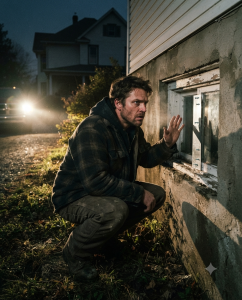
At the rear foundation, the basement windows had been painted over from the inside. One frame had fresh screws.
Garrett crouched beneath it and listened.
At first there was only wind and the hum of a nearby transformer.
Then he heard it.
Tap.
Tap-tap.
Three slow knocks.
His entire body tightened.
Asa used to do that when storms frightened him. Three taps on the wall, and Garrett would answer back from the next room. A private code. Still small enough to be hope, still specific enough to be a message.
Garrett raised his hand to answer.
Headlights swept across the yard.
He flattened against the wall as a pickup truck rolled into the driveway. Royce climbed out first, talking over his shoulder. Tobias came around the other side. They looked irritated, not alarmed, like men arriving for routine maintenance.
Garrett waited until they entered through the side door, then circled to the storm-cellar entrance hidden behind stacked landscaping stones. New padlock. New hinges. The latch from the receipt.
He cut the power to the exterior floodlight, slipped the shackle, and went down the steps without making a sound.
The basement smelled of bleach over mildew.
A washer and dryer sat along one wall. Shelves of canned food lined another. But Vogel had been right: one section of the basement was newer than the rest. Fresh framing hidden behind cheap paneling, painted to match badly enough that only someone trained to read structures would notice the lie.
Garrett pressed his ear to it.
A whisper from inside.
Then a child’s breath, hitching.
He pulled the panel screws in seconds and exposed a narrow door built into the false wall. Interior latch. Insulated edges. No knob on the inside.
When he opened it, Asa flinched even in the hospital gown they had sent him home in for imaging transfer before he crashed. The boy had not been moved after all; Garrett’s mind corrected itself instantly. This was not Asa.
It was another child.
A little girl, maybe eight, curled on a mattress on the floor, eyes wide with the exhausted panic of someone who had forgotten rescue was possible.
Garrett knelt slowly. “You’re safe. What’s your name?”
“Emily,” she whispered.
He got her out through the cellar before Tobias and Royce realized anyone was downstairs. He hid her beyond the tree line and told her not to move. Then he went back in.
This time he wasn’t looking for children. He was looking for records.
He found them in a locked cabinet in the reframed room behind stacks of old moving blankets. Polaroids. Dates. Medication bottles with scraped labels. Behavioral logs written in Vivian’s neat handwriting. Notes on food restriction. Notes on silence. Notes on “compliance.” Notes on Asa by name.
And there was more.
Three other children’s first names. Two crossed out. One marked transferred. Beside each name were intake dates, bruise diagrams, punishment methods, and the names of county workers who had “resolved” prior complaints.
The Kesslers had not just abused Asa.
They had built a hidden pipeline around vulnerable children.
Children of addicts. Children of overwhelmed relatives. Children quietly shifted through temporary custody arrangements, insurance claims, state reimbursements, and private payments from people who wanted troublesome family situations handled off-record. Vivian called it “correction.” Boyd called it “care leverage” in his notes. They made money through fraud, influence, and fear, while using their county connections to keep every report fragmented.
Garrett photographed everything.
Then a floorboard creaked behind him.
Boyd stood in the doorway with a revolver in one hand.
For a second, the older man looked almost relieved.
“I wondered when you’d stop pretending to be civilized,” Boyd said.
Garrett held up the file folder. “You caged children in a basement.”
Boyd shrugged once, as though morality were for people with less to lose. “Your boy was difficult. Dana always spoiled him. Vivian tried softness first.”
Garrett’s face went still in a way that frightened even armed men.
“You touched my son for weeks.”
“For his own good,” Boyd said. “And for ours. Once the guardianship cleared, he was useful. Sympathy money. Medical leverage. Quiet pressure on you if you ever became inconvenient.”
That was the moment Boyd made the mistake that ended everything. He smiled.
Garrett moved before the smile finished forming.
The gun discharged into the ceiling. Boyd hit the concrete hard enough to lose consciousness. Tobias came running and got dropped at the bottom of the stairs. Royce tried to flee through the side door, but Detective Vogel and two state investigators were already there, guns drawn.
Vogel had not trusted the county, but he had trusted timing. After the blocked call, he had contacted the state abuse task force and a federal fraud unit through an old academy friend. He did not file locally. He went around the machine.
Within an hour the house was flooded with uniforms Vivian could not control.
Emily was taken to safety. The hidden room was photographed. The cabinet was seized. So were the financial records in Boyd’s office, the forged custody signatures in Judge Draver’s chambers, and the encrypted camera storage from Aviary’s back office where county favors had apparently been negotiated for years.
By noon, Vivian Kessler was in handcuffs on her own front lawn, screaming that everyone was ungrateful. Lyle was arrested at the salvage yard. Garson was picked up while trying to shred documents. Tobias and Royce turned on the family within two days. Judge Draver resigned before formal indictment and was arrested anyway.
The bigger shock came three weeks later.
Dana’s death was not murder, but it had been exploited. Vivian had used the chaos after her daughter’s sudden passing to begin preparing guardianship paperwork long before Garrett ever left. Emails recovered from Garson’s laptop showed they had discussed Asa as an “asset” because Garrett’s background made him hard to control and useful to possess. If he stayed obedient, they had his son. If he resisted, they had a pressure point.
Asa survived the surgeries.
The first time he spoke again was at night, in the hospital, after one of the casts had come off and Garrett was half asleep in a chair beside him.
“Dad?”
Garrett was on his feet instantly.
Asa’s voice was tiny and raw. “I tapped for you.”
Garrett had trained himself for years not to break under pressure. He broke then.
He bent over the bed, careful of wires and healing bones, and pressed his forehead gently to Asa’s hand.
“I know,” he said. “I’m sorry it took me so long. I know.”
Recovery was slow and ugly in the real way, not the cinematic one. Asa needed more procedures, more therapy, more patience than any six-year-old should be asked to give. Some fractures would ache in winter. Some fear would arrive without warning. There were nights he woke screaming at harmless house noises, convinced a lock had clicked somewhere in the dark.
But he was out.
That mattered first.
Emily was placed with an aunt in another state. Two other children tied to the Kessler records were found and removed from dangerous guardianships. The county blew open under the investigation. Careers ended. Charges multiplied. Assets froze. People who had laughed in waiting rooms stopped laughing when cameras appeared.
Garrett sold his company six months later and moved with Asa to a smaller town where nobody knew their last name. They rented a house with wide windows and no basement. Asa started drawing airplanes again. Fewer wings this time.
One spring evening, nearly a year after the arrests, Garrett found a picture on the kitchen table.
It showed a house, a dog they did not own, a blue sky, and two people standing in the yard. One tall. One small.
Neither was inside.
Garrett stared at it longer than he meant to.
Asa looked up from his crayons. “It’s us.”
Garrett swallowed. “Outside?”
Asa nodded. “Because outside means we can leave.”
That sentence stayed with him.
So did another truth he never shook: monsters do not always look wild. Sometimes they bring coffee to hospitals. Sometimes they call themselves family. Sometimes half a town helps them stay respectable because respectability is easier to live beside than horror.
The question Garrett kept turning over long after the trials ended was not whether the Kesslers were evil. That part was simple.
It was how many people had seen the signs, felt the wrongness, heard the taps inside the wall, and decided silence was safer.
And whether forgiveness belongs more to survivors than to anyone who asks for it.