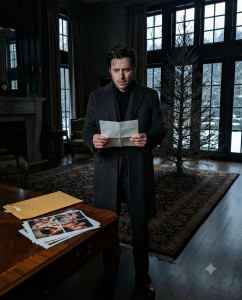
After spending Christmas with his mistress, Julian Blackwood came home expecting to slide back into his life as if nothing had happened.
Instead, he walked into a house that felt like a mausoleum.
The driveway to the Blackwood estate was rimmed with old snow, gray at the edges where the tires had packed it down over the week. Julian stepped out of his black Mercedes with a leather briefcase in one hand and a bottle of Japanese whisky in the other, an expensive prop for an expensive lie. He had timed his arrival perfectly — late enough to explain the lack of enthusiasm, early enough to avoid suspicion about the flight he had never taken.
For the last seven days, his wife believed he had been in Tokyo closing a merger. That had been the official version. It was neat, believable, and flattering to the kind of man Julian liked to imagine himself to be.
The truth had unfolded under mountain lights in Aspen.
He had spent Christmas in a private chalet with Isabel, a woman twenty years younger than Elena and far easier to impress. Isabel laughed at his stories, touched his arm when he talked, and acted as if every room belonged to him the second he entered it. Julian had soaked in the attention like a man drinking after a drought. He told himself he deserved it. The pressure. The responsibility. The endless obligations of his family name. Surely he was entitled to a private reward.
He had planned the deception carefully. False receipts. A burner number for certain messages. Calls to Elena spaced to match the Tokyo time difference. He had even bought airport souvenirs on his way back — the whisky, a silk scarf, a box of sweets he knew she didn’t even like.
He expected to find Elena tired, quiet, perhaps mildly hurt that he had missed another holiday.
He expected Harrison asleep upstairs.
He expected his life waiting exactly where he had left it.
When he opened the front door and called out, “Elena, I’m home,” the silence was so complete it startled him.
Not peaceful. Not ordinary.
Wrong.
The heat was off. The house had the dead cold of a place abandoned in a hurry, except nothing about what came next suggested haste. It suggested intent.
The Christmas tree in the living room still stood, but bare. The antique ornaments were gone. The lights were gone. The silver ribbon Elena always wound around the branches by hand each year was gone. It looked less like holiday decor and more like evidence of one.
Julian set down the whisky and went upstairs.
The nursery was empty.
The crib had been stripped. The shelves cleared. The blue stuffed bear Harrison dragged everywhere had vanished. There was no bottle in the warmer, no folded blanket, no stack of clean onesies, no baby lotion. Even the air smelled wrong — sharp and sterile, as if the room had been deliberately wiped down.
His first thought was not fear but offense, as though someone had dared rearrange a possession that belonged to him.
“Elena?” he called again, louder this time. “Harrison?”
No answer.
He crossed to the master bedroom and stopped cold. His wardrobe remained untouched, every shirt and jacket in place. Elena’s side of the room had been erased. Closets emptied. Drawers cleared. Jewelry box open and vacant. Her vanity scrubbed bare.
This was not the work of someone running from danger.
This was someone making sure not to leave anything behind.
A hard pressure began to build in his chest. He told himself there had to be an explanation. A fight. A dramatic gesture. A trip to her parents’ house. Something emotional. Something temporary.
Then he found the envelope on his desk.
On top of it lay a diamond bracelet he recognized instantly — not because he had given it to Elena, but because he had hidden it himself inside the wall safe in the upstairs corridor. He froze, then ran to the painting that concealed the safe.
It hung crooked.
He pulled it down. The safe stood open.
Cash, passports, private bonds, backup drives, account records — all gone.
For the first time that evening, panic displaced irritation.
He tore open the envelope expecting a furious letter. Instead, he found printouts.
Screenshots of his messages with Isabel.
A photograph of him at the airport, hand low on Isabel’s back, smiling in a way he had not smiled with Elena in years.
Copies of transfers.
Travel records.
And beneath them, a court order that turned his blood to ice.
Legal name change of minor child.
Harrison James Blackwood was now Harrison James Sterling.
He read the line again and again, as though repetition might change it. Sterling was Elena’s family name. The Blackwoods were old-money East Coast power — the kind of family that wrapped legacy in ritual and treated inheritance like a blood religion. Harrison’s surname had never been a sentimental detail. It was a key.
A Blackwood heir carried access to a trust set aside before Julian even married. Forty million dollars would vest on Harrison’s third birthday.
That birthday was two weeks away.
Julian sat down because he suddenly could not feel his legs.
At the bottom of the order was a note in Elena’s unmistakable handwriting.
You wanted a life without consequences, Julian. Now you have one without us.
P.S. Don’t check the Cayman accounts.
He lunged for his laptop.
The warning on the screen might as well have been a slap. His credentials no longer worked for several private accounts. The joint account was closed. The liquidity reserve was empty. Funds had been moved into a protected legal structure administered by Sterling & Vance LLP, the law firm belonging to Elena’s family.
He called his lawyer, Arthur Pendleton, with all the restraint of a man trying not to scream.
“She changed my son’s name.”
Arthur’s response was immediate and uneasy. “That shouldn’t be possible without your consent.”
“I never gave it.”
“Did you sign anything recently? Guardianship papers? Trust amendments? Temporary authorizations?”
Julian said nothing, and in the silence a memory rose with horrible clarity.
Elena in the kitchen a week earlier, sliding a stack of papers toward him while he drank coffee and answered email.
“Insurance renewals,” she had said. “House and cars.”
He had signed without reading.
Arthur understood before Julian admitted it. “Dear God,” he murmured. “What exactly did you sign?”
Julian ended the call.
Humiliation was beginning to creep in now, sliding in behind the panic. Not because Elena had outsmarted him — though she had — but because he had made it easy. He had not imagined she was capable of anything beyond sadness. He had lived so long assuming control that he had stopped noticing where it came from.
He drove straight to Newport.
The Sterling estate sat behind iron gates and old trees, stately and discreet in the way only generational wealth could afford. Julian expected resistance, but he also expected negotiation. A scene. Tears. Some final opportunity to dominate the terms.
Instead, he got Robert Sterling through the intercom.
“Go home, Julian.”
Julian gripped the metal speaker. “She took my son.”
Robert’s voice remained calm. “Then ask yourself why.”
“She stole from me. I’ll call the police.”
“You should do that,” Robert replied. “We’ve already provided the recordings.”
Julian felt something drop inside him. “What recordings?”
“The nursery camera. Security footage from Aspen. Your calls with Isabel. The financial transfers. The timeline. There’s a hearing on Tuesday.” Then the final strike: “Bring a better lawyer than Arthur.”
The gate clicked off.
Julian stood there in the freezing dark, no longer angry in the clean, simple way he had been an hour before. Anger assumed weakness in the other person. This was something else.
This was fear of an opponent who had prepared longer than you knew.
On the drive back, details rearranged themselves in his head. Elena’s recent quietness. The absence of tears. The way she had stopped asking where he was going. The way she nodded through his excuses without arguing. He had treated her silence as surrender.
It had been strategy.
He slept little that night and woke to the buzz of calls he did not answer. By morning, his driver informed him there were reporters outside Blackwood Capital’s headquarters.
Julian told himself it was a leak connected to one of the mergers. Markets were nervous. Journalists circled constantly. There were always fires to contain.
But when he stepped out at the tower entrance, the cameras swung toward him too fast.
“Mr. Blackwood, is it true compliance has opened an internal investigation?”
“Did company resources fund your Aspen trip?”
“Were private accounts used to conceal executive expenses?”
“Is your wife cooperating with the board?”
His scalp prickled.
He moved through security without replying, jaw tight, pulse unsteady for the first time in years. The lobby staff avoided his eyes. On his floor, conversations stopped when he appeared, resumed in low tones when he passed.
His keycard failed at the executive corridor.
Red light.
He tried again.
Red.
Then the glass doors opened from inside and Marianne Cole, the company’s chief legal officer, stepped out with a sealed file in her hand.
“There’s been an emergency board meeting,” she said.
“I’m aware of how meetings work,” Julian snapped. “Move.”
She did not.
Her face held something worse than anger. Controlled pity.
“You should know before you enter,” she said, “your system access has been suspended pending review.”
Julian stared at her. “Pending review of what?”
She handed him the folder. “Misappropriation of company travel budget, undisclosed personal relationships affecting negotiations, exposure to blackmail risk, undisclosed offshore holdings, and potential fiduciary breaches.”
For a second, he could only hear the blood in his ears.
“This is absurd.”
Marianne’s voice remained even. “Your father is already inside.”
That made him stop.
Richard Blackwood rarely attended emergency meetings in person. He preferred power exercised at a distance, through calls placed from clubs, town cars, and silent offices where other men waited to be judged. If he had come in himself, this was not ordinary damage control.
Julian entered the boardroom and understood immediately that no one there intended to save him.
His father sat at the head of the table, silver-haired and rigid, looking not furious but disgusted. Two outside directors avoided Julian’s gaze. Compliance counsel had three binders open. And on the large screen at the far end of the room was Elena.
Live video.
She wore a dark blouse, her hair pulled back, no jewelry except her wedding ring — which Julian noticed with irrational sharpness. Beside her sat a woman from Sterling & Vance and, on the table, several files.
“Elena,” he said, disbelief and fury colliding. “What the hell is this?”
She looked at him steadily. “The part where your choices stop being private.”
Richard Blackwood spoke before Julian could answer. “Sit down.”
Julian obeyed because, despite everything, that command was still reflex.
What followed was less a meeting than a methodical dismantling.
Compliance had traced charges from corporate accounts that coincided with Julian’s Aspen trip. A company-owned shell had paid maintenance fees on the chalet booking. Security data from a vendor connected his burner number to private negotiations he had claimed were happening overseas. There were timestamp discrepancies. Expense manipulations. Use of staff to facilitate personal travel under false pretenses.
Julian turned to Elena more than once, hoping to catch hesitation, regret, some soft remnant of the woman he had married. He found none.
Then came the recordings.
There was video of the Aspen property. No graphic betrayal, but enough — him arriving, embracing Isabel, moving through the doorway together. Audio clips from phone calls in which Julian mocked Elena’s trust. A nursery camera segment recorded at home weeks earlier, when he stood over Harrison’s crib speaking to Isabel through an earpiece, promising, “Two more years and everything unlocks. After that, I won’t need to pretend anymore.”
The room seemed to contract around him.
Richard Blackwood’s face did not change, which was worse than shouting.
“You discussed trust strategy while standing over your son’s bed?” his father asked.
Julian swallowed. “That’s not what—”
“Enough.”
Elena finally leaned toward her microphone. “You thought this was about catching you cheating. It wasn’t. I could have left for that months ago. This is about what came after.”
Julian’s eyes narrowed. “What are you talking about?”
She opened a file. “Three months ago, I found preliminary documents redirecting future trust influence away from Harrison and toward a discretionary structure you controlled. There was language suggesting his financial protections could be diluted through guardianship interpretation if our marriage ended under conditions favorable to you.”
Julian went still.
He had never expected her to find those drafts. They were exploratory. Unfinalized. Quietly commissioned through a private advisor who believed all rich men should plan for hostile divorces.
“It wasn’t finalized,” he said weakly.
Elena’s expression hardened. “No. Because I found it first.”
Silence spread across the table.
Then she added, “That was the day I stopped asking questions.”
The board voted within the hour.
Julian was suspended immediately from all operational authority pending full investigation. His office access was terminated. His compensation frozen. Outside counsel would review his transactions. The company would issue a statement about leadership restructuring effective immediately.
His father did not defend him. When the meeting ended, Richard remained seated while everyone else rose.
Julian stayed behind.
For a moment, it was just the two of them.
“You embarrassed the family,” Julian said finally, hating how small he sounded.
Richard looked at him with a contempt that seemed to age him. “No. You did.”
Julian laughed once, hollow. “And Elena? You’re just going to let her strip my son of our name?”
Richard’s eyes chilled. “Our name is not a shelter for cowards.”
The words landed harder than anything else that day.
By Tuesday morning, the family court hearing made the rest official.
Julian arrived with new counsel and the remains of his pride. Elena arrived with files, recordings, financial timelines, testimony from advisors, and a calmness that made him feel reckless by comparison. She did not exaggerate. She did not cry. She simply laid out the pattern: deception, financial concealment, misuse of marital structures, plans affecting their son’s future, repeated dishonesty, and conduct that made the Blackwood name a liability rather than a protection.
Julian’s attorney argued legacy, stability, paternal rights, family continuity.
Elena’s attorney argued documented intent.
The judge asked Julian twice whether he had signed the authorizations voluntarily. He was forced to admit that he had.
The judge asked whether the evidence of deception was materially disputed. It was not.
The provisional name change stood.
More important, the court affirmed emergency restructuring of Harrison’s trust protections under independent oversight until a final settlement was reached. The Blackwood family influence Julian had counted on was effectively neutralized.
Outside the courthouse, reporters gathered again, but this time no one shouted his name with interest. They shouted Elena’s.
She did not stop.
Weeks later, the divorce terms were finalized.
Julian did not lose contact with Harrison entirely; the court did not reward Elena with absolute control. But he lost the shape of fatherhood he had imagined — the symbolic dominance, the effortless inheritance, the certainty that his son would grow up under his terms. Supervised transitions became structured visits. Financial oversight tightened. Hidden accounts remained under investigation. Several of his offshore arrangements triggered tax scrutiny he had spent years avoiding.
Blackwood Capital survived by sacrificing him quickly.
Richard issued a statement praising the board’s commitment to ethics and governance. Privately, he made clear Julian would not be welcomed back in any leadership role. The family trust was amended. Contingencies were rewritten. Doors Julian had assumed would always open for him now remained politely shut.
Isabel disappeared within a month.
No dramatic farewell, no grand betrayal. She simply stopped answering once the headlines turned ugly and the money became inaccessible. The chalet photos were replaced by legal notices and reputational fallout. Julian realized too late that fantasy depends on someone else paying for the weather.
Elena rented a house by the coast under the name Sterling and rebuilt her life there with Harrison. The quiet she had worn during those final months of marriage turned out not to be despair but concentration. She returned to consulting work with her family’s firm, not because she needed the income, but because competence had always steadied her. Those who knew her well said she laughed again eventually, though never the same way.
As for Harrison, he was too young to understand the storm that had erupted around his name. He learned routines, faces, houses, and the emotional climate of rooms before he learned the legal meaning of any of it. By the time he was old enough to ask difficult questions, the answers were complicated in the way family truths usually are.
Did Elena go too far?
Some people said yes. They said a child should not be pulled from a lineage because of adult betrayal. They said the name was bigger than Julian, that inheritance should have been protected without severing identity.
Others said she saw the danger before anyone else did. That Julian’s cheating was ugly, but his willingness to treat his son’s future as a strategy was the real fracture. That a surname means nothing if the person carrying it cannot be trusted.
Julian, when he thought about it honestly — which was rare and never comfortable — knew the moment everything truly ended had not been Aspen, or the empty crib, or the boardroom, or even the judge’s order.
It was the kitchen.
Coffee steaming between them.
Elena sliding papers across the table with calm hands.
And him signing away certainty because he was so sure she would always be exactly where he left her.
In the end, that was the red flag bigger than the affair, bigger than the money, bigger than the family name itself: Julian did not just betray his wife. He underestimated her.
And sometimes the most devastating justice doesn’t come from rage.
It comes from someone who had enough time to think.