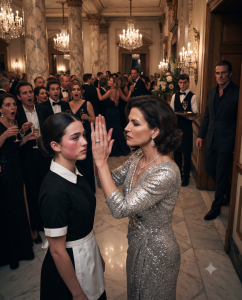
The slap was loud enough to silence a ballroom full of people who were used to ignoring everything that didn’t concern them.
It cracked through the marble hall, rose into the crystal chandeliers, and seemed to hang there for one impossible second while more than fifty wealthy guests stood frozen with glasses in hand and polite smiles dying on their faces.
Clara Reeves took the blow without moving.
She did not stumble. She did not cover her cheek. She did not lower her gaze.
Margaret Callaway, on the other hand, looked like a woman who had just restored order in a universe that had briefly dared to offend her.
She was radiant in the way expensive people often are—carefully assembled, lacquered with confidence, glittering under the light as if money itself had become flesh. Her silver gown swept the floor in a deliberate shimmer. Diamonds flashed at her throat, her wrists, her ears. Her dark hair had been pinned perfectly, her lipstick was untouched, and her face was arranged in that sharp expression particular to people who believed power exempted them from shame.
“People like you should remember your place,” Margaret said, her voice edged with contempt. “A thief will always be a thief.”
Clara slowly turned her head back toward her, the red imprint already forming across her cheek. Her gray eyes remained unnervingly steady. That calm was what unsettled the room more than the slap itself. It wasn’t the calm of someone defeated.
It was the calm of someone who knew something everyone else did not.
At the far end of the hallway, hidden partially by the ballroom doors, a study door clicked open.
Adriano Salvad had stepped into the corridor.
Margaret did not notice.
If she had, she might have chosen a different target hours earlier. She might have swallowed her spite, smiled through the evening, and gone home believing she had won again.
But Margaret had always confused impunity with invincibility.
And Clara Reeves had once already learned what kind of woman Margaret was.
That morning, Clara had risen before the sun.
The estate overlooking the sea was still wrapped in a gray pre-dawn hush when she moved through it with practiced precision. She checked the flower arrangements in the front hall, replacing drooping stems with fresh white lilies. She polished the black grand piano until the reflection of the ceiling beams sharpened on its lid. She reset crystal flutes in perfect alignment. She supervised linens, adjusted candle placements, inspected table settings, and reviewed service flow with the kitchen staff.
No one had to tell her twice how to do her job.
No one, in fact, had to tell her much at all.
Clara worked with a kind of discipline that had nothing to do with fear and everything to do with self-respect. She had carried that discipline since childhood, shaped by a mother who had lived hard and spoken softly.
Her mother had cleaned other people’s houses until her hands split open in the winter. She scrubbed floors, washed sheets, ironed shirts, and took in mending by night just to keep food on their table. She raised Clara alone, often pretending she wasn’t hungry so her daughter could eat the larger share.
When Clara was nineteen, her mother died in a narrow bed near a window that barely closed against the wind. In her final hours, she held Clara’s hand with shocking strength and gave her one last instruction.
“Never let anyone convince you that you are worth less.”
Those words stayed with Clara long after everything else was taken from her.
The first time Margaret Callaway entered Clara’s life, she did not remember her name either.
Clara had been twenty-two and newly hired in a wealthy household where Margaret was a frequent guest—always overdressed, always loud, always speaking to staff as though they were furniture that occasionally malfunctioned. Clara learned quickly to stay invisible around her.
Then one evening, after a dinner party, a diamond ring vanished.
Margaret was the first to raise her voice. She never requested a search of the guests. She never suggested a mistake, or misplacement, or drunken carelessness. She looked around the room, saw the newest maid, and made her choice.
“This one,” she said. “Check her.”
Clara, stunned, begged them to search everything. Her room. Her apron. Her locker. Her bag. She pleaded with an urgency that should have convinced any reasonable person.
Instead, it only seemed to excite Margaret more.
The household wanted the problem gone quickly. Clara was dismissed that same night. Her wages were withheld. Her protests meant nothing. No ring was ever found, at least not publicly, and Margaret never apologized.
For weeks, Clara moved through a hard, humiliating hunger she would never fully forget. She rationed bread, sold two dresses, and learned to sleep with her coat on. Shame followed her everywhere, but bitterness never quite took root. In its place grew something colder and more useful: clarity.
She learned that some people do not accuse because they are certain.
They accuse because they enjoy what accusation lets them do.
Two years later, on a freezing evening, Clara found a black briefcase on a public bench near the train station. The wind was vicious, the park nearly empty. The case had no visible tag, no label, nothing but a subtle monogram on the clasp. She considered leaving it for the authorities, but when she picked it up, the lock gave under pressure.
Inside were documents, contracts, photographs, handwritten notes, bank records, and sealed envelopes carrying names she recognized from newspapers and television. Even without understanding every detail, Clara could tell the contents were dangerous.
Tucked inside the inner pocket was a card embossed with a single number.
She stood under a streetlamp and called.
A dark sedan arrived less than thirty minutes later. The man who stepped out carried authority the way some men carry a weapon—without needing to display it. He wore a charcoal coat and gloves. A thin scar cut along one side of his jaw. His eyes, sharp and controlled, moved first to the briefcase, then to Clara.
He opened the case on the hood of the car and checked every paper in silence.
Finally, he looked up.
“Why didn’t you sell it?” he asked.
Clara was shivering by then, but her answer came easily. “Because it wasn’t mine.”
For the first time, something shifted in his expression.
That man was Adriano Salvad.
Publicly, he was a businessman with luxury holdings, private security contracts, shipping interests, and discreet political relationships. Privately, far fewer people were foolish enough to say exactly what they believed he was. He inspired fear even among those who smiled in his presence.
A week after the briefcase incident, Clara was offered a job at one of his properties.
At first, she handled ordinary duties. Then came more sensitive tasks. Locked cabinets. Delivery logs. Guest restrictions. Personal scheduling. Inventory management for items too valuable to leave in common circulation. Adriano never gave trust all at once. He parceled it carefully and watched what happened.
Clara never abused it.
Over the next five years, she became the only employee granted access to his most private suite and the concealed safe beyond it. She managed valuables, documents, and schedules with absolute discretion. She knew how much silence was worth in houses built on secrets. Adriano, who trusted almost no one, trusted her.
She never spoke of it.
That was why the gala mattered. It was not just another event. It was one of the year’s most important social evenings at the coastal estate, attended by politicians, donors, investors, socialites, and people whose names opened doors in three countries. The guest list itself was a network of influence.
Margaret Callaway arrived late enough to be noticed.
She swept in on a cloud of perfume and expensive annoyance, flanked by two women from the charity board and a man from her husband’s campaign circle. She greeted Adriano with polished familiarity, complimented the estate loudly enough for others to hear, and began treating the staff like disposable tools almost immediately.
Clara noticed her, of course.
Margaret did not notice Clara.
To Margaret, employees blended together into one faceless category. Aprons, trays, nametags, lowered eyes. She had likely forgotten the young maid she once ruined. Or perhaps she remembered only the satisfaction of it, not the person attached.
Either way, the evening soured fast.
A teenage waiter named Teddy Brink, new to formal service and visibly nervous, was carrying a tray with wine and champagne when Margaret pivoted just enough to catch the edge with her arm. One red glass tipped and spilled against her gown.
The room recoiled in expectation.
Teddy went pale. “I’m so sorry, Mrs. Callaway. I didn’t—”
“You incompetent little fool,” she snapped. “Do you know what this dress costs?”
His hands started shaking so badly the remaining glasses trembled. A few guests pretended not to hear. Others watched with thinly veiled interest, as though cruelty were entertainment when wrapped in couture.
Clara stepped in before Teddy could collapse under the humiliation.
“The stain can be treated immediately, Mrs. Callaway,” Clara said. “Please allow me to handle it.”
Margaret turned toward her with open irritation, and for the briefest moment, Clara saw it—that ugly flicker of recognition not of identity, but of resistance. Margaret could tolerate fear. She could tolerate apology. What she hated was composure.
She stared at Clara’s face for a beat longer than necessary, then walked away without another word.
Clara hoped that would be the end of it.
She was wrong.
Later in the evening, Margaret made a small show of removing a diamond necklace from a velvet case. It was exquisite—old-cut stones, platinum setting, delicate craftsmanship. She displayed it to the women nearest her as if unveiling a relic.
“Family heirloom,” she announced. “Irreplaceable.”
Clara accepted the necklace for secure storage, noted the transfer in the inventory ledger, and took it to the hidden room beyond Adriano’s study. She entered the code, opened the safe, placed the necklace in compartment seven, turned the lock twice, checked the seal, and exited.
There was no mistake.
There was no gap in procedure.
There was only intent.
When Clara returned to the ballroom, Margaret was already planting the first seeds. Quiet conversations. Concerned frowns. A whispered mention of valuables. By the time the accusation came, it felt rehearsed.
“My necklace is missing,” Margaret declared.
Conversations stopped. Heads turned. Music died.
Clara answered at once. “It is secured.”
Margaret’s eyes locked on her. “Is it?”
“Yes.”
“How reassuring. Coming from you.”
A murmur rippled through the room. Clara remained still.
“You may verify the safe log,” Clara said.
Margaret laughed, brittle and cruel. “You don’t instruct me on handling theft.”
One of the charity board women shifted nervously. Teddy stood near a column, trapped between dread and helplessness. The room waited to see whether anyone powerful would intervene.
No one did.
Margaret stepped closer. “I know your kind. I’ve seen this before.”
That was the moment Clara understood. Margaret remembered enough. Not the facts. Not the truth. Just the pleasure of choosing her once, and the certainty that she could do it again.
“I want her searched,” Margaret said.
Clara’s jaw tightened almost imperceptibly. “The necklace is in the safe.”
“Liar.”
Then came the slap.
The ballroom went dead silent.
And from the far hall, Adriano Salvad stepped into view.
At first, few noticed him. But the people who knew him best reacted before anyone else did. A state senator lowered his glass. A real estate magnate took half a step back. One of Adriano’s senior associates near the staircase looked down immediately, as though eye contact itself might become dangerous.
Margaret turned, expecting reinforcement.
Instead, she saw Adriano looking directly at Clara.
Not at the necklace issue.
Not at the room.
At Clara.
At the mark on her face.
The silence grew colder.
“Mr. Salvad,” Margaret said, her tone quickly reshaped into offended dignity. “Thank God. Your employee has stolen my necklace, and I was forced to—”
“Forced?” Adriano said.
He did not raise his voice, but the single word cut through the ballroom harder than Margaret’s slap had.
Her confidence wavered for the first time.
“She has a history,” Margaret pressed on. “I recognized her type immediately.”
Now Adriano looked at Margaret.
Those who had spent any time around him understood something then: he was not considering the possibility that Clara was guilty. He already knew she was not. The only question left in the room was how badly Margaret had miscalculated.
Adriano took one deliberate step forward.
“Do you have any idea,” he asked, “who you just put your hands on?”
Margaret blinked, confused. “A maid.”
“No,” Adriano said. “You slapped the one person in this house I trust more than anyone standing in this room.”
A collective shiver ran through the guests.
Margaret gave a nervous laugh. “Surely this is some misunderstanding. She took my necklace.”
Adriano didn’t answer. He extended his hand slightly toward Clara.
“Compartment?”
“Seven,” Clara replied.
“Log entry time?”
“Eight fourteen.”
Without breaking eye contact with Margaret, Adriano said to one of his security men, “Open the safe.”
The man moved instantly.
Two minutes later, he returned carrying the velvet case with the necklace inside.
No one spoke. No one needed to.
Margaret’s face lost color in visible stages.
Adriano accepted the necklace, opened the case, verified it, then handed it to her without warmth. “Your heirloom.”
Margaret swallowed. “Then I… perhaps there was confusion—”
“There was no confusion,” Adriano said. “There was an accusation. Then an assault.”
She tried to recover. “I acted out of distress.”
“No,” he said again, quieter this time. “You acted out of habit.”
The words landed harder than any public insult could have. Several guests looked at Margaret with something close to revulsion now that the tide had turned and it was safe to have principles.
Adriano turned to Clara. “Were you injured?”
Clara touched her cheek for the first time. “No.”
It was a simple answer, but it deepened the shame in the room. She was protecting the dignity of the moment more than anyone else had.
Then something unexpected happened.
Teddy stepped forward.
His voice shook, but he forced it out. “Sir… Mrs. Callaway also blamed me earlier for spilling wine. But she moved into the tray on purpose.”
Margaret whipped around. “How dare you—”
“Enough,” Adriano said.
He didn’t shout. He didn’t need to.
Margaret’s mouth closed.
Adriano glanced at two other staff members. “Did anyone else see it?”
A woman from catering nodded reluctantly. “Yes.”
A footman near the west doors added, “I did too, sir.”
The room had shifted completely now. Power was redistributing itself in real time. Margaret felt it. Everyone did.
And Adriano, for all his reputation, was methodical. He did not rush to humiliate. He dismantled.
He looked back at Margaret. “Five years ago, did you also accuse Clara of theft in another house?”
Margaret stiffened. “I don’t remember every servant I’ve encountered.”
Clara said nothing.
Adriano’s expression hardened. “Convenient. Because I do remember what happens to people discarded by false accusations. Clara nearly starved after yours.”
That revelation shook the room. Margaret opened her mouth, then closed it again.
One of the charity board women stepped away from her.
Adriano continued, “Do you know how Clara came to work for me?”
Margaret said nothing.
“She found something that could have bought her freedom twice over. Instead of profiting from it, she returned it untouched. Since then, she has had access to valuables, records, rooms, and information that people in this room would destroy each other to obtain. She has never taken so much as a coin that wasn’t hers.”
Every sentence stripped Margaret smaller.
Then Adriano did what no one expected. He addressed the room.
“Let this be clear. In this house, status does not grant permission to degrade the people who serve it. Anyone who cannot understand that will not cross these doors again.”
The message landed broadly. It was not just for Margaret. It was for every guest who had watched and waited to see which way power leaned before deciding what they believed.
Margaret, sensing the ground disappearing beneath her, made one last attempt. “My husband’s office will hear about this.”
Adriano tilted his head slightly. “Then they will also hear there are witnesses to your public assault, false accusation, and attempt to intimidate staff at a private event full of donors and cameras.”
Her lips parted. “Cameras?”
Adriano nodded once toward the corners of the ballroom.
The blood drained from her face.
The gala had been recorded for security throughout the house. There would be footage of the accusation, the slap, Teddy’s earlier incident, and Margaret’s performance from beginning to end.
For the first time all night, Margaret looked truly afraid.
“Please,” she said, dropping the brittle hauteur and reaching for civility too late. “I was upset. I made a mistake.”
Adriano’s voice remained flat. “You made several.”
He turned to his head of security. “Escort Mrs. Callaway out. Her invitation is revoked permanently. Notify her husband’s office that she will not be admitted to any future event under my name or any affiliated property.”
Margaret stared at him. “You can’t seriously be doing this over a servant.”
The room recoiled.
Adriano’s answer came without delay. “No. I’m doing it over character.”
Security moved to either side of her.
Margaret looked around for support, but the room had abandoned her. The women who had laughed with her earlier looked away. The campaign adviser who arrived with her pretended sudden interest in his phone. Even those who privately agreed with her cruelty lacked the courage to stand beside a public loser.
That was always the truth about circles like these. Loyalty was often just opportunism in eveningwear.
As Margaret was escorted toward the exit, she twisted once more toward Clara, as though desperate to reclaim some shred of superiority.
Clara met her gaze calmly.
No triumph. No cruelty. No performance.
Just a woman still standing.
That, more than anything, broke the last of Margaret’s composure.
She left without another word.
The ballroom remained stunned for a few long seconds after the doors shut behind her. Then conversations began again in low, uncertain fragments, like guests were relearning how to speak in a room where the usual rules had failed.
Adriano turned back to Clara. His voice softened enough that only those closest could hear it.
“You should have told me who she was.”
Clara held his gaze. “I knew how it would look if I made it personal before she showed everyone who she was herself.”
A faint, humorless smile touched one corner of Adriano’s mouth. “You were right.”
He then did something that stunned the room one final time.
He offered Clara his arm—not as a servant to be commanded, but as a person to be honored.
“Come,” he said. “You’re done working tonight.”
Clara hesitated only a moment before accepting.
As they crossed the ballroom together, the guests stepped aside.
Not for Adriano.
For her.
Teddy watched with wide eyes, and Clara paused long enough to tell him quietly, “You did the right thing.”
He nodded, almost unable to speak.
Later that night, after most guests had gone and the ocean wind rattled softly at the windows, Clara stood alone for a minute on the terrace overlooking the black water. Her cheek still stung. Her hands still held the memory of all the years between one false accusation and this ending.
Adriano joined her with two glasses of water, handing her one.
“You could have humiliated her much earlier,” he said.
Clara looked out at the sea. “She already lives inside the kind of life that does that for her.”
He studied her for a moment. “You’re kinder than she deserved.”
“Maybe,” Clara said. “But I didn’t stay silent to protect her. I stayed silent because I didn’t want her to decide who I became.”
The wind lifted a strand of hair from her face.
Somewhere far below, waves struck the cliff in the dark.
By morning, the story of what had happened would move through political offices, social circles, hotel boards, and donor networks with the speed reserved for scandal that exposed something real. Margaret’s husband would issue a statement distancing himself from the incident. The charity board would quietly remove her from an upcoming leadership role. Invitations would stop. Calls would go unanswered. Not because society had suddenly developed a conscience, but because public cruelty had become expensive.
Clara, meanwhile, would return to work the next day exactly as she always did—steady, precise, dignified. Not because she had forgotten what happened, but because she understood something Margaret never had.
Respect that is bought can vanish in a room full of witnesses.
The kind built in silence, choice by choice, survives the slap.
And for many of the people who watched that night, the most unsettling part was not that a rich woman had fallen.
It was that the person she tried to reduce had turned out to be the strongest one in the room.
Even now, that leaves an uncomfortable question hanging in the air: what was Margaret’s biggest mistake—striking Clara, underestimating her, or believing that wealth could forever hide the emptiness of her character?