By the summer of 1886, Emma Brooks had learned how to move through a room without disturbing anyone’s conscience.
At Miller’s Boarding House in Red Creek, Texas, she rose before first light and coaxed fire back into tired coals. She kneaded dough in the dark. She boiled coffee so strong the drovers praised it between curses. She peeled, chopped, scrubbed, lifted, stitched, soothed, mended, and remembered everything. She knew which travelers wanted extra gravy, which regulars complained if bacon was crisp, which men would shout for pie even after claiming they were too full to breathe.
Most days she heard her work praised from the other side of a swinging kitchen door.
Nobody attached her name to it.
“Best biscuits in three counties,” a cattle buyer would say.
Mrs. Miller always smiled and accepted the compliment as if she had shaped each one herself.
Emma never corrected anyone. Nine years had worn that impulse out of her.
She was twenty-three now, with capable hands roughened by lye and heat, dark hair usually pinned back in haste, and a quietness people mistook for meekness. It was not meekness. It was economy. She had learned young that some words only made hard people sharper.
The only person in town who greeted her as though she existed at all was Clara Hatch, a widow who had lost her husband to a fever the winter before. Clara had a thin little boy and too much pride to beg. Emma recognized that kind of pride because it was all she had left of her own.
On Saturday evenings, after the supper rush died, Emma sometimes slipped food out the back if she could spare it. Never much. A heel of bread. A spoonful of beans. Once, two boiled potatoes wrapped in cloth. Enough to get Clara and the child to morning.
That July evening, she gave away more than she could afford.
She had saved all week for the cornbread—flour pinched from the bin a little at a time, one egg hidden before Mrs. Miller could count them, a scrap of lard reserved like treasure. Emma had meant it for herself. She had been dizzy with hunger by sundown. But when she opened the back door and saw Clara’s boy staring at the skillet with hollow, reverent eyes, the decision made itself.
She lied and said she had already eaten.
The widow tried to refuse. Emma insisted. The child whispered thank you. Then Emma closed the door before gratitude could become humiliation.
When she turned back toward the kitchen, she never noticed the man standing in the shadows near the stable.
Nathan Carter had not meant to spy on anybody. He had stepped out for a smoke and found himself watching a scene that unsettled him more than he expected. He knew hunger when he saw it. He knew effort. He knew the difference between charity done for admiration and sacrifice made because a person simply could not walk away.
The woman in the doorway was tired enough to sway. She gave up her supper anyway.
He asked about her the next morning.
Her first reaction was defense. He could see that plainly. A woman who had spent years overlooked did not know what to do with direct attention. But she answered him, finally, and when he asked her name, the pause before she gave it told him more than the name itself.
Emma Brooks.
The name stayed with him.
Over the following days he returned to Miller’s more often than he needed. He told himself the coffee was decent. The truth was simpler. He was watching Emma work.
She anticipated needs without fuss. She fixed small breakages before they became expensive ones. She kept the room moving even when the Millers bickered or neglected things. She carried the place on skill so quietly that men sitting five feet away never noticed who was saving them from delay and disorder.
Nathan employed over forty men out at Carter Ranch. He had learned the hard way that operations failed where vanity replaced competence. He also knew what happened when capable people were denied credit for too long—they began to disappear into the machinery of other people’s comfort.
He had just lost his long-time housekeeper to family matters in New Mexico. Since then, the main house had been sliding toward chaos. Supplies vanished. Meals came late. Accounts didn’t match inventory. None of the problems were dramatic. That was precisely why they were dangerous.
So on Friday night, after the last supper dish was cleared, he made Emma an offer.
She met it with suspicion.
“You don’t know me,” she said.
Nathan answered, “I know enough.”
What he meant was this: he knew quality when he saw it. He knew steadiness. He knew someone worth trusting with real responsibility. But there was something else he did not say aloud. Watching Emma at Miller’s had awakened a quiet anger in him—not on his own behalf, but on hers. An entire town was living on her labor and pretending she was part of the furniture.
When she asked why he would choose her over women who might make people less uncomfortable, his answer came without effort.
“I don’t hire for comfort. I hire for ability.”
The words seemed to hit her like a blow.
She accepted before dawn.
Mrs. Miller did not take it well.
“You’ll come crawling back,” she shouted from the porch as Emma climbed into the wagon.
Emma kept her face still, but Nathan saw her hands tighten in her lap as they left town.
The road to Carter Ranch was long enough for doubt, and doubt came. Emma wondered what kind of mistake she was riding toward. Ranch households were no kinder than boarding houses by nature; they were simply larger. But when they arrived, Nathan did exactly what he had promised. He showed her the written contract. Six weeks. Better wages. Authority over kitchen and household matters. No vague conditions. No hidden debt. No false generosity.
Emma read every line before signing.
The ranch staff did not celebrate her arrival. Why would they? She was unknown, and Nathan’s confidence in her made some of them wary at once. Two maids exchanged glances. A stable hand muttered something she did not catch. Several cowboys looked at her as though trying to guess whether she would last the week.
Emma had no time to care.
The pantry had been mismanaged. Flour sacks were left open. Salt and sugar sat in unmarked tins. The laundry rotation was a mess. Two of the kitchen knives were nearly useless. The old cook fires were being fed too late, which explained half the supper delays. She made a list before noon, rewrote the meal schedule by evening, and by the second day had assigned duties so clearly that even the surliest hand knew where to be and when.
Nathan watched from a distance.
She never made a show of authority. She used it. There was a difference. She corrected mistakes firmly but not cruelly. She listened when someone knew more than she did in a narrow area. She refused sloppiness. Within days the household breathed easier. Meals improved. Waste dropped. Complaints faded.
Some people admired that.
Others resented it immediately.
The first real trouble arrived in the form of Aldis Briggs.
He rode in late morning in a town coat that looked absurd against ranch dust and introduced himself with the oily confidence of a man who trafficked in other people’s misfortunes. He carried a sealed letter for Nathan Carter and, more curiously, another folded paper he kept tucked under his hand.
Nathan knew the name Aldis Briggs. He had seen it before on old debt claims, collection notices, predatory contracts—always at the edge of someone else’s desperation. Men like Briggs never dirtied themselves with outright force if paper and shame would do the work.
Nathan read the letter on the porch. Its contents turned his expression to stone.
From the kitchen doorway Emma noticed only fragments: Briggs’s smug patience, Nathan’s silence, and one visible word on a second page.
Brooks.
That evening, odd little acts of sabotage began.
The pantry lock jammed.
The biscuit flour tasted wrong because someone had dumped in salt.
A groom swore he’d heard in town that Emma had been turned out of Miller’s for stealing eggs.
She understood the pattern at once. This was not random mischief. Someone had reached in from Red Creek and started loosening boards under her feet.
Nathan found her after dark in the storeroom, standing rigid with the account ledger open and the letter she had not yet seen hovering between them like a threat.
“Tell me what’s wrong,” he said.
“Ask your visitor,” she replied.
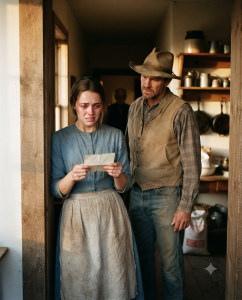
He took the paper from his coat and hesitated only once before unfolding it.
There were actually two letters. The first was from Mrs. Miller, written in a tone of righteous grievance. It claimed Emma owed the boarding house nine years of room, board, clothing, medicine, and instruction. It called her ungrateful. It warned Nathan that he was harboring a woman under financial obligation to another household and implied legal consequences if she was not returned.
The second was worse.
It was a copy of an agreement dated nine years earlier, witnessed by Aldis Briggs and signed not by Mrs. Miller alone but by Emma’s uncle, Josiah Brooks.
The paper described Emma, then fourteen, as being placed into the Miller household in exchange for settlement of an outstanding family debt. Her labor would stand in for repayment until costs were considered satisfied. Those costs, however, were to be assessed by the receiving household.
In plain truth, it meant Mrs. Miller could claim Emma owed her forever.
Emma read the agreement twice without fully seeing the words. Then her eyes fixed on the signature.
Josiah Brooks.
Her uncle had not turned her away after her father died because he lacked room. He had traded her. Perhaps not with the language a slaver would use in public, but the effect was the same. He had handed her years to other people and called it rescue.
“I was fourteen,” she said, voice thinned by disbelief.
Nathan did not insult her with false comfort. “I know.”
“How do you know?”
“Because I knew Briggs’s kind the moment I saw him. I asked a man in town after supper. He remembered the arrangement.”
Emma went pale but did not break. Nathan noticed that too. Many people, faced with proof of betrayal, would have collapsed into tears or denial. Emma became quieter, which was more dangerous.
Then footsteps sounded outside the storeroom.
A shadow stopped at the door.
A voice she had not heard in nine years said, “Now that you’ve seen the paper, Emma, you may as well hear what your family agreed to.”
Josiah Brooks had come to Carter Ranch in person.
Emma turned slowly. Her uncle looked older, heavier, and meaner around the eyes than she remembered. Men like him often wrapped cowardice in authority. He did it expertly.
“You should have stayed where you were put,” he said. “The Millers took you in when no one else would.”
Emma stared at him. “You sold my work.”
His expression hardened. “I settled a debt.”
“With my life.”
Josiah glanced at Nathan, perhaps hoping male sympathy would save him. “You know how these things are done.”
Nathan’s reply came flat and cold. “No. I know how thieves justify them.”
For the first time, Josiah faltered.
Aldis Briggs appeared behind him, smugness returned now that the confrontation was underway. He produced a ledger book Mrs. Miller had apparently kept over the years, full of charges so absurd they might have been laughable if they were not meant to imprison—three dollars for boots Emma never received, charges for medicine she had not been given, fees for ‘instruction’ in cooking and housekeeping, rent for a room little bigger than a closet. Interest had been added. Then more interest.
It was a fiction built to look like law.
Emma read enough to understand the trap. If Nathan yielded to respectability, he might send her back simply to avoid a dispute. If she protested alone, the town would likely side with the established household over a kitchen woman with no property and no family standing behind her.
Except she was not entirely alone now.
Nathan asked Briggs one question. “Did Emma ever sign this debt herself?”
Briggs smiled thinly. “She was a minor when placed.”
“That is not what I asked.”
“No.”
Nathan held out his hand for the ledger. Briggs hesitated, then gave it over. Nathan examined the pages, the dates, the witness marks. When he reached the end, he shut it with deliberate care.
“You are trespassing on my property while trying to enforce fraudulent claims against an employee under lawful contract,” Nathan said. “You will leave.”
Josiah scoffed. “You can’t simply dismiss—”
Nathan looked toward the door. Two ranch hands had already appeared, drawn by the raised voices. Both were large, both loyal, and neither looked inclined to debate legal theory.
“Leave,” Nathan repeated.
Briggs calculated faster than Josiah did. He touched the older man’s sleeve. “This isn’t finished.”
Nathan’s eyes stayed on him. “It is here.”
They left, but not quietly. Josiah muttered that Emma would regret public ingratitude. Briggs warned that papers had a way of traveling. Nathan waited until their horses disappeared in the dark before turning back toward the storeroom.
Emma was still standing where they had left her, rigid as a fence post.
He said her name once.
That did it.
Not the accusation, not the debt, not even the sight of her uncle—but the simple sound of her own name spoken without possession or contempt. She sat abruptly on the low stool by the flour bins and covered her face with both hands.
“I thought I had been forgotten,” she said from behind them. “I didn’t know I had been accounted for.”
Nathan crouched a few feet away, near enough to steady her if she wanted it, far enough not to presume. “None of that paper is right,” he said. “And none of it owns you.”
Her hands lowered slowly. Her eyes were dry again.
“People like them always win in town,” she said.
“Then we won’t keep this in town.”
The next morning Nathan rode to the county seat with the contract, copies of the letters, and two men willing to swear to Briggs’s reputation and Mrs. Miller’s habit of claiming credit for Emma’s work. He also found the minister who had conducted Emma’s father’s funeral years before. The minister remembered Josiah’s rush to settle debts and the unusual speed with which Emma had vanished into the Miller household. Then Nathan visited an aging bookkeeper who had once handled supply deliveries to the boarding house. He confirmed what anyone who looked closely could see: the Millers had prospered beyond what their own labor could explain in the years since Emma arrived.
By the end of the week, the legal question was no longer whether Emma owed a debt. It was whether Josiah Brooks and the Millers had conspired to exploit the labor of a minor under false accounting.
Red Creek shifted quickly once the right kind of attention found it.
Men who had eaten Emma’s food for years began recalling details. One remembered Mrs. Miller boasting she’d never had to pay for “that girl’s keep.” Another admitted Emma had once worked through a fever because Mrs. Miller refused to hire help. Clara Hatch, quiet and proud Clara, came forward to testify that Emma had regularly given away her own meals despite having almost nothing of her own to give. That mattered less legally than morally, but moral pressure has moved many communities faster than statutes.
Mrs. Miller tried outrage first, then tears, then claims of misunderstanding. Josiah insisted he had acted as guardian. Briggs vanished for two days before reappearing with suddenly weaker confidence. Under scrutiny, the ledger collapsed. Charges contradicted supply records. Dates overlapped impossibly. Items listed as purchased for Emma had never been bought at all.
The county clerk was not a heroic man, but he was vain about order and hated being made to look foolish by fraudulent paperwork. That, in the end, helped Emma more than anyone’s pity would have.
The debt was voided.
The contract with Carter Ranch stood.
A formal note of censure was issued against Briggs. Josiah, unable to pay certain penalties, sold off a strip of land outside town. Mrs. Miller kept the boarding house, but the stain never left it. Once people saw how long Emma had been carrying that business, they could not unsee it. Trade thinned. Compliments stopped sounding innocent.
Emma did not return to watch any of it.
She stayed at Carter Ranch and worked.
The six weeks passed. Then Nathan asked if she would remain for the autumn. She said yes. Later he asked if she would take over ordering for the winter stores as well. She did that better than anyone expected. By spring, the ranch house ran with a steadiness it had not known in years.
More surprising to Emma than the work itself was what grew around it.
The maids stopped treating her like an intruder and began treating her like the person who had made their days less chaotic. Ranch hands who once tested her instructions now obeyed them without argument because supper arrived hot and fair, and because Emma did not play favorites. Clara and her son visited one Sunday with a jar of preserves as thanks, though Emma insisted no thanks was needed. The child, healthier now, asked if the ranch always smelled like bread at dusk. Emma smiled and told him only on good days.
And Nathan?
Nathan remained careful.
He never used generosity as leverage. He never reminded her what he had done on her behalf. He asked opinions and listened to answers. Some evenings they sat on the porch after supper and spoke of inventory, weather, cattle prices, books neither had much time to read, and the odd ways people reveal themselves under strain. It was not dramatic. It was better than that. It was trust building in plain sight.
One evening, nearly a year after she first rode away from Miller’s, Nathan brought her a document.
Emma looked at him suspiciously. “More papers?”
“Better ones.”
It was a partnership agreement of sorts—not ownership of the ranch, but a formal share in the household and supply operations she had transformed into a profitable arm of the business. Her systems had reduced waste enough to matter. Her baking had become so well regarded among trail crews that neighboring ranches had begun placing orders for travel loaves and cured provisions.
“This is too much,” she said.
“It’s exact,” Nathan replied.
She read every line.
Then she looked up. “Why?”
His answer did not come fast, which made her trust it more. “Because credit should go where it’s earned. And because I’d rather build with you than merely employ you.”
Emma, who had once believed her life could be calculated in someone else’s ledger forever, felt something inside her loosen at last.
She signed.
They married the following year, though not because rescue turned into romance in some neat storybook way. They married because by then they knew each other’s character in storm and strain, in anger and exhaustion, in silence and truth. There was nothing sentimental about the decision. There was love in it, certainly, but also respect, which lasts longer when hardship comes.
Sometimes Emma still thought about the alley behind Miller’s Boarding House. About a hot skillet in her hands and a hungry child looking up as if hope were a thing you could smell.
That had been the moment the world shifted, though she could not know it then.
Not because a powerful man noticed her.
Because when no one was watching—so she believed—she had still chosen to be exactly who she was.
Years later, people in the county told the story differently depending on what they valued most. Some said Nathan Carter had discovered the finest housekeeper in Texas over a pan of cornbread. Others said a boarding-house cook had outworked every person who ever tried to use her. Clara said the real truth was simpler: Emma fed people before the world learned her name.
Maybe all of them were right.
But if you asked Emma which moment mattered most, she might have said it was not the court clerk voiding the debt, nor the day Mrs. Miller’s lies unraveled, nor even the afternoon she signed her own business papers with a steady hand.
It was the first time someone asked, with no ownership in his voice and no contempt in his eyes,
“What’s your name?”
And after everything that followed, after justice and grief and work and love, that question still carried its own aftershock.
Because the sharpest red flag in her whole story had never been hunger, or hard labor, or even poverty.
It had been all the years no one thought to ask.