Alma Figueroa had known for three days that her wedding dress was not really a wedding dress.
It was collateral.
The lace had belonged to her mother, altered twice by nervous hands that kept pretending this ceremony was a blessing. The pearls had come from a cousin who smiled too brightly. The shoes were borrowed. The veil had once been stored in cedar with dried lavender, and when Alma lifted it that morning, the scent made her think absurdly of funerals instead of brides.
No one in the family said the truth aloud, but it sat in every room of the old house like a fifth season.
The winery was collapsing.
For years the Figueroas had lived off reputation, pretending their labels still carried the power they had once held. The stone cellars, the tasting room, the rows of vines slipping over the hills under golden light—it all looked beautiful from the outside. Visitors still came for private tours. The family still wore elegant clothes to harvest dinners. They still spoke in the old language of tradition, legacy, and sacrifice.
But beneath the polished wood and polished smiles was rot.
Her grandfather had taken out loans against the land. Her father had altered inventory records to hide shortages and losses. Her uncles had delayed payments, sold future harvests twice, and lied to suppliers, creditors, and one another. By the time the bank’s last notice arrived, the debt was no longer a storm on the horizon. It was inside the house, seated at the table, eating with them.
Then came the proposal.
Don Ramiro Castañeda, owner of the neighboring vineyard, would inject enough capital to stop foreclosure, settle the most urgent claims, and keep the Figueroa winery from public humiliation.
In return, he wanted Alma.
Not publicly in those words, of course. Publicly it was called a merger of estates, a reconciliation between old families, a strategic union that would preserve local heritage. Her grandfather used those phrases with solemn pride, as if he were arranging peace after a war.
In private, when Alma said no, he did not bother with poetry.
“This family fed you, clothed you, educated you,” he told her. “You will do your part.”
Her father would not meet her eyes. Her uncles mumbled about necessity. Her mother cried but still fastened the dress at her back.
Alma stopped arguing not because she accepted it, but because she understood something terrible: no one intended to save her. They intended to spend her.
She had met Don Ramiro Castañeda only a handful of times before the engagement was announced. He was known in the region as a difficult, disciplined man. Older than Alma by decades, according to everyone’s whispers. A widower, some said. A recluse, said others. He rarely attended festivals, spoke little at public events, and never corrected the stories people told about him.
When he visited the estate after the agreement, he moved slowly, with the measured caution of a man carrying old injuries. His hair was silver. His face was deeply lined. His voice rough enough to sand wood. Alma had expected vanity or triumph in him, some visible satisfaction at taking the daughter of a ruined house as payment.
She found neither.
That unsettled her more.
He watched everything. The books her father kept stacked and hidden. The glance her grandfather gave certain workers. The panic under every smile at dinner. He never once treated Alma with tenderness, but he did not treat her like a prize either. He acted like a man sitting through a process already decided long ago.
At the wedding, that feeling deepened.
The chapel smelled of wax and old flowers. The guests came dressed in expensive fabrics and practiced curiosity. Everyone in the valley knew something desperate was happening; they just lacked the exact shape of it. Alma walked down the aisle as if moving through someone else’s nightmare, refusing to look at the faces in the pews until she reached the altar.
There stood Don Ramiro.
His expression was calm, almost weary. Not the look of a groom. The look of a man waiting for a door to open.
He spoke his vows evenly. Alma echoed hers. When the priest pronounced them married, applause broke out with suspicious speed, and Alma thought: They are relieved, not happy.
At the reception, the performance grew louder.
Her aunts praised providence. Her father drank too quickly. Her uncles laughed at jokes no one had made. Staff who had known Alma since childhood lowered their eyes when she passed. And then her grandfather rose with a crystal glass in one hand and declared, in a grand voice meant to travel, that the Castañedas and the Figueroas were finally laying old grievances to rest.
The room cheered.
Alma felt cold.
She had heard that voice before. It was the one he used when he lied so confidently that contradiction felt impolite. As a little girl she had watched him deny things that had happened right in front of people—missing shipments, broken promises, unpaid wages—and somehow make others thank him for clarifying. It was one of his gifts.
That night, after the guests drifted away and the music died, she was led to the old barrel house at the edge of the property. It was a romantic choice on the surface: private, historic, softly lit by firelight. But Alma knew the place too well. Thick stone walls. Narrow windows. Old wood beams overhead. A room built to keep temperature steady and secrets contained.
Don Ramiro entered behind her and locked the door.
The sound of the key turning landed in her spine.
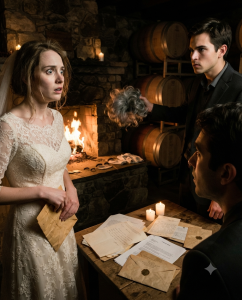
He did not approach her immediately. Instead he crossed to the fireplace where a servant had lit a tidy blaze, and he stood there silently for several seconds. Alma watched his reflection in the copper tools mounted above the hearth. Then, with absolute calm, he lifted both hands to his head.
The gray hair came off.
Alma stared as he removed the silver wig and tossed it into the flames. Fire seized it at once, twisting the false hair into black curls. Then he peeled away false brows and wiped at his face with a cloth, taking off shadows and lines that had deepened his cheeks. Before Alma’s eyes, age disappeared.
The man standing before her was not old at all.
He was young. Early thirties, perhaps. Hard-faced, yes. Tired in some older, inward way. But undeniably young.
Alma took one step back until she felt the edge of a table behind her.
“My name is Mateo Soria,” he said.
The name hit her like an echo from another room.
Soria.
She knew it.
Not from open conversation—no one in the Figueroa house spoke that name cleanly—but from fragments. Old workers calling a row of vines by a different surname before her father cut them off. Her grandmother going silent at the mention of neighboring parcels. A story about a woman who had once partnered with the family and then disappeared. As a child, Alma had tried to ask questions. Each time, the answers changed.
Mateo opened a leather portfolio and placed documents on the table.
Property records.
Copies of transfers.
A genealogical report.
DNA results with official seals.
And beneath them all, a contract tied to the marriage she had just entered.
“Your grandfather stole my grandmother’s vineyard while she was pregnant,” Mateo said. “He made her sign papers she thought formed a partnership. Instead, she signed away the land. When she realized what happened, she had no money to fight him. He left her ruined.”
Alma looked down at the papers as if one might suddenly blink and prove itself false.
But there, in ink she recognized immediately, was her grandfather’s hand.
The loops of his signature. The aggressive downward slash in the last letter. The same hand that signed Christmas cards and debt notices and angry instructions to staff. The same hand that had patted her shoulder that morning and told her she was saving the family.
A pulse started pounding in her ears.
Mateo tapped the marriage contract. “Your family knew the bank would close in. They also knew I’d been building this case for years. The contract gives me immediate legal leverage over the estate. One breach, one default, one missed condition, and everything tied to the original fraudulent transfer reverts.”
He looked directly at her.
“Everything.”
For a moment Alma could not speak. She thought of the family portrait in the hall, the one taken in front of the winery doors with harvest baskets at their feet. She had grown up under that portrait, under the idea that Figueroa endurance was noble. But what if endurance was just another word for refusing to surrender stolen things?
She should have defended them. Or denied knowledge. Or begged to be left out of a battle that started before she was born.
Instead, a strange calm rose in her.
Maybe because betrayal, once fully seen, leaves very little to protect.
Slowly she unclasped the emerald necklace at her throat, the heirloom her grandmother had worn and her mother had placed around Alma’s neck with shaking fingers. She held it for a second, then set it on the stone ledge beside the fire.
Mateo’s gaze sharpened.
“Then you don’t know the best part,” Alma said.
She reached into the inner pocket sewn into her skirt and removed an old envelope.
The paper was fragile, softened at the edges by years. It had been hidden in the false bottom of her grandmother’s cedar chest, beneath winter shawls and black mourning clothes no one had touched since the funeral. Alma had found it by accident two months earlier while searching for a title document her father claimed was missing. Instead she found letters tied with a faded ribbon and one note addressed only with a date.
She had read them alone in the attic and felt the floor of her life tilt.
“My grandmother knew who you were before she died,” Alma said.
Mateo did not move.
For the first time since revealing himself, he looked genuinely unprepared.
“She knew?” he asked.
“Yes.”
“Then why didn’t she come forward?”
Alma swallowed. “Because by the time she understood the full truth, she was afraid of what would happen if it came out.”
Mateo’s jaw tightened. “Afraid of me?”
“No.”
That answer landed harder than accusation.
Alma set the letters between them. Mateo hesitated only a second before opening the first one. His eyes moved over the first lines, then slowed. He read them again. Color began to leave his face.
“What does it say?” he asked, but his voice made clear that he already knew the words and simply could not trust them.
Alma had memorized them.
Your mother was not the one he betrayed first.
Mateo looked up sharply.
Alma forced herself to continue. “There were two women. Your grandmother lost the vineyard. But before that, my grandfather was involved with another woman connected to the estate. My grandmother discovered it after the papers were signed. She wrote that he lied to both of them, and when one of them became pregnant, he manipulated everything to hide whose child it was.”
Mateo’s hand tightened around the paper so hard Alma thought it might tear.
He opened the second letter with less care. This one contained names. Dates. Pleading. Her grandmother’s confusion turned gradually into horror as she realized the story her husband had constructed around the neighboring land dispute was also covering a paternity secret.
One sentence was underlined.
He cannot know whose blood he carries until the truth can no longer be buried.
The room went silent except for the fire.
Mateo stared at the line.
Then at Alma.
Then back at the line.
“My grandmother never wrote about my grandfather,” he said slowly. “She never named him. She never explained why we had to leave. She only said the Figueroas took what was ours and that one day I would need proof.”
Alma felt something terrible and inevitable assembling between them. “Maybe she couldn’t prove the most dangerous part.”
Mateo stepped back from the table as if distance might help him think. “If these letters are real, your grandfather didn’t just steal land.”
“No.”
“He built both families’ lives on a lie.”
“Yes.”
His voice roughened. “And your family arranged this marriage anyway.”
Alma looked at the contract beside the letters. “Maybe because they thought keeping you close was safer than letting you keep digging.”
That answer sat in the room like smoke.
Mateo crossed to the window, bracing one hand against the stone. Outside, the vineyards lay in moonlight, perfectly ordered, every row straight, every trellis deliberate. Land always looked innocent at night. People could spill generations of lies across it, and the vines still grew as if history did not matter.
“When did you decide not to destroy me with this?” Alma asked quietly.
He turned back. “I never wanted to destroy you.”
She almost laughed at the absurdity of that sentence spoken by a man who had just married her under a false identity and arrived armed with documents that could strip her family of everything.
“You used me.”
“Yes,” he said, with no attempt to soften it. “I did. I needed legal access, leverage, and proximity. Your family would never have allowed anything else.”
That honesty was uglier than a lie, but cleaner.
“And now?” she asked.
Mateo looked at the letters, then at the necklace by the fire, then at the face of the woman the Figueroas had offered him as settlement.
“Now I think your family may have trapped both of us in something they hoped neither of us would survive.”
They spent the next hour reading.
Letter by letter, Alma’s grandmother unfolded a history of fraud, coercion, and fear. The old vineyard transfer had indeed been presented as a partnership to a pregnant woman who trusted the wrong man. But that betrayal ran parallel to another secret: a concealed relationship, a disputed child, and a frantic effort to keep the neighboring estate and the Figueroa household from ever comparing dates too closely.
By the final pages, one thing was clear.
Her grandfather had known there was a risk that Mateo’s existence could expose more than theft.
He could expose blood.
Near dawn, they went to confront him.
The old man was in his study, already dressed, as if he had not slept. Perhaps he had expected tears or outrage. Perhaps he had expected Alma to submit quietly and Mateo to proceed according to some script of greed and revenge.
He did not expect them together.
His eyes fell first on Mateo’s unmasked face. Then on the letters in Alma’s hand. The change in him was instant. Not surprise. Recognition.
Pure, naked recognition.
“So,” he said slowly, sinking back into his chair, “she kept them.”
Alma felt her stomach twist. “You know exactly what they say.”
He ignored her and looked at Mateo. “I wondered when you’d stop hiding behind that old man’s face.”
Mateo took one step forward. “Tell me the truth.”
Her grandfather smiled without warmth. “Truth is a luxury for people who don’t build anything.”
Alma had heard many cruel things in that study over the years, but never one that stripped a person so cleanly.
“You stole from his family,” she said.
“I preserved what weak people would have lost.”
“You lied to everyone.”
“I did what men do when the alternative is ruin.”
Mateo’s hands curled at his sides. “Am I his grandson,” he asked, “or your son?”
The question tore through the room.
For the first time, the old man’s composure cracked.
It was small. A twitch near the mouth. A narrowing of the eyes. But Alma saw it. So did Mateo.
Her grandfather stood slowly. “Your grandmother should have kept silent to the grave.”
“That isn’t an answer,” Mateo said.
The old man looked at Alma then, and the hatred in his face made her feel colder than she had at the altar. “You should never have gone through your grandmother’s things.”
“Answer him.”
He didn’t. Instead, he turned to the desk drawer and removed an envelope of his own.
Inside was a copy of a medical report.
Mateo snatched it first. Alma moved beside him to read.
It was old. Older than both of them had expected. Signed by a physician now dead. It referenced a fertility injury her grandfather had suffered years before the date of Mateo’s birth. Years before, as the note made brutally clear, he could have fathered any child at all.
Alma read it twice.
Then a third time.
Her grandfather had stolen the vineyard.
He had ruined a pregnant woman.
He had let another family believe he might have been the father to keep fear alive and questions buried.
And all the while, he had known he could not have been.
Mateo looked up slowly. “Then who—”
The answer came not from the old man, but from the doorway.
Alma’s grandmother’s brother, Tomás, stood there with her father behind him, pale and wrecked. Tomás had lived in a small house on the far side of the property for years, dismissed by the family as bitter, unstable, forgetful. No one listened when he spoke. Alma suddenly understood why.
Tomás looked at Mateo with wet eyes.
“Because it was me,” he said.
The room seemed to lose all sound.
Alma turned so sharply she nearly dropped the letters.
Tomás crossed the threshold with the stumbling dignity of a man who had rehearsed a confession in silence for decades and hated himself more each time. He had loved Mateo’s grandmother when they were young, he said. Her grandfather found out. When she became pregnant, panic spread. The Figueroa patriarch saw an opportunity. He forged the land papers, forced distance between them, threatened scandal, and used Tomás’s cowardice to keep everyone obedient. Mateo’s grandmother was pushed out with nothing. Tomás let it happen. The old man took the vineyard and controlled the narrative. Everyone got trapped inside the version of events he found most useful.
Mateo listened without interruption, which was somehow more devastating than rage.
“So all these years,” he said finally, “you knew.”
Tomás nodded once and broke.
Not dramatically. Not loudly. Just a quiet collapse of shoulders that looked like punishment arriving late.
“I knew enough,” he whispered. “Not everything at first. But enough. And every year it became harder to speak because by then your life had already been built on one lie and ours on another.”
Alma’s father sank into a chair and covered his face. He had known part of it too, it turned out. Not the paternity, but the fraud. Enough to understand the estate was poisoned from the beginning. Enough to keep falsifying records because if the books ever opened fully, the past would come with them.
The dawn light slowly entered the room, pale and merciless.
There was no dramatic shouting after that. No one had the strength. Truth did what storms do when they finally arrive: it stripped everything decorative first.
The legal consequences unfolded over months.
The fraudulent transfer was overturned. The vineyard that had been stolen from Mateo’s grandmother’s line was restored to his name. The Figueroa winery did not disappear entirely, but it was carved down to what could honestly be defended. Her grandfather faced public disgrace before he died, which Alma considered kinder than he deserved. Her father and uncles negotiated settlements instead of prison by surrendering records and property. The family name survived, but not as legend. Only as a warning.
And Alma?
At first she stayed because leaving would have felt like another form of exile. Then she stayed because for the first time, the land around her was being spoken of truthfully. She and Mateo did not become a love story overnight. Too much had happened for that kind of fantasy. Their marriage began as coercion, strategy, and revenge, and both of them respected reality too much to rename it tenderness just because the worst secrets had surfaced.
But truth creates its own strange intimacies.
They spent weeks untangling records, reading letters, interviewing workers who had been dismissed for remembering too much, walking parcel lines at dusk, learning where one family’s false history ended and the real one began. Sometimes they fought. Sometimes they sat in silence. Sometimes Alma saw in Mateo’s face the child who had grown up on fragments and fury. Sometimes he saw in her the woman who had been traded by men who preached honor.
One evening, months later, Alma found the emerald necklace in a drawer where she had left it after the wedding night. She turned it over in her hand for a long time before closing the drawer again.
Some inheritances are too heavy to wear.
The marriage contract was eventually rewritten into something neither of them had chosen first, but both signed willingly in the end. Not because the past had become romantic. Not because forgiveness erased what had been done. But because together they had looked directly at the ugliest thing in both families and refused to keep feeding it.
And in the valley, people still argued about who was most to blame.
The old man who started it.
The coward who stayed silent.
The sons who protected the lie.
The daughter who exposed it.
Or the man who came back wearing another face to reclaim what had been taken.
Maybe the real answer was simpler and harder: the first unforgivable act was the theft, but the deepest rot came from everyone who found a reason to live comfortably beside it.