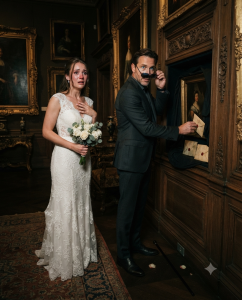
Her family forced Inés to marry a blind collector to save their bankrupt museum, but the moment he opened his eyes in the dark and walked straight to the painting hidden behind the wall, she understood he had never come for art.
He had come for the truth.
The wedding took place beneath a ceiling painted with saints, gold leaf, and false devotion.
Every guest who entered the museum that afternoon looked upward first, as they always did. That was part of the family’s design. Make people admire the grandeur before they notice the cracks. Let them be dazzled before they begin asking where the money came from, why the museum’s acquisitions moved through so many private hands, or why several works had histories that became strangely vague before arriving in the collection.
Inés had grown up under that ceiling.
As a child, she used to think the saints looked tired.
By the time she was old enough to understand debt, reputation, and the violence polite families commit behind velvet curtains, she knew exactly why.
The museum had never belonged to the public, no matter how often her aunt said otherwise. It belonged to the family name. It was their altar, their shield, their inheritance, and their most profitable lie. People in the city called it a cultural treasure. Donors called it a legacy. Journalists called it historic.
Inside the family, no one called it what it really was: leverage.
Inés’s parents had died when she was young, leaving her in the care of her aunt Emilia, who took over both the museum and the household with the same style of affection: elegant, cold, and impossible to refuse. Emilia believed in image the way priests believe in salvation. She wore discipline like perfume. She never raised her voice in public. She never made a threat she couldn’t disguise as advice.
From the beginning, she trained Inés to understand value.
Not moral value. Market value.
Who mattered, which names opened doors, which critics could be bought with access, which collectors could be manipulated with scarcity, which restaurateurs talked too much after drinking, which politicians needed to be seated next to donors, which paintings needed to disappear for six months before returning with a cleaner story.
By twenty-eight, Inés knew how to guide patrons through the galleries with grace, how to speak about artistic schools and historical movements, how to smile during fundraising dinners, and how to recognize fraud without being allowed to name it.
She also knew the museum was in danger.
For the last year, invoices had gone unpaid. Insurance claims had become frantic. Private lenders had started asking for meetings. One restorer resigned without warning after a screaming fight behind closed doors. Then an auditor requested provenance files on a group of early works, and the whole house changed temperature.
Her cousin Tomás, who handled “special acquisitions,” stopped joking entirely. Lawyers began coming and going through the side entrance. Emilia started sleeping at the museum two nights a week. Boxes of old records were moved from the archive to the private wing.
Nobody explained anything.
They didn’t need to.
In families like theirs, silence was the explanation.
Then one evening, Emilia invited Inés into her office, poured tea she had no intention of drinking, and said, “You are about to do something meaningful for all of us.”
That was the moment Inés knew her life had already been decided.
The name Aurelio Montalbán was introduced like a miracle.
A private collector. Extremely wealthy. Almost mythically discreet. Blind for years, according to every profile written about him. Known for acquiring entire collections and keeping them out of spectacle. A man who avoided press, avoided crowds, avoided scrutiny. Emilia described him as cultured, generous, and uniquely positioned to stabilize the museum.
Tomás described him with even less humanity.
“He’s exactly what we need.”
When Inés asked what that meant, neither of them answered directly. They spoke instead of alliance, continuity, prestige, and mutual benefit. Then came the paperwork. Legal structures. Financial transfers. Quiet emergency funding contingent on marriage.
Not courtship.
Marriage.
Inés told them no.
Emilia let her finish, then said, “The museum survives because people in this family understand when sacrifice is necessary.”
It wasn’t framed as coercion. It never was. It was framed as duty. Gratitude. Legacy. The family had raised her, educated her, given her status, purpose, and a name that meant something in the city. Now the family required something in return.
Inés recognized the technique because she had seen it used on everyone.
Guilt was their preferred currency.
So the engagement was announced.
The city applauded. Society pages called it an extraordinary union between old cultural prestige and modern collecting power. Donors who had been growing skittish suddenly relaxed. Two creditors agreed to delay action. A board member who had threatened resignation publicly praised Emilia’s “vision.”
The museum was already benefiting from Inés’s silence before she even reached the altar.
She met Aurelio only twice before the wedding, both times in carefully staged settings. He arrived with dark glasses, a cane, and an assistant who described the room in soft tones, though not often enough to be useful. Aurelio spoke politely and very little. He asked her almost nothing personal. His voice was controlled, expensive, unreadable.
But Inés noticed odd details.
He sat without feeling for the chair.
He turned toward sounds with exactness that felt practiced rather than instinctive.
And once, when a server nearly dropped a tray behind him, he flinched before the first glass hit the floor.
She carried that detail with her all the way to the ceremony.
The wedding itself was a masterpiece of hypocrisy. White flowers framed canvases whose histories no guest would have trusted if they had known where to look. Critics, patrons, magistrates, and smiling benefactors filled the central hall. Emilia glowed. Tomás hovered near the legal team. Musicians played softly beneath the frescoed ceiling.
Aurelio stood waiting, elegant and composed, his cane resting lightly against his leg.
Inés approached him feeling less like a bride than an object being transferred between display cases.
When it came time to exchange rings, his hand found hers immediately.
Too immediately.
No hesitation. No searching. No error.
A man who could not see should have missed by a fraction. He didn’t.
By the time the guests rose to applaud, Inés was certain of only one thing: her new husband was lying about something fundamental, and he had come into her family’s world with his own secret hidden under perfect tailoring.
At the reception, Emilia spoke of salvation.
She stood under a portrait of the museum’s supposed founder and thanked everyone for supporting “the continuation of a cultural mission larger than any individual.” The phrase made several people emotional. It almost made Inés sick.
Across the room, she caught sight of Tomás sliding loan documents toward a banker while the champagne was still flowing.
That was the truth of the evening. No one was celebrating love. They were refinancing panic.
Aurelio spent much of the dinner listening more than speaking. Once or twice, he angled his face toward Emilia when she mentioned a specific gallery wing. Another time, he traced the stem of his glass while Tomás muttered about restricted access rooms and updated security routes.
He was collecting information.
By the end of the night, Inés no longer wondered whether he was blind. She wondered what exactly he had come to find.
The answer arrived after midnight.
Emilia instructed a maid to escort the couple to a private room off the central gallery, a richly appointed space reserved for confidential meetings with major patrons. Emilia called it a gesture of trust.
Inés knew the room well enough to distrust the word immediately.
The walls were lined with silk panels and decorative molding. One cabinet held old catalogs. Another concealed a safe no one mentioned. The room adjoined the gallery displaying some of the museum’s earliest and most disputed acquisitions.
When the door closed behind them, the silence changed.
Aurelio set down the cane.
Then he removed his glasses.
His eyes met hers directly.
Inés didn’t speak. She didn’t gasp. She simply watched him with the stillness of someone who has finally caught a lie by the throat.
He took one more step and lifted opaque contact lenses from his eyes.
“My name isn’t Aurelio Montalbán,” he said.
His voice was no longer soft. It had stripped itself down to something clean and severe.
“I’m Nicolás Vera.”
The name meant nothing to her at first. Then everything.
Vera.
There had been whispers years ago. A collector’s widow. A contested inheritance. Claims dismissed for lack of documentation. Emilia once called it “an unfortunate misunderstanding created by grief.” Tomás had referred to it as “garbage from people who don’t understand provenance law.”
Inés had been too young then to know which details mattered.
Now Nicolás walked to the far wall without hesitation, pressed a thumb to one precise point in the carved trim, and a hidden panel sprang open.
Inside were a small wrapped painting and several sealed envelopes.
Inés’s pulse turned sharp.
She had seen that compartment once before, by accident, when Emilia had left the room unlocked and believed the house asleep. The memory came back whole now: Emilia standing in the glow of a single lamp, removing a painting no larger than a ledger book, pressing her mouth to its surface, and whispering something Inés hadn’t been able to hear.
Not admiration.
Possession.
Nicolás unwrapped the canvas.
The portrait was exquisite and intimate, painted with a tenderness unlike the museum’s more famous works. In one corner was a signature Inés recognized from disputed files and buried references.
“This belonged to my mother,” Nicolás said. “Along with the works your family used to build this museum’s prestige.”
He laid the painting down with care and opened the envelopes.
Document after document covered the table. Original ownership certificates. Appraisals with handwritten corrections. false donation papers routing works through intermediaries. Bank transfers to shell entities. Letters between Emilia and legal consultants discussing how to “stabilize” provenance before public acquisition. A signed statement from a frightened former registrar retracting an earlier objection.
Inés looked at the paper trail and felt the museum around her transform in her mind. Every polished gallery. Every donor plaque. Every guided tour. Every speech about stewardship. All of it stood on top of this.
“My mother died nine years ago,” Nicolás said. “Within months, the collection she spent her life protecting began appearing in fragments under other names. Whenever anyone challenged the paperwork, they were buried in expert opinions and procedural delays. I followed the transfers until they ended here.”
“You came as a husband to get into one room,” Inés said.
“I came as whatever your family would trust.”
That landed exactly where it was meant to. There was no apology in it. But there was no cruelty, either. Only fact.
He had used the same logic Emilia used on everyone else: identify the weakness, wear the right mask, and walk through the door.
Inés should have hated him for that.
Part of her did.
Another part understood, with painful clarity, that if he had come openly, the truth would have been buried again by morning.
“If you take those,” she said, looking at the painting, “the museum collapses.”
Nicolás met her eyes. “Good.”
He expected resistance after that. She could see it in the way he squared himself slightly, ready to protect the evidence, ready perhaps to push past fear or loyalty or outrage.
Instead, Inés turned back to the hidden panel.
There was one more recess behind the frame. A narrower slit. Emilia had always checked only the obvious compartment. Years ago, curious and lonely and tired of being treated like furniture, Inés had explored the wall after witnessing Emilia’s secret ritual. Her fingers had found the second space by accident.
She had never told anyone.
Now she reached into it and withdrew a flat envelope gone slightly soft with age.
Nicolás’s eyes narrowed. “What is that?”
“The part they hid from everyone,” she said.
She opened it on the table.
Inside were names.
Judges. Curators. Sponsors. Board members. Two former culture ministers. A museum association president. A private conservator known for authenticating major European works. Next to each name were amounts, dates, favors, or brief notations in Emilia’s hand. A payment routed through a donor foundation. A promised exhibition. A nephew placed in a law firm. A vacation home “borrowed.” A complaint delayed. An inquiry redirected. An affidavit rewritten.
At the bottom lay a photograph from a private dinner. Emilia, smiling. Three patrons smiling back. A judge lifting his glass. On an easel behind them, partially visible but unmistakable, stood the supposedly nonexistent painting from Nicolás’s mother’s collection.
On the back, in Emilia’s handwriting, were four words: Settled. No further risk.
Nicolás said nothing for several seconds.
“This is bigger than theft,” he said at last.
Inés almost smiled, though there was no humor in it. “You thought you were tearing down one woman. You’re holding up part of the city.”
A soft sound in the hallway cut through the room.
Both of them turned.
A footstep. Then stillness.
Nicolás swept the most critical documents into an inner pocket. Inés kept the photograph in her hand.
The door handle moved a fraction, then stopped.
Tomás.
She knew the rhythm of his hesitation. He never entered a room until he had already guessed what version of himself would be most useful on the other side.
“Inés?” he called through the door, too casually. “Everything all right?”
Her heart pounded once, hard, then settled.
Nicolás looked at her, waiting.
It struck her then that this was the real wedding vow of the night. Not the one spoken in front of the guests, but this private choice between silence and consequence.
She crossed to the door and opened it.
Tomás stood there in his half-undone tie, one hand still raised as if he had been about to knock. His gaze flicked to Nicolás, then to the discarded cane, then to the glasses on the table, then to the papers spread across the room.
His face drained of color.
For one naked second, no one moved.
Then Tomás recovered enough to sneer. “You don’t understand what you’re looking at.”
Inés held up the photograph.
“I understand this,” she said.
He took one step forward. “Give me that.”
Nicolás moved between them instantly, and the motion was so fast, so unhesitating, that Tomás finally accepted the full reality of the deception.
“You,” Tomás said, staring. “You’re not blind.”
“No,” Nicolás replied. “Your family just hoped truth was.”
Tomás’s expression hardened. “You have no idea what happens if those leave this building.”
“I do,” Inés said.
He looked at her then with something close to disbelief. “Inés, think carefully. Emilia did all this to preserve what belongs to us.”
Us.
The oldest lie in the family.
As if she had ever really been included except when a sacrifice was required.
“What belongs to you?” she asked quietly. “The museum? The money? The borrowed prestige? Or the bodies you buried under certificates?”
Tomás’s jaw clenched. “You are being emotional.”
There it was. The final insult. Reduce. Dismiss. Reframe the truth as instability.
Inés stepped closer until they were almost face to face.
“You sold me tonight,” she said. “So don’t talk to me about stability.”
For the first time in his life, Tomás had no smooth answer. His eyes darted to the photograph, to the envelope, to Nicolás, calculating routes out of disaster.
That was when Emilia appeared at the end of the corridor.
She had not dressed for bed. Of course not. Emilia never slept on nights she thought history might move without her permission. She took in the scene in one glance: the open door, Tomás’s panic, Nicolás standing unmasked, Inés holding evidence.
She did not gasp. She did not rage.
She smiled.
A small, devastating smile that belonged in the presence of enemies, not family.
“So,” she said, stepping forward. “Now we can stop pretending.”
Nicolás’s posture went rigid. Inés felt the old instinct to shrink under Emilia’s gaze, but it passed almost immediately. Too much had been exposed to go backward now.
Emilia looked first at Nicolás. “Your mother should have sold when she had the chance. Sentiment ruins intelligent people.”
Something changed in Nicolás’s face then, a wound briefly visible beneath all his control.
Emilia turned to Inés. “And you. After everything I gave you.”
The words should have hurt. Instead they clarified everything.
Love had never been the price of loyalty in this family. Debt had.
“You gave me a costume,” Inés said. “Tonight I’m done wearing it.”
Emilia’s eyes chilled. “If those papers go public, half the institutions in this city go down with us. Judges, collectors, ministries, foundations. You think the truth makes you righteous? It makes you dangerous.”
“No,” Nicolás said. “It makes us finished.”
Emilia looked at him almost pityingly. “You still think this ends with documents. It doesn’t. It ends with who the public is willing to believe.”
She was right about one thing. Paper alone was not enough. Not against people who had spent years manufacturing legitimacy.
But Inés still held the photograph.
And the note.
And the list.
And, suddenly, something more powerful than proof: witnesses who no longer feared each other more than the family.
Tomás lunged.
Not far. Not successfully. Just enough to snatch for the photograph.
Inés moved back. Nicolás caught Tomás’s wrist and shoved him away. A lamp crashed into the wall, shattering the quiet of the corridor. Somewhere deeper in the museum, a guard shouted.
Emilia’s perfect composure broke at last.
“Stop them!” she snapped.
But it was already too late.
Footsteps thundered toward the hall. Staff. Security. Two board members who had stayed late in the private lounge. Faces appeared one by one, drawn by the noise, by the raised voices, by the sight of the museum’s untouchable director standing in the corridor with terror in her eyes.
Inés lifted the photograph high enough for everyone to see.
“This museum was built on stolen work,” she said, louder than she had ever spoken in her life. “And there are records naming everyone who helped hide it.”
Silence dropped like a blade.
Emilia moved to speak, but Nicolás was faster. He spread several of the documents across a console table beneath the corridor lights. Original certificates. Transfer records. Emilia’s notes. The image of the private dinner with the painting behind them.
People leaned in.
They didn’t need a speech. Fraud has a smell. Once it reaches open air, everyone recognizes it.
One board member sat down without meaning to. Another whispered, “My God.”
Tomás tried one last time. “These were planted.”
“In your mother’s handwriting?” Inés asked.
No one answered him after that.
The authorities arrived before dawn.
By noon, the museum was sealed pending investigation. News spread faster than Emilia had imagined possible. Journalists published the wedding photographs beside the first leaked allegations, turning the family’s triumphant spectacle into a national scandal overnight. Creditors withdrew support. Board resignations began. A judge named in the documents abruptly recused himself from three active cases. Former staff members came forward with stories they had buried for years.
And because rot invites confession once the first wall cracks, more evidence followed.
Not all of it from Nicolás.
Not all of it from Inés.
There had been others waiting for permission to tell the truth.
The painting was returned to Nicolás as part of the growing legal process surrounding his mother’s estate. Additional works were identified and removed from disputed galleries. Emilia was charged, though she kept her back straight even when cameras surrounded her. Tomás tried to negotiate, then tried to disappear, then finally began naming people when he realized he had been considered expendable all along.
As for the museum, it did not survive in the form the family had worshipped.
The institution was dissolved, restructured, and stripped of the dynasty that had used it as a mask. Some argued it should have been closed forever. Others believed the public deserved to reclaim what corruption had poisoned. The debate lasted months and never fully ended.
Inés testified.
So did Nicolás.
The marriage was annulled, of course. The legal absurdity of it became one of the scandal’s most repeated details: a bride traded to preserve a lie, and a groom disguised to expose it. The press treated it as sensational. Strangers treated it as myth.
For Inés, it felt simpler than that.
It felt like the first honest thing her family had ever forced her into.
Months later, she stood in a temporary conservation space where several recovered works were being cataloged for restitution. Nicolás was there, sleeves rolled up, arguing quietly with an archivist about climate controls. He looked different without the disguise. Younger in some ways. More tired in others.
He noticed her and stopped.
Between them lived too many things to call the silence comfortable: deception, rescue, fury, grief, alliance.
“Do you regret it?” he asked.
She knew he meant all of it.
The wedding. The exposure. The collapse. The lives ruined. The family destroyed.
Inés thought of Emilia’s smile in the corridor, of Tomás calling her emotional, of the hidden painting kissed like a relic, of the photograph labeled no further risk, of the moment she chose to hand over the second envelope.
“No,” she said. Then, after a pause: “I regret how long I thought survival meant obedience.”
Nicolás looked at her for a long time before nodding.
That was all.
No dramatic reconciliation. No easy redemption. Some stories do not heal neatly after the truth. They simply become livable.
Still, when Inés left that evening, she passed a covered canvas waiting to be transported back to its rightful collection. For a moment she rested her hand against the crate and thought about what her family had always believed.
That art could outlast people.
They were wrong.
What outlasted people was what they did to protect power, and what others finally dared to reveal.
The museum fell because too many hands had held it up for the wrong reasons.
And in the end, the question that remained was not whether Emilia deserved forgiveness, or whether Nicolás had gone too far, or whether Inés should have protected her own blood.
It was simpler, and harsher, than that:
How many crimes start to look like culture when enough important people agree to frame them beautifully?