They dressed Renata Ferrera like a peace offering.
By the time the last pin was slid into her hair and the veil was lowered into place, she no longer looked like herself. She looked like a polished answer to a problem created by men with old grudges, expensive lawyers, and bloodless smiles.
The mirror in front of her reflected a bride in ivory silk, diamonds at her throat, a waist cinched tight enough to make breathing feel ceremonial. Behind her, three women moved quietly around the room, adjusting fabric, smoothing lace, stepping back to admire the result. No one asked how she felt. No one needed to. In her family, feelings were decoration. The useful things were signatures, appearances, and timing.
Her stepmother, Verónica, stood near the doorway with her arms folded. “You should be grateful,” she said, her tone calm, practical, almost gentle. “Most women in your position wouldn’t get this kind of ending.”
Renata kept her eyes on the mirror. “This isn’t an ending.”
Verónica tilted her head. “Then don’t make it a beginning you regret.”
There it was again—that peculiar strain of pity Verónica had perfected over the years. It was not love. It was not kindness. It was the expression people wore when they were relieved that the sacrifice on the altar was someone else.
Renata said nothing. She had learned long ago that silence made people careless.
Outside the dressing room, the estate pulsed with wedding-day choreography. Florists rushed through halls. Security moved discreetly at the edges of every corridor. Staff carried champagne and crystal as if the fate of two corporations depended on whether a single glass caught the light correctly. In a way, it did.
The Ferrera Group was sinking, though only the people closest to the rot fully understood how badly. Her grandfather had gambled too aggressively. Her father had hidden liquidity problems beneath short-term rescues and private borrowing. Several divisions were operating on prestige rather than profit. What remained of the family’s power survived because no one wanted to be the first outsider to say, publicly, that the empire was bleeding out.
The Belmontes knew. Of course they knew.
That was why this marriage existed.
A week after the alliance was proposed, Renata had overheard her father say, “We need the appearance of stability long enough to renegotiate exposure.” Her grandfather had replied, “Then she’ll marry him. We are not losing everything because the girl wants principles.”
The girl.
That was what they called her when they wanted to erase the fact that she was a person.
By noon the chapel was full.
The Belmonte estate was the kind of place built to remind visitors that wealth could outlive affection. Stone arches, antique wood, family portraits with predatory eyes. The guests filled the pews in careful gradients of influence—bankers, board members, political intermediaries, society women who collected scandals the way others collected art.
At the front, seated beside his mother, was León Belmonte.
He was more striking in person than in photographs, though not in any way that made Renata feel calmer. His dark suit was cut perfectly. The brace beneath it forced his posture into rigid control. A wheelchair, sleek and discreetly expensive, framed him with an image of disciplined tragedy. His expression gave nothing away.
Months ago, the gossip had started: an accident, a degenerative condition, some private collapse. By the time the engagement was announced, León had become a story people told in lowered voices—a once-ruthless heir reduced to reclusion, fury, and physical dependence.
When Renata reached the altar, he looked up at her.
And in that one second, she felt something slip.
Not romance. Not recognition.
A warning.
His gaze was too sharp for a man numbed by defeat. Too alert. Too deliberate. He looked like someone listening to hidden machinery inside a wall.
The ceremony moved forward. The officiant spoke about unity, legacy, and the noble strength of families willing to bridge old divisions. Renata repeated her vows clearly. León repeated his in a voice low and even, the words precise enough to sound rehearsed and meaningless at once.
When he placed the ring on her finger, his hand brushed her skin. It was warm. Steady. Stronger than she expected.
She noticed.
She noticed everything.
That his shoulders never sagged with the fatigue people claimed he lived with. That the blanket over his legs seemed less like necessity than concealment. That his hands, resting calmly in public view, sometimes tightened with controlled force, as if resisting an instinct to move.
But noticing had never saved anyone in the Ferrera family. It only taught you how much danger could fit inside a beautiful room.
The reception took place in the glass hall overlooking the estate gardens. News cameras were kept outside the gates, but selected photographs would be released later: the happy union, the healed rivalry, the promise of mutual strength. Inside, no one spoke openly about the debts, the board pressure, the lawsuits waiting to bloom if this alliance failed.
Her grandfather, Esteban Ferrera, was in his element. Silver-haired, elegant, smiling with the confidence of a man who had ruined people for decades and mistaken survival for righteousness. He moved through the crowd like a king returning from war. Men laughed too loudly at his jokes. Women leaned in when he spoke. Everyone who mattered understood he was dangerous. Most chose to call that impressive.
When it was time for the toast, he raised his glass and drew Renata to his side.
“To my granddaughter,” he said, “the bridge between two empires.”
Applause followed. Flashing smiles. Crystal chimes. Renata felt every eye in the room slide over her, evaluating the fit of the narrative. Bridge. Alliance. Future. She had never felt less human.
Her father kissed her forehead after the toast, already half drunk. “You did the right thing,” he murmured, though his relief sounded indecently close to gratitude for a debt someone else had agreed to pay.
Verónica’s embrace came next, perfumed and cold. “It will settle,” she whispered. “These things always do.”
Renata nearly pulled away. Verónica’s compassion was too polished to trust. It felt staged, like an emotion practiced in a mirror.
Across the room, León watched the exchange without expression.
All evening he remained restrained. He answered questions in short sentences. Accepted congratulations. Allowed attendants to manage his movements. But every so often, when the crowd shifted and no one was directly observing them, Renata caught his eyes on her.
Not admiring.
Assessing.
Waiting.
Hours later, when the formalities finally thinned and the oldest relatives were ushered toward cars and guest suites, the newlyweds were led to the tower suite reserved for Belmonte heirs.
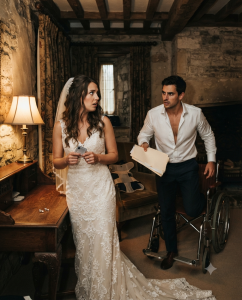
The room was unlike the modern luxury below. It belonged to a different era of the house—stone walls, carved beams, heavy curtains, the smell of old cedar and locked histories. There was a bed large enough to dwarf the room and a fireplace dark with disuse. One lamp burned near a writing desk. Everything else sat in amber shadow.
A maid set down a tray, bowed her head, and left. The door shut behind her. Another click followed.
The sound was final.
For one long second, neither Renata nor León spoke.
Then he reached back, turned the lock himself, and wheeled toward the center of the room.
Renata set down her bouquet.
León exhaled once, as if something tedious had finally ended.
Then he stood up.
No hesitation. No dramatic struggle. No awkward attempt to hide effort.
He stood with terrifying ease.
Renata’s body reacted before her mind did. She stepped backward, her pulse slamming hard enough to make the room tilt for a second.
He unfastened the orthopedic brace beneath his shirt and tossed it aside. Without it, he seemed taller, more dangerous, unmistakably alive in a way the carefully disabled public version of León Belmonte had never been.
“Don’t scream,” he said.
She stared at him. “You can walk.”
“Yes.”
“Then who the hell are you?”
He crouched in front of the wheelchair and pressed his fingers under the seat. A hidden panel released with a click. From inside he withdrew a sealed leather folder.
When he stood again, his face had changed. It was not merely that he was no longer pretending to be injured. It was that the man behind the injury had no reason left to soften anything.
“My name is Bruno Salcedo,” he said. “León Belmonte exists on paper, in board records, in photographs, and in enough legal structures to pass scrutiny. But that’s not who I am.”
The name hit her with a dull flash of memory.
Salcedo Holdings.
A company her grandfather had once called “a necessary lesson.”
She felt sick.
Bruno crossed the room and handed her the folder. “Open it.”
Inside were contracts drafted with surgical precision. On the surface, everything looked like standard alliance architecture—marital asset protections, voting contingencies, emergency control conditions. But underneath, hidden in the layered language, was the real design. Trigger clauses. Proxy transfers. Quiet consolidations routed through trusts and back-channel instruments. Enough to strip Esteban Ferrera of effective control once the right signatures and filings were activated.
“This marriage,” Bruno said, “was the delivery system.”
Renata kept reading, forcing her breathing to stay even.
He continued, his voice flat in the way truly old anger often is. “Your grandfather destroyed my family. He bought our executives one by one, collapsed our credit, fed regulators selective information, and pushed us until there was no way out except a sale we could never survive. My brother fought him. My brother found proof. Then there was a car crash. Officially, it was driver error. Unofficially, everyone who mattered was paid enough to stop asking questions.”
“Your brother is alive?” Renata asked.
“In a coma.”
The words landed like stones.
“I came back to do what he can’t,” Bruno said. “I built a version of León Belmonte your family would trust just enough to complete this deal. Sick enough to disarm suspicion. Bitter enough to be believable. Powerful enough to make the marriage seem worth the humiliation.”
He was watching her closely now, waiting for revulsion or outrage or some reflexive defense of her family name.
Instead, Renata closed the folder, reached up, and removed one diamond earring. Then the other. She laid them on the desk with deliberate care.
Bruno frowned.
“My grandfather has destroyed more lives than you know,” she said. “You made one mistake.”
He said nothing.
“You assumed I came here to save him.”
The silence that followed was different from the ones before. Not empty. Charged.
Renata turned slightly and slid her fingers into the hidden seam inside her gown. She had stitched the pocket herself two nights earlier, while everyone around her had been busy deciding how much obedience could be sewn into a bridal silhouette. From the seam, she withdrew a slim electronic key.
Bruno’s eyes dropped to it instantly.
“What is that?”
“Insurance,” she said.
She told him about the mirror accounts. About the shell entities her grandfather used when ordinary laundering routes became too visible. About the private vault in the south wing beneath the old archive room. About the way money vanished from one bleeding division only to appear months later inside obscure trusts connected to dead subsidiaries. She had not always known what she was seeing, but years of silence had sharpened her. People ignored her so thoroughly that they often spoke in front of her as if she were furniture.
Her father, drunk and angry one night, had muttered that Esteban kept “the real spine of this family” in a room no auditor would ever find. Verónica had once snapped at a lawyer for mishandling “mirror transfers.” A household employee had whispered that Esteban visited the south wing only at night and never alone.
Bruno listened with absolute focus.
“He keeps evidence there?” he asked.
“He keeps control there,” Renata said. “And proof of who helped him maintain it.”
“Can you get in?”
“With the key and the access code.”
Bruno’s jaw tightened. “And the code?”
She met his gaze. “That part is a problem.”
He gave the slightest humorless smile. “At least now we’re honest.”
He took the folder back and spread several pages on the desk. Renata moved beside him. The intimacy of it was startling—two strangers in wedding clothes, standing shoulder to shoulder over the blueprints of each other’s ruin.
He pointed to a clause near the end. “This activates if your grandfather signs the final emergency control packet tomorrow morning.”
“Tomorrow?”
“He wanted speed. Public confidence fades if lawyers have time to read slowly.”
Renata scanned the language and felt a new chill creep into her. A secondary provision sat beneath the main transfer pathway, disguised under personal welfare protections tied to the marriage. If the bride became legally compromised, mentally unstable, missing, or deceased within the first thirty days, asset authority would reroute through contingency trustees.
Her mouth went dry.
“This isn’t just about me being useful,” she said.
“No,” Bruno replied quietly. “It’s about you being disposable.”
In an instant, the whole day rearranged itself in her mind.
Her father drinking too hard too early.
Verónica’s pity.
Her grandfather’s almost theatrical satisfaction.
None of it had been about relief alone. Some of it had been anticipation.
“If the marriage triggered scrutiny,” Renata whispered, “they needed a way to bury me and protect the transfer.”
Bruno looked at her without blinking. “Someone planned for the possibility.”
She turned away and pressed her fingertips to the edge of the desk until the polished wood bit into her skin. She thought of all the times she had been treated as background, all the moments she had swallowed her anger because survival in that house meant invisibility. And now even invisibility had not been enough. They had taken her compliance and still built a future that assumed she would be gone before the paperwork settled.
A sound interrupted them.
The suite door handle moved.
Once. Lightly.
Then again, more deliberately.
Bruno had crossed half the room before the second rattle finished. The change in him was immediate—cold, efficient, ready.
“Who has access?” he asked.
“Family. Senior staff. Security.”
Another slow turn of the handle.
Then a knock.
“Renata?” Verónica’s voice floated through the wood, soft and almost sweet. “Are you all right in there?”
Renata felt something inside her harden.
Bruno’s expression sharpened. He mouthed, Do not open it.
Verónica knocked again. “Your grandfather asked me to check on you.”
Of course he did.
Renata looked at Bruno, then at the discarded wheelchair, the brace, the opened documents on the desk. One wrong move and the entire lie would explode before they had the vault, the code, or any proof that could survive Esteban’s lawyers.
She raised her voice just enough. “I’m fine.”
A pause.
Then Verónica said, “Open the door, darling. There’s one final document your husband needs to sign tonight.”
Bruno’s eyes narrowed. He moved to the side of the doorway, silent.
Renata understood two things at once.
First: there had never been a chance this night would end quietly.
Second: Verónica either knew much more than she had ever shown, or she had just been sent to confirm whether the bride was still safely obedient.
Renata approached the door but stopped short of unlocking it.
“What document?”
“Estate protocol,” Verónica replied. “Routine.”
Bruno held up a hand, counting silently with his fingers.
Three.
Two.
One.
The latch clicked.
Not from Renata’s side.
From the outside.
Someone was opening the bridal suite with a master key.
The door pushed inward. Verónica entered first, elegant and composed in silver satin. Behind her came Esteban Ferrera’s personal attorney, carrying a leather case, and one of the Belmonte security men Renata had seen all evening but never properly registered. His presence in the doorway made the room feel suddenly much smaller.
Verónica’s smile lasted exactly one second too long.
Then she saw Bruno standing.
Everything broke.
The attorney froze. The guard moved instinctively. Verónica’s face drained of color, but not from surprise alone—from recognition. She knew exactly what this meant.
Bruno stepped into full view. “That expression,” he said softly. “You knew.”
The guard reached inside his jacket, not for a weapon but for a phone or alert device. Bruno was faster. He grabbed the man’s wrist, drove him into the wall, and tore the device away before a call could go through. The attorney stumbled back, leather case falling from his hand and spilling papers across the carpet.
Verónica didn’t scream. That was what convinced Renata more than anything.
She whispered, “You were supposed to stay in the chair.”
Bruno’s head turned slightly. “So you were in on it.”
“No,” Verónica snapped, too quickly. “I was in on survival.”
Esteban appeared in the doorway behind them then, slower than the others, one hand on his cane, fury gathering across his face as he took in the scene.
For a strange instant, no one moved.
The old king. The false heir. The bride who was never meant to matter.
Esteban looked at Renata, not with concern, but with cold outrage. “What have you done?”
Renata laughed once, quietly. “That’s a dangerous question coming from you.”
His eyes flicked to the open documents on the desk, the brace on the chair, the exposed folder. He understood enough immediately. Men like him always did. “You think this changes anything?” he said. “You have no proof.”
Renata held up the electronic key.
For the first time in her life, she watched fear touch her grandfather’s face.
Only for a moment. Only around the eyes.
But it was there.
Bruno saw it too.
“The vault,” he said.
Esteban’s voice sharpened. “You don’t know the code.”
“No,” Renata said. “But you do.”
The attorney tried to edge toward the scattered papers, probably searching for the one document that could still be salvaged or hidden. Bruno planted a hand on his shoulder and shoved him back into a chair.
Verónica closed her eyes briefly, then opened them with something like exhaustion. “Esteban,” she said, “it’s over.”
He turned on her with disbelief. “You weak, stupid woman.”
That insult did what years of manipulation had not. It stripped away her last hesitation.
Verónica looked at Renata. “The code is his daughter’s birthday. Not the public one. The first one. The child he never acknowledged.”
The room fell silent again.
Esteban’s rage became something uglier—panic.
Renata stared at him. All those years of rules, punishments, loyalty speeches, and he had hidden an entire daughter the same way he hid money. A life made secret because it inconvenienced his version of power.
Bruno’s expression darkened. “Interesting choice for a man who claims family is sacred.”
The security guard, recovering, tried to move again. This time Renata took the phone from Bruno’s hand and tossed it into the fireplace. It struck the stone and shattered.
No one spoke.
Because now the momentum belonged to her.
She stepped closer to Esteban, the wedding skirt whispering around her feet, the veil still pinned like a joke to the back of her hair.
“You sold me,” she said. “You planned for me to disappear if the alliance needed it. You buried money, ruined families, and called it leadership. And all night you stood downstairs pretending this was peace.”
Esteban recovered enough to sneer. “Without me, none of you would have anything.”
Bruno answered before she could. “Without men like you, most of us would still have our families.”
That landed.
Esteban looked at Bruno carefully then, as if finally seeing not the fake heir but the son of a man he had once destroyed and expected never to rise again. “If your brother found something,” he said, “he should have known better than to challenge me.”
Renata felt Bruno go still beside her.
There was the confession. Not legal. Not clean. But real.
Verónica heard it too. So did the attorney. So did the guard.
Bruno stepped forward. “Say that again.”
Esteban lifted his chin. “I said weak men create their own accidents.”
The silence after that was absolute.
Bruno didn’t lunge. He didn’t shout. He simply smiled once, without warmth, like a man who had just watched a locked door open by itself.
Then he turned to Renata. “We go to the vault now.”
Esteban barked at the guard to stop them, but the man hesitated, eyes darting from one face to another, already calculating which side would still exist by morning.
Verónica moved first. She stepped out of the doorway and let Renata pass.
That tiny motion changed the axis of the night.
Bruno followed Renata down the hall, leaving the attorney and guard behind with an old man whose authority was evaporating one withheld obedience at a time. Verónica came too, heels sharp against the stone floors, breathing unsteady but determined.
The south wing was dark and rarely used. Portraits lined the corridor like witnesses. At the end of it, behind the archive room, a concealed panel opened to a narrow stairwell leading underground.
The vault door was steel disguised behind paneled wood.
Renata inserted the key.
A keypad lit up.
She looked at Verónica.
Verónica gave the date.
Renata entered it.
For one second nothing happened.
Then the locks retracted.
Inside were shelves of binders, drives, paper ledgers, sealed packets, trust documents, offshore routes, signed authorizations, dormant company structures, and enough evidence to destroy Esteban Ferrera’s public life ten times over. The mirror accounts were real. So were the names attached to them—lawyers, executives, regulators, even members of Renata’s own family.
Bruno stood in the doorway, stunned not by the existence of the records but by their scale.
Renata walked inside slowly, absorbing the shape of the machinery that had consumed so many lives while she was told to smile, nod, and stay grateful.
She picked up one ledger and saw her father’s signature.
Another bore Verónica’s initials beside transfer approvals.
Verónica looked away. “I told you. Survival.”
Renata turned the page and found a restricted file bearing the Salcedo name.
Inside was the proof Bruno had come for—payments tied to the crash investigation, falsified maintenance reports, a chain of approvals leading back to Ferrera-controlled intermediaries. Enough, at last, to connect suspicion to design.
Bruno took the file with hands that were suddenly less steady than before.
“My brother was right,” he said.
Renata looked at him. “Yes.”
He closed his eyes for one brief moment, and when he opened them again the revenge in his face had changed into something heavier. Not triumph. Grief with teeth.
By dawn, copies of the records were secured in three separate places. The Belmonte board received enough documentation to freeze the alliance. Authorities received anonymous packets that could not be quietly buried. Esteban Ferrera spent the morning shouting at people who no longer feared him enough to obey. Her father attempted denial, then collapse, then tears. None of it helped.
León Belmonte disappeared from public records within forty-eight hours.
Bruno Salcedo did not.
When the story finally broke, the headlines called it a merger scandal, a financial betrayal, a dynastic implosion. They described the wedding as the stage on which an empire began to die. They did not know half of it.
They did not know what it had taken for Renata to stand still through the ceremony while every instinct told her she was being buried alive.
They did not know what Bruno had felt when the proof of his brother’s destruction sat open in his hands after years of rage.
They did not know that the first true act of honesty in that entire alliance had happened in a locked bridal suite, between two people who were meant to use each other and instead chose to expose the people above them.
Weeks later, after the arrests, after the resignations, after the commentators had exhausted themselves arguing over whether Esteban Ferrera had built greatness or merely weaponized inheritance, Renata visited her brother’s grave—
No. There was no grave for Bruno’s brother. He still lived, suspended between presence and absence in a private clinic outside the city.
So she visited the clinic with Bruno instead.
They stood beside the hospital bed in silence. Machines hummed softly. Morning light stretched across the floor. Bruno placed the recovered file on the bedside table, not because his brother could read it, but because some truths deserved to be brought home.
“He won’t know we won,” Renata said.
Bruno looked at his brother for a long time. “Maybe not. But he’ll know they didn’t finish us.”
That was the closest thing to peace either of them had found.
Later, when Renata was alone, she thought about the wedding dress still boxed in a closet somewhere, preserved by staff who did not understand it had become evidence of a different kind. She thought about her grandfather calling her a bridge between empires. He had meant it as ownership. In the end, he had been right for the wrong reason.
She had been the bridge.
Just not the one he intended to cross.
And if there was any aftershock that remained, it was this: the most dangerous people in that story were not the ones who lied in public. It was the ones who told themselves their cruelty was necessary, strategic, deserved. The real red flag had never been the man in the wheelchair.
It had been everyone who felt relieved when the bride stopped asking questions.