The day Sofía Salvatierra was told she was getting married, no one in her family pretended it was about love.
They used gentler words, of course. Stability. Protection. Respectability. Her father, Esteban Salvatierra, sat behind his desk with the expression he reserved for political negotiations and funerals, and in that house the two things had always looked the same. He never asked her to sit. He never softened his voice. He simply explained that difficult moments demanded sacrifice, and sacrifice, if made with grace, became legacy.
Outside his office, the family name was beginning to rot.
The newspapers hadn’t yet printed the worst of it, but they were circling. Missing funds. Rigged contracts. Judicial favors. Private meetings that should never have happened. Men who had once owed Esteban their careers were suddenly failing to answer calls. The scandal hadn’t fully broken, but everyone in the house could feel the walls shifting.
And when powerful men feel collapse coming, they do not ask what can be saved. They ask what can be spent.
In the Salvatierra home, that was Sofía.
She had grown up learning the rules without anyone ever stating them directly. Her father’s reputation mattered more than her comfort. Her stepmother’s appearances mattered more than truth. Her older sister, Luciana, had survived by becoming an extension of the family will—beautiful, controlled, smiling at exactly the right moment. Sofía had never learned that skill. She was quieter, more observant, harder to read. Her silence made people think she was weak.
That misconception had kept her alive.
“The marriage will calm the press,” her father said, as if discussing the placement of furniture. “It associates the family with a man no one would dare question.”
Sofía stood across from him and said nothing.
“The ceremony will be small,” he added. “Private. Dignified. You will behave accordingly.”
Only when she turned to leave did he say the name.
Alonso Ferrer.
Even Sofía stopped for that one.
Everyone knew Alonso Ferrer. Retired magistrate. National figure. A widower with decades of judicial prestige and the kind of reputation reporters treated with reverence. He was old enough for the match to feel absurd, which was precisely why it would work. No one would call it romantic, but plenty would call it honorable. A noble alliance in troubled times. A respected man extending his protection to a prominent family under attack.
It was grotesque.
It was brilliant.
And it was exactly the sort of thing Esteban Salvatierra would arrange without losing a minute of sleep.
The wedding happened quickly. Too quickly for gossip to cool or questions to form properly. The house filled with flowers, lawyers, strategically invited politicians, and women who pretended not to understand what they were watching.
Sofía wore white because her stepmother insisted it would photograph better.
When Alonso Ferrer arrived, the room shifted around him. He had silver hair, a fine cane, elegant posture touched with believable age, and an expression so reserved it bordered on distant. He looked exactly like the man the country believed him to be.
Yet from the moment she saw him, Sofía knew something was wrong.
It was not one thing, but a collection of them. The way he stepped from the car without the uncertain hesitation of an elderly man. The way his eyes skimmed exits, windows, faces. The way he held his shoulders as though the slight stoop had been chosen, not earned. During the signing, she watched his hand close around the pen. Steady. Strong. Controlled.
He noticed her noticing.
Neither of them reacted.
At the ceremony, the priest spoke about fidelity, honor, and divine providence, while Esteban stood near the front with the face of a man congratulating himself on a successful rescue. Luciana dabbed at dry eyes for the photographers. Sofía’s stepmother, Verónica, kept adjusting small details that did not need adjusting—the veil, the earrings, the angle of Sofía’s chin.
At one point, while pretending to straighten a clasp behind her ear, Verónica leaned close enough to whisper, “You were born to clean up disasters.”
Sofía looked at her reflection in a gilded mirror and felt something inside her go cold.
At the reception, the house glittered. Crystal, music, soft laughter, expensive perfume, men discussing ethics with bloodless hands. Alonso Ferrer was greeted like a relic. He accepted it all with perfect restraint. He drank almost nothing. He spoke politely, listened far more than he talked, and never once seemed surprised by anyone in the room.
But he did look at Esteban twice in a way that made Sofía’s pulse catch.
It was hatred.
Not vague moral disapproval. Not old political rivalry. Hatred sharpened into discipline.
That was when she stopped thinking of herself as a bride and started thinking like a witness.
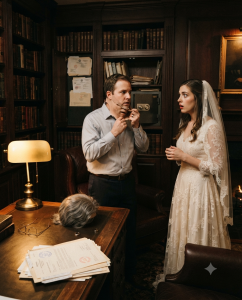
By midnight, the guests had thinned. The family, eager to preserve appearances, had prepared a “private suite” for the newlyweds in the library until they departed the next day. It was an absurd choice on the surface and a revealing one beneath it. The Salvatierra library was less a room for reading than a shrine to power—floor-to-ceiling law books, antique seals, framed decrees, dark wood polished by generations of men who believed paper could sanctify cruelty.
Sofía entered first.
When Alonso closed the door behind them, the lock clicked with deliberate finality.
For the first time all day, they were alone.
She turned toward him, ready for almost anything except the truth.
He removed his glasses. Then, with patient, practiced movements, he reached behind his neck and undid a fastening hidden near the collar. A thin prosthetic came away from his skin. He peeled back age from his face in layers so subtle and precise they would have been invisible to anyone who had not been standing inches away.
The transformation happened fast and impossibly.
The old judge vanished.
In his place stood a younger man in his thirties with hard eyes, sharp features, and the look of someone who had learned long ago that rage was more useful when hidden.
Sofía didn’t move.
“I’m not Alonso Ferrer,” he said.
His real voice was deep and steady, carrying none of the softness he had performed all day.
“My name is Daniel Orta.”
There was no reason to lie now, and he didn’t.
He crossed to a bookshelf, pressed on the carved edge of one volume, and opened a concealed safe built behind a row of legal reports. Inside were folders, copied records, photographs, notarized duplicates, lists of payments, edited rulings, sealed testimony that should never have been altered. It was enough to suggest an entire corruption network, but Daniel’s expression said this was only what he had managed to collect from outside.
“With this marriage,” he said, “your family gave me legal access to the one house where they still keep what can destroy them.”
Sofía found her voice at last. “Why tell me?”
“Because if I misjudged you,” he said, “you’ll try to stop me. And I need to know that before I go any further.”
The answer was so direct it startled her more than the deception had.
Then he gave her the rest.
Years earlier, his mother had been a prosecutor. Brilliant. Relentless. Dangerous to men like Esteban Salvatierra because she refused to bend rulings for the powerful. She had begun building a case—bribery, judicial tampering, public embezzlement, enough to send careers collapsing in chains. Before the case could go public, she was accused of corruption herself. Evidence appeared. Witnesses reversed statements. Her reputation was shredded in days.
“She was framed,” Daniel said, each word controlled with effort. “They destroyed her professionally, isolated her publicly, and by the time anyone questioned what happened, she was already dead.”
“How?” Sofía asked.
He looked at her for a long second. “Officially? An overdose. Quiet, tragic, convenient.”
But there was too much in his face for her to believe he accepted that version.
“My father did this?” she asked.
Daniel’s jaw tightened. “Your father led it. He didn’t act alone.”
Sofía believed him almost immediately, which should have horrified her. Instead it only clarified what she had spent years sensing in fragments. Locked rooms. Panicked whispers. Envelopes exchanged after midnight. Staff dismissed without warning. The strange, devouring silence that followed anyone who asked one question too many.
Daniel waited for fear.
What he got was calculation.
Sofía crossed to the large desk at the center of the library and picked up an antique notarial seal. It had sat there for as long as she could remember, one of many objects Esteban liked to display as proof of legacy. Daniel watched without understanding as she turned it, pressed a hidden seam, and opened a narrow chamber inside.
His eyes sharpened.
“That isn’t all they keep in this room,” she said.
He stepped closer. “What do you know?”
“The original case file against your mother never left this house.”
That was the first time Daniel truly lost his composure. Not dramatically, but enough. Enough that she saw the human being beneath the plan.
“How?”
“Because I heard them,” she said. “Years ago. My father and Verónica. They thought I was asleep on the landing above the hall. They were arguing about whether to burn something or move it. My father said the original stayed where no one would dare search for it.” She looked around the library. “Here.”
“Then why hasn’t anyone found it?”
“Because this room has more than one secret compartment.”
His gaze flicked across the bookshelves, the fireplace, the desk, the portraits.
“You know where it is?”
“I know who hid it,” she corrected.
That person, she explained, had not been Verónica or Luciana or any politician in her father’s orbit. It had been the housekeeper, Teresa, a woman who had worked in the house for almost twenty years and seen more than anyone realized. Teresa had always moved quietly. She brought tea, cleaned shelves, opened curtains, and existed in that dangerous category powerful families depended on most: people they considered invisible.
Then Teresa disappeared.
Verónica said she had stolen jewelry and fled. Esteban ordered the staff never to speak her name again.
Sofía never believed either part.
She also knew something else. In the years after Teresa vanished, her father had the old cellar beneath the west wing sealed under the excuse of water damage. Before that, the cellar had connected to a storage archive used decades earlier when the house briefly functioned as a private administrative annex for court records. Most of the old rooms had been emptied. Officially, nothing of value remained.
But children hear things in houses adults consider safe. Sofía remembered sounds under the floors at night. Metal dragging. A low striking noise that came and went during meetings involving judges, ministers, and men who left through side entrances.
Daniel listened without interrupting.
When she finished, he said, “Why didn’t you tell anyone?”
She laughed once, without humor. “Tell who?”
That answer told him as much about her life as any confession could have.
Slowly, she removed the wedding ring from her finger and placed it on top of the documents in the safe.
“If you want justice,” she said, “don’t treat me like collateral.”
He looked at the ring, then at her.
“Because the only person who can open their grave from the inside,” she said, “is me.”
The alliance formed there, in the stale perfume of a wedding night turned inside out, not from trust but necessity. Yet necessity can be cleaner than affection. It demands honesty.
Daniel nodded once. “Then we do this together.”
Before they could begin searching, a sound came from outside the library door. A faint scrape. Both of them froze.
Nothing.
Then another scrape, lower this time.
Sofía approached first and found an envelope pushed beneath the gap. Her name was written in her father’s unmistakable hand.
Inside was a key and a single note.
You were never meant to see what’s in the cellar.
Daniel read it over her shoulder.
“Is this a threat?” he asked.
“No,” Sofía said softly. “It’s a warning. And my father doesn’t warn people unless he thinks he’s losing control.”
The library lights flickered.
Then, from somewhere below them, came a dull metallic knock. One strike. Then another.
Daniel turned toward the floor.
Sofía went pale. “I know that sound.”
They followed the old architectural lines of the room until Daniel noticed shallow marks near the fireplace mantel. A portrait above it—an ancestral painting of a dead magistrate—hung slightly off center. Hidden hinges. Concealed weight. Daniel pressed against the frame, and with a low shift of old machinery, the painting swung inward.
Behind it, a narrow passage dropped into darkness.
The air rising from below smelled of dust, stone, and trapped years.
Daniel took the small lamp from the desk. Sofía picked up the key.
Neither spoke as they descended.
The stairwell was tighter than either expected, built between walls rather than within them, as if designed for movement no one was supposed to witness. At the bottom, the passage opened into a chamber bricked around an older room. Shelves lined one wall. Rusted cabinets lined another. At the center stood a metal archive door half hidden beneath collapsed boards.
There were marks on the inside of the brickwork.
Scratches.
Sofía forced herself not to stare.
The key fit.
When the door opened, stale air rolled out, followed by the unmistakable scent of paper sealed too long in darkness. Daniel swept the lamp across stacked boxes, bundled files, ledger books tied with red tape, and a desk covered in dust so thick it preserved the shape of a hand dragged across it years earlier.
Then the lamp reached the far corner.
A woman sat there in a chair.
Sofía gasped and stumbled back, but the figure did not move. It was not a body. It was a wax training dummy dressed in one of Teresa’s old uniforms, positioned deliberately in the shadows to terrify whoever found it. Around its neck hung a tag.
This is what happens to witnesses.
Daniel’s face hardened. “Your father staged this.”
“No,” Sofía said, voice shaking. “Verónica would have. She liked messages.”
They searched quickly. Inside the second cabinet Daniel found bundled copies of judgments sold for cash. In the third, photographs of meetings that could destroy half the ministry. But what he needed most appeared in a locked wooden case at the back: the original prosecution file bearing his mother’s name, complete with annotations in Esteban’s handwriting and signed override orders that proved evidence had been altered before submission.
Daniel’s hands trembled as he opened it.
For a moment, the room vanished from his face. He was no longer an infiltrator or strategist. He was a son standing over the remains of his mother’s stolen name.
“This is it,” he said, barely above a whisper.
Sofía stepped closer and read enough to understand the scale. Witness payments. Replacements for chain-of-custody records. A memo ordering “containment of Prosecutor Orta through personal compromise.” Another suggesting “medical instability” be inserted into her profile to support future reputational collapse.
Then she found the final page.
It wasn’t legal.
It was personal.
A handwritten note from Verónica to Esteban: If the prosecutor becomes impossible to manage, Daniel must be dealt with as well. Children are leverage until they become memory.
Sofía went cold. “He was a child.”
Daniel stared at the note with a stillness more frightening than anger.
“We need everything,” he said.
They were gathering files when footsteps sounded overhead, followed by voices in the passage. Not servants. Too deliberate.
Esteban had discovered the breach.
Daniel extinguished the lamp. In the dark, Sofía knew the room better than he did. She felt along the wall, found a vented stone panel Teresa had once shown her when she was little, and pushed. A secondary crawlspace opened behind old shelving. They moved just as the archive door burst wider and light spilled in.
From the narrow gap, they watched.
Esteban entered first, furious but controlled. Verónica followed, elegant even in panic. Behind them was Luciana, pale and tight-lipped, clutching a candle.
“You told her?” Verónica hissed.
“I warned her,” Esteban snapped.
Luciana looked at the open cabinets. “We should burn it now.”
“No,” Esteban said. “Not until we know what they took.”
Daniel’s hand curled into a fist beside Sofía in the dark.
Then Luciana said something that changed everything.
“She’ll help us if we offer her the truth about Mother.”
Sofía stopped breathing.
Mother.
Not Verónica.
Their real mother had died when Sofía was young, and in the family version of events it had been a frail, tragic illness. Never discussed. Never examined.
Esteban turned on Luciana with murderous eyes. “You will say nothing.”
Verónica’s silence was answer enough.
Sofía understood in a rush so violent it nearly made her cry out. Their mother had known. Or worse—she had tried to expose something. And whatever had happened to Daniel’s mother had not been the family’s first burial.
When Esteban and the others moved deeper into the room, Daniel leaned close to Sofía’s ear. “There’s one way out?”
She nodded.
“Then we make them follow us.”
It was reckless. It was dangerous. It was exactly right.
Daniel slid one box into the open, sending files across the floor. Esteban spun toward the noise. In that second, Sofía shoved the dummy chair hard into the opposite cabinet. Metal crashed. Verónica screamed. Luciana dropped the candle. The room erupted in confusion.
Daniel grabbed the evidence case. Sofía seized the loose note about her mother.
They ran.
Up the passage, through the library, into the east corridor where portraits rattled from the force of slamming doors behind them. Esteban shouted for guards. Verónica called Sofía’s name in a voice dripping false maternal panic. Luciana screamed for them to stop, but there was fear in it now, not loyalty.
The front staircase opened below.
Daniel veered toward the side exit. Sofía caught his sleeve and pointed toward the central hall instead.
“The cameras,” she said.
He understood instantly.
If they fled quietly, her father would bury the truth again. If the house saw them, if the staff woke, if the recording system captured Esteban chasing his own daughter through the hall while she carried archived court files, control would fracture before dawn.
They burst into the great hall just as two servants emerged from the back wing, startled awake. Behind them came Esteban, red-faced and stripped of dignity.
“Sofía!” he roared. “Give that to me.”
She turned at the bottom of the stairs and for the first time in her life answered him with the full force of her voice.
“No.”
The word cracked through marble and wood like a gunshot.
Daniel moved to her side, no longer pretending to be anyone else. The wig was gone. The posture gone. The mask gone. Esteban saw his real face clearly for the first time and blanched.
“You,” Esteban said.
“Yes,” Daniel replied. “The child you should have made sure was dead.”
Verónica actually staggered.
More doors opened. Staff appeared. A guard entered from the courtyard. Luciana stopped halfway down the corridor, staring at the file in Sofía’s hands as though it were an explosive.
Esteban recovered first, because men like him often do. “He deceived us,” he said, pointing at Daniel. “He infiltrated this home. Sofía, come here now.”
But Sofía held up the file.
“No,” she said again, and this time she looked at everyone in the room. “He came for the truth. I was the one you tried to sell to stop it.”
Even Luciana flinched.
Daniel took out his phone, already recording, and read aloud the prosecutor’s name from the original file. Then he read Esteban’s signed override order. Then Verónica’s handwritten note.
The house fell silent around the sound of their own crimes.
Esteban lunged.
The guard stepped between them—not out of loyalty to Sofía, but out of instinct. Violence looks different once witnesses are present.
By sunrise, copies of the documents had been sent to three newspapers, two opposition legislators, and a judicial ethics commission Daniel had prepared in advance for any opening he managed to create. This time the evidence was original, layered, undeniable, and attached to living witnesses.
The scandal did not merely return.
It detonated.
Esteban Salvatierra was arrested within forty-eight hours. Verónica’s private correspondence surfaced next, revealing years of extortion, witness intimidation, and hush payments. Luciana negotiated limited immunity in exchange for testimony about internal meetings, fake trusts, and the circumstances surrounding their mother’s death.
That truth proved uglier than Sofía had feared. Her mother had discovered part of the corruption network and threatened to go public. She did not die of illness. She died after being deliberately denied treatment during a “private recovery” arranged by her husband and managed by Verónica. No court ever called it murder. But no one who saw the records used softer words again.
As for Daniel’s mother, the original file exonerated her completely. Her name was restored in court and in public memory. The ruling came too late for her, but not too late to expose what had been done.
Months after the arrests, Sofía stood outside the courthouse where the revised findings were read. Daniel was beside her, not as a husband and not as a stranger. Whatever had begun in that library had become something harder to define and stronger than either of them would have trusted at the start. They had not fallen into romance during the ruins. There had been too much bloodless damage for that kind of easy story. What they built instead was respect born in fire.
When the reporters called Daniel a hero, he said the case would have stayed buried without Sofía.
When they called Sofía brave, she almost laughed.
Bravery had nothing to do with it.
Some people break because the truth is too heavy.
Others survive because they are finally more afraid of silence.
The marriage was annulled, of course. The country delighted in the deception before slowly understanding its cost. Debates raged for weeks about ethics, infiltration, privilege, and whether justice could ever come cleanly through dirty systems. Some said Daniel had gone too far. Others said he had not gone far enough. Some pitied Sofía. Others called her complicit for living in the house as long as she had.
That was the aftershock truth rarely gives anyone: once exposed, it does not divide the world neatly into innocent and guilty. It leaves behind ash, evidence, and questions sharp enough to live with forever.
Sofía kept one thing from the library: the antique notarial seal with the hidden compartment. Empty now.
A relic of the night her family tried to trade her like an object and instead handed their enemy the key to their destruction.
The strangest part was not that Daniel had entered her life wearing another man’s face.
It was that he had been the first person to step into that house and tell her the truth before asking for anything in return.
And sometimes, long after the trials ended, that was the thought she came back to most.
Not who betrayed whom.
Not who deserved prison.
Not even who deserved forgiveness.
But which red flag had mattered most in the beginning—the corruption everyone saw too late, or the quieter one hidden inside the family itself:
the moment a daughter learns the people raising her would rather sacrifice her than confess what they’ve done.