Valeria had been raised to understand that appearances were more valuable than truth.
Not in those exact words, of course. Families like hers never said ugly things plainly. They polished them. They dressed greed as duty, cruelty as discipline, and sacrifice as honor. By the time she was old enough to recognize the machinery around her, the lessons had already settled into the walls of the house where she grew up—a sprawling palace of faded gold and ancestral portraits, a place that looked immortal from the street and desperate from within.
So when her mother told her she was to marry Octavio de la Vega, the richest widower in the city, Valeria did not waste time asking whether she had a choice.
The answer was already in the room.
Her mother stood by the window in blue silk, one hand resting lightly on the back of a carved chair, as if discussing flowers for a luncheon instead of her daughter’s future. Her uncle sat nearby with a ledger open on his knee. He did not bother pretending this was anything but a transaction.
“This marriage restores stability,” her mother said.
“It prevents embarrassment,” her uncle corrected.
Valeria had looked from one to the other, unsurprised by either version. “For whom?”
No one answered directly.
They didn’t need to. The creditors had become impossible to ignore. Debts hidden for years under prestige and bluff were finally surfacing. A series of risky investments had failed. Properties were overleveraged. Accounts that once looked untouchable were hollow. A week earlier, two men with legal papers had arrived at the palace gates demanding access to inventory holdings. Another public step, and the family’s decline would become social fact. Once that happened, people would stop pretending to admire them and start enjoying the fall.
Then came Octavio’s proposal.
A widower. Reclusive. Wealthy enough to sweep the debt aside with one signature. He asked for little, according to Valeria’s mother. Discretion. A swift ceremony. And one oddly specific condition: the wedding had to be held at the old Montenegro estate, now owned by Valeria’s family and used only for formal events.
That condition should have provoked questions.
Instead, it provoked relief.
Valeria knew the Montenegro name only as something discouraged. A dead branch in the city’s history. There had been a fire ten years earlier, a devastating one. The family house had burned at night. The father had died. The son had supposedly perished with him. A ruined company had been quietly absorbed in the months that followed. Whenever Valeria asked for details as a girl, adults changed the subject too quickly.
Now she knew why.
On the day of the wedding, the old Montenegro house glowed with candlelight and expensive lies. Guests arrived dressed in admiration. Musicians played as if the family fortune had not spent the week coughing blood behind velvet curtains. Her uncle moved through the crowd with renewed confidence. Her mother smiled with the radiance of a woman who believed disaster had been delayed and therefore defeated.
Octavio de la Vega stood at the front of the long room beside the officiant, one hand resting on an ivory cane. He wore age convincingly. His silvered temples, the subtle stiffness in one leg, the patch over part of his face—everything invited sympathy while discouraging scrutiny. Yet when Valeria reached him, something failed to match the performance. His hand was too steady. His posture too deliberate. When he bent to kiss her forehead, a fresh, clean scent reached her, impossible to place but unmistakably wrong for the image he projected.
Not old. Not frail. Not fading.
Watching him, she had the eerie sensation of looking at a painting hung over a locked door.
During the reception, her mother did not leave her side for more than a minute. Every smile she gave Valeria was sharp at the edges. Every touch seemed affectionate until one noticed the pressure beneath it.
“You’ve done the right thing,” her mother murmured as a pair of bankers toasted nearby.
Valeria met her eyes. “For the family?”
“For yourself,” her mother replied. “You will understand one day.”
That was how her mother always spoke after committing a cruelty. As if time itself would excuse her.
Later, near the champagne table, Valeria’s cousin caught her by the arm and squeezed hard enough to bruise.
“Quiet,” he whispered. “Obey him. By tomorrow, we’re safe.”
Valeria almost laughed. Safe was not the word for what people like them meant. Safe meant concealed. It meant fed, funded, protected from consequence. It never meant innocent.
She endured the rest in silence.
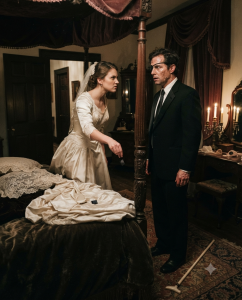
By nightfall, she was led to the bridal suite on the upper floor of the Montenegro house—a room preserved with unnerving care, all carved wood and burgundy drapes, as though someone had expected its ghosts to return. When Octavio entered and locked the door behind them, Valeria braced herself for humiliation, negotiation, or some carefully packaged variation of power.
What she got was the truth.
He set aside the cane. Removed the eye patch. Peeled away a nearly invisible layer of prosthetic latex that altered his face and aged his skin. Beneath the disguise was a man perhaps in his thirties, his expression severe and alive with old purpose.
“My name is Elías Montenegro,” he said.
The surname struck like cold water.
He watched her closely, probably expecting denial or a rehearsed innocence. Instead, she felt an almost unbearable clarity spread through her body. The pieces she’d sensed all evening locked together at once.
“You’re dead,” she said.
“So your family prefers to believe.”
He opened a leather case and began laying out documents across the bed. Copies of property transfers. Insurance irregularities. Banking records. Correspondence between officials and shell companies. Evidence that the fire which consumed the Montenegro home had not been a tragic accident but an arranged destruction—one used to erase a rival and strip a family of its holdings while surviving members were presumed gone.
At the center of it all, repeatedly, was Valeria’s mother’s name.
Not alone, but essential.
“She wanted my father ruined before the fire,” Elías said. “Your uncle handled the acquisitions. Judges were paid. Witnesses bought. By the time the city finished gossiping over the ashes, my family’s business had already been carved apart.”
Valeria stared at the papers, each page turning rumor into anatomy.
“My father survived the fire for three days,” Elías continued, voice flat with controlled rage. “Long enough to know what had been done to us. Long enough to tell me who was behind it. I escaped because one servant dragged me out through the stables before the roof came down.”
His gaze lifted to hers.
“They announced my death before dawn.”
She believed him.
Not because of the documents. Not because of his anger. Because this was the first thing anyone had ever said to her that made her entire childhood make sense.
There were reasons her mother hated certain names. Reasons she corrected servants too quickly. Reasons records disappeared from study shelves and old conversations stopped when Valeria entered a room. She had grown up inside the aftermath of a crime large enough to become architecture.
Elías reached the final document: the marriage contract.
“Your family thinks this alliance protects them,” he said. “Instead, it binds their surviving assets to scrutiny. The first concealed transfer they attempt, the first false declaration, the first lie under oath, and I can expose all of it at once.”
He said it with satisfaction, but not pleasure. Revenge had carried him this far, yet it had not soothed him. It had merely organized his pain.
“Why me?” Valeria asked.
The question escaped before she could stop it.
He answered without hesitation. “Because your mother would sacrifice anyone before she surrendered the family name.”
Valeria looked at him for a long moment. Then she unclasped her bracelet.
A tiny memory card fell into her palm.
Elías’s eyes narrowed.
“I’ve been collecting evidence for months,” she said. “Not about you. About her.”
She placed the card on the bed between the documents. It was absurdly small, almost laughable against the weight of old crimes, and yet Elías stared at it as if it had altered the balance of the room.
“There are recordings,” Valeria said. “Account numbers. Copies of letters. A file she keeps hidden behind a false panel in her dressing room. Proof she shifted assets through the charity foundation. Proof my uncle forged signatures. Proof my cousin paid a servant to disappear after he overheard an argument about the fire.”
Elías did not touch the card immediately. “Why?”
“Because I knew she’d do this eventually.” Valeria lifted her chin. “Maybe not this exact marriage. But something. She’s always treated me like an heirloom she could trade.”
“What were you planning to do with it?”
“Survive long enough to choose the right moment.”
Silence stretched.
Then a faint sound came from outside the door. A scrape. The delicate testing of a handle.
Both of them turned.
Valeria’s expression hardened. “She sends listeners when she’s nervous.”
“Your mother?”
“She doesn’t trust outcomes she can’t watch.”
A moment later, her mother’s voice drifted through the wood, composed and low. “Valeria? Open the door. There’s something your husband deserves to know before morning.”
Elías’s face tightened. “What is she doing?”
Valeria went pale in a way that had nothing to do with fear and everything to do with recognition. “If she sounds that calm,” she said quietly, “she has figured something out.”
Elías moved quickly, gathering the documents. Valeria crossed to the fireplace, retrieved a sealed envelope hidden behind the iron grate, and tucked it into the bodice of her dress.
“What’s that?” he asked.
“A letter from the notary who handled the first Montenegro transfer after the fire,” she said. “He wrote a confession before he died. My mother thought she destroyed every copy.”
The knocking came again, slightly firmer.
“Valeria.”
She looked at Elías. In that instant, alliance stopped being theoretical.
“Open it,” he said.
She did.
Her mother stood in the corridor in a silver dressing gown, flawless despite the hour. Behind her was Arturo, Valeria’s cousin, and two household men who pretended not to be there for intimidation. Her mother’s eyes moved first to Valeria, then to Elías, and finally to the cane leaning uselessly against the wall.
The smallest pause.
Too small for anyone not watching her carefully.
But Valeria saw it. So did Elías.
“Should I come back?” her mother asked with exquisite politeness.
“No,” Elías said. He had already dropped Octavio’s roughened tone. “Since you’re here, let’s stop pretending.”
Arturo frowned. Valeria’s mother’s gaze sharpened.
“Elías Montenegro,” he said.
For one naked second, the woman who had controlled every room Valeria had ever seen her enter forgot her face. Shock flashed across it—not theatrical, not social, but primal. The kind the body gives before the mind can construct a defense.
Then it vanished.
“You should be dead,” she said.
“You made sure enough people believed it.”
Arturo looked between them, confused. “Mother, what is he talking about?”
She did not answer him. Her eyes stayed on Elías. “If you’re alive, you made a mistake coming back here.”
Valeria almost admired the speed with which her mother shifted from surprise to threat. It was a skill refined by years of getting away with evil.
“Elías didn’t make the mistake,” Valeria said.
All heads turned toward her.
She had never interrupted her mother in public, much less contradicted her in a room full of witnesses. The silence that followed was its own fracture.
Her mother’s expression cooled. “Go inside, Valeria.”
“No.”
Arturo stepped forward. “Careful.”
Valeria looked at him, then at the household men, then back at her mother. “You sold me to a dead man’s revenge and expected gratitude. That was your careful plan.”
A pulse flickered in her mother’s throat. “You have no idea what this family required.”
“I know exactly what it required. Fire. Theft. Bribes. Disappearances.” She touched the hidden envelope against her ribs. “And I know what you hid to keep it all standing.”
Her uncle’s voice sounded from farther down the corridor as he approached, half dressed and irritated. “What is this noise?”
Then he saw Elías’s face.
The color drained from him.
That, more than anything, ended the performance.
Elías reached into his case and drew out the first page of evidence. “The marriage contract is valid,” he said. “Which means every financial disclosure connected to this union can be examined. Tomorrow morning, unless I am prevented, copies of these documents go to the magistrate, the press, and every creditor you tried to placate tonight.”
Arturo lunged first, stupidly. He snatched for the papers. Elías stepped aside and drove him back with one clean shove, sending him into the corridor table hard enough to overturn a porcelain lamp. One of the household men moved as if to intervene, but Valeria’s mother raised a hand.
Not yet.
She was calculating still.
“How much?” she asked Elías.
Valeria stared at her.
There it was. Not denial. Not remorse. A price.
Elías gave a short, disbelieving laugh. “You think this is a negotiation?”
“Everything is a negotiation,” she said.
“No,” Valeria replied. “Not this.”
Her mother looked at her then with something close to hatred. “After everything I preserved for you.”
“You preserved your name,” Valeria said. “You just tied mine to it.”
The uncle recovered enough to bark at Arturo to close the doors and call no one. He understood what scandal meant better than any of them. He also understood that panic makes people reckless. He advanced on Valeria.
“Give me whatever she took,” he snapped.
Valeria stepped back, but Elías was faster. “Touch her,” he said, “and I skip the magistrate and send everything directly to the papers before dawn.”
The uncle stopped.
Valeria drew out the sealed envelope.
Her mother’s stare fixed on it instantly.
That was the tell.
Elías saw it and smiled without warmth. “What’s in the letter?”
Her mother’s composure cracked a fraction. “An old lie from a dying man.”
“A lie you’re suddenly eager to recover,” Valeria said.
Arturo muttered a curse. The household men looked uncertain now, no longer sure whom they were protecting. The advantage had shifted, and everyone felt it.
Valeria broke the seal.
Her mother took one involuntary step forward.
The confession inside was short, written in a trembling hand by the notary who had legalized emergency transfers after the fire. It named payments. It described forged authorizations. And in the final paragraph, it recorded one devastating detail: the order to accelerate the Montenegro property seizure had come after confirmation that the son might still be alive.
They had known.
They had known Elías had escaped.
And they had still declared him dead.
Elías read that line twice.
When he looked up, the vengeance in his face had changed. Until then, he had been fighting the people who ruined his family. Now he was facing the people who had knowingly buried him alive.
Valeria’s mother saw the change too. “That proves nothing,” she said too quickly.
“It proves intent,” Elías answered.
“It proves murder,” Valeria said.
No one corrected her.
The uncle swayed where he stood. Arturo whispered, “Mother…”
She rounded on him with such contempt he actually recoiled. “Be quiet.”
That was when the first servants began gathering at the far end of the corridor, drawn by the crash, the raised voices, the unusual sight of the family losing control. The household had always run on fear and secrecy. Once both started to slip, silence became impossible to maintain.
Valeria turned to one of the older servants, a woman who had worked in the house since before Valeria was born. “Send for Magistrate Robles,” she said clearly. “And for the city paper. Tell them there has been a fraud concealed under a marriage contract.”
The servant hesitated only a second.
Then she bowed. “Yes, señora.”
It was the first time anyone had ever obeyed Valeria before her mother.
Panic finally surfaced. Arturo swore and moved toward the staircase, perhaps to stop the message, but two more servants blocked him with the careful neutrality of people who had endured enough. The uncle began shouting about slander, theft, betrayal. His voice had become useless noise.
Valeria’s mother went very still.
When she spoke again, her tone was almost intimate. “Do you think he will thank you for this? Do you think destroying us makes you clean?”
Valeria held her gaze. “No. I think it makes me done.”
By dawn, the magistrate had arrived with clerks. By sunrise, creditors had returned with far less civility than they’d shown at the reception. By noon, the first edition of the city paper was carrying whispers of forged transfers, a false widower, a resurrected heir, and a bride who had turned against her own family before the wedding flowers wilted.
Arrests followed within days.
The uncle tried to flee and was caught at a rail station with bonds sewn into his coat. Arturo attempted to claim ignorance until recordings disproved him. Valeria’s mother held out longest, denying everything with the elegance of a queen at execution, but elegance is weak against documents, witness statements, and a city suddenly delighted to stop protecting old names.
The case lasted months.
In court, Elías spoke with brutal clarity. Valeria testified with a calm that made her mother visibly uneasy for the first time in memory. The surviving servants, once afraid, found courage in numbers. Former officials turned on one another. The past, so carefully buried, was exhumed piece by piece until everyone could smell the rot.
When judgment came, it was not poetic. Real punishment rarely is. Assets frozen. Estates seized. Prison terms for fraud, conspiracy, and criminal arson tied through reopened investigation. Public disgrace. Titles emptied of force. Doors closed where they had once opened automatically.
The family name survived on paper.
It no longer protected anyone.
Afterward, Valeria left the palace without ceremony. She did not take much. A few books. Her father’s watch. One plain suitcase. The air outside tasted different than she remembered, less perfumed and more honest.
Elías found her on the front steps as workers inventoried the house behind them.
“It’s over,” he said.
She looked at the building where she had spent most of her life feeling owned. “No,” she said. “It’s finished. That’s different.”
He stood beside her for a while without speaking.
People would likely decide later what story they preferred. That he had returned from the dead to avenge his family. That she had betrayed her blood for freedom. That they had used each other. That they had saved each other. Cities love simple versions of complicated things.
The truth was less flattering and more human.
He had come back carrying revenge like a religion. She had survived by hiding evidence in jewelry and patience in her spine. Their marriage had begun as a trap designed by several enemies at once. Yet in the one room meant to seal her powerlessness, they had recognized something familiar in each other: not innocence, but refusal.
At last Elías said, “I don’t know what happens now.”
Valeria almost smiled. “Neither do I.”
For the first time in years, that uncertainty did not feel like terror.
It felt like choice.
Later, when people spoke of the scandal, they argued over the obvious questions. Whether Elías had gone too far. Whether Valeria should have exposed her mother sooner. Whether blood demanded loyalty even after corruption. Whether revenge and justice had blurred beyond recognition long before the wedding night.
But the question that lingered most stubbornly was quieter than all the others:
What was the greater sin—to destroy a family for power, or to build your life on top of the ashes and call it legacy?