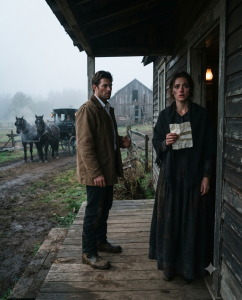
Rachel Dunn heard the knock just as the milk pail slipped in her grip.
It hit the porch boards hard enough to slosh fresh milk over her shoes, but she barely noticed. Her attention had gone to the stranger standing outside her door, hat in hand, shoulders squared despite the ragged coat on his back.
He looked like a man who had fallen on hard times and hated every second of being seen that way.
It was early in Harmony Valley, that gray hour when Oregon fog still clung low over the fields and every breath carried cold into your lungs. Rachel tightened her shawl around herself and opened the door only a little wider. She had learned caution the hard way. Since Daniel died, caution had become as necessary as bread.
The farm behind her was failing in the quiet ways that hurt worst. A loose fence here. A sickly hen there. A roof patch she could not afford to replace. A pump that coughed mud instead of clean water. A mortgage payment that hung over every waking hour like weather. She was thirty-two years old, widowed young, and tired in a way sleep could not fix.
The stranger lowered his eyes slightly, as if to make himself less imposing.
“My name’s Nate Carver, ma’am,” he said. “I’m looking for work. Honest work. I don’t need much. A place in the barn would do. Meals, if you can spare them. I can earn my keep.”
Rachel looked at him carefully.
His coat was worn. His trousers were patched. His boots were caked in road dirt. Yet his voice carried something odd in it—not arrogance, exactly, but a kind of restraint. As though he was used to being obeyed and had spent all morning trying to sand that away.
Still, she needed help.
“I’ll tell you plain,” she said. “There’s work enough for three men and money enough for none. I can offer the barn, three meals, and nearly no pay.”
“That will do.”
“If you want real wages, try Ashford Ranch. Mr. Ashford pays better than anyone in this valley.”
For the smallest fraction of a second, something unreadable moved across his face.
Then he nodded. “I’d rather work where I’m needed.”
Rachel stepped back from the door. “Then start with the west fence.”
He tipped his head once. “Thank you, ma’am.”
His real name was Jonas Ashford.
And he had lied to her before he ever crossed the threshold.
Jonas Ashford was not a drifter. He owned the biggest ranch in Harmony Valley, eleven thousand acres of grazing land, cattle by the hundreds, horses bred to turn heads, and more money than most families in the valley would see in three generations. Men straightened when he entered a room. Merchants smiled too fast around him. Women looked at him with ambition tucked behind sweetness.
He had once mistaken that ambition for love.
Clarissa Bell had nearly become his wife. She was beautiful in the polished, practiced way that made men miss what sat underneath. Jonas had believed her softness. He had believed the way she looked at him when she thought no one else noticed. He had believed himself lucky.
Then, two weeks before the wedding, he passed a half-closed parlor door and heard her laughing with her sister.
“Love him? Don’t be foolish. I could endure far worse than Jonas Ashford for eleven thousand acres.”
Her sister laughed. Clarissa laughed harder.
Jonas said nothing. He walked away before either woman saw him, canceled the wedding the next morning without explanation, and never fully trusted tenderness again.
After that, every smile felt calculated. Every compliment sounded purchased in advance. He began to hate the way people looked at him when they knew his name.
Then one afternoon in town, he saw Rachel Dunn.
He remembered it with embarrassing clarity. He had been surrounded by men hoping for business and mothers nudging daughters into his path. Rachel drove past in a plain wagon stacked with feed sacks. She glanced at him once, briefly, with no more interest than if he had been part of the general store fence. Then she drove on.
It was not admiration. It was not contempt. It was simple indifference.
And it lodged in him.
So on a cold morning months later, with Clarissa’s words still poisoning his memory and loneliness stretching too wide in that enormous house of his, Jonas did something reckless. He dressed in borrowed clothes, left his horse down the road, and walked to Rachel Dunn’s farm to see who she was when there was nothing to gain from kindness.
By sunset of that first day, he already knew he had made a dangerous mistake.
Rachel worked harder than anyone he had known. She did not perform grief, but it lived everywhere around her—in Daniel’s coat hanging by the kitchen door, in the way she paused before entering the bedroom at night, in how she still said we sometimes before correcting herself to I.
When evening came, she served beans, stale bread, and weak coffee. Jonas picked up his plate, intending to eat in the barn.
“Where are you going?” she asked.
He stopped. “Outside. I don’t want to intrude.”
Rachel frowned. “No one eats alone in my house. Not if there’s room at the table.”
It was a small kitchen. The cloth was mended. The candle leaned crooked. The meal was plain. Yet as Jonas sat across from her, listening to the wind push at the walls, he felt something he had not felt in years.
Not comfort.
Recognition.
Rachel did not look at him the way others did. She did not flatter him. Did not study him for advantage. Did not soften her voice to manipulate him. She simply treated him as though human dignity cost nothing and ought to be given freely.
That unsettled him more than suspicion ever could.
The days found a rhythm. Jonas rose before dawn and worked until his shoulders ached. He repaired fencing, split wood, mucked stalls, cleaned tools, and hauled feed. Rachel worked beside him, practical and unsparing. She never coddled him, but neither did she diminish him. If he did good work, she said so. If he did foolish work, she said that too.
Little by little the farm changed.
The west fence stood straight again. The hens grew stronger. The pump behaved better after he pulled it apart and rebuilt part of the mechanism. Rachel’s face, always serious, began now and then to loosen into something that almost looked like peace.
One freezing morning she noticed him shivering in his threadbare coat.
That afternoon, she brought out a heavy wool overcoat.
“It was Daniel’s,” she said. “You may as well wear it.”
Jonas stared at it. He owned tailored coats from San Francisco. He owned gloves lined with soft leather. He owned more warmth than one body could ever need. Yet the thing that nearly broke him was this widow pressing her dead husband’s coat into his hands because she thought he had nothing.
“I can’t take that.”
“You can,” Rachel replied. “And you will.”
There was no refusing her when she used that tone. He pulled on the coat. It fit almost perfectly.
Rachel gave a single nod. “Good.”
He could barely meet her eyes.
The first time Jonas heard someone insult him on her behalf, he understood how badly he had misjudged the cost of his deception.
They were in town buying feed when two men near the hitching post smirked at Rachel.
“Heard you’ve taken in a tramp,” one said.
“Careful,” the other added. “Next thing you know he’ll be in your house.”
Rachel turned so fast both men straightened.
“That man,” she said sharply, “has worked more honestly in one month than either of you have in your full miserable lives. Keep your mouths shut unless you’ve got something worth saying.”
The men muttered and looked away.
Jonas stood with a sack over one shoulder, stunned. People praised him constantly when they knew who he was. They deferred to him. Agreed with him. Laughed too hard at his jokes.
No one had ever defended him when they thought he was worth nothing.
That night he lay awake in the barn staring at the rafters.
This had gone too far.
He told himself that often in the weeks that followed, but still he stayed. Because each day he intended to confess, and each day Rachel gave him one more reason to fear losing the right to stand near her.
Then the letter came from the bank.
Rachel opened it at the kitchen table. He watched the blood leave her face as she read. Thirty days. Pay the mortgage or surrender the farm.
She folded the paper very carefully, the way people handle pain when they are trying not to let it spill.
Jonas felt sick.
He could end her fear with one signature. More than that—he could pay off every debt, repair every outbuilding, replace every failing board on the place. He could do it in an hour.
But not as Nate Carver.
Only as Jonas Ashford.
And if he told her now, after all these weeks of lies, would she see rescue? Or humiliation? Would she believe anything he felt for her was real? Or would she hear only the echo of a rich man entertaining himself with a widow’s trust?
That evening he found her studying old ledgers by lamplight.
“Rachel,” he said quietly, “if help came from somewhere unexpected… would you take it?”
She gave a tired laugh. “Unexpected help is usually debt dressed up in Sunday clothes.”
“What if someone wanted to help with no strings?”
Her expression changed. Not soft. Hard.
“I’m not a charity case, Mr. Carver. And I’m no rich man’s amusement.”
The words landed like a slap because they were true in ways she did not know.
After that, Jonas began trying to help her without naming himself. He pushed harder at market and sold livestock for stronger prices. He paid a supplier through an intermediary to let a needed machine part go cheaply. He spent evenings repairing things Rachel had long ago given up on replacing. But the sums were too small. The mortgage remained.
Rachel responded by cutting pieces off her own life.
She sold a silver brooch that had belonged to her mother. She stopped putting sugar in her coffee. She skipped meals when she thought Jonas wouldn’t notice. Once, coming around the side of the barn, he saw her standing alone with both hands braced against the wall, crying silently into the crook of her arm.
He started toward her.
She straightened before he reached her.
“Don’t,” she said.
“I wasn’t going to pity you.”
“Yes, you were.”
He shook his head. “No.”
Rachel looked at him with wet eyes and a lifted chin. “I may be cornered, but I am not broken.”
Then she walked away.
Jonas loved her a little from that moment, though he would not name it until later.
Not for her suffering. Not for her beauty, though she had a quiet beauty sharpened by endurance. Not for the softness she gave him when he least deserved it. He loved her because there was steel in her where life had expected surrender.
The valley, of course, began to gossip.
Harmony Valley survived on weather, cattle prices, and other people’s business. A widow with a strange hired man under her roof was enough to season every supper table in town. Some thought Rachel desperate. Some thought reckless. Others simply enjoyed saying her name with sympathy they didn’t feel.
Then a sharper rumor spread.
The drifter at Rachel Dunn’s place didn’t move like a drifter. He spoke too carefully. Knew too much. A few people thought they recognized his profile. One stable boy swore he’d seen Ashford Ranch horses waiting on the east road where no one should have been.
Rachel heard more than Jonas knew.
The reckoning came on a Sunday evening.
He stepped into the kitchen carrying kindling and stopped. Rachel stood by the table, the bank letter clenched in one hand. Her face was pale, but not with fear. With clarity.
“I asked around,” she said.
Jonas set the wood down gently.
“A man in town says your boots are too fine under the mud. Another says no drifter learns figures as fast as you do. And someone else says Jonas Ashford’s carriage has been seen on the east road more than once this week.”
He didn’t answer.
Rachel’s voice dropped. “Who are you?”
He opened his mouth, then closed it.
She took one step back.
That hurt more than he would have believed possible.
“Don’t come closer,” she said. “Not unless the next thing you say is the truth.”
The room felt suddenly too small to hold his shame.
“My name is Jonas Ashford.”
Rachel did not gasp. She did not shout.
She simply went very still.
Then understanding moved across her face in slow, devastating pieces. The first day at her door. The too-educated speech. The way certain men in town had stared. The odd skill with numbers. The hidden reserve beneath every answer.
“It was all a lie.”
“No,” Jonas said. “Not all of it.”
Her laugh came out broken. “Was I a test?”
He said nothing quickly enough, and that silence condemned him.
Rachel nodded once, as if some private fear had just been confirmed. “Of course.”
“That’s not what it became.”
“No?” Her eyes shone. “Tell me, Mr. Ashford, at what point was I supposed to feel grateful? When I gave my dead husband’s coat to one of the richest men in this valley? When I defended you in town? When I nearly let myself…”
She stopped.
Jonas took a breath he could not steady. “Rachel—”
“No.” She pressed the bank letter flat against the table. “You wanted to know whether a woman could care for you if you had nothing. So you came here and let me show you exactly who I am while giving me no chance to know who you were.”
“I came because you were the only person who ever looked at me like my name meant nothing.”
“And you decided that earned you the right to deceive me?”
He had no answer good enough to survive the truth.
Outside, wheels rolled over the dirt road.
Rachel turned toward the window just as a polished black carriage came into view. It stopped in front of her weathered porch like an accusation made of lacquer and steel.
She looked from the carriage to Jonas.
The size of the lie settled fully between them.
He should have hated that carriage. Instead, in that moment, he was grateful for it, because pretending had become impossible.
“I came to tell you before anyone else could,” he said.
“And yet here we are.”
He could hear the servants waiting outside. He had come intending to confess, to offer full payment of the mortgage, to ask her forgiveness if he could earn it, and perhaps—if mercy truly existed—to ask for more someday.
But now the words sounded absurd.
Rachel stared at him for a long moment.
“Do you know what the worst part is?” she asked.
Jonas thought of the insult, the humiliation, the breach of trust. “No.”
“It’s that the man I cared for was real.” Her voice shook once, then steadied. “And now I don’t know whether that makes this easier or crueler.”
He stepped forward only when she didn’t retreat.
“I love you,” he said. “Not because you proved anything. Not because you passed some test. I loved you long before I knew what to do with it, and by the time I understood, I had already wronged you.”
Rachel closed her eyes for one second.
When she opened them, the tears were there but so was anger.
“You don’t get to place love on the table like it wipes away what you did.”
“I know.”
“Do you?”
“Yes.” He swallowed. “That’s why I’m not asking for your answer tonight.”
She looked at him, suspicious now of everything, even honesty. “Then why did you come with a carriage?”
Jonas glanced toward the window. “Because I came as Jonas Ashford. No disguise. No more hiding.”
Then he did the one thing he should have done from the beginning.
He told her all of it.
Clarissa. The overheard laughter. The broken engagement. The disgust that followed. The hollow house. The way Rachel had passed him in town without calculation in her eyes. The foolish plan. The first meal at her table. The coat. The defense in town. The bank letter. The shame.
Rachel listened in silence.
When he finished, the kitchen seemed hollowed out by it.
At last she said, “You let your old wound become my burden.”
“Yes.”
“You let me trust a stranger who was never a stranger.”
“Yes.”
“You stood in my house, watched me sell pieces of my life, and still waited.”
That one cost him most. “Yes.”
Rachel turned away. For a moment he thought she might ask him to leave, and he would have deserved it. Instead she stood by the window looking out at the carriage while twilight pressed against the glass.
Finally she said, “Will you pay the mortgage?”
He blinked. “If you’ll allow it.”
She turned back sharply. “I didn’t ask if you wanted to. I asked how.”
He understood then. This was not surrender. This was Rachel reclaiming ground.
“I’ll buy the note from the bank in your name,” he said. “The farm remains yours. No hidden agreements. No claims. No repayment unless you someday insist on it, and even then only what you choose.”
“And if I send you away after?”
His chest tightened. “Then I go.”
Rachel studied him, perhaps for the first time seeing all of him together—the man at her door, the owner in the carriage, the liar, the worker, the fool, the one who loved her.
“I don’t forgive you,” she said.
“I know.”
“But I won’t lose this farm because of my pride either.”
“That’s fair.”
She gave a weary nod. “Then tomorrow you speak to the bank. Tonight you leave the carriage where it is and walk back out of here like the man who entered.”
He almost smiled despite everything. “Yes, ma’am.”
That next morning he met the bank manager before the doors even opened. By noon the mortgage was paid in full, the deed secured, and the farm legally Rachel Dunn’s with no encumbrances. The manager, who had been pleased enough to tighten the noose weeks earlier, became astonishingly respectful once Jonas Ashford sat across from him without smiling.
Rachel did not thank him.
He admired her for it.
For two weeks after that, he did not step inside her house. He worked on the farm when she allowed it, left before supper, and gave her every inch of space she demanded. Harmony Valley buzzed itself half-mad with the story. Some called Rachel clever for capturing the richest rancher in the valley. Others called Jonas pathetic. A few who mattered less than dust called her a fool for not grabbing the advantage faster.
Rachel ignored them all.
Jonas tried to.
One evening, while repairing a gate, he heard her voice behind him.
“You missed a nail.”
He looked over his shoulder. She stood with her arms folded, the smallest edge of mischief in her expression.
“I was wondering how long it would take you to say that,” he admitted.
Rachel walked closer. “Don’t mistake tolerance for forgiveness.”
“I wouldn’t dare.”
She nodded toward the gate. “Move.”
He moved. She drove the nail in herself, two clean strikes.
When she straightened, he said, “Why are you here?”
Rachel looked out over the field, where the late light turned the grass gold. “Because I’ve spent weeks deciding whether the man who lied to me is the same man who rose before dawn to fix my fences, sat at my table like it mattered, and looked ashamed to take Daniel’s coat.”
“He is.”
“And whether I hate him.”
He waited.
“Do you?”
Her mouth twitched once, sad and unwilling. “I tried.”
That was the first crack in the wall.
The second came later, when they spoke of Daniel openly. Rachel expected jealousy, or at least discomfort. Jonas only listened. He asked what Daniel had been like. He laughed at a story about Daniel falling into the creek trying to impress her. He did not try to replace a dead man. He made room for him.
The third crack came when winter threatened early and Jonas sent lumber without asking. Rachel sent it back. He sent himself instead with tools and no argument. She let him stay.
By spring, the house roof no longer leaked. The hens were fat. The fence lines were strong. The orchard had been trimmed properly for the first time in years. And Rachel had begun, against all strategy, to look for him when the day bent toward evening.
He never pressed.
Perhaps that was what finally let her trust him again.
When Jonas proposed, he did not do it in a ballroom or before witnesses. He did not kneel in polished boots with servants hovering nearby. He came in a carriage because that was how the valley expected Jonas Ashford to travel, but he stepped down from it carrying mud on his hem and nerves plain on his face.
Rachel was on the porch shelling peas.
He stopped at the foot of the steps and said, “I should have asked you everything honestly from the start. So I’m asking honestly now. Not as a test. Not as a rescue. Not as the owner of anything but my own stubborn heart. Will you marry me?”
Rachel set the bowl aside.
For a long moment she looked at the carriage, then at him, and perhaps at the strange road between the two versions of the same man.
Then she said, “Only if you understand one thing.”
“Anything.”
“If you ever test me again, I’ll make you sleep in the barn until you’re old.”
He laughed for the first time in weeks, full and helpless.
“That seems fair.”
She smiled then—a real one, bright enough to undo him.
“Yes, Jonas. I’ll marry you.”
When he kissed her, it felt less like triumph than relief. Relief that truth had finally outrun fear. Relief that love had survived the worst thing he had done to it. Relief that Rachel Dunn, who had once fed a stranger at her table because no one should eat alone, had chosen to make room for him again.
Some in Harmony Valley said she should have sent him away forever. Others said she was wise to secure a wealthy future. Still others whispered that no man who begins with a lie deserves a second chance.
Maybe there was truth in all of it.
But those who knew the full story understood something simpler and harder: Rachel had not married the richest man in the valley because he was rich. She married the man who had once arrived at her door in borrowed misery and left changed by the way she loved without calculation.
The largest red flag had never been his money.
It had been his fear.
And perhaps the most unsettling part of love is that sometimes forgiveness does not go to the one who deserves it most. It goes to the one who finally tells the truth and spends the rest of his life proving he means it.