“Give me one plate of food for my daughters… and I’ll work until dawn.”
Socorro Vidal had heard every kind of lie a hungry man could tell.
She had heard men swear they were master carpenters when they could not hold a hammer straight. She had heard drifters promise loyalty in exchange for a corner of a barn, only to disappear before sunrise with a saddle, a chicken, or whatever else they could carry. She had heard sob stories sharpened for women with soft hearts and weak judgment.
That was why, at forty-two, she had built her life around the opposite of softness.
Her father’s ranch, Los Naranjos, sat on the edge of the Jalisco hills where the dust turned gold at sunset and every visitor was visible long before they reached the gate. After her father died, everyone expected her to sell at least part of it. A woman alone, they said, should not be managing that much land. A woman alone should not trust herself with cattle, workers, accounts, repairs, harvests, boundaries, legal papers, taxes, drought, thieves, and all the other small wars that came with keeping a ranch alive.
But Socorro had kept it all.
She learned to fix what broke. Learned which men inflated prices because they thought she would not notice. Learned which neighbors were decent and which ones smiled only when they wanted something. Over the years, her resolve hardened into legend. In town, some respected her. Many feared her. A few resented her. Her younger brother Arturo did all three.
He had debt in every season and an excuse for each one. Every December he found a way to arrive with tired eyes, a trembling voice, and another proposal about selling a strip of land “just for now.” Socorro refused every time. Their father had spent his whole life protecting Los Naranjos from greedy hands, and she would not be the one to break it apart.
So when the stranger appeared at her gate one evening, everything in her history should have turned him away.
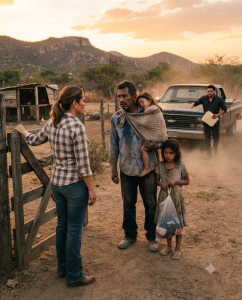
He was dusty, exhausted, and clearly desperate. One little girl slept on his back under a worn rebozo. Another stood beside him clutching a plastic bag with two sets of clothes inside. The man’s face was burned dark by the sun, his hands rough with labor, his eyes dull with fatigue—but his posture was still straight.
“Give me one plate of food for my daughters,” he said, his voice hoarse but steady. “And I’ll work until dawn.”
He did not ask for pity. That was what unsettled her.
Most desperate people, when they sensed a heart might bend, pushed harder. They told you every sorrow in their life before you even asked. They stacked their pain into a performance and waited for mercy to come loose.
This man did none of that.
Socorro looked first at the older girl. Thin face. Dust on her sandals. The look of someone already too old for her age. Then at the little one asleep against his back, cheeks warm and flushed from the road.
“And you?” Socorro asked. “Aren’t you hungry too?”
He lowered his eyes at last.
“I’ll eat if there’s anything left.”
That answer reached somewhere she had kept locked for years.
“Come in,” she said.
Inside the kitchen, the stranger gave his name: Ramón Ríos. The older girl was Milagros. The younger one, Lupita.
As they ate, the story came out in careful pieces. Ramón had been working on another ranch farther south. The owner shut it down without warning and vanished without paying anyone. Ramón waited two days with the others, hoping the man would return. He never did. With nothing left and no wages in hand, Ramón gathered his daughters and started walking. Five days. Ranch to ranch. Gate to gate. Work for shelter. Labor for food.
“And their mother?” Socorro asked without softness, because softness always made hard truths harder to say.
Ramón stared at his plate.
“She died when the little one was born.”
Lupita was busy feeding beans to the cat under the table, too young to understand the silence that followed. But Milagros did. The girl’s shoulders tensed, and she looked at her father with protective attention.
Ramón continued in a low voice. “It was a difficult labor. We were far from town.”
He said no more. He did not need to.
Socorro saw grief all over him—not loud grief, not theatrical grief, but the kind that settles into bone and changes how a person breathes forever.
When the girls finished eating, Ramón rose immediately.
“Tell me where to start.”
Socorro almost told him to sleep. Instead she said, “The chicken coop roof leaks.”
“Then I’ll fix it.”
She watched him take the ladder, tools, and sheet metal without another word.
That night, the sounds of work echoed through the ranch long after darkness swallowed the hills. Hammering. Dragging wood. Water splashing. A gate creaking back into alignment. Socorro lay awake in her bed, arms folded over her chest, staring at the ceiling. At first she listened with suspicion. Then with curiosity. Then with something more dangerous: trust beginning to form before she had approved it.
At dawn she stepped into the yard with coffee in hand and found more than she expected. The roof was fixed. Three fence posts reinforced. The trough cleaned. Firewood stacked. The hinges on the shed oiled.
Ramón stood at the basin washing dust from his face.
“I told you I’d work until dawn,” he said.
She handed him the coffee. “You also worked past what I asked.”
He looked toward the house, where the girls still slept. “They sleep better when I know I earned it.”
That answer stayed with her.
Over the next two days, Ramón did not act like a guest. He acted like a man deeply aware that one wrong move could cost his daughters their last safe place. He repaired loose boards, cleaned tools, checked water lines, patched cracks in the stable wall. He ate only after the girls did. He never sat long. He spoke little. But when he did, there was thought behind every word.
Milagros offered to help without being asked. She gathered eggs, swept the porch, and carried feed with a seriousness that made Socorro ache in ways she was not prepared to examine. Lupita, meanwhile, turned the ranch cat into her best friend and followed it from the kitchen to the yard as though joy were a small animal she might finally catch.
The place changed quickly.
For fourteen years, Los Naranjos had been clean, efficient, and silent. Now there were tiny sandals by the door. Childish laughter near the wash line. Questions at dinner. A sleepy head falling against the table after sunset. It was chaos by Socorro’s standards—and yet the house had never felt more alive.
That was exactly why the gossip in town spread so fast.
At the store, women lowered their voices when she entered. Men under the jacaranda pretended not to stare. Someone told someone else that Socorro Vidal had finally let a man under her roof. Someone added that he was a widower. Someone else said he had daughters. By the time the story circled the church, people were speaking as though a scandal were blooming at Los Naranjos.
Socorro ignored them all.
Until Arturo arrived.
His black pickup truck came just before sunset, roaring up the entrance road with enough force to send chickens scattering. He jumped down with a thick folder tucked under his arm and the expression he always wore when outrage and opportunity were traveling together.
“Is it true?” he shouted before he even reached the gate. “You let a widower and his daughters stay here?”
Socorro folded the sheet she had been hanging and set it aside. “They were hungry.”
Arturo barked out a laugh. “Hungry. Is that all you think this is?”
Ramón was near the corral, tightening wire. Milagros stood beside a bucket. Lupita ran to his leg the moment Arturo raised his voice.
Arturo held up the folder. “That man didn’t come here for food, Socorro. He came for your ranch.”
The air went still.
Socorro felt irritation first. Then something colder. Ramón had gone expressionless. Too expressionless. Not confused. Not offended. Not even surprised.
That was the first crack.
“What are you talking about?” Socorro asked.
Arturo opened the folder dramatically, pulling out copies of old documents and a hand-drawn map she recognized at once. It was one of her father’s boundary maps, yellowed with age, showing the contested strip of land along the eastern edge where a decades-old dispute had never fully died.
“Ríos,” Arturo said, tapping the page. “That name means nothing to you?”
Socorro looked at Ramón.
He met her eyes this time, but remained silent.
Arturo stepped closer, his voice swelling with vindication. “Father spent years fighting a claim tied to that surname. The dispute was never settled cleanly. And now this man appears out of nowhere, lands under your roof, gains your trust, starts fixing the place, and suddenly everyone in town thinks he’s some saint with two little girls.”
Milagros’ face drained of color.
Lupita tightened her grip around Ramón’s leg.
“Is he lying?” Socorro asked.
Ramón’s answer came low and even. “No.”
Arturo smiled as if he had won.
“But,” Ramón added, “he isn’t telling all of it.”
That smile vanished.
“Then tell it,” Socorro said.
For a moment Ramón said nothing. His jaw tightened. Milagros looked up at him with a fear so old it made Socorro’s stomach twist. Then, before Ramón could speak, Milagros stepped forward.
“We didn’t come to steal anything,” she said, her small hands balled into fists. “Mama told Papa to come here if something ever happened to her.”
Arturo blinked. Socorro did too.
Ramón closed his eyes briefly, like the truth had escaped before he could choose its shape.
“What does that mean?” Socorro asked.
Ramón took a slow breath. “Your father knew my wife.”
Arturo scoffed. “Convenient.”
Ramón ignored him. “Before she married me, my wife worked seasonally on a property near here. There was a drought that year. Families were leaving. She had nowhere safe to go. Your father let her and her mother stay in one of the old workers’ houses for almost three months.”
Socorro stared. She had no memory of it. But she had been younger then, often away at market with her mother.
“Her name was Elena,” Ramón said. “She never forgot what your father did. She said he was one of the only men who ever helped without asking for something back.”
Arturo cut in. “And somehow that turns into rights over our land?”
“No,” Ramón snapped, the first true anger in his voice. “It turns into this: when Elena was dying, she made me promise that if the world ever closed in and I had nowhere left for the girls, I should come to Los Naranjos. She said your father once told her this ranch would never turn away honest work.”
Socorro felt something shift beneath her certainty.
Arturo waved the map again. “And the land dispute? That’s just a coincidence?”
Ramón’s mouth hardened. “No. It’s not.”
The yard held its breath.
“My father was the son of the man who filed that claim,” Ramón said. “But he never saw a peso from it. Neither did I. What reached us wasn’t land. It was bitterness. Old stories. Accusations. Men poisoning their sons with grudges over dirt none of them worked.”
Socorro remembered enough of her father’s temper to believe that.
Ramón continued, “When I was young, I heard your family’s name often. Not with respect. But Elena told me the truth was more complicated than that. She told me not every fight belongs to the next generation.”
Arturo’s face twisted. “So you admit it. You came here because of the land.”
“I came here because of my daughters,” Ramón said. “And because my wife trusted this place more than she trusted her own blood.”
That landed harder than anyone expected.
Arturo looked at Socorro quickly, recalculating. “You can’t actually believe him.”
Socorro did not answer at once.
Instead, she looked at Milagros—the child who always checked whether Lupita had enough before taking her own bite. She looked at Lupita, half-hidden behind her father’s leg, frightened by a fight she could not understand. She looked at Ramón, whose hands were blistered from repairing a ranch he had no reason to repair if he planned to seize it by trickery.
Then she looked at Arturo, who only seemed to visit when papers were involved.
“What exactly were you hoping to prove?” she asked.
Arturo stared at her. “I’m trying to protect you.”
“No,” she said. “You’re trying to frighten me.”
His face darkened. “You think that man is honest? Then ask him why he never told you who his father was.”
Ramón answered before she could. “Because the moment people hear an old enemy’s surname, they stop seeing who is standing in front of them.”
The simplicity of that struck her harder than any speech.
Still, Socorro did not like being kept in the dark.
“You should have told me,” she said.
Ramón nodded once. “I know.”
“Then why didn’t you?”
He looked toward his daughters. “Because I have spent their whole lives trying to keep other men’s grudges from becoming their inheritance. And because hunger leaves little room for noble timing.”
Arturo let out a bitter laugh. “Beautiful words. Very moving.”
Then he made his mistake.
He turned to Milagros and said, “Your father is teaching you to take what isn’t yours.”
The sound of Socorro’s slap across Arturo’s face cracked through the yard before anyone saw her move.
Even the chickens went silent.
Arturo staggered half a step, stunned.
“Do not,” Socorro said, each word sharp as broken glass, “drag those girls into a fight they did not start.”
His hand rose to his cheek. Fury burned through his embarrassment. “You’re choosing strangers over your own family?”
“Family?” Socorro said. “You come here with old papers and poison in your mouth, and you call that family?”
He opened his mouth again, but Socorro had already taken the folder from his hand.
She flipped through the pages quickly. Most were copies of records she had seen before. Claims. Counterclaims. Notes in her father’s handwriting. Old bitterness pressed flat between legal language. At the back, however, was something new: a typed draft agreement. Unsigned. Fresh.
Socorro lifted it slowly.
“What is this?”
Arturo’s silence answered too fast.
She scanned the page. It was a proposed sale of the disputed eastern strip to an outside developer pending her signature as primary heir.
Her eyes rose.
“You were going to sell it.”
Arturo drew himself up. “That section has been trouble for years. I found a buyer. It’s practical.”
“Without telling me?”
“I was going to tell you when—”
“When it was too late to stop it?” she said.
The truth came together with ugly speed. Arturo had not come to protect the ranch. He had come because Ramón’s presence threatened his own plan. A man linked, however distantly, to the old dispute was the last person Arturo wanted near the property lines while he tried to push a sale through.
“You wanted me scared,” Socorro said quietly. “Scared enough to sign.”
Arturo’s expression hardened into something almost unfamiliar. “You don’t understand what kind of money—”
“I understand perfectly.”
Ramón said nothing. He did not need to. The shame in the yard belonged entirely to Arturo now.
For a moment no one moved.
Then Milagros, in a tiny voice, asked, “Do we have to leave?”
Socorro turned to her.
The girl was trying not to cry. That effort alone nearly broke something in Socorro’s chest.
“No,” Socorro said. “Not because of this.”
Arturo looked from Socorro to Ramón and back again. “You’re making a mistake.”
“Maybe,” Socorro said. “But it’ll be mine.”
He snatched the remaining papers from her hand, spun on his heel, and stormed back toward his truck. Gravel sprayed as he tore down the road.
When the dust finally settled, silence returned in layers.
Lupita began to cry then, small frightened sobs she had been holding in. Ramón knelt and gathered her into his arms. Milagros stood very still, as though any movement might shatter the fragile peace that had survived the afternoon.
Socorro looked at Ramón.
“You should have trusted me with the truth.”
“I know.”
“Do you want that land?”
He did not answer immediately, which made his answer worth hearing.
“I want my daughters to sleep without fear,” he said. “I want work I can earn honestly. I want a future that doesn’t start with another man’s feud. If you ask whether I came here to take your ranch, the answer is no.”
Socorro believed him.
Not because he sounded noble. Not because Elena had once trusted her father. Not because the girls needed safety.
She believed him because every broken thing he had touched since arriving, he had tried to repair instead of claim.
That mattered.
Over the following weeks, the arrangement became something steadier. Ramón stayed on as paid help once Socorro insisted he accept wages. Milagros began laughing more and watching less. Lupita claimed half the yard as her kingdom and the old cat as her loyal subject. At night, the house filled with the sounds of ordinary life—chairs scraping, dishes clinking, a child resisting sleep, someone humming absentmindedly while folding laundry.
Arturo stayed away.
But his absence did not erase what had happened. The attempted sale forced Socorro to review every paper tied to the ranch. She hired a lawyer from Guadalajara, not one of Arturo’s drinking companions from town. The old boundary dispute was finally examined properly, and the result was messier than either family legend allowed: both sides had been wrong, both sides had been stubborn, and both fathers had allowed pride to outlive reason. In the end, the disputed strip remained with Los Naranjos under corrected registration, but the process exposed just how close Arturo had come to manipulating the situation for his own gain.
Socorro did not forgive him quickly.
Ramón did not ask her to.
One evening months later, as the rainy season cooled the air and the scent of wet earth drifted through the open kitchen window, Socorro found Ramón sitting on the back step after the girls had fallen asleep.
He looked less haunted than the man who first appeared at her gate, though grief still lived in him.
“Elena must have trusted this place very much,” Socorro said.
He nodded. “She trusted your father. More than that, she believed kindness leaves a mark that doesn’t disappear.”
Socorro sat beside him. “My father could be difficult.”
Ramón smiled faintly. “So could my wife.”
For the first time, they laughed together without tension wrapped around it.
After a while, Ramón said, “I almost turned back twice before coming here.”
“Why didn’t you?”
He looked toward the dark outline of the coop he had fixed on his first night. “Because when everything else is gone, sometimes a promise is the only road left.”
Socorro understood that.
The story of how he arrived would remain in town for years, changed and retold with each version. Some said she saved him. Some said he changed her. Some still whispered that trouble had entered her ranch wearing a widower’s face.
But the truth was less dramatic and more dangerous than gossip ever managed to be.
A tired man had asked for food.
A guarded woman had opened her gate.
And between them stood two children who made lying much harder and mercy much more expensive.
In the end, the ranch did not fall because a stranger entered it. It came closest to breaking because someone born inside the family tried to carve it apart for profit.
That was the part Socorro never forgot.
Nor the other truth that lingered long after Arturo’s dust had settled: sometimes the person at your door is not the threat. Sometimes the real danger is the one who already knows where you keep your papers, your grief, and your fear.
Years later, when people asked Socorro why she let Ramón stay, she never gave them the answer they expected.
She did not say pity.
She did not say loneliness.
She did not even say destiny.
She said, “Because he asked for food for his daughters before asking for anything for himself.”
And for a woman who had spent most of her life measuring others by what they tried to take, that told her more than any document ever could.
Still, on certain quiet nights, she would think about the gate at sunset, the dust on Ramón’s shirt, Milagros holding that plastic bag, little Lupita asleep on his back, and Arturo’s papers flapping in the wind like old ghosts trying one last time to stay alive.
Then she would ask herself the only question that still mattered:
What ruins people faster—hunger, pride, or the grudges they inherit before they are old enough to choose their own?