The first thing Julián Aranda noticed was the silence.
Not the usual quiet of dawn at Rancho El Mezquite, when the wind still held a trace of coolness and the cattle shifted lazily before the day’s heat came down. This silence felt wrong. Empty. Like something had been removed from the land so completely that even the air had not figured out how to fill the space it left behind.
He stood at the edge of the north pasture while the sun rose over the hard country of Chihuahua, turning the dust pale gold. The gate was still shut. The chain still hung where it belonged. The fence line stood straight, without a broken post or sagging wire. There was no sign of struggle, no blood, no injured animal crying from the brush.
And yet forty head of cattle were gone.
Behind him, Evaristo Robles removed his hat and held it against his chest. “I counted twice.”
Julián didn’t look at him. “Count again.”
“I already did.”
Only then did Julián turn. Evaristo was fifty-two, dark from decades in the sun, a little slower in the knees than he used to be, but steady in all the ways that had mattered for years. He had worked for Julián’s father, then for Julián. He had taught ranch hands how to mend fence, judge weather, and calm a nervous horse. He had stood at the grave when Julián buried his father. He had stood there again when they buried Inés.
There were men a ranch owner trusted.
And then there was Evaristo.
Julián set down the coffee cup he was still holding and walked the pasture himself. Four ranch hands followed. The earth was dry and cracked, making tracks difficult to read, but near a shaded stretch by the fence, he found faint marks—sandaled footprints, nearly erased by the wind.
That was all his anger needed.
“They came from the hill,” he said.
No one contradicted him.
Across the arroyo, a Rarámuri community had lived for years in small homes among low pines and rock. They sold baskets in town sometimes. Herbs. Labor during hard seasons. They passed the ranchers in the market, in church on feast days, at the well in bad drought years. They lived close enough to be seen and far enough to remain strangers.
Julián had never tried to know them. He had never thought he needed to.
By midmorning, he was riding uphill alone.
The old man who met him introduced no ceremony into the moment. Don Nabor stood in front of the settlement with a straight back and clear, watchful eyes.
“Your cattle are not here,” he said.
Julián’s mouth hardened. “You haven’t heard what I came to ask.”
“You don’t need words for a face like that.”
“I want to search.”
Don Nabor moved aside. “Search.”
The permission made Julián feel no less hostile. He looked everywhere. Small corrals. Smoke-blackened kitchens. Storage sheds. Lean-tos. Every place stolen animals might be hidden. Children watched him from behind their mothers. Men stood with unreadable expressions. Women said nothing at all.
He found no trace of his cattle.
No hides. No blood. No fresh meat. No evidence of slaughter or sale. Only simple lives interrupted by a man too angry to see his own ugliness.
Then, under a rough shade roof beside one of the houses, he saw a young woman sewing a blue blanket.
“She is my daughter,” Don Nabor said. “Leave her out of this.”
Julián took off his hat on instinct. “Ma’am.”
The woman looked up at him. Her expression was calm enough to unsettle him. Not submissive. Not frightened. Not even openly offended. Just calm, as if she saw something in him he was trying very hard not to see himself.
Her name, he later learned, was Mireya.
She returned to her stitching without a word.
Julián rode home feeling no relief, only irritation sharpened by embarrassment. He had expected evidence. Resistance. Something to confirm the story he had already written in his mind. Instead, he had been forced to walk through a community that had every reason to resent him and found nothing but silence.
Still, he apologized to no one.
For the next six nights, Rancho El Mezquite became a watch post. Men took shifts near the north pasture. Lanterns stayed lit. Dogs were moved closer. New locks were added to the gates. Evaristo organized most of it, moving through the yard with the authority of a man who had protected the place his whole life.
On the seventh morning, eighteen more cattle were gone.
This time, Julián did not feel rage first.
He felt dread.
The losses no longer made sense as a simple outside theft. Whoever was taking the animals understood the ranch too well. They knew where the men stood watch, when the dogs would be quieted, how to open the gate without a sound, how to move cattle without leaving panic behind.
As he rode back toward the arroyo, Julián told himself he was not returning to the settlement for answers.
But he was.
Mireya was waiting near the dry creek bed as though she had known he would come.
“You lost more,” she said.
“How do you know that?”
She met his eyes. “Because a proud man does not come back where he was wrong unless something finally scares him.”
He climbed down from his horse. “Then help me.”
Her gaze shifted toward the ground. “Three nights ago I saw horse tracks in the arroyo. They were heading away from your land. Not from ours.”
“That sounds like an accusation.”
“No,” she said quietly. “An accusation is what you brought to us.”
She led him toward a patch of shaded mud beneath the roots of a cottonwood. There, preserved more clearly than anywhere else, was a horseshoe print with a small triangular notch broken from one side.
Julián stared at it.
He knew that shoe.
The horse belonged to the ranch. More specifically, it belonged to one of the riders who moved through El Mezquite so naturally that nobody would question his presence in the dark.
He did not thank her. He did not deny what he had understood.
But when he looked back at Mireya, some of his hardness had cracked.
“Why tell me?” he asked.
“Because I know what it costs when people decide guilt before truth.” She paused. “And because if someone near you is doing this, more will disappear.”
He returned to the ranch and said nothing. That silence was the hardest thing he had done in years. At supper, Evaristo sat across from him, tearing tortillas with rough hands and speaking about feed, water levels, and a broken hinge near the calving pen. Julián listened to every word, searching for a tremor, a hesitation, a slip.
Nothing.
Tomás, the youngest ranch hand, ate nearby with his head down. He had arrived six months earlier asking for work, thin and respectful, eager enough to impress. Julián had taken him in because he remembered what it was to be young and desperate for a chance.
That night, Julián hid in the old feed shed above the north pasture with a rifle across his knees.
He waited.
Near midnight, a whistle drifted through the dark. Low. Specific. A signal, not a tune.
Another answered from farther down.
Then came the soft metal click of the gate opening.
Julián eased toward a gap in the boards and watched shadows move among the cattle. Two riders guided animals toward the arroyo, calm and practiced. One rider sat a little heavier in the saddle. One horse showed a slight hitch in its rear step.
The notched shoe.
Julián’s heart began to pound so hard he could feel it in his jaw.
He followed them at a distance through the creek bed, keeping to deeper shadow. The cattle moved in a long restless line. Dust rose around their legs and hung low in the moonlight. The ravine narrowed ahead until the walls stood high on both sides, turning the place into a corridor of stone.
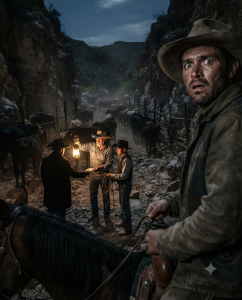
Then he saw the lanterns.
Three of them, hooded low.
Men stepped out from the dark.
Evaristo dismounted first.
Julián nearly made a sound. It took everything in him not to.
Tomás got down beside him and began pushing the cattle into a makeshift holding space between the rocks. Another man, broad and unfamiliar, crouched with a ledger while a fourth checked brands with a lantern.
“Move them before sunrise,” the stranger said.
Tomás muttered, “What if the boss starts checking farther south?”
Evaristo gave a dry laugh. “He won’t. He’s too busy staring at the hill. Men usually see what they already want to believe.”
Julián felt the words like a blow under the ribs.
This had not been impulsive. Not desperate. Not some one-time betrayal born of debt or weakness. Evaristo had studied him. Understood his grief, his pride, his blind spots. And he had used them.
Julián shifted to get a better look at the buyers when his horse nudged a loose stone. It skittered down the slope.
Every man below looked up.
For a second, no one moved.
Then Evaristo’s voice cut through the ravine. “Who’s there?”
Julián could have fired. Instead, he kicked his horse forward and rode into the lantern light.
Shock hit Tomás first. “Boss—”
Evaristo didn’t finish the expression on his face. It began as surprise, hardened into calculation, and ended in something Julián had never seen there before: contempt.
“So,” Evaristo said, straightening. “You finally looked in the right place.”
Julián kept the rifle pointed low but ready. “How long?”
Evaristo said nothing.
“How long?” Julián repeated.
Tomás swallowed hard. “It wasn’t supposed to—”
“Quiet,” Evaristo snapped.
That told Julián enough. Tomás was weak. Evaristo was the spine of it.
The stranger with the ledger began edging backward, but Julián raised the rifle. “Nobody moves.”
“Careful, boss,” Evaristo said. “You’re one man.”
“And you’re a thief.”
Evaristo’s mouth twisted. “A thief? I gave this ranch thirty years.”
“And you stole from it.”
“I helped build what your father left you. I held it together while you drowned in your grief. I watched you shut every decent person out and trust only your own bitterness. Don’t act shocked that rot grows where a man stops looking.”
Julián’s hand trembled with anger. “You think grief excuses this?”
“No,” Evaristo said. “Need does.”
At that, something in the older man’s anger shifted and revealed what sat beneath it. Not innocence. Not remorse. Resentment.
He glanced toward the far side of the ravine, where two wagons stood waiting.
“You want truth? Here it is. Taxes rose. Feed costs rose. Water got worse. And every season your land became more valuable to men with money. They made offers. You refused them all. So I made my own arrangements.”
“The land,” Julián said, remembering the voice he had heard earlier. “This was never only about cattle.”
Evaristo gave a thin smile. “No.”
He nodded toward the stranger, who now looked less like a cattle buyer and more like a broker. “Developers want access through this area. Road rights. Storage. Future drilling surveys maybe. Once your losses got bad enough, you’d have to sell off parcels. Maybe the whole ranch. Especially if your neighbors took the blame and no one trusted anyone long enough to unite against the deal.”
The ugliness of it settled over the ravine.
Not just theft.
Manipulation.
Division.
A plan built on old prejudice and fresh desperation.
Tomás looked sick. “He said it was temporary,” he blurted. “He said nobody would get hurt.”
Evaristo rounded on him. “Shut up.”
But the boy kept going, words tumbling loose now that fear had broken him. “He said we’d sell enough cattle to weaken the ranch, then spread stories in town, make people think the hill communities were behind it, drive down prices, pressure you to borrow, then sell. He said everyone does it like this.”
Julián looked at Evaristo as though seeing a stranger wearing a familiar face.
“You buried my father with us,” he said quietly. “You stood beside me when Inés died.”
Something flickered in Evaristo’s expression then, but it was too late and too small.
“I stood beside you,” Evaristo said, “and you still never saw me.”
The sentence hung there longer than the others.
Julián finally understood that part of Evaristo’s betrayal had been greed, but another part had grown from years of swallowed bitterness. He had spent his life serving a family whose name would never be his, on land he knew better than any owner ever could. He had wanted more. Perhaps he had once believed he deserved more. At some point, resentment had found men willing to profit from it.
The standoff broke when Tomás tried to run.
One of the buyers lunged after him. Julián fired into the air. The shot exploded through the ravine, sending cattle surging and men ducking. Horses panicked. Lantern light swung wildly.
That chaos saved him.
Voices answered from the ridge above.
Riders.
More than one.
Mireya appeared first at the edge of the ravine with two men from her community, and behind them came three ranch hands Julián had secretly warned earlier that evening in case he did not return by dawn. Don Nabor himself rode behind them, straight-backed even in the saddle.
The buyers broke.
One made it to a wagon before a ranch hand dragged him down. Another dropped the ledger in the dust and threw up his hands. Tomás sank to his knees crying. Evaristo stood very still, then slowly removed his hat.
When the local authorities arrived with first light, the story spilled out in pieces, then all at once. Records in the ledger connected the thefts to a broker working for outside investors. There had been efforts to stir suspicion between ranchers and Indigenous communities in the area before land negotiations began. Missing cattle from other properties were tied to the same network. False rumors had traveled faster than proof, just as planned.
Tomás confessed everything by noon.
Evaristo said less, but enough.
The days that followed were harder than Julián expected. Recovering stolen cattle was only one part. Repairing what his own accusation had damaged was another.
He rode back to Don Nabor’s settlement without a weapon this time.
The people watched him arrive. No one welcomed him. No one needed to.
He stood before Don Nabor, then looked at Mireya.
“I was wrong,” he said.
The words felt small. Inadequate. But they were true.
Don Nabor studied him for a long moment. “Yes,” he said. “You were.”
Julián nodded, accepting the sting of it. “I accused your people because it was easier than doubting my own house.”
Mireya folded her arms. “That is how injustice usually starts.”
He had no defense.
Over the following weeks, he did what he could instead of speaking too much. He testified clearly. He corrected rumors in town. He named Evaristo’s scheme without hiding behind vague language. He worked with neighboring communities on new grazing patrols and shared water watch information during a stretch of brutal heat. It did not erase what he had done, but it was a beginning.
As for Evaristo, the law took him, but punishment alone did not settle the ache of it. Betrayal by an enemy hardens a person. Betrayal by someone woven into your daily life leaves a different wound. Julián found himself looking toward the bunkhouse at dusk expecting to see him there. He would hear an old phrase in his head and remember whose voice used to say it. Anger came. So did grief. Then something uglier than either: shame at how ready he had been to blame the people on the hill.
That part belonged to him.
One evening, months later, rain finally arrived over the canyons in a silver curtain that darkened the dirt and cooled the whole valley. Julián stood under the porch roof watching it when he noticed a rider approaching through the storm.
It was Mireya.
She dismounted without ceremony, rain beading on her braid and shoulders. For a moment they simply listened to the downpour.
“The calves are doing better near the south grass,” she said. “You should keep them there another week.”
He blinked. “You rode here in the rain to tell me that?”
“You were about to move them tomorrow,” she said. “That would have been a mistake.”
He almost smiled. “You sound very certain.”
“I usually am.”
There was no softness in her voice, but there was no distance either. Just honesty.
He looked out toward the pasture, then back at her. “I still think about the day I rode to your community.”
“You should.”
“I do.”
She nodded once, satisfied by the answer. Then she stepped under the porch beside him as thunder rolled across the hills.
People in town would later say many things about what grew between them after that. Some would exaggerate it into romance too quickly. Some would reduce it to symbolism, as if a single relationship could erase history. The truth was simpler and harder: trust built slowly, and only where truth had been faced without excuses.
Julián never forgot that.
What happened at Rancho El Mezquite became a warning in the region. Not only about theft, or land greed, or corrupt deals hidden behind respectable men. It became a warning about how easily suspicion can be aimed where history has already made it convenient. How quickly grief can turn a person rigid. How pride can make a lie feel believable simply because it confirms what is easiest to fear.
In the end, Julián recovered much of the cattle, saved the ranch, and exposed the scheme.
But the hardest thing he recovered was his own judgment.
And the question that stayed with everyone who heard the story was not whether Evaristo deserved punishment. He did.
It was whether Julián’s greatest mistake was trusting the wrong man—
or being so ready to distrust the right people.