The morning the bank took Martina Salcedo’s house, she did not scream, beg, or collapse in tears the way people expected women like her to do.
She stood in the doorway while the court officer read from a stamped folder and two bank employees avoided looking directly at her. The sun had barely risen over the outskirts of Celaya. The light was pale and merciless. Dust clung to the hem of her skirt. Somewhere nearby, a dog barked once and then went silent, as if even the street understood there was nothing to be done.
When the men finished listing what the bank now owned, Martina asked only one question.
“How long do I have?”
The officer shifted awkwardly. “An hour.”
She nodded and closed the door in their faces.
Inside the house, she moved without shaking. That surprised her most. Twenty-three years of carrying other people’s debts had hollowed out her fear long ago. By then, humiliation was familiar. It had sat at her table, slept in her bed, followed her into every market and church pew. Her late husband had left her more than grief. He had left promises made carelessly, loans signed recklessly, and the kind of ruin that stuck to a widow because everyone found it easier to blame the woman who remained than the man who had disappeared into the ground.
She packed three dresses into an old trunk. A photograph of her mother. Her knives. Her cast-iron skillet.
Then she opened the drawer where she had kept her husband’s gold watch for years.
It was the one thing she had never sold.
Not because she loved it, but because she hated what it represented. His charm. His foolish pride. The way people still spoke of him as if he had merely been unlucky instead of irresponsible.
She walked outside to the irrigation canal, looked at the watch for one last second, and threw it into the muddy water.
It vanished instantly.
“So do the last of your excuses,” she whispered.
By noon, she no longer had a house.
By sunset, she no longer had a reason to stay.
Two days later she arrived in San Miguel de Allende with a folded paper advertisement and a trunk that seemed heavier with every mile. Los Encinos Ranch needed a cook for the work crew. Ask for Esteban Carranza.
The ranch driver who met her at the bus stop barely spoke until they left town behind. Then he gave her the warning every newcomer got.
“The men work hard. They eat hard. Don Esteban doesn’t tolerate laziness.”
Martina adjusted the skillet resting across her knees and said, “Neither do I.”
He glanced at her then, as if noticing for the first time that she was not the kind of woman who apologized for taking up space.
The ranch appeared in stages: stone walls, dry pasture, corrals, low adobe buildings browned by sun and dust. It was not beautiful in any soft or romantic way. It was weathered. Useful. Alive with effort. Martina liked it immediately because it looked honest.
The first person to greet her was the foreman, Julián, whose skepticism arrived before his words did.
“You’re the cook?”
“That’s what the letter says.”
“The boss expected someone younger.”
Martina stepped down from the truck, lifted her own trunk, and looked him in the eye. “Then he can tell me himself.”
That answer followed her all the way to the corral, where Esteban Carranza stood bent over a mare with an injured leg. He straightened when he heard her footsteps.
He was younger than she expected and older too, in the ways that mattered. Broad-shouldered. Quiet. Dark-haired, but touched with gray at the temples. Not handsome in the polished sense. Something firmer than that. A man shaped by loss and work, not vanity.
“Mrs. Salcedo,” he said.
“Mr. Carranza.”
“I need someone who can cook for fourteen men three times a day. No drama.”
“Give me your kitchen until tomorrow,” she replied, “and you’ll have your answer.”
One corner of his mouth almost moved. Not quite a smile. More like respect noticing itself.
The kitchen was a disaster left by neglect. Greasy pots. Stale flour. Shelves in disorder. But the bones of it were good. Strong table. Good heat. Big stove. She had built meals out of less.
She found beans, rice, potatoes, dried chiles, eggs, stew meat, and guavas. By evening she had transformed those humble things into a meal that made the whole building smell like safety.
The men came in loud and hungry. They went quiet after the first bite.
All except Daniel, a young ranch hand too eager to be cruel in front of others.
“No wonder they hired a big cook,” he said with a smirk. “Probably cooks like she’s feeding a wedding.”
Martina poured him coffee and answered so calmly that his grin collapsed.
“You’re going to finish that plate. Then ask for more if you’re still hungry. And tomorrow you’re going to thank me.”
The room waited.
Daniel ate.
He asked for seconds.
The others never forgot it.
That night, after the dishes were washed, Esteban stayed in the doorway and watched her tie dried herbs with a piece of twine.
“Where did you learn?” he asked.
“In a house where hunger never missed a meal.”
He nodded. There was no pity in him, and because of that, she answered more honestly than she meant to.
“People think cooking is softness,” she said. “It isn’t. It’s strategy. Timing. Knowing what to save and what to sacrifice.”
His eyes held hers a second longer than necessary. “If you stay, this ranch gets better.”
The words settled into some bruised place inside her. She had spent years being treated like a burden. One sentence from a stranger nearly undid her.
Then a woman’s voice sliced through the open window.
“So that’s the woman you brought in to live on your ranch, Esteban.”
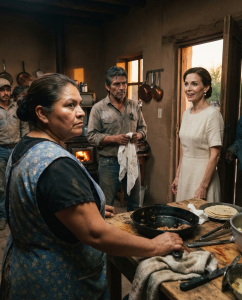
Martina turned and saw elegance sharpened into a weapon.
Isabel.
She stepped out of a black truck in white clothes too fine for dust, smiling with practiced cruelty. Esteban’s whole body changed at the sight of her. Not longing. Not welcome. Tension. History.
She walked into the kitchen like she still owned every silence there.
“No one said the new cook would be permanent,” Isabel said.
Martina wiped her hands. “If you came to eat, sit down. If you came to insult me, do it quickly.”
Several men lowered their heads to hide their reactions. Esteban said, “That’s enough, Isabel.”
But Isabel barely looked at him. Her attention was fixed on Martina with the particular hostility of a woman who wanted her reduced immediately.
“You should be careful,” Isabel said. “Men like Esteban don’t bring women onto a ranch unless they expect something.”
Martina met her gaze. “Then it’s a good thing I don’t scare easily.”
What happened next might have ended as one more bitter exchange if an older ranch hand had not rushed in from the yard, pale and breathless.
“The north pasture,” he said. “Someone cut the fence. Three horses are gone.”
The kitchen changed at once.
Esteban moved for the door. Julián swore. Daniel dropped his plate into the wash basin with a clatter.
Then came the detail that stopped everything.
“In the tack room,” the ranch hand added, “there was a scarf caught on the broken latch.”
He brought it in moments later.
White silk. Fine embroidery. Expensive perfume.
Isabel recovered fast, but not before Martina saw a crack in her expression. It was tiny. A blink too slow. A jaw too tense.
“That didn’t tear by accident,” Martina said.
Isabel gave a brittle laugh. “You’ve been here one day.”
“Yes,” Martina said. “Long enough to know women who wear silk don’t crawl over broken wood. They send someone else.”
Esteban turned toward Isabel, studying her with a stillness that felt more dangerous than anger.
Before anyone could speak again, the old ranch hand opened his palm and showed them something else found near the broken fence: a brass button.
Esteban’s face hardened.
Martina did not know the button, but Isabel did. Her color drained so quickly it was answer enough.
“Where did you find this?” Esteban asked.
“Near the hoof prints.”
Julián muttered a name under his breath before he could stop himself.
Rafael Mena.
The room went cold.
Martina quickly pieced together the shape of what had just surfaced. Rafael had once worked for Esteban. Not as a hand. As something closer. Trusted. The kind of man who had known the land, the routines, the lock placements, the weak spots in the fence. Years ago, he had been thrown off the ranch under circumstances nobody there liked discussing.
And Isabel knew exactly why.
“What is Rafael to you?” Martina asked, not looking away from her.
Isabel lifted her chin. “Nothing.”
“Then why do you look like a widow hearing his name?”
Esteban inhaled once, sharply. That told Martina enough. The real injury was older than stolen horses. More intimate. More expensive.
Later, she would learn everything.
Years before, when Esteban’s wife was still alive but already ill, Isabel had been close to the family. A frequent guest. Helpful. Elegant. Trusted. After the wife died, whispers started, first among neighbors, then among ranch workers. Isabel and Esteban were expected to marry. Instead, Esteban discovered that Isabel had been secretly involved with Rafael for months—using his access to move information, routes, and sale dates to men who trafficked stolen livestock across state lines.
Esteban had kept the scandal quiet to protect his late wife’s memory and the ranch’s reputation. He had paid off damages privately, fired Rafael, and cut Isabel out of his life. Everyone believed that ended it.
It had not.
Now the missing horses proved the theft ring had returned, and Isabel had walked straight into the kitchen before anyone even announced the crime. That meant she had come not to visit, but to stage a story.
Martina saw it clearly before the others did.
“She wanted witnesses,” Martina said.
Julián frowned. “What?”
“She arrived while everyone was still here. She insulted me in front of the men. She made sure all eyes were on the kitchen. If that scarf had been blamed on me, she’d have a stranger on the property with no history, no allies, no proof, and a convenient reason to accuse me of helping thieves.”
Daniel cursed softly. “Dios.”
Esteban looked at Isabel as if seeing the final shape of her for the first time. “Did you think I’d believe her over you?”
“No,” Martina said before Isabel could answer. “She thought you’d believe confusion. That’s enough when a person is already vulnerable.”
Isabel’s composure started to split. “You have no idea what you’re talking about.”
Martina stepped closer. “No? Then tell us why you’re wearing one earring.”
Isabel’s hand flew to her left ear too late.
Daniel let out a startled sound. Even Julián blinked.
Martina had noticed it the moment Isabel walked in. One pearl earring. The other missing. Vanity like hers did not misplace details by accident.
“Search the tack room floor,” Martina said.
Julián went himself.
The wait was short and unbearable.
When he returned, he held up a pearl earring coated with dust.
That ended the denial.
Isabel’s face changed completely. The polished mask dropped, revealing something meaner and more desperate.
“You think this proves anything?” she snapped. “That ranch owes me.”
“Owes you?” Esteban repeated.
“Yes,” she said, voice trembling now with fury rather than grace. “I gave years to this place. To your family. To you. And you cast me aside because of one mistake.”
“One mistake?” Esteban’s restraint finally broke. “You stole from me while my wife was dying.”
Isabel laughed bitterly. “Your wife was dying long before I did anything. Don’t make me your villain because you needed someone to blame.”
The words struck the room like a slap.
Even Daniel, careless Daniel, seemed ashamed to witness it.
Esteban went deadly quiet. “Get off my property.”
But Isabel had crossed too far to retreat cleanly.
“Rafael only took what you never deserved,” she said. “And those horses are already gone.”
That was the confession.
Not complete, but enough.
Julián took a step forward. “Should I call the authorities?”
“Yes,” Esteban said.
Isabel spun toward the door, but Martina moved first. Not by grabbing or shouting. She simply stepped into her path with the skillet still in her hand from where she had set it aside earlier. She did not raise it. She did not need to. Her stance alone was enough.
“You should sit down,” Martina said.
For the first time that evening, Isabel looked uncertain.
Within an hour, the rural police arrived. Under questioning, Isabel kept trying to recast herself as a victim, but the earring, the scarf, and the button linked her to the scene. A patrol was sent toward the old road Rafael used years earlier when transporting cattle. By dawn, two of the horses were recovered in a hidden corral near an abandoned lime kiln. Rafael was arrested trying to flee on the third. He had records, forged permits, and enough evidence with him to expose a small theft network operating through neighboring ranches.
By noon the story had spread, though not all of it. Esteban never gave people the parts that fed gossip too well.
What mattered was this: Martina’s name never got dragged through it.
In fact, the opposite happened.
By evening, the men on the ranch treated her differently. Not with false sweetness. With respect. Daniel thanked her properly for the first time in his life, or close enough to it.
“If you hadn’t noticed the earring…” he started.
“But I did,” she said, rolling dough.
He nodded, chastened. “You did.”
Julián’s approval came harder, which made it worth more.
“I judged you wrong,” he said the next morning by the stove.
“Yes,” Martina replied.
To his credit, he almost smiled.
As for Esteban, he found her after supper standing outside the kitchen watching dusk settle over the fields. The recovered horses had been led back. The fences were being mended. The ranch sounded tired but alive.
“I should have told you who Isabel was,” he said.
“You didn’t owe me your history.”
“No. But I owed you protection from it.”
Martina looked at him then. Really looked. Men often confused regret with repair. Esteban did not seem like one of them, but she had learned not to trust too quickly.
“I’m not asking for protection,” she said. “Only truth.”
He accepted that. “Fair.”
After a moment he added, “When I said the ranch gets better if you stay, I meant it.”
She smiled, small and unwilling, the kind that surprised her own face.
“For the record,” she said, “your men eat like wolves.”
“I warned you.”
“No. The driver warned me. You only issued terms.”
That earned the first real smile she had seen from him.
The days that followed did not turn magically soft. Los Encinos remained what it was: a hard place built by hard people. But something in Martina’s life shifted. No one there treated her like a leftover. The kitchen became hers in the full sense of the word. She reorganized shelves, started a garden patch for herbs, taught the youngest hand not to burn coffee, and quietly became the center of the ranch in the way the strongest women often do—without ceremony, without title, without ever asking permission.
Weeks later, a letter arrived from the bank about the final closure of her old property. She held it over the stove flame and watched it curl to ash.
Esteban, passing the doorway, said nothing.
He did not need to.
Some endings did not require witnesses.
Months later, when the rainy season finally broke the heat and the first green pushed up through the pasture, Martina stood at the kitchen window and thought about the woman she had been the day the watch sank into the canal.
Homeless. Humiliated. Discarded.
She had believed that was the final chapter.
It wasn’t.
It was only the day her old life stopped pretending it could still hold her.
Whether Esteban ever became more than the man who offered her work was a question the ranch left unanswered for a long time. Maybe that was wise. Both of them had buried too much to rush toward promises. But trust grew there, steady as bread rising under a cloth, and sometimes that was worth more than romance.
What everyone agreed on, even the men too stubborn to say such things aloud, was simpler than that.
Los Encinos changed the day Martina Salcedo walked into its kitchen carrying nothing but a trunk, a bundle of knives, and a skillet blackened by years of survival.
She had arrived as a stranger people underestimated.
She stayed as the woman who saw through lies faster than anyone, fed fourteen men like they mattered, and refused to bend for people who mistook kindness for weakness.
And if there was an aftershock to the whole affair, it lingered in one uncomfortable question that the ranch hands still argued about whenever Isabel’s name came up and the coffee ran low: what was the bigger red flag—betrayal dressed in silk and perfume, or the fact that everyone found it easier to suspect a tired widow with a trunk before they suspected the woman who already knew exactly where to place the blame?