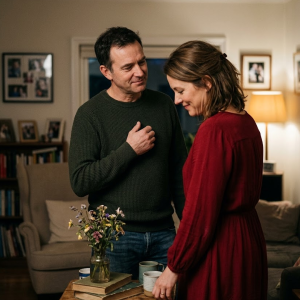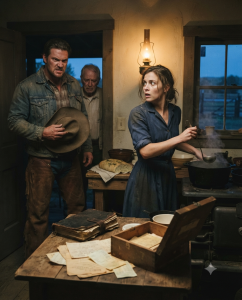
“Who made this stew?” the mountain cowboy roared, and for one suspended second Clara Bennett thought she had somehow ruined everything just by trying to feed a starving house.
She stood in the Whitaker kitchen with a wooden spoon in one hand and steam curling around her face, while Caleb Whitaker filled the doorway like a storm. His voice still echoed off the rafters. Behind him, the hall was dim, and the late light from the western window cut the room in bands of amber and shadow.
Clara had arrived at the ranch only hours earlier. Already, she had walked into grief, old silence, and something far more dangerous than either.
Before dawn that morning she had still believed her worst trouble was humiliation.
Mrs. Aldrich’s boardinghouse had rejected her in full view of Red Hollow. Clara had come all the way from Missouri carrying a signed offer for work, only to be looked over and dismissed as “not presentable.” She had stood in the street with three dollars in her pocket, her travel case at her feet, and her mother’s recipe notebook pressed against her ribs while the town quietly decided she was finished.
Then Caleb Whitaker had ridden in, asked if she could cook, and offered her work on the spot.
He had not sweetened the truth. His uncle Amos was half-lost in grief after his wife Margaret’s death. The ranch house still stood, but the life inside it had gone dim. Caleb needed someone capable, not fragile. Someone who would not flinch at silence.
Clara had accepted because there was nothing else to do.
By the time she reached the ranch, she understood that Caleb had not exaggerated. The house felt paused in a sorrow too heavy to move. Amos Whitaker was a gaunt, sharp-eyed man whose grief had not softened him so much as stripped him down to the hardest parts. He watched Clara open the kitchen window as if she had broken into a chapel.
Then she had said she intended to make rosemary bread.
That had stopped him cold.
Caleb had told her on the ride that Margaret used to bake rosemary bread so often that the smell drifted across the lower pasture. Clara had found the rosemary patch still alive outside the kitchen wall, neglected but stubborn, and had taken it as a sign. If the house had forgotten how to breathe, bread was as good a beginning as any.
She made dough. She cleaned while it rose. She started a stew from what she found in the pantry. She worked the way her mother had taught her—steady hands, clear eyes, no fear of labor, no nonsense wasted on self-pity.
And then she found the box.
It sat shoved behind flour sacks in the pantry, marked with the initials A.W. Dell, one of the ranch hands, saw it in her hands and went still.
“Best leave that,” he told her.
When Clara asked why, he hesitated before admitting those papers were valuable enough that Silas Crowe would happily see them destroyed.
That was the first moment her instincts sharpened.
She waited until the house had quieted before opening the box. Inside were maps, deeds, surveys, and one federal land paper dated 1871. It clearly established that the northern spring belonged to the Whitaker ranch. In a country where dry months could turn decent men cruel, ownership of water was wealth, leverage, survival.
Silas Crowe, whose ranch bordered Whitaker land, was not after a simple strip of earth. He was after the spring.
That explained the tension in town, the careful way Caleb had spoken Crowe’s name, and the exhaustion in Amos’s face when land was mentioned. It also explained why the papers had been hidden in the pantry instead of filed somewhere respectable.
What Clara did not yet know was that someone else had already gone looking for them.
The next morning she saw boot prints near the kitchen steps, too fresh to be old and too careful to belong to casual traffic. By noon a rider arrived from Crowe’s ranch with a smug message: Silas Crowe intended to stop by the following evening with a “neighborly offer.”
Amos fed the note to the stove.
Caleb merely watched the flames.
Clara understood then that whatever war had been building between the two ranches was about to move closer to the house. She also understood something else. The Whitakers had spent so long inside grief that danger had learned to walk around them almost unchallenged.
So she kept working.
She baked the bread. She set the table. She started supper again near dusk, using what she found in a side cupboard that smelled faintly of cloves, sage, and old memories. One tin held a spice blend unlike anything else in the kitchen. Rich, warm, layered with pepper, wild thyme, and something almost sweet beneath it. She added a little to the stew without thinking much of it.
Then Caleb walked in and demanded to know who had made it.
“I did,” Clara answered, too startled to soften her tone. “Why?”
He stared into the pot as though the scent had reached across years and grabbed him by the throat.
“You used that spice tin.”
“It was in the cupboard.”
“That cupboard hasn’t been touched since Margaret died.”
Before Clara could respond, Amos stepped into the doorway. He inhaled once. Then again. His face drained of all color.
“My God,” he whispered.
The smell had done what no conversation, no request, no effort had managed. It had broken straight through the crust of years. Amos crossed to the stove with a trembling hand and dipped the ladle into the stew. He tasted it. His eyes shut.
“Margaret made this the night she told me,” he said softly.
Clara set down her spoon. “Told you what?”
His gaze shifted to the open box on the table.
“That Crowe would come for the spring. That he’d try charm first and force after.”
Caleb turned immediately toward the table. Clara followed his line of sight and felt a sharp chill. The stack of documents was no longer exactly as she had left it. One page was missing.
“When did you move these?” Caleb asked.
“I didn’t,” Clara said.
Dell entered at that exact moment, drawn by the raised voices. The look on Caleb’s face changed before he spoke.
“One paper’s gone.”
Dell swore under his breath.
No one in the room had an answer for how that could have happened. The windows were closed. The front hall had not creaked. None of them had left the kitchen long enough for a stranger to rummage through the papers unnoticed.
Then hoofbeats sounded outside.
Caleb looked toward the porch. “Crowe.”
Silas Crowe arrived just before full dark with one rider beside him. He dismounted with the self-possession of a man accustomed to trespassing under the disguise of courtesy. He was handsome in a polished, expensive way that made Clara distrust him instantly. His smile never reached his eyes.
“I hear you’ve hired yourself a cook,” he said, glancing at Clara. “That was quick.”
“What do you want?” Caleb asked.
Crowe brushed imaginary dust from his sleeve. “Neighborly concern. I worry about Amos managing this place in his condition.”
Amos appeared in the doorway behind Clara, one hand braced against the frame. “You’ve been worrying about my land longer than my health.”
Crowe smiled. “Land, health, family affairs—they often overlap.”
Clara saw it then: the smallest flick of Crowe’s gaze past the men, toward the kitchen table where the papers sat. He knew they had been opened. He knew one was missing.
“You’ve already sent someone inside,” she said.
Crowe’s eyes returned to her. “Bold accusation for a woman who’s been here less than a day.”
“I don’t need more than a day to notice a rat around grain.”
For the first time, Caleb looked at her with something close to approval.
Crowe’s mouth twitched. “Careful. New people often mistake what they think they see.”
Dell came up from the barn at a run before the exchange could sharpen further. He held a torn strip of dark cloth in his hand.
“Caught on the pantry latch,” he said, breathing hard. “Whoever went in there tore this getting out.”
Crowe looked at it and did not react quickly enough. Clara saw the tiny delay. So did Caleb.
But then Clara saw something else.
The cloth was not from Crowe’s coat.
She had seen that fabric before, near enough to brush against it. Not on the porch. Not in town. In the kitchen. At the pantry door. On the shoulder of a man who belonged on the ranch.
Her gaze went to Dell.
He noticed it. So did Caleb.
For one heartbeat everything stopped.
Dell’s face changed first—only slightly, but enough. It was not guilt exactly. It was fear of being found out before he had chosen his own moment.
“You?” Caleb said, disbelief roughening the word.
Dell stepped back. “Listen to me.”
Amos stared at him. “How long?”
“It isn’t what you think,” Dell said.
“That’s what liars say when the truth’s already standing in the room,” Clara snapped.
Crowe’s expression hardened. The charm was gone now. “If you’re going to accuse a man, best do it clean.”
“Funny,” Clara said, “I was about to say the same to you.”
Dell looked from Crowe to Amos, then to the papers on the table, and Clara understood the shape of it all at once. He had not stolen the document for himself. He had been pressured, cornered, or bought. Crowe had used someone inside the ranch because grief had weakened the house and loneliness had made trust careless.
“I didn’t give it to him,” Dell said quickly. “Not yet.”
Caleb moved down the porch steps. “Where is it?”
Dell swallowed. “Safe.”
Crowe’s rider shifted in the yard, and Caleb’s head snapped up at the movement. The atmosphere turned dangerous in an instant.
“No games,” Caleb said.
Dell’s voice rose with panic. “You don’t understand. He said if Amos fought the sale, the county would side with him anyway. He said debts would surface. Taxes. Claims. He said this place was finished one way or another.”
Amos straightened with visible effort. “So you sold me out before the fight was even fought?”
Dell looked sick. “I worked this ranch twelve years. I didn’t want to watch it die.”
“You chose the man killing it,” Clara said.
Crowe took one step toward the porch. Caleb blocked him.
“That document doesn’t save you,” Crowe said calmly now. “You’re behind on taxes, Amos. Your fence lines are failing. Your labor is thin. The county clerk can be persuaded to question any survey old enough.”
“Try it,” Caleb said.
Crowe’s eyes narrowed. “You think sentiment and a cook’s lucky supper will protect this place?”
“No,” Clara said. “But witnesses might.”
Everyone looked at her.
She stepped onto the porch, voice carrying clearly into the dusk.
“I came to Red Hollow yesterday with a written offer from Mrs. Aldrich that she denied the moment she saw me. Your rider delivered a message today announcing this visit before any invitation was given. Dell found torn cloth on the pantry latch. You arrived already expecting the paper to be missing. That’s not neighborly concern. That’s attempted fraud with advance confidence.”
Crowe let out a low laugh, but there was strain under it now. “And who exactly is going to care what a stranger says?”
“Maybe the federal land office,” Clara replied. “Maybe the county judge. Maybe every rancher in this valley who needs that spring to stay under honest title instead of under the thumb of a man who steals first and negotiates second.”
That landed.
Crowe’s power depended on fear, but fear thinned quickly when named aloud in front of witnesses.
Caleb turned to Dell. “Last chance. Where is the paper?”
Dell shut his eyes, then pointed toward the smokehouse.
Caleb moved at once. Clara followed despite his sharp look telling her to stay back. The smokehouse smelled of old cedar and salt. Behind a stack of curing boards, wedged inside a broken flour barrel, Caleb found an oilskin-wrapped bundle.
The missing deed.
Crowe saw it in Caleb’s hand when they stepped back into the yard, and for the first time his composure cracked completely.
“This isn’t over,” he said.
Amos, who had seemed frail all evening, suddenly found a voice that belonged to a much stronger man.
“No,” he said. “It’s finally beginning.”
He ordered Crowe off the property.
Crowe hesitated long enough to show everyone he was calculating whether force would serve him better than retreat. Then he looked around and realized the balance had shifted. Caleb stood ready. Dell had stepped away from him, not toward him. Clara held the recovered document under the porch lamp where every eye could see it.
Crowe mounted without another word. His rider followed. They left in a cloud of dust and bitterness.
The moment the gate shut behind them, Dell sagged like a post pulled from the ground.
Amos looked at him for a long time before speaking. “Why?”
Dell’s answer came out raw. “My brother owes Crowe money. I thought if I brought the paper, Crowe would wipe the debt. I thought at least one family might survive what’s coming.”
The anger in Amos’s face did not disappear, but something older moved beneath it—recognition of desperation, perhaps. He had known enough hardship himself not to mistake panic for pure malice.
“You should have come to me,” Amos said.
Dell laughed once, bitterly. “You hadn’t come to anybody in three years.”
That truth landed even harder than the betrayal.
Silence followed. Not empty silence this time, but the kind that strips excuses down to bone.
At last Amos said, “You’ll stay tonight. Tomorrow we decide whether you still work here.”
Dell nodded, unable to meet anyone’s eyes.
Inside, the kitchen felt changed. The stew still simmered. The bread still sat wrapped in cloth. But the room was no longer sealed around memory alone. It held conflict now, truth, and the first rough stirrings of life.
Amos sat at the table and looked at the bowl Clara placed before him. He took a bite of the stew, then another. No one interrupted him.
After a long while he said, “Margaret used to put a pinch of dried apple peel in the spice tin. Said it rounded the thyme.”
Clara smiled faintly. “That’s the sweetness I couldn’t name.”
He looked up at her. His eyes were wet, though his voice stayed steady.
“You brought her into this room without pretending to be her.”
“It was never meant to be hers again,” Clara said. “Only alive.”
Caleb, standing by the stove, let out a breath she hadn’t realized he’d been holding.
The days that followed were hard, but no longer directionless. Caleb rode to the county seat with the recovered deed, copies of the surveys, and statements from Amos, Clara, and—eventually—Dell. Crowe tried exactly what Amos had predicted. He challenged boundaries, whispered to officials, and hinted at debts. But the paper trail held. So did the testimony.
It helped that Crowe’s methods had reached farther than the Whitaker ranch. Once word spread that he had tried to gain control of the spring through theft and coercion, two neighboring ranchers came forward with stories of pressure and forged “offers.” The county judge, who had once been content to ignore rumor, became far more attentive when federal title was involved.
Within a month, Crowe’s claim collapsed.
Within two months, the debt arrangement with Dell’s brother was exposed as predatory and voided under scrutiny from the court. Dell kept his place on the ranch, though not quickly and not without earning it back. Amos did not forgive easily, but he did something harder: he started speaking again, working again, asking questions at breakfast, complaining about fence repairs, arguing over feed prices, and once—even more shocking—requesting a second slice of Clara’s rosemary bread.
The kitchen changed first, then the house, then the ranch.
Windows opened. Floors echoed with movement instead of memory alone. Men laughed in the yard again. Amos began telling stories about Margaret without sounding as if each sentence cost blood. He even showed Clara where Margaret kept her better serving platters and admitted she would have approved of anyone who answered Silas Crowe with the kind of spine Clara had shown.
As for Caleb, he remained a man of few words, but silence around him grew easier to read. Gratitude showed in the way he fixed a loose porch step before Clara noticed it. Respect in the way he asked her opinion on accounts after hearing she could manage numbers. Something warmer in the way his eyes found her first whenever anyone rode into the yard unexpectedly.
One evening, long after the legal fight had ended, Clara was standing at the kitchen window kneading dough when Caleb came in carrying a split crate of winter apples.
“You know,” he said, setting them down, “you never answered the first question properly.”
She looked up. “Which one?”
He leaned against the table, watching her with that restrained, unreadable expression he wore when he was closest to smiling.
“The day I found you in town. I asked if you could cook.”
Clara brushed flour from her hands. “I believe I answered in detail.”
“You listed skills,” he said. “That wasn’t the same thing.”
“And what would count as an answer to you?”
Caleb glanced around the kitchen—warm stove, bread rising by the hearth, lamp glow on polished wood, Amos’s voice drifting faintly from the porch where he argued with Dell about weather signs.
“This,” he said. “This would.”
Clara held his gaze, feeling something slow and certain settle between them.
Months earlier, Red Hollow had watched a rejected stranger stand in the street with three dollars and nowhere to go. They had thought they were looking at the end of a story.
They had been wrong.
Sometimes a slammed door is not the ruin of a woman’s life. Sometimes it is the last insult required to push her toward the place where she is meant to matter.
And sometimes the first thing that saves a house is not force, law, or even courage.
Sometimes it is bread, a stew no one expected, and a woman who walks into a dead kitchen and dares to bring the room back to life.
Later, when people in town argued over the whole affair—as they did for years—some said Amos should never have trusted a stranger. Some said Dell deserved harsher punishment. Some said Crowe had only done what ambitious men always do when they smell weakness. But the people who had been closest to it remembered something simpler.
The biggest red flag had never been the missing paper.
It had been the silence in that house before Clara arrived, the kind of silence that lets grief rot into surrender and makes betrayal easy.
Once the silence broke, everything else changed.