William Hayes was called a traitor before he finished filling the first barrel.
That was the part people remembered later, after the lies had been stripped away and the dead cattle had been counted and the whole valley was forced to admit it had nearly destroyed the wrong man. But on that blazing afternoon in the summer of 1885, none of that had happened yet. There was only dust, heat, and the sight of a rancher standing beside his north well while his own hired hands watched him give precious water to the people the territory had taught them to fear.
Arizona was burning that year.
The creeks had gone dry so early that even the old-timers stopped pretending rain was just a week away. The ground cracked open in long jagged seams. Wind lifted dust in sheets and threw it against houses, barns, skin, and eyes. Cattle wandered farther each day for less grass and came back with ribs showing. Every conversation in town circled back to water, feed, and who looked weak enough to fail first.
On the Hayes ranch, survival had become a discipline. William measured everything now—the grain, the herd, the hours of labor, the depth of water in the well. He had learned that life after loss narrowed a man. Since his wife Margaret died six years earlier of fever, he had spoken less and watched more. He did not waste words, and he did not waste mercy either. That was what the valley misunderstood about him. He was not generous because he was naïve. He was generous because he had suffered enough to know what cruelty cost.
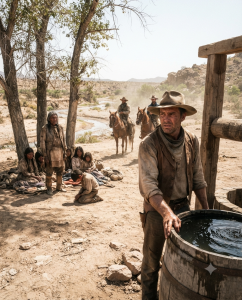
When he rode out that afternoon with Tom Briggs and a younger hand named Eli Turner, he expected to find a broken fence line near the southern wash. Instead he found people.
A small Apache traveling party had collapsed in the shade of three dying cottonwoods along the dry creek bed. William saw at once what mattered: no fighting formation, no rifles aimed, no scouts circling wide. Just exhaustion. A grandmother whose hands shook too badly to lift a cup. A woman with a baby tucked into the crook of one arm. Two boys with hollow faces. A child too weak to stay standing.
Tom muttered a warning under his breath, but William was already dismounting.
The Apache leader rose when William approached. He was older than William had first thought, his black hair streaked with gray, his body drawn tight by fatigue. He held himself upright through sheer will. There was pride in him, but no threat.
“Water,” William said, not as a question.
The leader gave a single nod.
That should have been simple. To William, it was simple. But the territory had made simple things dangerous. Men talked about honor, civilization, and law while children died one canyon over. They called it caution. They called it loyalty. William had heard every version of that excuse.
He looked once at the smallest child kneeling in the dirt and made his decision.
Back at the ranch, he ordered barrels drawn from the north well, blankets brought from storage, food cooked immediately. The hands obeyed, though the mood in the yard turned tense. No one wanted to argue with him outright, but fear moved through them like wind through dry grass.
When the Apache arrived, William kept the order of service himself. Women first. Elders next. Children after. He made sure every frightened eye at the ranch saw that these were human beings before they were anything else.
That was what Silas Mercer could never forgive.
Mercer ran the general store in town, but he was more than a shopkeeper. He extended credit in lean months, bought hides cheap when ranchers were desperate, and listened closely whenever men were angry enough to be useful. He understood something others did not: fear could be sold if you wrapped it in certainty. By dusk he was at the Hayes ranch with four other men, shouting from the yard as if William had committed a hanging offense.
“Is it true?” Mercer called. “You’ve got Apache sleeping in your barn?”
William stood on the porch, tired and dusty, and said, “I’ve got thirsty people drinking water.”
Mercer laughed, and there was no humor in it. “You keep calling them people and you’ll get us all killed.”
William came down the steps until they stood nearly level. “Nobody dies of thirst here if I can stop it.”
Mercer’s eyes hardened. “Then don’t come crawling to town when they pay you back with fire.”
The words were loud enough for the travelers to hear. A little girl flinched. Her mother drew her back. The Apache leader remained still, but William noticed the tightness around his eyes. He understood enough English to know contempt when he heard it.
The confrontation ended without shots, but not without consequence. Mercer rode back to town before full dark and took William’s defiance with him. By morning, the valley had a new story: Hayes had sided with the enemy. Hayes had invited danger home. Hayes had betrayed his own.
That night William sat watch by the well, rifle beside him, while the strangers slept in the barn. He expected trouble from town more than from his guests. Near midnight, the Apache leader joined him.
In slow Spanish, the man said, “Your kindness will cost you.”
William answered, “It would cost me more not to do it.”
The older man looked at him a long time. “Some debts are not paid with coins.”
William almost asked his name, but the moment passed. At dawn the travelers departed quietly. Before leaving, the leader set a leather pouch on a flat stone by the well. Inside was a carved arrowhead and a narrow strip marked with symbols William did not know how to read.
By then he had too many immediate problems to puzzle over gifts.
Three days later he found seven dead cattle at the west corral.
The poison had worked quickly. Foam had dried at their mouths. One had fallen halfway against the trough. Flies swarmed thick enough to darken the hides. Eli gagged when he saw them. Tom swore and said exactly what half the valley would say by noon.
“The Apache came back.”
William said nothing. He crouched beside the trough and studied the ground. There were hoofprints, yes, but they were placed too neatly. A sign made for frightened eyes. He found a broken bit of reed wedged in the trough’s edge and smelled it. Bitter. Deliberate.
By the time he rode to town for supplies, no one would meet his gaze. The butcher said he had no room for Hayes beef. Two men outside the smithy stopped talking when he passed. At Mercer’s store, credit was suddenly unavailable.
“Bad season,” Mercer said with a shrug that was almost a smile. “Can’t take chances.”
William leaned on the counter. “Funny. You seemed full of certainty three days ago.”
Mercer met his eyes without blinking. “I know a mistake when I see one.”
The next week the pressure tightened. Buyers stayed away. One ranch hand quit. Another started asking whether it was true the Apache had marked the ranch for attack. William worked harder and spoke less. At night, he sat with the pouch from the Apache leader and turned the arrowhead over in his hands. It was well made, the stone polished smooth, the carving intentional. Not a trinket. A message.
The clue came from an unexpected place.
Old Manuel Ortega, who repaired harnesses south of town and knew more languages than people guessed, came to the ranch to sell leather scraps. He noticed the strip on William’s table and froze.
“Where did you get this?”
William told him.
Manuel lifted the strip carefully. “These symbols are not random. Not exactly words, but marks tied to trade trails. Warnings. Identifiers.” He pointed to one sign cut deep near the edge. “This one means a trader. A merchant. Someone who deals with both sides.”
William frowned. “That could be half the territory.”
Manuel nodded. “Maybe. But look here.”
Beneath the symbol was another mark, one William had seen before without placing it—a hooked line over a small cross shape.
Mercer’s store sign.
Not the official brand on his goods, but the private mark he used on crates shipped through back channels to mining camps and outposts. William had seen it burned into packing boxes behind the store.
Manuel’s expression changed. “Whoever gave you this wanted you to know danger was close. Not from the travelers. From a trader.”
Suddenly the dead cattle, the town’s speed in assigning blame, Mercer’s confidence—it all lined up too neatly.
William made his first move at sunrise.
He rode into town with the leather strip in one pocket and a square of hide cut from one poisoned carcass tied behind his saddle. Tom came with him, silent and wary. Mercer was on the porch before the store, already talking loudly to three ranchers about law, safety, and what happened when weak men forgot their place.
When Mercer saw William dismount, his voice faltered for half a beat.
William tossed the carved arrowhead onto the porch boards. It clicked and spun to a stop near Mercer’s boot.
“You know what that is?” William asked.
Mercer forced a laugh. “Looks like bait.”
William unfolded the leather strip. “It came with a warning.”
The ranchers nearby stepped closer. Mercer moved to block their view, too quickly. That was his mistake. Guilt is often clearest in the moment a man tries hardest to look calm.
Old Jed Palmer, who disliked William well enough but disliked lies more, squinted at the strip and then at the hide hanging from William’s saddle. “What am I looking at?”
William held the hide up so the morning light caught the cut. Branded into it, shallow but unmistakable, was Mercer’s hooked trade mark.
Not Hayes’s brand. Mercer’s.
A ripple of confusion moved through the crowd.
“That hide came from one of my dead cattle,” William said. “Found at the poisoned trough. Your mark was cut into the flesh.”
Mercer’s face went pale, then red. “Anybody could do that.”
“Maybe,” William said. “But not everybody knew to blame the Apache before the carcasses were cold.”
Murmurs spread along the street.
Mercer straightened. “You think I poisoned your cattle?”
“I think you needed a scare,” William said. “I think drought makes men desperate. I think dead cattle drive prices up. And I think if the valley feared Apache attack badly enough, every rancher here would start buying through your store, borrowing on your terms, loading up on guns, feed, and whatever else you chose to sell.”
That was the ugly brilliance of it. Fear would tighten Mercer’s grip on the valley. He could sell protection from a danger he helped manufacture.
Mercer reached for anger now because composure had failed him. “You’ve gone mad.”
But then a voice rose from the edge of the crowd.
“No. He hasn’t.”
Everyone turned.
Two Apache riders sat at the far end of the street, still as carved stone in the morning dust. The older leader William had met at the creek bed was with them. Beside him rode a younger man carrying a wrapped bundle.
Several townsmen reached for weapons, but the leader spoke first in careful Spanish, loud enough for Manuel Ortega to translate.
“We came back because the warning was not enough.”
The younger rider dismounted and unwrapped the bundle on the porch: trade goods, ammunition, and medicine tins stamped with military issue marks. Beneath them lay account slips and a ledger page tied with cord.
Mercer lunged for the papers. Tom caught him hard in the chest and drove him back against a post.
Manuel grabbed the top sheet and read aloud. It was a record of off-book trade: Mercer selling cartridges and supplies to raiders and then spreading word through the valley that Apache travelers were responsible for thefts, stock poisonings, and missing freight. He had been feeding both panic and profit for months.
The Apache leader pointed to Mercer. “He sold to men who robbed our people too. Then blamed all Apache so no one would ask questions.”
The crowd changed in an instant. Fear turned outward, then inward, as men realized how easily they had been steered. Jed Palmer looked physically sick. Another rancher muttered that he had signed notes at twice fair price because of stories Mercer pushed. Eli Turner, who had trailed in behind the others, stared at Mercer like he was seeing a snake stand up and speak.
Mercer made one last attempt. “They’re lying. You trust them over your own?”
William’s answer cut through the street.
“I trust the man who warned me before I knew I needed warning.”
Silence followed. Heavy, humiliating silence.
Sheriff Nolan arrived minutes later, drawn by the crowd. He read the ledger, examined the marked hide, listened to Manuel’s translation, and put Mercer in irons right there on his own porch while the whole town watched. Mercer did not look frightened until then. Only when the metal closed around his wrists did his face finally collapse into something honest.
The aftershocks spread for weeks.
The charges went beyond poisoning cattle. Fraud. Illegal trade. Conspiracy. Evidence connected Mercer to rustlers operating along the valley’s edge and to falsified credit books that had trapped desperate ranchers in debt. His store was seized. His accounts were combed through. Men who had called William a traitor stopped speaking so loudly in public.
An apology came, though not all at once and not from everyone.
Jed Palmer brought two sacks of feed to the Hayes ranch and left them by the barn without waiting to be invited in. The butcher reopened his books. Even Tom, ashamed of his own suspicions, admitted he had mistaken fear for wisdom.
The Apache leader returned one final time before autumn.
This time he came openly, with only one companion, and William met him at the well. Manuel came too, to help with words where needed. The leader gave his name: Taza. He explained that Mercer had tried to trade through men who preyed on Apache families moving between settlements. When Taza’s group realized Mercer planned to use them as cover for more violence, they left the warning in the only form they thought might survive mistrust.
“You gave water when others gave hate,” Taza said. “So we gave what we could.”
William looked at the well, then at the man whose people the valley had blamed so quickly. “You gave more than that.”
They stood in silence a moment. Then Taza extended his hand. William took it.
No speech in church could have matched the power of that quiet gesture.
The drought eventually broke. Not dramatically, just enough rain to darken the soil and remind the valley that mercy could still arrive after long cruelty. The Hayes ranch survived the season. More than that, it changed. Trade routes became less secretive. A few men in town learned to ask harder questions before swallowing the easiest answer. Not all of them. People rarely change all at once. But some did.
Years later, William would still keep the carved arrowhead in a drawer near the kitchen table. Visitors sometimes asked about it. He never told the story for effect. He told it plainly. A thirsty child. A well. A warning everyone else wanted to ignore.
The truth was uncomfortable, which is why it mattered.
Because the most dangerous thing in that valley had never been the strangers under the cottonwoods. It had been the man who understood exactly how fear worked and how eager decent people could be to borrow his eyes instead of using their own.
And that was the part that stayed with those who heard the story to the end.
Not whether William was brave, though he was. Not whether Mercer was evil, though he chose evil often enough. It was the harder question left behind after justice was done: how many people had been ready to watch children die of thirst because it was easier than standing against the crowd?
Some swore they would have done what William did.
Maybe they would have.
But the valley had already given its first answer, and it was not one anyone could feel proud of.