The rain had a way of making Dust Hollow look meaner than it already was.
By the time the stagecoach rolled into town that October evening, the road had turned to mud, the storefronts looked half-drowned, and every window seemed to hold a pair of eyes waiting to judge whatever the storm blew in next. Nora Estelle Reed stepped down first, clutching her medical satchel to her chest while the driver tossed her suitcase onto the slick street beside her.
She was twenty-eight years old, exhausted, and nearly broke.
The driver didn’t offer a hand. Men in towns like this rarely bothered unless they wanted something. Nora bent, grabbed the suitcase handle, and nearly lost a boot in the muck. The cold rain slapped her cheeks, ran down the back of her neck, and soaked through her jacket within seconds.
She had arrived in suspicious towns before. She knew the look people gave a woman alone. No husband. No father. No brother. No respectable explanation that fit neatly into what they believed a woman ought to be. It did not matter that she carried bandages, medicines, and years of hard-earned experience. Most people saw one thing first: unclaimed.
That night, she was too tired to care what they thought.
She only needed somewhere to sleep.
Murphy’s boarding house sat near the center of town, yellow lamplight glowing through rain-streaked windows. Nora walked in, dripping water across the wooden floor. Conversations stopped. Men turned. One woman behind the counter looked her over like she was deciding whether mud had blown in or trouble.
“I need a room for the night,” Nora said.
“We’re full.”
The answer came too fast.
Nora glanced around. Empty chairs. Open tables. No one climbing stairs. And behind the counter, a neat row of keys.
“I can pay.”
“We don’t board women alone after nine.”
“Mrs. Pritchard’s place sent me here.”
“Then Mrs. Pritchard can take you in.”
“She refused.”
The woman’s expression did not change. “Then sleep wherever you can.”
For a moment Nora thought of arguing. Instead, she swallowed the humiliation so hard it hurt, lifted her bag, and walked back out into the storm with all those eyes still on her back.
She kept going until the lamps grew thin and the road gave way to an abandoned station at the edge of town. Rusted roofing rattled overhead. Wind drove rain in sideways. She sat against the wall, pulled her satchel onto her lap, and listened to the creek swelling nearby.
Inside the bag were the pieces of her life: instruments wrapped in cloth, clean bandages, tinctures, thread, scissors, and letters signed by people who claimed she was skilled, respectable, reliable. It was a strange thing to hold proof of your worth in your hands and still know it would not buy you a bed.
She slid one hand into her boot and touched the small knife hidden there.
Kindness existed. She had seen enough suffering to know that.
But she had also seen what happened when a woman counted on it too soon.
The creek climbed higher, and water began creeping under the shelter. Nora had just stood to move farther back when she heard footsteps cutting through the rain.
A man emerged from the darkness.
He was tall, broad through the shoulders, and moved with a pronounced limp that suggested old pain, not weakness. Rain poured from the brim of his hat. He kept his distance.
“Miss.”
“I’m not looking for trouble.”
“I know,” he said. “I saw what Murphy did.”
Nora straightened. “Then you saw I can look after myself.”
He took off his coat and draped it over her suitcase. “Name’s Callum Wyatt. I’ve got the blacksmith shop down the road. There’s a spare room at my house. Fire too. Door locks from the inside.”
She didn’t move.
“What do you want in return?”
His mouth tightened, not angry—just tired.
“Nothing.”
“No man offers shelter for nothing.”
“Maybe not most men.”
She studied him. A dangerous man would have smiled more. Stepped closer. Tried to soothe. Callum did none of that. He looked like a man who understood cold and had no talent for pretending he didn’t.
“I keep a knife,” she warned him.
“Then keep it close.”
The creek reached her ankles.
That decided it.
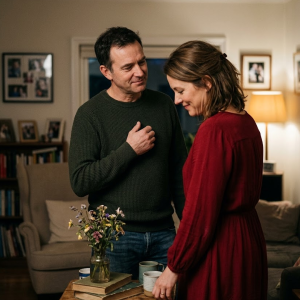
His house stood only a few doors away, small and plain with a red-painted door dulled by weather. Inside, it was clean in a careful sort of way, as if everything had a place because disorder was harder to bear than loneliness. He showed her a room, set down her suitcase, and said, “This was Margaret’s. Bed’s made. Key works.”
“Margaret your sister?”
A pause.
“Someone who’s gone.”
That was all he gave.
He heated water for washing, left dry clothes folded on a chair, and spread his own blanket by the hearth. Nora locked the bedroom door and slept with the knife under her pillow. Twice she woke to hear him rise and place more wood on the fire. He never touched the door.
By morning, the town was already talking.
The first knock came before breakfast. A stern widow named Mrs. Hutchkins stood there with a basket over one arm and accusation in both eyes.
“So you’re the woman from the coach.”
“Nora Reed. I’m a nurse.”
“My grandson’s been feverish two weeks. Morrison says he’ll recover. He isn’t recovering.”
“Then let me see him.”
“If you’re lying, I’ll see you run out of town myself.”
The child was thin, hot with fever, and struggling to swallow. Nora recognized the infection at once. She cleaned his mouth, reduced the fever, prepared treatment from what she had, and showed the grandmother exactly what to do. Mrs. Hutchkins watched every movement like a guard dog.
Three days later, the boy asked for broth.
Five days later, he grinned when Nora walked into the room.
Word spread the way it always did in isolated places—suspiciously first, then desperately. A baby wouldn’t latch. An old rancher had a leg wound that smelled wrong. A woman had a cough that wouldn’t break. A boy everyone called simple had never spoken a word, and Nora was the first person patient enough to teach him signs with his hands until his mother burst into tears the day he told her he was hungry.
Dust Hollow did not become warm overnight. But it became practical.
People who would not have shared a table with her let her into their homes because pain makes room for truths pride cannot afford.
Through all of it, Callum remained the quiet constant at the edge of every day. He repaired hinges, shod horses, mended broken tools, and appeared at strange moments carrying chopped wood, hot tea, or whatever Nora had forgotten to ask for. He never intruded. He noticed.
She noticed things too.
The way he favored his left leg after long hours standing. The way one shoulder stayed stiff in cold weather. The untouched dresses still hanging in the wardrobe. A porcelain cup no one used. A faded ribbon in a drawer that he closed too quickly when searching for thread.
Margaret was not gone from that house. She was arranged neatly into every silence.
One evening, while Nora was changing the wrapping on his badly healed leg, she said, “A doctor should have reset this differently.”
He gave a humorless laugh. “Doctor did what he could.”
“Then he could not do much.”
Callum watched the fire. “This town doesn’t get the best versions of anything.”
Including mercy, Nora thought, though she did not say it aloud.
Weeks passed. Then one night, with sleet tapping at the windows and the lamps turned low, the truth finally slipped loose.
Margaret had not been his sister.
She had been the woman he loved.
They had never married. By the time he had enough saved to ask properly, she had already fallen ill. He cared for her at home because there was nowhere else to take her and no one in town who could save her. By the time the doctor admitted that, she was already dying.
“She hated hospitals,” he said quietly. “Said she wanted her own blanket and her own window. Wanted to hear the forge in the morning.”
Nora folded a clean cloth in her lap. “Were you with her at the end?”
“Yes.”
He said the word the way some people carried stones—plainly, but with weight.
That should have been enough to satisfy her. But grief recognizes grief, and something in Callum’s expression made Nora speak too.
She told him about Chicago. About Charles, her fiancé with polished manners and weak loyalties. About the family gathering where she had gone looking for him and instead found him with Rose, her younger sister. About the ring she returned with shaking fingers. About the wedding that followed three months later, as if betrayal had only been a delay in everyone else’s plans.
“I left before breakfast,” she said. “Didn’t say goodbye.”
Callum poked the fire once. “Probably wise.”
“I kept thinking maybe I was a fool for not seeing it sooner.”
“Maybe.”
She looked at him sharply.
He met her gaze. “And maybe they were fools for losing someone worth keeping.”
That was Callum. Never sweet for performance. Never cruel for sport. Just honest in a way that made lies sound childish.
Winter edged closer. Nora’s place in town grew firmer. People still whispered, but less boldly. The woman once denied a room was now the one people rode through snow to fetch in the middle of the night. She delivered babies, eased fevers, set fingers, dressed wounds, and quietly proved herself until even those who disliked her had to speak of her with respect.
And somewhere inside all that work, without permission and without ceremony, Nora began to love the man who had left his coat over her suitcase in the rain.
It frightened her.
Not because Callum was unkind. Because he wasn’t.
She had survived one kind of heartbreak already—the showy kind, the public humiliation, the betrayal with witnesses. What Callum offered was worse in a different way. It was real enough to lose.
The fire came in the first hard cold of the season.
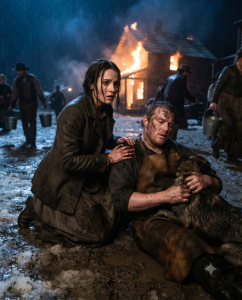
A shout tore through the night. Then another. By the time Nora reached the street, flames were leaping from the Malone house windows. Snow on the ground had turned to black slush. Mrs. Malone was screaming her daughter’s name.
“Mary’s inside!”
No one moved quickly enough for Nora.
She wrapped her scarf over her mouth and ran in.
Heat slammed into her face. The room was all sparks and smoke. She crouched low, calling for Mary until she heard a child coughing near the back. The girl was wedged beneath a table, sobbing too hard to crawl. Nora pulled her free, half dragged and half carried her toward the rear window where fresh air knifed in through cracked glass. Men outside smashed the frame wider and hauled Mary through. Nora collapsed out after her, coughing so violently she thought she might vomit.
Then Mrs. Malone screamed again.
“Caesar!”
The little dog.
Several people shouted to let it go. Houses could be rebuilt. Dogs could not be worth a life.
Callum did not ask anyone’s opinion.
He ran inside.
Nora got to her knees in the snow, horror tearing through the fog in her chest. “Callum!”
The doorway glowed orange. The roof moaned. Seconds stretched hideously long. Then he appeared, bent low, one arm shielding his head, the other clutching a terrified dog against his chest.
He almost made it.
A burning beam broke loose and struck his shoulder, driving him down just outside the threshold.
Nora reached him on hands and knees. Ash melted into the snow beneath her palms. The dog wriggled free, alive, singed, shaking. Callum tried to rise and failed.
“Don’t you dare die after saving a dog,” she said, her voice breaking.
His eyelids fluttered. “Wasn’t just a dog.”
She opened his coat and found the wound beneath the burn. Deep. Ugly. Dangerous.
“Move back!” she shouted at the crowd gathering around. “Either help or get out of my way.”
This time, nobody argued.
She pressed hard against the bleeding while another woman handed her cloth. Callum hissed through his teeth but kept trying to turn his head toward the dog.
“The dog is alive,” Nora said.
His breathing stuttered. “Margaret… asked me.”
Nora looked at him. “What?”
“Before she died.” He swallowed, each word dragged through pain. “She made me promise. Caesar would never be left. Never scared. Never alone in the dark.”
For a moment the world narrowed to that sentence.
The untouched dresses. The careful silences. The way Caesar always slept beside Callum’s chair. The reason he had gone into a burning house for a creature half the town considered disposable.
This was not about a dog.
This was about the last promise he had made to the woman he loved and buried.
And he had been willing to die keeping it.
Nora pressed harder against the wound and leaned close. “You are not following her tonight.”
His eyes found hers then—clearer than they had been moments before, as if pain had stripped him down to only truth.
Around them, Dust Hollow had gone silent. Men who once would not defend Nora from an insult now stood ready at her command. Women who had judged her were tearing linens into strips. Mrs. Murphy herself hovered at the edge of the crowd with a face gone pale, watching the woman she had turned into the rain save the man the whole town depended on.
“Get him inside somewhere warm,” Nora ordered. “Now.”
They carried him to the nearest building—the schoolhouse—because it had space, tables, and a stove that could be kept roaring. Nora worked for over an hour while people ran for water, more cloth, broth, whiskey, lamps. She cleaned the wound, bound the shoulder, fought the bleeding, and ignored the tremor in her own hands until it stopped mattering.
Callum drifted in and out.
Once, when the room had finally emptied except for the two of them and the low crackle of fire, his fingers closed weakly around her wrist.
“Nora.”
“I’m here.”
“If I don’t wake—”
“You will.”
He looked at her with the same plain honesty he had worn from the first night, and said, “Then answer me truthfully while I can still hear it.”
Her throat tightened. “What truth?”
His gaze did not waver. “Would you have stayed, if I had asked?”
The question cracked something open in her so suddenly she had to close her eyes.
All this time she had been afraid of naming what lived between them, afraid love might invite loss the way open doors invite winter. But he was lying there, pale from blood loss, still smelling of smoke, still stubborn enough to worry more about an answer than his own pain.
Nora bent over him and pressed trembling fingers to his face.
“Yes,” she whispered. “I would have stayed.”
Something in his expression eased. Not joy exactly. Relief. A burden set down after being carried too long alone.
He slept then, and for two days he hovered in that uncertain place where the body decides whether it still belongs to the living. Nora barely left his side. She forced broth between his lips, changed bandages, drove away visitors when he needed quiet, and fought for him with all the skill and fury she possessed.
He woke on the third morning to find Caesar asleep at his feet and Nora dozing in a chair beside the bed.
“You stayed,” he murmured.
She opened her eyes. “I said I would.”
The smile that touched his mouth was small and tired and more intimate than a kiss.
Dust Hollow changed after that.
Not all at once. Towns rarely do. But shame has a harder time surviving once it has been witnessed clearly. Mrs. Murphy came to apologize in person, stiff-backed and awkward. Nora accepted because bitterness was heavy and she had carried enough. Mrs. Hutchkins sent pies. The Garrett boy brought firewood and signed thank you with solemn concentration. Mrs. Malone arrived crying with Mary on one side and Caesar on the other and could not stop saying sorry for what Callum had risked.
By spring, no one in Dust Hollow referred to Nora as the stagecoach woman anymore.
She was Nurse Reed.
Later, simply Nora.
Callum healed slowly. The shoulder would always trouble him in cold weather, just as the leg did. But when he could finally stand at the forge again, Nora stood in the doorway watching him with her arms folded and said, “If you tear those stitches because you’re stubborn, I’ll sew you back together without mercy.”
He glanced over his shoulder. “That a threat?”
“A promise.”
He crossed the room carefully, as if he respected the pain but no longer feared it. Then he stopped in front of her, lifted one rough hand, and tucked a loose strand of hair behind her ear.
“I kept one promise,” he said softly. “I’d like the chance to make a new one.”
Nora felt tears press unexpectedly behind her eyes. “You should know I’m not easy.”
“So I’ve noticed.”
“I come with knives, opinions, and more work than is reasonable.”
“Good.”
“And I won’t be turned out into the rain.”
A shadow passed through his face at that, old regret still sharp enough to sting. “Never again.”
He did not kneel. His leg would not have tolerated it, and she would have hated the performance anyway. He simply took her hand and said, “Stay. Not because you need shelter. Because this is your home if you want it.”
Nora looked around the little house with the red door. The wardrobe now held both old grief and new life. Margaret’s memory had not been erased; it had been honored enough to make room for joy beside it. Caesar thumped his tail on the floor. Outside, the forge rang steady and bright through the open window.
“Yes,” Nora said. “I’ll stay.”
They were married in June in front of half the town and talked about by all of it. Some claimed they had known from the beginning. They were lying, of course. Most people only recognize love after it survives a fire.
Years later, Dust Hollow still remembered the night the blacksmith carried a dog from a burning house and nearly lost his life for a promise. But the people who knew the whole story remembered something else too: a soaked woman no one wanted, a red door opened without conditions, and the strange way two broken lives had fit together better than either ever had intact.
Maybe that was the real question left behind by their story.
Not whether Callum should have risked himself for a dog.
Not whether Nora should have trusted a stranger in the rain.
Not even whether love after grief is braver than love before it.
Maybe the real question was this:
How many lives would remain lonely if mercy always waited to be deserved first?