“He hasn’t spoken in years,” the cowboy whispered when he dropped Lucy Harper in the middle of Red Hollow. By the way he said it, the boy might as well have been a ghost waiting at the end of the road.
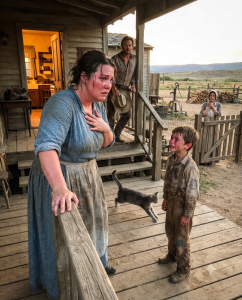
Lucy climbed down from the wagon with stiff legs, a cheap trunk, and a gray cat named Juno in a wire crate. Sweat had soaked the back of her dress. Dust clung to the hem. The street had that hard, glaring brightness of towns where even the sun seemed judgmental.
She knew the looks before she saw them clearly. Women on the boardwalk paused mid-conversation. A man outside the barber shop tipped his chair back and stared for half a second too long before pretending to focus on his boot. Lucy had lived inside that pause all her life—that instant when people measured her body before they measured anything else.
At thirty-one, widowed eight months, and nearly out of money, she had stopped expecting tenderness from strangers. Four towns had found reasons not to hire her. Sometimes the reasons were spoken politely. Sometimes not. But poverty had a way of stripping language down to its bones. She was too much woman, too much trouble, too easy to dismiss.
Cobb dropped her trunk in the road.
“Callahan Ranch is two miles west,” he said. “Boss planned to meet you at noon.”
Lucy squinted up at the sun. “It’s past noon.”
He shrugged. “Yep.”
Then he drove off, leaving her in a haze of heat and horse smell.
The job notice folded in Lucy’s pocket had been plain: Housekeeper needed. Cooking, cleaning, care of a seven-year-old boy. Room, board, fair wages. Callahan Ranch.
Fair wages had sounded almost miraculous.
James Callahan arrived forty minutes later on a dark gelding. He looked like a man carved by weather and unfinished grief—broad shoulders, worn shirt, sun-browned face, eyes too tired for his age. Lucy braced herself for the glance she had learned to dread, the small recoil people tried to hide.
It never came.
“Mrs. Harper,” he said, removing his hat.
“Mr. Callahan.”
He glanced at the crate in her hand. “A cat?”
“Her name is Juno. She catches rats.”
“Then she earns her keep.”
That was all.
The ranch sat low against the land, practical and weathered, held together by repair instead of prosperity. Nothing was fancy, but everything had been cared for—steps mended with mismatched boards, windows scrubbed clean, curtains washed thin by use. Beyond the house lay a garden trying not to die in the dry heat.
A boy sat on the porch.
Thomas Callahan was smaller than Lucy expected, all elbows and solemn eyes, dressed in clean clothes that hung loose on him. He watched her with such intense stillness that she was suddenly careful with every movement.
“That’s Thomas,” James said. His voice lost some of its hardness. “He hasn’t spoken since his mother died. Three years now.”
Lucy looked at the child, then back at the man.
“What happened to his mother?”
James’s jaw shifted once. “Fever. Quick and ugly.”
Lucy nodded. She did not crowd the boy. She had met fear often enough to know it hated being cornered.
Inside the kitchen, James explained the work. Meals, laundry, cleaning, gardening when possible. He mentioned, almost as an afterthought, that the previous housekeeper had quit after two weeks.
“She said she couldn’t stand the quiet,” he said. “Said the boy looked haunted.”
Lucy opened the pantry, taking stock of what she had to work with.
“And what do you think?”
James stared toward the porch door. “I think he’s afraid. I think I’ve tried everything I know.”
“Then we start with what fear understands,” Lucy replied. “Consistency.”
She set the first rules before supper. Breakfast at seven. Supper at six. Clean towels every Wednesday. Bread baked every other morning if flour allowed it. Water glasses filled before dusk. Predictable things, ordinary things, strong enough to hold a life together if repeated long enough.
Thomas did not speak that first night. But he lingered in the doorway while she cooked beans and skillet bread. Juno wandered over and calmly sat on his foot. He glanced down at her with startled confusion, then remained still while the cat purred against his ankle. Lucy pretended not to notice.
Over the next week, she never asked him for speech. She asked him for nothing at all.
She left a glass of water on the porch rail each afternoon. The next day she added a biscuit. On the third day she sat nearby and talked to Juno about clouds, carrots, and the lack of intelligence in mule behavior. Thomas listened from the top step as though he were trying to solve a puzzle.
James listened too, often from a distance.
Lucy learned that James was decent in the way some grieving men become—quiet, dutiful, rough-edged, uncertain what to do with gentleness once it appears in front of them. He worked hard, slept little, and carried guilt in his shoulders. He spoke to Thomas kindly but carefully, as though terrified of saying the wrong thing and losing some invisible battle even further.
On the eighth day, Lucy rode into town for supplies.
At McCreedy’s store, conversation thinned the moment she entered. The shopkeeper’s mouth curled with that stale little pleasure small people take in saying ugly things indirectly.
“So,” he drawled, reading her list, “you’re the new housekeeper for the widower.”
Lucy met his gaze. “I am. And unless flour prices have changed, that’s the only subject that concerns you.”
A woman by the fabric bolts smirked. Another looked scandalized that Lucy had answered back.
Lucy paid, gathered her parcels, and left with her spine straight. She had learned that shame only deepened if you carried it for others.
When she returned to the ranch, James was waiting by the garden with a face that warned of trouble.
“Doctor Hensley says Thomas may need to be sent to an institution in Dallas.”
Lucy set down the flour sack.
“No.”
James frowned. “No?”
“Your son isn’t broken.” Her voice was steady. “He’s frightened. There’s a difference.”
“Hensley says this has gone on too long.”
“And what has he tried besides ordering the boy to perform grief on command?”
James looked away. That told her more than his answer would have.
Doctor Edwin Hensley came three days later. He was a narrow man in a neat black coat with polished boots and the smooth confidence of someone rarely contradicted. He greeted James courteously, ignored Lucy almost entirely, and crouched too fast in front of Thomas.
“Look at me, son,” he said. “Come now. You hear me, don’t you?”
Thomas’s fingers crushed the edge of a drawing until the paper wrinkled.
Hensley leaned closer. “Look at me.”
Lucy, folding laundry nearby, felt every muscle in the child’s body tighten.
“Doctor,” she said, “if you want him calm, don’t trap him.”
Hensley turned, visibly annoyed. “Mrs. Harper, I have years of training.”
“Then perhaps use some of it gently.”
James was silent, but he did not defend the doctor. Hensley noticed.
That night James stood at the kitchen table long after Thomas had gone to bed.
“You embarrassed him.”
“He was frightening your son.”
“He says I’m allowing sentiment to cloud judgment.”
Lucy kneaded bread dough with more force than necessary. “Men like that call it sentiment whenever someone else has the nerve to pay attention.”
James let out a breath that almost became a laugh.
Then things began to shift in ways too quiet for Red Hollow to respect.
Thomas started leaving treasures near Lucy’s chair: smooth pebbles, a hawk feather, a button he’d found by the barn, one crooked flower from the stubborn garden. He never placed them in her hand. He simply let them appear like evidence of a trust still too delicate to name.
Juno slept outside his bedroom. Sometimes Lucy heard the boy’s soft steps in the hall before dawn, followed by the cat’s answering trill. Once, through the kitchen window, she saw James kneeling in the yard while Thomas stood beside him holding tomato seedlings. Neither spoke. Neither needed to.
Lucy also saw something else.
Thomas was never equally afraid of everyone.
He was shy with strangers. Wary with townspeople. Quiet even with James. But when Doctor Hensley’s name was mentioned, the boy changed. His shoulders climbed. His hands went cold and rigid. Once, when Lucy said the doctor might stop by to check his cough before she could stop herself, Thomas dropped a cup so suddenly it shattered across the floor.
Lucy knelt to gather the pieces. “Thomas?”
He had backed into the corner by the stove, breathing too fast.
James saw it too. “Son?”
Thomas only stared.
That night Lucy asked, “Has Hensley ever been alone with him?”
James looked puzzled. “Of course. During examinations.”
“How often?”
“Whenever he was sick. Why?”
Lucy shook her head. She had no proof, only instinct, and instinct was a dangerous thing to accuse a respectable man with. Still, the question lodged in her mind and would not leave.
A week later, Dorothea Reigns arrived at dusk in a rush of dust and worry. She was one of the few women in town who had treated Lucy with plain decency from the start.
“I shouldn’t be here,” Dorothea said the moment she climbed down from her mare. “But I heard something at the post office and then again at the mercantile. Hensley’s spoken to Judge Talbot.”
James came out of the barn. “About what?”
Dorothea hesitated. “About taking Thomas from the ranch.”
The words hit like a shot.
“On what grounds?” Lucy asked.
“He claims the boy is being neglected. That his condition is worsening. That this household is unstable and proper treatment is being interfered with.”
James turned white with rage. “That lying—”
Lucy looked toward the porch.
Thomas had heard.
He stood with one hand on Juno’s back, face gone flat and pale. It was the expression of a child being yanked inward by some old terror. Lucy felt a cold understanding move through her.
James grabbed for his hat. “I’m going to town.”
Then Thomas stood so abruptly the cat bolted.
He opened his mouth.
The sound that came out was rough, barely human with disuse, but it was unmistakably a word.
“Don’t.”
James stopped as if the whole world had been nailed to the ground.
Thomas shook violently. Tears spilled down his cheeks.
“Don’t let him take me.”
James’s eyes filled. “Thomas… son… who?”
The boy pointed, not toward the road, but toward the kitchen doorway.
Hensley’s leather satchel, forgotten during his visit that afternoon, rested against the wall beside the washstand.
Lucy crossed the room and picked it up. It was heavier than she expected. James came behind her. Dorothea stood in the doorway, hand over her mouth.
“Thomas,” Lucy said carefully, “is there something in here you’re afraid of?”
The boy gave one sharp nod and hid his face against the porch post.
James took the satchel from Lucy and opened the clasp.
Inside were ordinary medical things at first—bandages, bottles, instruments wrapped in cloth. Then beneath them, tucked into a side compartment, he found a small tin and a folded handkerchief tied around something hard.
He untied it.
A silver locket fell into his palm.
James stared at it for one stunned second, then another.
“Martha’s,” he said hoarsely.
Lucy looked at him. “Are you sure?”
“I buried her with this.”
Silence rippled through the room.
James opened the locket with shaking fingers. Inside was a tiny painted portrait of Martha and, beneath it, a pressed blue flower.
He looked toward Thomas. “How did he get this?”
Thomas was crying openly now, but when James crouched and held out the locket, the child recoiled with a frightened sound and covered his ears.
Lucy understood before James did.
“Hensley took it before the burial,” she whispered. “Or from her things after. He kept it. And Thomas saw.”
James slowly rose to his feet. The grief in his face was overtaken by something harder.
“What else?” he asked.
They searched the satchel more carefully. In the tin were little tablets wrapped in paper twists and labeled in Hensley’s hand. Lucy recognized none of them, but James found invoices from a supplier in Dallas. One packet bore instructions for sedation.
“How often was he giving Thomas this?” Lucy asked.
James’s expression turned stricken. “Whenever he said the boy needed rest. Whenever Thomas had night terrors. God help me.”
Dorothea whispered, “He wanted the boy quiet.”
That alone would have been enough to ruin a doctor if proven. But the truth was uglier.
Folded into the deepest pocket was a letter draft addressed to Judge Talbot, already signed. In it, Hensley described Thomas as mentally impaired, emotionally inaccessible, and increasingly attached to a female caretaker whose influence he called irrational and unhealthy. He recommended immediate removal and appointment of a guardian pending placement. At the bottom, in a separate note clearly never meant for anyone else to see, he had written that Mr. Callahan’s prolonged grief and poor judgment made him susceptible to suggestion, and that the ranch could likely be sold under supervision to settle future costs.
Lucy looked up sharply. “He doesn’t only want the boy.”
James understood at once. “He wants the land.”
The room seemed to tilt.
Red Hollow had been dry for years, but survey crews had recently passed near the western edge of the county. Men had muttered in town about water rights, rail extension, future prices. James had ignored it. He had land, debt, and a silent child. He had not imagined anyone would circle a grieving family like a buzzard with paperwork.
“Why would he think he could get away with it?” Dorothea asked.
Lucy answered before James could. “Because no one listens to a child who won’t speak. And no one believes a woman they’ve already decided is ridiculous.”
James closed the satchel with terrifying calm. “Get your bonnet,” he said to Lucy.
They rode into town before full dark—James on his horse, Lucy beside him in the wagon with Thomas wrapped in a blanket, Juno in his lap, Dorothea following close behind. For the first time since Lucy had arrived, Thomas did not shrink from leaving the ranch. He only held the locket in one hand as if it were proof he was not imagining any of it.
Judge Talbot was still at his office when they arrived. Hensley was there too.
The doctor turned at the sound of the door opening, annoyance already forming on his face. It disappeared when he saw his satchel in James’s hand.
“You forgot something,” James said.
Talbot, a square-faced man with silver in his beard, looked from one to the other. “What is this?”
James set the satchel on the judge’s desk, removed the locket, the sedatives, and the unsigned letter, then placed each item down carefully.
Hensley found his voice first. “This is absurd. A private medical bag should never have been—”
“Did you steal my wife’s locket?” James asked.
Hensley straightened. “I have no idea what you’re implying.”
“Then say how it came into your possession.”
Hensley’s mouth opened, closed.
Talbot’s eyes sharpened.
Lucy stood beside Thomas, one hand on his shoulder. The boy was trembling. Hensley noticed him and tried to recover his authority.
“The child is disturbed,” he said. “That much is plain. Mr. Callahan has become emotional and this woman—”
Thomas made a sound.
Everyone turned.
His face was wet, pale, fierce with effort. He stared directly at the doctor and forced the words out one by one, each one scraping him raw.
“You… hurt… Mama.”
The office went dead quiet.
James spun toward Hensley. “What did he say?”
Thomas swallowed hard. Lucy bent closer, not touching, only steadying the air around him.
“In… room,” the boy whispered. “Mama crying. He said… sleep. She said no more.” He squeezed his eyes shut. “He grabbed me. Said quiet.”
Hensley stepped back. “This is nonsense. Hallucination. The child is confused.”
But Thomas was no longer looking at him. He was looking at the judge, at the desk, at the locket.
“He took it,” Thomas said. “Mama said… give back.”
Judge Talbot rose slowly from his chair.
“Doctor Hensley,” he said, his voice dangerously controlled, “you will remain where you are.”
The rest came apart fast.
Under questioning, Hensley contradicted himself three times in as many minutes. He first claimed Martha had gifted him the locket for services, then said James must have forgotten lending it, then insisted the item had been planted. Dorothea repeated the rumors she had heard of Hensley pushing for guardianship before ever meeting with the family again. Talbot sent for the deputy.
By midnight, enough had surfaced to keep Hensley from walking free. His invoices showed sedatives ordered in quantities no country doctor could reasonably justify. A clerk at the supplier later confirmed Hensley had spoken often of “difficult children” and “managing inconvenient mothers.” A woman from the next county came forward within days to say her sister had also been overmedicated under his care and had nearly died. Another family reported missing keepsakes after a house call during a funeral illness.
The official inquiry took weeks, but the truth no longer belonged to Hensley.
Martha had indeed suffered fever, but evidence suggested Hensley had administered repeated sedatives beyond what was necessary, likely to keep her compliant during her final days. Whether through arrogance, greed, or something darker, he had inserted himself into the family’s most vulnerable moments and treated their grief like opportunity. Thomas had seen more than anyone knew. He had watched the doctor pocket the locket. He had heard his mother protest weakly. He had been threatened into silence by terror no child should have carried alone.
The county dropped all discussion of removing Thomas immediately.
Judge Talbot later apologized to James in person for entertaining Hensley’s petition at all. It was not enough to erase the harm, but it mattered that he said it where others could hear.
As for Red Hollow, the town did what towns always do when the truth embarrasses them. Some people pretended they had never sided with the doctor. Some turned their cruelty toward Hensley with suspicious speed, as though that repaired anything. A few had the grace to look ashamed when Lucy passed.
McCreedy, at least, had the misfortune of being forced to sell Lucy supplies while she looked him straight in the eye and let him sit in the memory of his own smallness.
Thomas did not suddenly become a chatterbox. Healing was not magic, and silence that deep did not vanish in one brave night. But words came back in small pieces. A yes one morning over eggs. A no when James offered him too much syrup. Juno’s name, spoken into her fur. Then one evening in the garden, when Lucy handed him a ripe tomato warm from the vine, he looked up and said, very clearly, “Thank you.”
Lucy had to turn away for a second so he would not see her cry.
James changed too. He learned to hear what his son did not say. He stopped mistaking authority for wisdom. And little by little, he stopped living like a man waiting to be punished for surviving his wife.
Summer broke at last with real rain. The garden came up green. The porch boards dried clean after storms. Juno ruled the house as if she had inherited it.
One Sunday after church, with half the town pretending not to stare, James walked beside Lucy to the hitching post and said, “I should have trusted you sooner.”
Lucy adjusted her gloves. “Most people don’t.”
“I’m trying to become less like most people.”
She looked at him then—at the sincerity, the awkwardness, the careful honesty of a man who had learned the hard cost of looking away.
It took time after that. Time for friendship to deepen into something steadier. Time for Thomas to decide he wanted Lucy near not only at breakfast and supper but always. Time for Lucy to believe she was not simply useful in that house, but wanted.
When James finally asked her to stay for good, it was not with grand speeches. It was on the porch at dusk, Thomas half-asleep in a chair, Juno draped over his boots, the fields smelling of rain.
“I can’t offer perfection,” James said. “Only a home that is better with you in it.”
Lucy laughed softly through tears. “That may be the finest offer anyone’s ever made me.”
She married him the following spring.
Years later, folks in Red Hollow still told the story in lowered voices—the silent boy, the doctor, the widow who saw what others missed. But the part Lucy treasured most was never the scandal.
It was the ordinary future that came after.
Thomas grew. He spoke more. Not always easily, not always to strangers, but enough. He kept his mother’s locket in a wooden box by his bed until he was old enough to wear it on a chain. He remembered Martha with sadness, not terror. He remembered Lucy with gratitude first and then with love so natural it no longer required naming.
People often said Lucy Harper had saved that family.
Lucy knew the truth was more complicated. She had not performed a miracle. She had arrived with tired feet, a stubborn cat, and a refusal to mistake fear for brokenness. She had done the unfashionable work of staying calm, paying attention, and believing a child before the rest of the world was ready to.
Sometimes that is all rescue looks like.
And yet, for all the town’s later admiration, Lucy never forgot how quickly they had judged her on sight, how readily they had trusted the polished doctor over the grieving father, the frightened child, and the woman they found easy to dismiss. The biggest red flag had not been only Hensley’s arrogance. It had been how comfortably everyone else made room for it.
That was the part that lingered.
Not whether Hensley was guilty. He was.
Not whether Thomas could heal. He did.
But how close a family came to being destroyed because the wrong man looked respectable, and the right woman did not.