The day Antonia Vargas Ruiz sold her first harvest at the Cerro Quemado market, Doña Trinidad Cienfuegos called her a thief in front of the entire town.
The accusation cracked through the square so sharply that even the chickens pecking beneath the stalls scattered. Rosenda froze with a green bean in her hand. Cleofas stopped in the middle of weighing cilantro. A woman reaching for a bundle of peppers slowly pulled her hand back as if she had wandered into danger without realizing it.
Antonia did not flinch.
She stood behind a woven mat spread over two wooden crates, her vegetables arranged in careful rows that made their freshness impossible to deny. Green beans still cool from dawn. Cilantro bright and fragrant. Dark chiles with tight glossy skin. Two modest piles of onions dusted with pale soil. It was not a large harvest, but in Cerro Quemado it may as well have been a miracle.
The land it came from had been called dead for over sixty years.
“That land was left to me by Marciano Fuentes,” Antonia said. Her voice was steady, and that steadiness unsettled people more than shouting would have. “By legal will.”
Doña Trinidad smiled the way some people sharpen knives.
She was a handsome woman once, people said, and age had not softened her. At fifty-seven she carried herself like someone used to being obeyed. She owned the biggest store in town, the grain warehouse near the road, and half the credit that kept poorer families surviving from one season to the next. People lowered their voices when they spoke about her, and not out of respect.
“Wills can be challenged,” she replied. “Especially when they involve property tied to old obligations.”
A rustle moved through the crowd. Antonia felt it. The fear. The curiosity. The relief that, for the moment, the target was someone else.
Six months earlier, nobody in Cerro Quemado knew her name.
By then she had already buried her husband, Cipriano, after years of enduring a marriage built on uncertainty and excuses. He had left her with unpaid debts she did not fully understand, vague stories about bad luck, and the kind of exhaustion that lived in the body long after sleep. For months after his death, Antonia moved as though she were carrying an invisible sack of stones across her shoulders. She rented a small room, mended clothes for other people when work came, and learned how quickly pity turned into inconvenience.
The letter from notary Lucio Peralta arrived folded twice and stained at one corner. It informed her that Marciano Fuentes, a great-uncle on her mother Petra’s side, had died at eighty-two with no wife or children. Antonia was his only legal heir. He had left her an eight-hectare ranch in the mountains outside Cerro Quemado.
She read the letter three times before believing it said what it said.
A property. Land. Something real.
When she arrived, it looked like a joke made by fate.
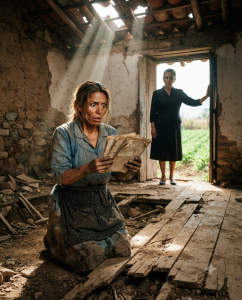
The gate hung from one hinge. The adobe walls were fractured and shedding chunks of dry earth. The roof sagged inward, with a hole large enough to expose broken beams and a slab of white sky. Weeds and thorn brush crowded the yard. A dead grapevine clung to a post as though it had given up years ago but never quite let go.
The boy who guided her there, Nachito, would not cross into the yard.
“My mother says nobody stays in that house,” he told her. “It brings bad luck.”
Antonia looked at the ruin, then at the boy. “Bad luck already knows where to find me,” she said.
He did not laugh.
That first night, she spread her rebozo over the floorboards and lay staring into darkness while the mountain wind slipped through broken tiles and gaps in the walls. A loose shutter tapped softly against the frame like knuckles against wood. She cried into her arm, not from fear, but from fury. This was what life had finally given her: a dead relative, a dead ranch, and a future that looked only one shade less hopeless than the past she had left behind.
By morning, the crying had burned itself out.
Rage remained. And beneath it, something harder.
She began with the yard. She cut brush until her wrists ached, dragged away branches, stacked broken adobe into piles, and cleared a narrow path from the door to the old well despite being told the well had gone dry years earlier. She scrubbed soot from the stove. She patched one wall with mud and straw. She sorted through what little remained in the house: a cracked basin, a warped chair, two clay jars, a bed frame too heavy to move alone.
On the third day, while straining to shift that bed frame, she noticed one plank beneath it sitting a little higher than the others. There was a notch carved into the edge. Not damage. Intentional.
She knelt and pried it up.
Two stone steps descended into a cramped hidden space under the room.
The air smelled dry, sealed, and old.
Inside were wax-capped jars filled with seeds. Some small and pale, some dark and flat, some striped, some rounded. Beside them lay leather-wrapped tools for carving channels in soil and shaping handles. In the corner sat a notebook tied with cord.
Antonia carried it into the light and opened it carefully.
Marciano’s handwriting leaned across the pages in patient lines. He had written what no one else in town had believed—or had wanted anyone to believe. The land was not dead. It was tired. It had been misused, neglected, deprived of water and timing, but not ruined. He had mapped where the ground stayed cool after midday heat, which beds needed shade first, what to plant after beans, how to recognize the wind that came before true rain versus the one that only carried dust. There were pages about seed rotation, pages about drainage trenches, pages about the old guava tree that had once fruited so heavily children stole from it before dawn.
On the last page he had written:
The land is good. It only needs water and someone patient. I did not know how to wait. I hope whoever comes after me is more stubborn than I was.
Antonia sat still for a long time with the notebook in her lap.
No one had ever left her instructions for hope before.
From that day, the ranch changed because she did.
She rose before first light, walked to the town cistern, and carried water back in dented buckets that bruised her legs with every step. She dug until the ground softened beneath the crust. She mixed ash and scraps into compost. She cleared old channels and cut new ones. She covered seedlings with cloth when the nights turned sharp. She repaired the stove enough to cook beans and boil water. She read Marciano’s notes by candlelight and followed them at dawn like scripture.
People watched.
At first they watched with amusement.
Then with curiosity.
Then with a discomfort they did not name.
Epifanio Sandoval, the blacksmith, was the first to cross the distance between watching and helping. He was a large man with scarred forearms and a habit of speaking only when he meant it. One afternoon he arrived carrying a hoe, a hammer, and a saw with a split handle he had repaired himself.
“You’ll work twice as long without proper tools,” he said.
Antonia looked at him carefully. “What do you want for them?”
He shrugged. “If that guava tree gives fruit again, bring me a few.”
She almost smiled. “That’s all?”
“That’s all.”
He left before she could thank him properly.
The first seedlings appeared three weeks later, so small they seemed like a trick of light at dawn. Antonia crouched beside them in disbelief. Then she laughed aloud, a sound that startled even her. More came after that. Beans. Herbs. Peppers. An onion bed she had nearly given up on. The guava tree pushed out leaves along one branch, then another, green so tender it looked impossible.
By the time summer reached the hills, the old ranch had color again.
And with color came attention.
Not everyone approved.
Some said Marciano had hidden money there. Others said Antonia had made a deal with something she should have left sleeping. A few insisted the soil could not have come back on its own and therefore had not. The stories changed according to who told them, but they all served the same purpose: to make her hard work sound unnatural.
The first time Antonia noticed Doña Trinidad watching from the road, she was kneeling in the bean rows with mud to her elbows. The older woman sat on a mule under a wide hat, still as a carved figure. She did not greet Antonia. She only stared at the green rows, then at the repaired corner of the house, then turned her mule and left.
After that, more people passed by than before.
When Antonia harvested enough to sell, she hesitated for only a day. The market was where things became visible. Profit did not stay private in a town like Cerro Quemado. But she needed money for roofing tiles, salt, oil, and maybe, if she was careful, a second pair of work shoes before the rains worsened.
So she bundled her vegetables before dawn and took them to market.
At first, people gathered because they were curious.
Then they bought because the produce was beautiful.
Then Doña Trinidad arrived and changed the air.
“Enjoy your coins while you can,” the older woman told Antonia after the public accusation had done its work. She leaned closer so others would not hear the rest. “Marciano died owing more than you could ever pay.”
Antonia stared at her. “What debt?”
Doña Trinidad’s eyes glittered. “The debt attached to that ranch. Ask the notary. Ask anyone old enough to remember. Ask why that property sat untouched for sixty years.”
Antonia felt her stomach drop.
That night back at the ranch, she opened Marciano’s notebook again, turning pages with a care that bordered on panic. There were notes about rainfall, tools, planting beds, and one folded sheet tucked into the back cover that she somehow had not noticed before. She unfolded it under candlelight.
Do not trust the account book.
The debt was invented inside this house.
If they come for the land, look under the kitchen floor before you run.
Antonia read the lines until the letters blurred.
At dawn she moved the kitchen table, fetched the hammer and chisel, and knelt on the hard-packed floor. It took several strikes before she heard it: a hollow sound beneath the surface. She broke through packed earth and old planks, dug with both hands, and pulled out an oilskin bundle wrapped in cloth gone stiff with age.
Inside were ledgers.
Three of them.
The pages were thick and brittle, written in careful columns. Grain loans, livestock tallies, land liens, witness signatures. At first the numbers meant little. Then patterns emerged. Debts copied and recopied with altered dates. Interest added before the original loan term ended. Payments marked in one book but absent in another. Names of men long buried. Families she recognized from the town. Whole obligations transformed by ink.
Then she found Marciano’s entry.
There it was: the supposed debt against the ranch. In one ledger it was modest. In another it had nearly doubled. In the third, a seizure clause appeared in darker ink, inserted between lines in handwriting that did not match the original.
The authorizing signature belonged to Jacinto Cienfuegos.
Doña Trinidad’s father.
Antonia sat back on her heels, covered in dust, her heart pounding so hard she could hear it in her ears. The debt was not some forgotten burden that had resurfaced by chance. It had been built. Adjusted. Preserved. Passed down.
Someone had waited.
A shadow passed the kitchen window.
Antonia slammed the ledgers closed.
Outside, footsteps crossed the yard. Then came Doña Trinidad’s voice from the doorway, smooth as oil over water.
“Open up. We can settle this quietly.”
Antonia hid the books beneath a sack of corn husks before unlatching the door.
Doña Trinidad entered without waiting to be invited. She looked around the kitchen as if taking inventory of a future she already considered hers. Two men stood outside by the gate. Antonia recognized one as a laborer from the grain warehouse.
“You were not supposed to find anything,” Doña Trinidad said.
The honesty of it chilled Antonia more than denial would have.
“So it’s true,” Antonia replied. “Your family forged the debt.”
Doña Trinidad gave a tired sigh. “That word is for people who have the luxury of pretending the world was ever fair. My father kept this town fed during drought years. Men borrowed grain, tools, seed, animals, anything they needed. Some paid. Some lied. Some disappeared. Records had to be kept in a way that protected what was ours.”
“Marciano paid,” Antonia said, tapping the hidden ledgers with her eyes though not her hands. “You just kept changing the numbers.”
For the first time, something sharp flashed through Doña Trinidad’s composure.
“Marciano was a fool,” she snapped. “He sat on land he didn’t know how to use while better families could have made something of it. He challenged accounts he did not understand. He hid papers and started talking to outsiders. My father should have taken the ranch while he still had the chance.”
The words hung between them.
There it was—not just greed, but resentment. Marciano had resisted. The ranch had not been abandoned by fate alone. It had been isolated, stained by rumor, and left to decay until the claim could be enforced cleanly.
Antonia crossed her arms to hide her shaking hands. “Why now?”
“Because now it’s worth taking,” Doña Trinidad said, glancing toward the yard where rows of green were visible through the broken fence. “You did the hard part for us.”
The cruelty of that sentence hit Antonia with almost physical force.
Doña Trinidad softened her tone, but that made it worse. “Listen to me carefully. Hand over the ledgers. I’ll let you leave with enough money to start over somewhere else. Refuse, and I file the claim. The notary signs it. The judge in the district sees only official papers. A widow with dirt under her nails won’t outtalk stamped records.”
“Lucio Peralta sent me the inheritance papers.”
“The notary sends what he is told to send,” Doña Trinidad replied.
Antonia understood then how deep the rot ran.
But there was one thing Doña Trinidad had not accounted for: people were already watching. Too many had seen the harvest. Too many had heard the accusation in the market. And truth, once it begins moving through a town, does not always travel in the direction power expects.
After Doña Trinidad left, promising to return with documents, Antonia took one ledger and walked straight to Epifanio’s forge. He looked up the moment he saw her face and dismissed the young apprentice with a nod.
“You knew,” Antonia said.
Epifanio rested both hands on the anvil. “I knew there were stories.”
“That’s not the same thing.”
His jaw worked before he answered. “My father witnessed one of Jacinto’s account sessions. He came home sick afterward. Said he’d watched a paid debt written down as unpaid because the man was too drunk to read what he signed. He warned Marciano. After that, Marciano stopped trusting anybody.”
“Why didn’t your father speak?”
“He did. Quietly. To the wrong person. Two days later our mule was poisoned and the forge roof caught fire in the night.” Epifanio met her eyes. “People learn what fear costs.”
Antonia placed the ledger on the anvil and opened it to Marciano’s page.
Epifanio read, and the color drained from his face.
“This is enough,” he said.
“For what?”
“To split the town open.”
He was right.
By sunset, Rosenda had seen the page. Then Cleofas. Then the schoolteacher, Alma Serrano, whose brother had lost a corn field years earlier over a debt nobody could explain. Each person brought a name, a memory, a whisper their family had swallowed decades before. A payment that had gone missing. A signature obtained under pressure. A parcel seized after a funeral. What had always sounded like private misfortune began to look like a pattern.
The next morning, Doña Trinidad arrived at the municipal office with two men, the notary, and a prepared claim to seize the ranch.
She was expecting a frightened widow.
Instead she found half the town waiting.
Antonia stood on the steps with the ledgers in her arms. Epifanio stood beside her. Alma the schoolteacher held copied pages. Rosenda had brought her brother’s old receipts. Cleofas, who almost never spoke in public, announced that his father had paid grain interest twice in one season and still lost a mule under Jacinto Cienfuegos’s account book.
For the first time in years, Doña Trinidad’s face lost control before she could recover it.
Lucio Peralta, the notary, reached for the pages with trembling fingers. “These records should be reviewed privately,” he said.
“No,” Alma answered before Antonia could. “That is exactly how they survived this long.”
Voices rose around the square. Not chaotic—worse. Certain.
Old men who had kept silent began naming dates. Women who had heard stories at kitchen tables repeated them out loud. A man from the edge of town said his grandfather had died insisting he never owed the amount written against his land. Another woman began to cry when she recognized her mother’s name in one of the copied pages.
Doña Trinidad tried authority first.
Then outrage.
Then insult.
Finally, when none of that bent the crowd, she made the mistake of speaking as if they were still afraid.
“My family built this town,” she shouted. “Without us you would have starved.”
Epifanio answered from the front of the crowd. “And maybe that is why you thought you could own it.”
Something changed in the silence that followed.
The district authorities were called. The ledgers were seized for examination. Lucio Peralta, pale and sweating, admitted he had been instructed to prepare the seizure claim based on records provided by the Cienfuegos family without full verification. Under pressure, he also admitted that Marciano had visited his office years earlier trying to challenge old account discrepancies but had lacked enough documentary proof to force action.
Now the proof existed.
The investigation lasted weeks. It uncovered forged additions, altered balances, manipulated collateral clauses, and properties pushed into default through numbers designed never to be cleared. Some families were too far removed in time to recover what had been lost. Others were not. The grain warehouse accounts were frozen. Liens were suspended. The municipal office, eager to pretend it had not slept through decades of abuse, moved quickly once public anger made delay dangerous.
Doña Trinidad fought all of it.
She hired lawyers from the district. She claimed the ledgers had been tampered with. She accused Antonia of theft, fraud, trespassing, and defamation. But every new accusation only drew more attention, and more people came forward. Her certainty had always depended on everyone else remaining isolated in their own shame. Once they began speaking together, her power shrank faster than anyone thought possible.
In the end, the ruling was devastating.
The debt against Marciano’s ranch was declared fraudulent and unenforceable. Several historical seizures tied to the altered ledgers were reopened. The Cienfuegos estate was fined and stripped of control over disputed credit operations pending further legal actions. Lucio Peralta lost his notarial authority for failing to verify material claims and for cooperating in a seizure attempt based on compromised records.
Doña Trinidad did not go to prison—not then, not immediately, not in the clean way people like to imagine justice arrives. But she lost the thing that had mattered most to her: unquestioned control. Men who once removed their hats when she passed stopped meeting her eyes. Families who had bought on credit from her store took their business elsewhere when they could. The warehouse gates stayed shut more often than open.
As for Antonia, she went back to the ranch.
That surprised people the most.
After all the hearings, the statements, the copies, the arguments, the town expected her to stand in the center of victory and claim her place. Instead she returned to the bean rows, the herbs, the patched kitchen, the guava tree that had finally borne fruit.
One evening, months later, she carried a small basket of guavas to Epifanio’s forge and set it on the anvil.
He looked at the fruit, then at her, and for the first time since they had met, he smiled without restraint.
“You remembered.”
“You asked first,” she said.
He picked one up, turning it in his large scarred hand. “Marciano would have liked to see this.”
Antonia looked toward the road leading up to the ranch. “Maybe he did.”
The next market day, she returned to Cerro Quemado with a bigger harvest and stood in the same place she had stood when Doña Trinidad called her a thief. This time no one hesitated in front of her stall. Rosenda bought beans. Cleofas took cilantro and peppers. Alma bought onions and laughed when Antonia tried to charge her less. Children hovered near the guavas until Antonia handed them each one.
She still felt the weight of what had happened. Victory had not erased the years behind it, nor the losses other families could never fully recover. But the land was hers, cleanly now, not just by inheritance but by proof, by labor, by refusal.
The dead ranch was no longer dead.
The lie built to steal it had finally cracked open.
And yet what lingered most was not the downfall of Doña Trinidad, or even the legal ruling that restored the property. It was the uneasy question that stayed in people’s mouths long after the story spread beyond Cerro Quemado: how many times had they mistaken silence for truth just because the people in power wrote the books? How many lives had been narrowed by numbers nobody dared challenge? And if Antonia had never lifted that loose board beneath the bed, how many more would still believe that ruin was destiny, when really it had been planned by someone else all along?