On Christmas morning, Min watched her two daughters drink hot water as though it were soup and realized there were humiliations colder than hunger.
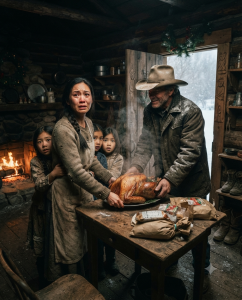
Outside, snow drifted over the Montana valley in thick, clean sheets, covering the pines, the fence posts, the wagon tracks, the roof of the little cabin where she and her girls had spent the last three months trying not to fall apart. Inside, nothing was clean. Smoke had stained the rafters. Damp cold clung to the walls. Old grief sat in the corners with the ashes.
Shio, seven years old and already far too observant, held her tin cup with both hands and tried to sip slowly. Little Fawn, five, blew on the hot water before tasting it, as if her body still expected flavor.
“Does Santa know how to find houses with no smoke?” she asked.
Min nearly turned away.
“Santa finds good children,” she said softly.
Little Fawn accepted the answer because she was five and wanted to. Shio accepted it because she was seven and knew her mother needed her to.
Wei had been dead since September. A fever had taken him with such speed Min still sometimes believed she had dreamed the entire week: the sweat, the shivering, the stubborn insistence that he would be up by morning, the way his hand searched for hers even after he could no longer hold it tightly. He had left behind a cabin of rough-hewn logs, a patch of land buried under winter, one old rifle, forty-seven dollars hidden under a loose board, and two daughters who still looked toward the door at dusk as if he might come in with snow on his shoulders.
Neighbors had come at first. They had stood by the grave. They had nodded soberly. They had said things people say because silence feels too honest. But help in the valley had always come with measurement. Who deserves it. Who can repay it. Who belongs enough to receive it without resentment.
Min and Wei had never fully belonged.
He had earned more respect than she had, because he was the one who cut timber, mended wheels, hauled loads, and spoke to men in town. But she saw what happened in rooms when she entered after him. Conversations shifted. Smiles thinned. Some women were polite. A few were kind. Others watched her with the guarded dislike reserved for women they considered both fragile and threatening.
A widow, she had discovered, was even worse.
The last of the food was gone by Christmas Eve. Min divided the final piece of cornbread between Shio and Little Fawn and told them it was a holiday treat. She smiled while they ate. That night, after they fell asleep, she pressed her fist against her mouth to stop herself from making any sound.
By morning, she had no more lies that looked like meals.
The fire burned low. Snow covered the road. The Harrows were the closest family in the valley, but Mrs. Harrow had made herself clear weeks before.
“A woman alone attracts trouble,” she had said, glancing around Min’s yard as if even the trees were suspicious. “Sell the place before it buries you too.”
Min had said nothing then. It was easier than saying what she really thought—that some people mistook survival for shame when it belonged to the wrong woman.
Near noon, Shio touched her mother’s sleeve.
“I’m not hungry,” she whispered.
Min looked at her daughter’s narrow face and answered with more honesty than comfort.
“Don’t lie to protect me.”
Shio swallowed. “Then don’t cry to protect us.”
Min almost laughed from heartbreak. Before she could answer, movement flickered between the trees.
A horse.
Large, gray, laboring through the drifts. A rider bent against the wind. Steam rising from a shape strapped across the saddle.
Min reached for Wei’s rifle before she reached for hope.
The knocks on the door were firm and controlled. She opened the door an inch, gun across her body. A tall man stood outside in a snow-caked hat and weather-beaten coat, his beard rough, hands red with cold. In his arms was a roasted turkey on a metal tray, golden and shining, surrounded by browned rolls.
The smell hit the cabin first.
Little Fawn made a tiny sound from behind Min.
The man didn’t step forward.
“Ma’am,” he said, voice low, “my name is Cole Hadley. I’m not here to bring trouble.”
“Men who bring trouble say that too,” Min replied.
A tired half-smile touched one corner of his mouth. “That’s fair.”
He glanced past her only long enough to see the girls. Whatever he saw in their faces made his own change.
“I saw the cabin from the ridge,” he said. “No smoke. It’s Christmas. I had food. That’s all.”
“You expect me to believe you rode out here carrying a turkey for strangers?”
“No,” he said after a beat. “I expect you to believe I know what it is to be hungry and not have anyone knock.”
That answer was stranger than an excuse, which made it feel more true.
Then he said, “I can leave it and go. I don’t need to come inside.”
That was what convinced her.
A dangerous man always wanted entry. This one offered departure.
Min lowered the rifle and opened the door.
Cole stepped in carefully, as though the cabin contained something more delicate than poverty. He set the turkey on the table, then returned to his horse and came back with saddlebags full of provisions: flour, lard, dried apples, cured meat, coffee, salt, canned peaches, honey. Each item landed on the table like a separate shock.
“Why?” Min asked when she finally found her voice.
Cole looked at Shio, then Little Fawn.
“Because once,” he said, “someone didn’t open the door for me.”
It was the kind of sentence that clearly belonged to a larger story, but Min didn’t press. Hunger had no manners left.
She carved the turkey with shaking hands. The girls ate as though afraid time might change its mind. Shio cried while chewing, embarrassed by the tears. Little Fawn hummed around a mouthful of bread, too relieved to stay quiet. Min took one bite and felt warmth hit her stomach so suddenly it almost hurt. For the first time in weeks, the cabin smelled alive.
Cole accepted a plate only after Min insisted. He sat near the door rather than at the heart of the table. He answered the girls’ questions with simple care. Yes, his horse was named Ash. Yes, he had seen wolves, though not lately. Yes, the turkey had taken all morning. No, he was not a sheriff. Little Fawn liked him instantly. Shio watched him in the solemn way children reserve for adults they are trying to decide whether to trust.
Min noticed details she couldn’t help noticing. He ate modestly. He kept his hat in his lap. He never once let his eyes roam her home as if taking inventory. Whatever loneliness he carried sat deep and quiet.
For one hour, Christmas returned.
Then dogs barked outside.
Cole turned first. Min went to the window and felt her body tighten.
The Harrows’ wagon.
Mr. Harrow climbed down heavily, boots crunching. Mrs. Harrow followed, wrapped in dark wool, face sharpened by purpose. Their oldest boy trailed after them with the eager curiosity of someone hoping to witness a scandal.
Min opened the door only because not opening it would have given them more power, not less.
Mrs. Harrow stepped in and froze just long enough to take in the scene: the stranger, the food, the girls with flushed cheeks, the supplies on the table.
“Well,” she said, “it appears Christmas was generous after all.”
Min’s voice cooled. “What do you want?”
“We came out of concern,” Mrs. Harrow replied. “A rider was seen heading here. We thought perhaps a widow alone with children might be in need of checking on.”
Her gaze moved deliberately to Cole.
He stood. “The food is mine. I brought it.”
“I’m sure it is,” she said.
Mr. Harrow, broad and red-faced, looked at the turkey bones and let out a short breath through his nose. “Quite a feast.”
Min knew that tone. A judgment disguised as observation.
The room changed. Warmth withdrew. Even the children sensed it.
Mrs. Harrow folded gloved hands before her. “It is a hard season. People do desperate things. Nobody could blame a woman for making arrangements.”
Shio frowned, not understanding. Little Fawn leaned into Min’s skirt.
“Leave,” Min said.
But Mrs. Harrow had already chosen her cruelty.
“No need for that look,” she said mildly. “I’m only saying that a meal this fine rarely arrives without a price.”
Cole’s face hardened. “Watch yourself.”
Mrs. Harrow ignored him. She looked directly at Min now, almost pitying, which was worse than contempt.
“A mother will sell many things before she lets her children starve. It’s sad, but it happens.”
Shio’s head snapped toward Min.
That was the unforgivable part—not the insult, but that it reached the girls.
Min felt her throat burn. “Get out of my home.”
Mr. Harrow crossed his arms. “Folks in the valley talk. They say a widow who can’t feed her family may find other ways to earn a supper.”
Little Fawn looked up, frightened by the adults’ voices.
Cole stepped between the Harrows and the table. “That is enough.”
Mrs. Harrow lifted her chin. “A strange man rides in with meat and gifts, and by noon the widow has him by her fire. You may call it charity, sir. It looks different from where we stand.”
Min saw Shio trying to understand, trying to make the pieces fit. Shame rushed through her so hot it became anger.
“You will not speak filth in front of my daughters.”
Mrs. Harrow opened her mouth again, but Cole was already reaching inside his coat.
Mr. Harrow took a step back. Min’s heart slammed once against her ribs. Cole drew out a packet of folded papers tied with leather.
He laid them on the table.
“Before you say another word,” he said quietly, “you should know why I came.”
Mr. Harrow grabbed the top paper. His eyes moved quickly, then stopped. “What is this?”
“Read the signature.”
Min stepped closer. The moment she saw the slant of the handwriting, the room tilted.
Wei.
Mrs. Harrow snatched the paper from her husband. Her confidence lasted only until she reached the bottom line. The color left her face.
Cole untied the rest of the bundle. “Your husband came to see me in August,” he said to Min. “He was looking for feed and seed, and I had some to spare. He worked off part of what he took. We spoke more than once after that.”
Min stared at him, unable to look away from Wei’s name.
“He knew he was getting weaker,” Cole continued. “Maybe not how bad, but enough. He asked me a favor I didn’t want him to need. He said if winter came hard and he didn’t make it through, I was to check on you and the girls. He gave me the route, the landmarks, all of it.”
Shio whispered, “Baba knew?”
Min’s eyes filled. “I think he feared it,” she said.
Cole touched another page. “This is a debt receipt. Not yours. Mine. Three winters ago I was caught out in a storm east of here. Thrown from a horse. Fever after. Your husband found me and hauled me to shelter. Kept me alive six days. I tried to pay him. He refused. Said a man repays kindness by passing it on when the chance comes.”
Cole looked at the Harrows then, and his expression turned flint-hard.
“So that is why I came to this cabin. To settle a debt to a decent man and keep a promise to his family.”
No one moved.
Mr. Harrow swallowed hard. “We… did not know.”
“That’s because you didn’t ask,” Cole said.
Mrs. Harrow recovered enough to reach for pride. “If all this is true, why was it secret?”
Min’s answer came before Cole’s.
“Because he knew this valley.”
The room fell still.
She understood now. Wei had seen what neighbors gave and what they withheld. He had known help wrapped in public humiliation was another kind of cruelty. He had found a quieter path. He had protected her from this exact spectacle as long as he could.
Cole unfolded the final paper and placed it before Min. It was a letter, brief and blunt in the way Wei often wrote when feeling too much.
Min, if this reaches you by another man’s hand, then I was right to worry and wrong to leave too soon. Cole Hadley is trustworthy. He owes me nothing that I would claim, but he will come because I asked. Take what he brings. Do not let pride make widows of our girls while you are still alive. This land is yours as long as you want it. Tell Shio the flower by the door still needs spring. Tell Little Fawn the deer must not be afraid of snow.
Min pressed her fingers over her lips and bent forward as tears came all at once.
Shio began crying too, quiet and open-faced. Little Fawn, confused by the adults’ grief but recognizing her father’s name, climbed into Min’s lap.
Mrs. Harrow stood in the center of the cabin with nowhere respectable to put her eyes.
Cole spoke into the silence. “You accused a hungry mother of selling her dignity for food. You said it in front of her children. I suggest your next words be chosen with more care than your last.”
Mr. Harrow removed his hat. “Mrs. Min,” he said awkwardly, “I was wrong.”
It was not graceful, but it was real.
Mrs. Harrow stayed rigid. Apologies did not come naturally to her; righteousness had always been easier. Yet even she could see there was no path out of this room except through truth.
“I misjudged,” she said at last, each word tight as wire. “I should not have spoken as I did.”
Min looked at her for a long moment. Forgiveness did not rise inside her. Neither did revenge. Only exhaustion, and the fierce instinct to protect what remained.
“You should not have thought it,” she said.
Mrs. Harrow dropped her gaze.
Then something surprising happened. Shio wiped her face and asked, with the relentless sincerity of children, “If you were worried about us, why didn’t you bring food?”
The question landed harder than any adult rebuke.
Mr. Harrow stared at the floorboards. Mrs. Harrow’s mouth parted, but she had no answer.
Because concern was easier than kindness. Because suspicion was cheaper than generosity. Because some people preferred a moral lesson to a hungry family being fed.
Min didn’t say those things aloud. She didn’t need to.
The Harrows left not long after. Mr. Harrow murmured another apology at the threshold. Mrs. Harrow paused once as if she wanted to salvage her dignity, but there was no clean way to do it. They stepped back into the snow smaller than they had seemed when they arrived.
After the wagon disappeared, the cabin was quiet except for the fire and Little Fawn’s soft breathing. Cole moved toward the door.
“I should go,” he said.
Min looked up sharply. “In this storm?”
“I’ve got a camp down the ridge.”
“You brought enough food for days,” she said. “You can accept one roof for one night.”
He hesitated, and she realized hospitality might be as hard for him as accepting help had once been for her.
“It would make the girls feel safe,” she added.
That decided it.
Cole stayed. He slept by the hearth. In the evening, Min read Wei’s letter three more times. Shio asked questions about her father until sleep overtook her mid-sentence. Little Fawn fell asleep clutching one of the bread rolls as if it were treasure.
The next morning the storm eased. Cole chopped wood before breakfast without being asked. By noon Mr. Harrow returned alone with a sack of potatoes, kindling, and a crate of jars from his cellar.
“No debt,” he said gruffly when Min opened the door. “Just food.”
She nodded and let him set it down.
Two days later, a church woman from town arrived with blankets. Then another neighbor sent milk. News traveled quickly in valleys like that, and shame traveled faster when it belonged to the right people. The Harrows’ accusation had spread, but so had the truth of it, and truth is a cruel mirror.
Min did not become close to the valley overnight. Wounds caused by public contempt do not vanish because someone finally feels guilty. But the temperature shifted. People spoke more carefully. Some offered genuine help. Others offered politeness, which was not the same thing but was at least less poisonous.
Cole stayed through New Year’s to repair the broken fence and check the roof before heading south. Before he left, he handed Min the leather packet of papers.
“These belong with you now.”
She took them. “And where do you belong?”
He looked toward the trees for so long she thought he might not answer.
“Still working that out.”
Shio hugged him first, solemnly. Little Fawn launched herself into his knees. Min thanked him once, plainly, because anything larger would have broken her voice.
Spring came late, but it came. The flower Wei had carved by the door caught morning light again. Little Fawn ran through mud chasing thaw-drunk chickens. Shio planted seeds with the seriousness of a farmer. The land, useless in winter, began at last to answer the living.
Cole returned in April with tools he claimed he no longer needed and stayed long enough to help mend the barn roof. By then the valley knew better than to make jokes. The Harrows kept their distance, though Mr. Harrow tipped his hat whenever he passed. Mrs. Harrow once sent a pie. Min accepted it because refusing would have fed the wrong kind of story.
That first Christmas after the hunger was never forgotten. Not by Min. Not by her daughters. Not by the valley.
Years later, people still told the tale differently depending on what kind of people they were. Some said it was about a stranger with a turkey. Some said it was about a widow too proud to beg. Some said it was about a promise between men.
But Min knew what it was really about.
It was about the difference between being seen and being judged.
About how quickly the world can stain a woman’s need with suspicion.
About how the cruelest people often call themselves concerned while doing nothing to help.
And about the fact that dignity was never what she nearly traded that winter.
What she almost lost was faith—that kindness could arrive without a hook in it, that her daughters might grow up remembering warmth more than shame, that Wei’s love had not ended at the grave just because his body had.
On the coldest morning of her life, help had come to the door carrying a turkey and a debt of honor. The valley had answered with gossip. In the end, everyone revealed exactly who they were.
The hardest question was not whether Min had been right to open the door.
It was why so many people who called themselves decent had needed proof before they believed a hungry woman could still have her pride.