Tessa did not believe in miracle programs, healing environments, or the kind of smiling community language that made exhausted parents feel like failures for not fixing everything with the right amount of optimism.
She believed in rent due on the first, in grocery lists written around coupon apps, in answering her son’s questions carefully when they were really about his father but disguised as something smaller. She believed in the sound of a child going too quiet.
That was why she drove Eli to the church basketball clinic on a Saturday she would rather have spent catching up on laundry.
Not because she loved sports.
Because he needed somewhere to stand that wasn’t between two adults who had once promised forever and now communicated through calendars, apologies, and last-minute rescheduling.
Eli had taken the divorce badly in the way that worried her most. He had not exploded. He had folded.
At eight years old, he had already learned that anger could be hidden inside politeness. He said “fine” when he wasn’t. He shrugged when he wanted to cry. He sat through video calls with his father wearing a face so blank it looked older than childhood had any right to be.
His father, Mark, had not left in some dramatic scandal. No affair Tessa could point to. No public betrayal. Just years of emotional drifting, then arguments, then the quiet cruelty of a man who wanted out but still wanted to be admired for leaving gently. He still visited on weekends when he could. He still brought gifts sometimes. He still smiled like a decent man.
Maybe that was what made it worse.
A villain gives children something simple to hate.
A disappointing father leaves them with confusion.
So when the local church advertised a free Saturday basketball clinic for elementary-age boys, Tessa signed Eli up before she could overthink it. The flyer promised confidence, friendship, and encouragement. She trusted none of that. But she trusted routine, movement, and the possibility that a child might feel less alone in a gym full of noise.
The church itself was older than it first appeared. Red brick outside, additions tacked on over decades, hallways that made sense only if you had watched the place grow room by room. The gym sat behind the sanctuary in a low wing with scuffed floors and fluorescent lights that hummed faintly overhead.
Inside, the clinic looked harmless enough. Boys in oversized shorts and mismatched sneakers dribbled badly while volunteer coaches smiled too hard. Parents sat in folding chairs and clapped at the smallest things. There were orange slices on a plastic table and a handwritten welcome sign near the door.
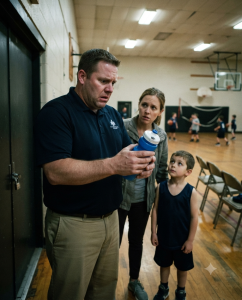
Eli stayed close to Tessa at first, clutching his blue plastic water bottle like a travel companion. It was old, scratched, and ordinary except for the chipped white flip cap and the faded strip of tape near the bottom where Tessa had once tried to write his initials. He took it everywhere. Car rides. School. Bedside table. Grocery store. She had stopped trying to understand why. Kids attached meaning to objects adults overlooked.
When the warm-up whistle blew, he left the bottle by the bench and shuffled onto the court.
The clinic leader introduced himself as Pastor Dean.
He was in his forties, broad-shouldered, steady, the kind of man boys instinctively watched when he spoke. He didn’t perform friendliness. He wore it like old clothing. He corrected kids without embarrassing them and laughed with them instead of at them. There was a wedding ring on his finger, though Tessa noticed he twisted it sometimes when he wasn’t talking.
By the time the boys started dribbling through cones, Eli had almost relaxed.
That was the moment Dean saw the bottle.
The change in him was slight but unmistakable. A missed beat. A complete pause. His eyes fixed on the blue plastic near the bench as if he had seen an animal where no animal should be. He handed the drill off to another volunteer and walked across the floor.
Tessa got up before he reached it.
“What’s wrong?”
Dean picked up the bottle slowly, turned it in his hand, then ran his thumb over the chipped cap. His face drained.
“Where did he get this?”
“From a store,” Tessa said. “Why?”
Dean’s throat worked before any sound came out.
“No,” he said. “Not this one.”
Something in his tone sharpened every nerve she had.
He kept staring at the bottle, then finally said, “My younger brother had this. We found it in his school locker after he died.”
The sentence hung there so strangely that Tessa didn’t understand it at first. It sounded less like grief than evidence.
Before she could respond, Eli ran over, flushed from drills. “Coach?”
Dean looked at him, then at the bottle. The ease left his face so completely it was like watching a mask slip off.
“What was your brother’s name?” Tessa asked.
“Micah.”
No recognition stirred in her, but Dean’s expression said recognition was not the point.
Eli reached for the bottle. “The boy said I could keep using it.”
Dean went white.
“What boy?”
“The boy in the church room.”
Eli said it casually, like everyone should know which room he meant.
Tessa looked at the corridor past the gym doors. On the way in, she had noticed a side hall blocked by a locked door and a sign reading STORAGE—AUTHORIZED STAFF ONLY. It had the dead feel of a forgotten part of the building.
Dean’s voice lowered. “What church room?”
“The old one,” Eli said. “By the smelly hallway.”
Dean shut his eyes for a second. “My brother’s locker was in the old youth room.”
The air around them seemed to thin.
Children did not know the history of church renovations. They did not identify dead boys from old youth programs. They did not casually refer to sealed wings of buildings unless someone had taken them there.
Tessa crouched slightly, keeping her voice even. “Eli, who showed you the room?”
“The boy.”
“What did he look like?”
“Brown hair. Gray hoodie. He looked sad.” Eli frowned, searching for accuracy. “Not crying sad. More like waiting too long.”
Dean made a rough sound under his breath.
Tessa stood again. “What happened to your brother?”
His answer came slowly, as if he hated every word already. “Everyone said overdose. Prescription pills. Hidden problem. Private struggle. The police didn’t push much because there wasn’t obvious force and the church wanted it quiet.”
“And you believed that?”
“I repeated it,” Dean said. “Believing wasn’t the same thing.”
Eli twisted the cap on his bottle. “He said it wasn’t pills.”
Dean stared at him.
Then Eli added, “He said Coach still blames the wrong person.”
That landed with an ugly kind of precision. Tessa saw it in Dean’s face immediately. There was guilt there, yes, but also a history of anger that had chosen the wrong target and built a home there.
Dean leaned one hand on a folding chair. “Did he say anything else?”
“The note’s still in the cap,” Eli said.
Tessa looked down at the bottle. It had been in her sink, in her car cup holder, in the side pocket of Eli’s backpack. She had opened it a hundred times and never thought of it as anything but plastic.
Dean took it with visibly shaking hands. Around them, the clinic kept stuttering forward under the assistant coach’s direction, but more adults had started watching. Whatever was happening was no longer private, not really, yet it still felt sealed in its own space.
Dean turned the white cap over and over. His thumbnail ran under the lip of the top until he stopped at some tiny resistance. He pried carefully. A hidden insert came loose with a soft click, revealing a cavity no one would notice unless they knew to look.
Inside was a tightly folded scrap of paper.
Dean unfolded it with extreme care.
Tessa saw handwritten blue ink, one corner smeared by moisture, the letters cramped and urgent. Dean’s eyes scanned the message once, then again, and all the color vanished from his face.
“What does it say?” she asked.
He looked at her as if he had forgotten where he was. Then he read aloud.
“Not pills. Don’t let Ron clean it up.”
Silence tightened across the bench area.
“Who’s Ron?” Tessa asked.
Dean didn’t answer immediately. He was looking at the note as if it had punched through fifteen years of denial in one line.
Finally he said, “Ron Calder. He volunteered here. Maintenance. Youth nights. Lockups. He had keys to everything.”
“Had?”
“He left town a week after Micah died.”
The implications gathered fast and ugly.
“You thought he was helping your brother hide drugs,” Tessa said.
Dean swallowed. “I thought my brother was in trouble and Ron was protecting his reputation. I thought Micah had gotten involved with something and Ron was the only adult willing to keep the church from tearing him apart afterward.”
Tessa heard the shape of it now. A dead boy. A church eager for a clean explanation. A trusted volunteer around every door, every room, every late night. A grieving family offered a version simple enough to survive.
Eli tugged her sleeve. “The boy said Coach never checked the bottle because then he’d have to know.”
Dean closed his eyes at that. When he opened them again, they were wet.
Across the court, the assistant coach called for another drill. The children ran back into line, unaware. But the adults nearest the bench had gone still. News traveled across a room before words did; everyone could feel that something was wrong.
Then it came — a sound from the sealed hallway.
Metal lightly striking metal.
Dean turned toward it.
The old youth wing door sat under a flickering light with its storage sign hanging slightly crooked. It was probably a settling noise, Tessa told herself. A building noise. Pipes, vents, old hinges. But then it came again, softer and more distinct.
A handle testing.
“Is someone back there?” she asked.
Dean was already moving.
He crossed the gym floor with the folded note in one hand and stopped at the locked hallway door. He stared at it like a memory had materialized in solid form.
Eli spoke behind him. “He said the locker’s still there.”
Dean looked over his shoulder.
“He said Ron didn’t take everything,” Eli finished.
For one long second, no one moved.
Then Dean pulled a ring of keys from his pocket.
“You have a key to that room?” Tessa asked.
“I’m the pastor,” he said, but his voice was distracted, unsteady. “I’ve just never had a reason to open it.”
That answer felt wrong even before he slid the key into the lock. People always had reasons. They just didn’t always survive wanting the answer.
The door opened with a reluctant scrape, releasing the smell Eli had described earlier — stale drywall, damp wood, and the sour dust of a space closed too long.
Tessa should have stayed in the gym. Every practical instinct told her to pull Eli away, go home, and let church people deal with church secrets. But the practical part of the morning had died when a hidden note came out of a water bottle linked to a dead boy.
So she took Eli’s hand and followed Dean.
The hallway beyond was narrow and dim. Old bulletin boards still clung to one wall, curling at the corners. Faded construction paper letters spelled out part of a Bible verse no one had bothered to finish removing. At the end of the corridor was a room with double doors and cloudy wired-glass windows.
Dean pushed them open.
The old youth room looked like time had been interrupted and never resumed. Stacked folding tables. A crooked whiteboard. Deflated sports balls. Metal lockers against the far wall. On one shelf sat plastic tubs labeled GAMES and CRAFTS in marker gone brown with age. Dust coated everything heavily except one narrow strip near the lockers where the layer looked disturbed.
Dean saw it too.
He walked to the locker row, counting under his breath. Then he stopped at one with a dented door and a rusted combination latch hanging uselessly from the handle.
“Micah’s,” he said.
It was not locked.
Dean pulled it open.
Inside were the remains of a teenage life no one had fully cleared out. An old flyer for a retreat. A cracked phone charger. A notebook with the cover peeling. And on the top shelf, shoved deep into the back corner, a small black memory card taped under the metal lip.
Dean reached in slowly and peeled it free.
Tessa’s chest tightened. “What is that?”
“I don’t know.”
But his face said he already feared the answer.
One of the other volunteers had followed them by then — an older man named Curtis who had helped set up cones that morning. He stepped into the doorway, saw what Dean was holding, and froze.
“Oh no,” he said softly.
Dean turned. “You knew Ron.”
Curtis’s eyes flicked to the memory card. “Everybody knew Ron.”
“That’s not what I asked.”
Curtis sagged against the doorframe in a way that made Tessa instantly dislike him. It was the posture of a man who had spent too many years doing nothing and calling it uncertainty.
“He was around a lot,” Curtis said. “Too much, looking back.”
“Looking back?” Dean repeated.
Curtis rubbed his forehead. “Micah complained once. Not clearly. He said Ron was always in his business, always checking up on him, cornering him when everyone else left. I told him Ron was awkward, that he meant well. I said not to make trouble without proof.”
The room seemed to contract.
Dean’s face hardened into something precise and dangerous. “And when Micah died?”
Curtis looked sick. “Ron said he found him first. Said there were pills. Said Micah had been spiraling. Your parents were shattered, the church board panicked, and everyone wanted the story to be one thing.”
“One thing manageable,” Tessa said.
Curtis nodded once, ashamed. “Yes.”
Dean stared at him for a long moment, then looked back at the memory card in his hand. “Did you ever go to the police with any of this?”
Curtis shook his head.
“No,” Dean said quietly. “You didn’t.”
The rest happened fast.
Dean called the police from the hallway outside the room. Not the local church liaison, not a friend, not someone “discreet.” The actual police. He gave Micah’s full name, the year of death, the reopened evidence, the hidden note, the staff volunteer’s name, and the fact that a previously sealed room had yielded additional material.
An officer arrived first with the strained patience of someone expecting an overexcited misunderstanding. That changed the moment Dean showed him the note, the bottle cap compartment, and the memory card. The room was secured. More officers came. The clinic ended early with apologies no one heard properly.
Tessa took Eli home, but she did not leave it there. Dean called that evening.
The memory card, he said, contained short video clips recorded by Micah on an old youth camera and transferred over for safekeeping. In the final clips, the image shook and the sound was poor, but Ron’s voice could be heard. Pressuring. Threatening. Telling Micah not to “ruin lives” over “misunderstanding attention.” One final clip ended with Micah whispering that if anything happened, Dean should check the bottle because Ron would search the obvious places first.
There were no pills in the footage.
There was fear.
There was coercion.
There was enough.
Ron Calder was located three states away under a different last name. He had spent years moving between contract jobs and churches willing to accept references no one checked deeply. When officers questioned him, he denied everything until the note, the footage, and old inconsistencies in the original report started lining up against him. The reopened investigation concluded that Micah had not died of an overdose at all. He had suffered a fatal head injury during a confrontation in the youth room. The scene had been staged afterward. Pills were planted. The church, eager to avoid scandal and desperate for a simple tragedy, had let the easiest story harden into the official one.
The headline that finally ran months later used words like reopened case, wrongful death, concealed evidence, trusted volunteer. Tessa hated all of them. They made a life sound like paperwork.
Dean had to stand before his congregation and say his brother’s name in public without the lie attached to it for the first time in fifteen years. He also had to live with what came next: the truth that his anger had once been aimed at Micah for “throwing his life away” instead of at the adults who had failed him, silenced concerns, and accepted convenience over scrutiny.
The church board issued statements. Lawyers got involved. Curtis testified. Others came forward with memories they had dismissed at the time because it had been easier to think awkward than predatory, easier to think troubled teen than dangerous adult, easier to trust the neat explanation.
Through all of it, Eli kept asking only one question.
“Is the boy okay now?”
Tessa never knew how to answer that exactly.
Dean did, in his own way.
A few weeks after the arrest, he asked if he could return the water bottle to Eli properly. He brought it to Tessa’s apartment, cleaned, empty, with the hidden note and insert removed and sealed in evidence bags elsewhere. The chip in the cap was still there.
“I don’t know why your son found it,” Dean said. “Or why Micah chose him, if that’s what this was. I’m a pastor and I still don’t have language that feels honest enough.”
Tessa looked toward Eli’s room, where the sound of a basketball thumped softly against the baseboard because the clinic had somehow stuck after all.
“Maybe,” she said, “he picked the one person small enough to be believed by the dead and ignored by the living.”
Dean laughed once, then cried in the same breath.
The bottle stayed on Eli’s dresser after that, though he no longer carried it everywhere. Whatever need had tied him to it seemed to have passed. He grew louder over the next months. Not all at once. But he started answering in longer sentences. He made one friend from the clinic. He asked to go back. He argued with his father once instead of swallowing the disappointment whole. Tessa counted all of that as progress.
She never became a sports parent. She still distrusted organized optimism. But she learned that healing sometimes enters through a side door no one would choose on purpose.
A free basketball clinic did not fix her son.
It did, however, put a forgotten object in the sightline of the one man who could recognize it, and that recognition cracked open a lie that had buried a child twice — once in death, and once in the story told afterward.
Some nights Tessa still thought about the moment Dean first lifted the bottle from the bench. How quickly a gym full of ordinary Saturday noise became the center of something unfinished. How much of life depended on tiny overlooked things: a chipped cap, a hidden seam, a child willing to repeat exactly what he had heard without understanding how impossible it sounded.
And she wondered, not for the first time, what was worse in the end — the man who had done something monstrous, or all the adults who had accepted the version of events that hurt less to say out loud.